Here’s a sweeping, story-rich tour of California’s biggest ranches—places where working cattle operations, conservation, and California history braid together. Each entry includes size (in acres) and other quick metrics in parentheses, then plunges into the lore, landscape, and little-known facts that make these properties singular. Saddle up.
#1: Tejon Ranch (≈270,000 acres; Kern & Los Angeles Counties)
Tejon Ranch isn’t just California’s largest private landholding—it’s a full-blown microcosm of the state, where the Mojave Desert meets the San Joaquin Valley, the Tehachapi Mountains, and the Transverse Ranges. At roughly 270,000 acres under one fence, it’s bigger than many cities and laced with oak-dotted hills, high-desert canyons, and sweeping wildflower displays in wet years. It’s also a working landscape: cattle graze hundreds of thousands of acres here, and the ranch raises orchard crops like almonds and pistachios alongside a long-running, tightly managed hunting program. That combination of scale, intact habitat, and diversified operations is rare in coastal states—and almost unheard of within an hour or two of Los Angeles.
What really put Tejon on a national map for land stewardship was a 2008 agreement with major environmental organizations to permanently protect about 240,000 acres—roughly ninety percent of the ranch—while concentrating any future development on a small fraction of the property. That deal created the independent Tejon Ranch Conservancy to manage the conserved expanse and has since shaped research, restoration, and public-access pilots across an area larger than many national parks. Conservation easements have rolled out in phases, with state grants and philanthropic partners helping to fund one of the biggest conservation pacts in California history. If you’ve ever wondered how a modern working ranch can knit itself into the fabric of long-term regional conservation, Tejon is the case study.
Anecdotes abound: film crews prize the ranch’s “any-place America” scenery; hunters come for managed elk and turkey seasons; botanists pore over floristic mash-ups that occur where bioregions collide. Old ranch roads still trace historic corridors once used by vaqueros, homesteaders, and early survey parties. This sense of continuity—of present-day cow work layered over nineteenth-century land grants and Indigenous homelands—gives Tejon that distinctive California feeling: a place where past and future are in continual, complicated conversation. Even as company leadership juggles development proposals and shareholder pressures, the sheer size of what’s under permanent protection means the ranch’s core identity—as a vast, intact, working landscape—endures.
#2: Hearst Ranch—San Simeon (≈80,000 acres; San Luis Obispo County)
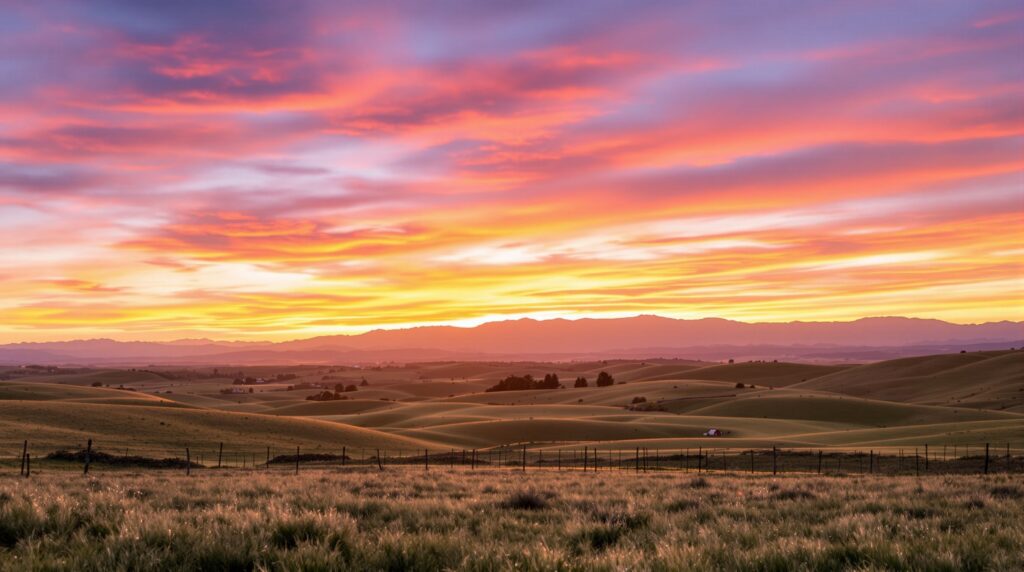
When people say “Hearst Ranch,” they often picture the hilltop palaces and guesthouses of Hearst Castle—but down on the coastal flats and rolling hills below, an 80,000-acre cattle operation still unfolds across one of California’s most scenic shorelines. The San Simeon unit (distinct from Hearst’s inland Jack Ranch) is an old-school cow-calf landscape where sea fog lingers over green winter pastures and historic barns weather the salt air. The scale alone is striking—miles of Highway 1 views that remain unfenced from the sea, with elephant seals flopping on beaches and zebras (descendants of Hearst’s private menagerie) occasionally spotted among beef cattle far inland. In 2005, a landmark conservation agreement ensured those pastoral vistas stay pastoral, permanently protecting tens of thousands of acres and guaranteeing public coastal access expansions while allowing the working ranch to continue. Anecdotally, locals will tell you that San Simeon’s seasonal rhythms—first rains, the emerald flush of annual grasses, the late-spring gold—feel like California distilled. The ranch’s juxtaposition with state parks and marine protected areas has turned it into a living laboratory for how private agriculture and public conservation can coexist on a world-class coastline. Tourists may never notice the quiet choreography behind the scenes: rotational grazing plans fine-tuned to rainfall, riparian fencing to protect creeks, and a century of ranch roads that ranch hands know like the lines in their palms. The romance of Hearst Castle is one thing; the daily work that keeps 80,000 acres productive and ecologically viable is another—and it’s that second story that makes San Simeon one of the great coastal ranches of the American West.
#3: Hearst’s Jack Ranch (≈73,000 acres; San Luis Obispo & Monterey Counties)
Drive east from Paso Robles into the interior hills and you’ll hit Jack Ranch, a 73,000-acre inland sweep of grasslands and oak savannas that feels like classic Central Coast ranch country. Historically part of the vast Piedras Blancas and Mission lands that William Randolph Hearst began assembling in the early twentieth century, Jack Ranch today is a working cattle outfit that also happens to host one of California’s most audacious renewable-energy projects: the 550-megawatt Topaz Solar Farm occupies a portion of lands long associated with Jack Ranch’s holdings on the Carrizo Plain, turning sunlight into enough electricity to power hundreds of thousands of homes. As a picture of the modern West—beef, biodiversity, and big solar in close conversation—it’s hard to beat.
The ranch is also a place where road names and fencelines whisper older stories: vaquero routes over dry ridges; springs that kept stock alive through the 1860s droughts; and the rise of grain farming and cattle that followed the mission period. For travelers, Jack Ranch is a waypoint—there’s even a famous café off Highway 46 that has long fed truckers, riders, and itinerant writers. But to Central Coast cattle families, it’s more like living memory: roundups at first light, branding days woven into the social calendar, and late-season rides where you can see fifty miles on a clear winter afternoon. That it remains a single, iconic holding in an era of fragmented ownership says a lot about the Hearst organization’s commitment to keeping big, contiguous ranchlands working.
#4: N3 Cattle Company (≈50,500 acres; Alameda, Santa Clara, San Joaquin & Stanislaus Counties)
Tucked into the backcountry east of the Bay Area, the N3 Cattle Company ranch sprawled for roughly 50,500 acres across four counties—oak woodlands, high ridges, and hidden valleys that most Silicon Valley residents never see. Long marketed as the largest contiguous private landholding in Alameda and Santa Clara Counties, N3 was a throwback: an enormous cow-calf operation within a short drive of the world’s most expensive tech real estate. When it went on the market in 2019, brokers and conservationists alike marveled at the map—dozens of watersheds, hundreds of miles of ranch roads, and wildlife corridors that linked the Diablo Range to the Central Valley floor. The sale ultimately steered substantial portions toward conservation outcomes while maintaining the property’s ranching identity in key areas.
The lore here is quieter than on coastal showplaces, but no less compelling. Old line shacks and corrals dot the ridgelines. Winter brings emerald grass; summer reduces the country to pale gold. Mountain lions, tule elk, and golden eagles traverse the same draws where cattle drift to water. For Bay Area residents used to weekend trailheads, the idea that such a vast, working ranch existed just beyond suburban cul-de-sacs felt almost mythic—a reminder that California’s ranching backbone still runs right up against its metropolitan edge. And for range scientists and land planners, N3 became a case study in “big-land” transitions: how to keep cattle on the landscape, stitch wildlife habitat together, and pass on working open space in a region where the default fate of land is pavement.
#5: San Felipe Ranch (≈28,000 acres; Santa Clara County)
If you’ve ever crested the hills southeast of San Jose and looked toward Pacheco Pass, you’ve scanned the edges of San Felipe Ranch—tens of thousands of acres of oak-studded ridges and rolling grasslands that form a quiet green wall between Silicon Valley and the interior Coast Ranges. Owned for decades by the Hewlett and Packard families, the ranch became a touchstone for conservationists in 2008 when the families placed a massive conservation easement over roughly 23,000 acres. Whether you call it 44 square miles or “about the size of San Francisco,” the scale is the point: San Felipe anchors a landscape-level corridor that keeps wildlife moving and watersheds functioning in one of the fastest-changing corners of California. There’s romance in its working rhythms, too. Cattle still graze the pastures. Springs and stock ponds punctuate the folds of the hills. On winter mornings the fog rolls through like a tide; on summer evenings the light goes amber and the sound carries for miles. The ranch’s adjacency to the Mt. Hamilton range and Henry W. Coe country gives it an “edge-of-the-backcountry” feel that’s rare this close to a major metro area. For planners wrestling with sprawl, fire, and water security, San Felipe has become a living example of how big ranches can serve as green infrastructure, cultural heritage, and viable businesses all at once—an old California solution to new California problems.
#6: Camatta Ranch (≈27,512 acres; San Luis Obispo County)
East of Santa Margarita, Camatta Ranch is vast, classic cow country—blue oak woodlands, sweeping grasslands, and fossil-rich hills that glow at sunset. It’s also a biodiversity standout, home to endangered species like the San Joaquin kit fox and rare plants such as the Camatta Canyon amole. In 2024, a coalition anchored by the Land Conservancy of San Luis Obispo County and the California Wildlife Conservation Board secured a conservation easement protecting more than 27,000 acres here, ensuring the ranch remains both ecologically intact and agriculturally productive. In a county full of storied ranches, Camatta’s scale and intactness make it a regional linchpin.
Spend time here and you feel why multigenerational ranch families fight to keep big properties together. Winter-green pastures give way to golden summer; pronghorn skim the flats; condors sometimes spiral on thermals above long ridges. The Morrison family has balanced cattle, habitat, and a touch of agritourism—think guided tours and educational visits—without losing sight of core ranch work. The 2024 easement didn’t freeze the place in amber; it locked in a future where cows, wildlife, and working open space all endure. That’s a win not just for ranching culture but for anyone who cares about connected, climate-resilient landscapes on the Central Coast.
#7: Cojo–Jalama (Jack & Laura Dangermond Preserve) (≈24,364 acres; Santa Barbara County)
Once known as the Bixby Ranch, the Cojo and Jalama ranches wrap around storied Point Conception—eight miles of wild shoreline, ancient Chumash homelands, and windswept coastal terraces where cattle grazed for more than a century. In 2017, thanks to a $165 million gift, The Nature Conservancy acquired the combined 24,364 acres and established the Jack and Laura Dangermond Preserve, protecting one of the last intact stretches of Southern California coast. It remains ranch country in spirit—wide-open, tough, and salt-sprayed—but now managed primarily for ecological research, cultural stewardship, and carefully programmed access.
Hidden gem: this coast marks a biological seam where northern and southern California currents and ecosystems meet, creating an outsize mix of species and habitats. The preserve’s plan leans into that uniqueness with watershed restoration, prescribed fire training, and partnerships with Tribes and agencies. Old cattle trails still crisscross the bluffs, and the vistas—Channel Islands to the south, ranchland to the north—give you that jolt of “old California” that’s getting harder to find. Put simply: Cojo–Jalama shows how a historic ranch can become a twenty-first-century conservation engine without losing the working-land DNA that shaped it.
#8: Rancho Mission Viejo (≈23,000 acres; Orange County)
The last working ranch in Orange County isn’t a relic—it’s a hybrid: part active cattle and citrus operation, part nature reserve, part master-planned communities tucked carefully into the folds of a 23,000-acre landscape. The O’Neill/Moiso/Avery family has shepherded the ranch through more than a century of urbanization, permanently setting aside the majority of the acreage as The Nature Reserve at Rancho Mission Viejo while building compact villages on a smaller footprint. As a land-use story, it’s unusually clear-eyed: preserve the lion’s share of habitat and working lands, then grow in a way that buffers communities from wildfire and keeps the ranching heritage alive. Look closer and you’ll still find everyday ranching: cowboys easing a herd through a creek crossing; windbreaks of eucalyptus guarding orchard blocks; old adobe walls that hint at the rancho era. Meanwhile, trails and educational programs bring residents into contact with the reserve’s wild side—coastal sage scrub, live-oak canyons, and raptor-filled skies. In a county famous for subdivisions, Rancho Mission Viejo’s scale and structure are the surprise: a 23,000-acre working landscape that’s both a modern community and a living fragment of Southern California’s ranching past.
#9: Rancho Guejito (≈22,359 acres; San Diego County)
Tucked behind Escondido and the San Pasqual Valley, Rancho Guejito is often called California’s last intact Mexican land-grant ranch—22,000-plus acres of rolling grasslands, oak woodlands, and creek-cut valleys that have stayed whole since 1845. That continuity alone makes it exceptional in Southern California. Today it remains a working cattle ranch with expanding wine grapes, citrus, and avocados, plus a small tasting-room footprint that lets the public glimpse a landscape most will only ever cross on haywagon tours. To stand under Engelmann oaks here, listening to the breeze, is to feel time slow to ranching pace.
The ranch has been a flashpoint in local debates about growth and conservation for decades—how to balance a rare, contiguous landscape with regional development pressure and public interest in access. Through it all, the working operation has persisted: grass-fed beef, careful water management, and a management philosophy that treats open range as the ranch’s beating heart. A fun “things you didn’t know” note: the property’s footprint is roughly the size of the entire city of Escondido—an astonishing pocket of old California amid one of the nation’s most urbanized counties.
#10: The Santa Lucia Preserve (Rancho San Carlos) (≈20,000 acres; Monterey County)
High in Carmel Valley, the Santa Lucia Preserve folds a historic 20,000-acre ranch—Rancho San Carlos—into a private preserve and low-density community where conservation leads and development follows. Think misty redwood canyons, oak-studded ridges, and grassy vales where cattle once grazed under the watch of the Pauson family and later owners. Today, a non-profit land trust stewards more than 18,000 acres under permanent conservation, with residents clustered in carefully sited envelopes that keep the wild, open feel intact across a tract the size of a small national park. Equestrian culture is strong; so is the sense that you’re living inside a protected watershed.
What sets the Preserve apart is the thoroughness of its land-management plan: fire ecology, invasive-species control, habitat monitoring, and seasonal grazing all integrate into a long-horizon stewardship model. Birders chase quail coveys and acorn woodpeckers; riders take to miles of private trails that crest ridges with Pacific views. It’s not a traditional commercial cattle ranch anymore, but it remains, at its core, a ranch landscape—one that proves big private properties can protect headwaters, harbor wildlife, and keep the feel of old-California range even as their uses evolve.
The Beautiful Ranches of California
From Tejon’s four-ecoregion sprawl to the coastal drama of Cojo–Jalama and the oak-rich backcountry of San Felipe and N3, California’s largest ranches are more than big numbers on a map. They’re working businesses and cultural touchstones that anchor wildlife corridors, safeguard water, and keep open space truly open. Some still run cattle from fence to fence; others have shifted toward hybrid models that blend conservation, community, and carefully managed access. All of them carry stories—of vaqueros and drought years, of conservation easements and branding days, of landscapes that still look, sound, and smell like California. In an era when open land can feel like an endangered species, these ranches remind us that size, stewardship, and heritage can still ride together.