

Exploring the 100,000-Light-Year Home of Billions of Stars
On a clear, moonless night far from city lights, a pale river of stars stretches across the sky. That glowing band is our home galaxy, the Milky Way—a sprawling island of stars, gas, dust, and dark matter that contains our Sun, our solar system, and every human story ever told. But just how big is it? The answer is both thrilling and humbling. The Milky Way is so vast that ordinary numbers feel useless. Its scale challenges imagination, bends language, and forces us to think in light-years rather than miles. To understand its size, we have to zoom out beyond planets, beyond star systems, beyond even visible structure, and into the grand architecture of a spiral galaxy. Let’s take that journey.
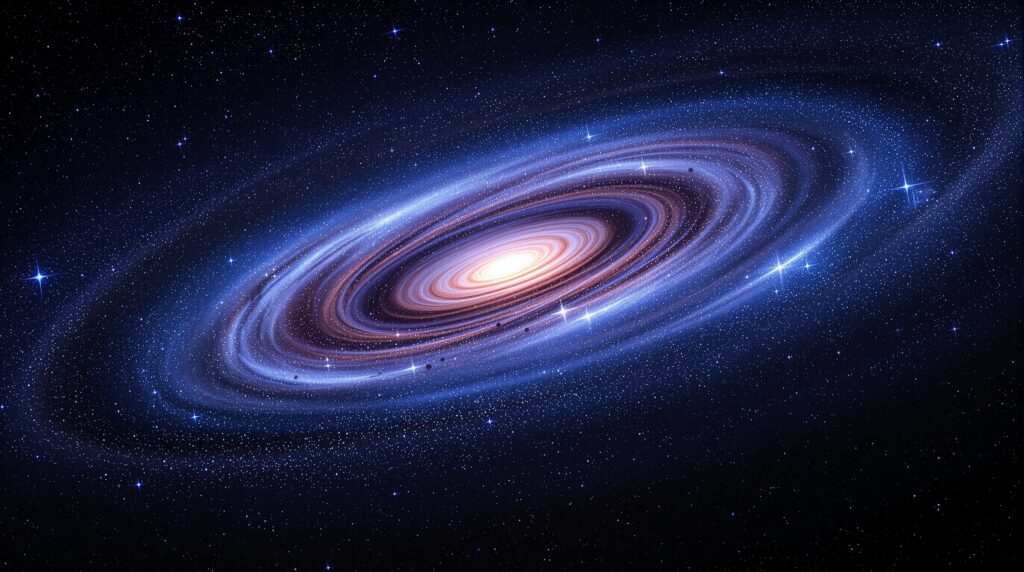
Measuring the Milky Way in Light-Years
When astronomers talk about the size of galaxies, they use light-years. A single light-year is the distance light travels in one year—about 5.88 trillion miles (9.46 trillion kilometers). Light moves incredibly fast, yet even it takes enormous spans of time to cross our galaxy.
The Milky Way’s main disk is roughly 100,000 to 120,000 light-years across. Some measurements suggest it may extend even farther, possibly up to 200,000 light-years when faint outer regions are included. That means if you could travel at the speed of light—186,282 miles per second—it would still take you 100,000 years to cross from one side to the other.
Its thickness is far smaller than its width. The thin stellar disk is about 1,000 light-years thick in most regions, though the central bulge swells much higher. Surrounding this disk is a faint, spherical halo of stars and globular clusters stretching even farther into space.
Already, we’re dealing with distances so large that comparisons to Earthly scales become almost poetic. If the Milky Way were shrunk down to the size of North America, our entire solar system would be smaller than a coin.
Our Position Inside the Galaxy
Understanding how big the Milky Way is becomes even more fascinating when we consider where we are within it.
Our Sun lies about 26,000 to 27,000 light-years from the galactic center. That places us roughly halfway between the core and the outer edge. We orbit the center of the galaxy at around 514,000 miles per hour. Even at that staggering speed, it takes about 225 to 250 million years to complete one full orbit—a period known as a galactic year.
When dinosaurs roamed Earth, our solar system was on a completely different side of the galaxy. We are not near the center. We are not on the rim. We exist in a spiral arm called the Orion Arm (or Orion Spur), a minor arm located between two larger ones. And yet, even at this “midway” point, we are thousands upon thousands of light-years from both the core and the edges.
The Spiral Structure: Arms That Stretch Across Space
The Milky Way is a barred spiral galaxy. That means it has a central bar-shaped region of stars, from which spiral arms wind outward like cosmic whirlpools.
Major arms include:
- The Perseus Arm
- The Scutum–Centaurus Arm
- The Sagittarius Arm
These arms span tens of thousands of light-years. Each one contains billions of stars, star-forming regions, nebulae, and molecular clouds. Within them, new suns ignite from collapsing gas and dust. When we talk about the “size” of the Milky Way, we’re not just measuring a flat disk. We’re measuring a rotating, dynamic structure shaped by gravity over billions of years.
The Galactic Center: A Dense, Powerful Core
At the heart of the Milky Way lies a region known as Sagittarius A*, a supermassive black hole with a mass about four million times that of our Sun.
This central bulge spans roughly 10,000 light-years. It is densely packed with stars—far more crowded than our local neighborhood. If we lived closer to the core, the night sky would blaze with constant brilliance.
But the black hole itself is only a tiny fraction of the galaxy’s size. It anchors the galaxy gravitationally, but it does not dominate the overall scale. The Milky Way extends tens of thousands of light-years beyond that central region.
The Halo: The Galaxy’s Invisible Giant
The visible disk of the Milky Way is only part of the story.
Beyond it lies a vast, spherical halo composed of sparse stars, globular clusters, and an enormous envelope of dark matter. This halo may extend 300,000 light-years or more from the galactic center.
Dark matter, which does not emit or reflect light, makes up most of the galaxy’s mass. Though invisible, it exerts gravitational influence, helping hold the galaxy together and shaping its rotation.
In many ways, the Milky Way is far larger than what we can see.
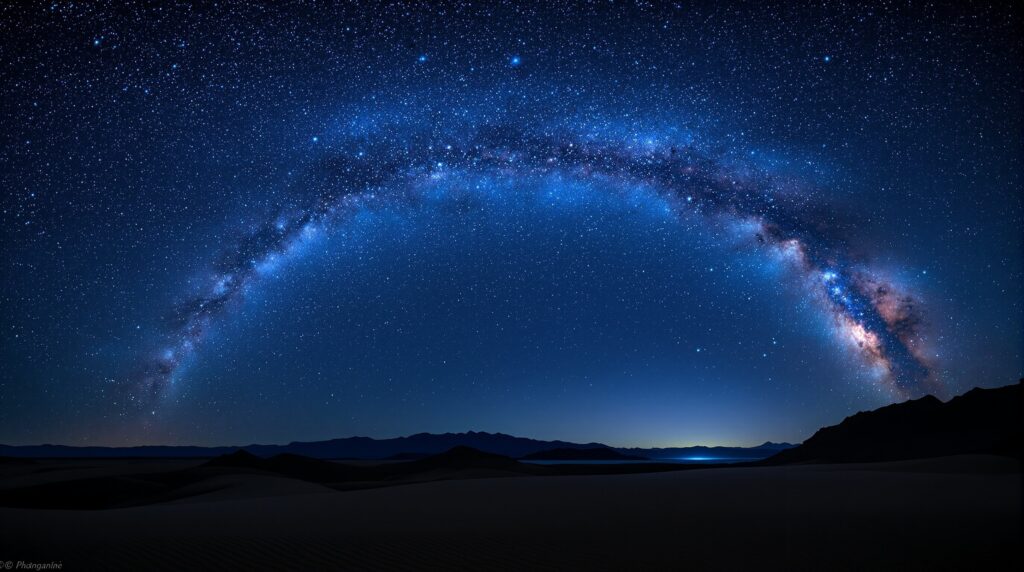
How Many Stars Are in the Milky Way?
Size isn’t just about distance—it’s also about population. Astronomers estimate the Milky Way contains between 100 billion and 400 billion stars. The range is wide because counting stars in a galaxy this large is extraordinarily difficult.
For comparison, there are about 8 billion people on Earth. If each person represented one star, the Milky Way would still need at least 12 Earths filled with humans to match its lower estimate. And around many of those stars are planets. The Milky Way may contain hundreds of billions of planets, with many potentially capable of supporting life.
Comparing the Milky Way to Other Galaxies
Is the Milky Way unusually large? Not really. It is considered a large spiral galaxy, but not the biggest. The Andromeda Galaxy, our nearest major galactic neighbor, is slightly larger—about 220,000 light-years across.
In about 4 to 5 billion years, the Milky Way and Andromeda are expected to collide and merge, forming a new, even larger galaxy sometimes nicknamed “Milkomeda.”
Other galaxies dwarf ours. Giant elliptical galaxies in dense clusters can span millions of light-years. Still, the Milky Way is massive enough to host a complex structure, billions of stars, and at least one planet with intelligent life.
Time and Motion: A Galaxy in Constant Rotation
The Milky Way is not static. It rotates. Stars orbit the center at different speeds depending on their distance from the core. Our solar system travels at over half a million miles per hour. Yet because the galaxy is so vast, everything appears calm and unchanging from our perspective. If you could step outside the galaxy and watch it in accelerated time, you would see spiral arms slowly turning, stars drifting, and gravity constantly reshaping structure. It would look like a luminous cosmic hurricane spanning 100,000 light-years.
How Do Scientists Measure Something So Big?
Measuring the Milky Way from inside it is challenging. It’s like trying to map a forest while standing between the trees. Astronomers use several methods:
They measure distances to stars using parallax. They analyze the motion of stars and gas clouds using spectroscopy. They observe radio emissions from hydrogen gas to map spiral structure. They rely on space telescopes such as Gaia, which precisely measures positions and motions of billions of stars.
Over decades, these methods have refined our understanding of the galaxy’s size and shape. Yet the numbers still evolve as new data emerges.
The Scale in Human Terms
Let’s attempt one more comparison.
If the Milky Way were the size of the continental United States, the Sun would be smaller than a grain of sand. Earth would be microscopic. The distance between the Sun and the nearest star system, Alpha Centauri, is about 4.37 light-years. That’s a short hop within our galaxy—but even that distance equals over 25 trillion miles. And Alpha Centauri is practically our neighbor. This perspective reveals something extraordinary: even local space is vast beyond comprehension.
The Milky Way’s Age
The Milky Way formed about 13.6 billion years ago, not long after the universe itself began with the Big Bang.
Over billions of years, it grew through gravitational collapse and mergers with smaller galaxies. It continues to evolve today, absorbing dwarf galaxies and reshaping its structure.
When we look at the Milky Way, we are seeing a structure shaped across nearly the entire history of the universe. Its size is not just spatial—it’s historical.
What Lies Beyond the Milky Way?
Zooming out further, the Milky Way is only one galaxy among an estimated two trillion in the observable universe. It belongs to a small cluster known as the Local Group, which includes Andromeda and dozens of smaller galaxies. This group spans roughly 10 million light-years.
Beyond that lies the Virgo Supercluster. Beyond that, even larger structures. Suddenly, our 100,000-light-year-wide galaxy feels almost modest. And yet, it is everything to us. Why the Size of the Milky Way Matters
Understanding how big the Milky Way is reshapes perspective.
It reminds us that:
- We orbit an ordinary star.
- That star is one among hundreds of billions.
- Our galaxy is one among trillions.
Yet within this vastness, consciousness emerged.
The scale of the Milky Way doesn’t diminish human significance—it enhances it. Against such enormous distances, the fact that we can measure, map, and comprehend our galaxy is astonishing. We are small, yes. But we are aware. And that may be the most extraordinary fact of all.
A Home of Staggering Proportions
So how big is the Milky Way? It is at least 100,000 light-years across. It may extend 200,000 light-years or more. Its halo stretches even farther. It contains hundreds of billions of stars and possibly even more planets. It has existed for over 13 billion years and continues to evolve. It is immense beyond intuition. And it is home. When you look up at the faint band of stars in the night sky, you are seeing the inside of a galaxy so vast that light itself takes millennia to cross it. You are seeing structure on a scale that challenges language. The Milky Way is not just big. It is beautifully, incomprehensibly, magnificently vast.