How Big Is the Sun? A Journey Into the Gigantic Heart of Our Solar System
The Sun is so familiar that we often forget to ask the simplest and most awe-inspiring question: How big is it really? It shines down on us every day, fuels life on Earth, warms our oceans, drives our weather, and defines time itself. Yet despite being central to everything we know, its sheer size is almost impossible to wrap our minds around. The Sun is more than just the glowing disc we see in the sky—it is a cosmic giant that makes Earth look like a pebble in comparison. Let’s dive deep into its astonishing scale and discover what “big” really means when it comes to our star.
The Sun’s Basic Measurements: Numbers That Stagger the Mind
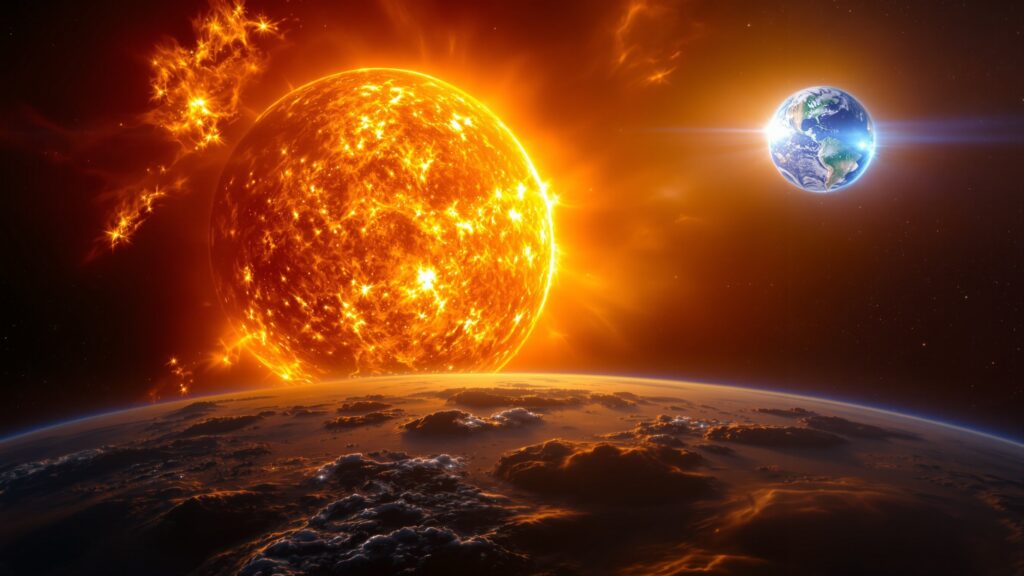
To start, the Sun has a diameter of about 864,000 miles (1.39 million kilometers). That makes it more than 100 times wider than Earth. If you placed Earth next to the Sun, you could fit more than a hundred of our planets across its surface. Volume tells an even bigger story. The Sun could hold about 1.3 million Earths inside it if it were hollow. Its mass is about 330,000 times greater than Earth’s, meaning if you put Earth on a giant cosmic scale, you’d need hundreds of thousands of our planet just to balance out the Sun. Even these numbers, as massive as they are, only begin to scratch the surface of how vast the Sun truly is.
Comparing the Sun to Earth: A Cosmic Reality Check
When we look at the Sun from Earth, it appears small enough to be covered with a thumb held at arm’s length. But appearances deceive. The Sun is so far away—about 93 million miles—that its enormity is disguised by distance.
To visualize scale, imagine shrinking the Sun down to the size of a basketball. On that same scale, Earth would be a tiny pea orbiting about 80 feet away. That kind of comparison helps remind us just how tiny we really are in the solar system.
Even gravity plays into the size equation. The Sun contains 99.8% of all the mass in the solar system. Every planet, asteroid, and comet dances to its gravitational tune. Earth doesn’t just orbit the Sun—it orbits a gravitational powerhouse so dominant that without it, the solar system as we know it wouldn’t exist.
How Big Is the Sun Compared to Other Planets?
If Earth looks small next to the Sun, what about the other planets? Jupiter, the gas giant and king of the planets, is enormous by our standards. You could line up about 11 Earths across Jupiter’s diameter. But the Sun dwarfs Jupiter too—you could line up about 10 Jupiters across the Sun. Saturn, with its dazzling rings, fares no better. Even Neptune and Uranus, often called the ice giants, are mere marbles in comparison to the star they orbit. In fact, all the planets in the solar system combined still account for just a fraction of the Sun’s total size and mass.
How Big Is the Sun Compared to Other Stars?
Here’s where things get truly humbling. Our Sun is big compared to Earth, but in the cosmic neighborhood, it’s classified as a G-type main-sequence star, often nicknamed a “yellow dwarf.” That might sound small, but it simply means it’s middle-of-the-road compared to other stars in the universe.
Some stars make our Sun look tiny. Betelgeuse, a red supergiant in the constellation Orion, has a diameter nearly 700 times larger than the Sun. If Betelgeuse replaced the Sun in our solar system, it would engulf everything out to the orbit of Jupiter. Then there’s VY Canis Majoris, one of the largest known stars, which could swallow the Sun and still have room left over.
On the flip side, there are smaller stars called red dwarfs that make the Sun seem huge. These stars can be less than half the Sun’s size, and they make up the majority of stars in our galaxy. So while the Sun feels unimaginably big to us, it’s just an average star in the grand scheme of things.
The Sun’s Layers and Why They Add to Its Size
The Sun’s structure also contributes to its sheer immensity. Unlike a planet with a solid surface, the Sun is a giant ball of hot plasma. It’s made up of layers, each adding to its vastness. At the core, nuclear fusion takes place, where hydrogen atoms fuse into helium, releasing massive amounts of energy. The core alone is about 170,000 miles in radius and is hotter than 27 million degrees Fahrenheit. That’s where all the Sun’s power originates.
Surrounding the core is the radiative zone, where energy slowly works its way outward—so slowly that it can take thousands, even millions, of years for a single photon of light to escape. Beyond that is the convective zone, where hot plasma churns and rises like boiling water. The visible surface, called the photosphere, is what we see from Earth, but above that are the chromosphere and corona. During a solar eclipse, the corona flares outward dramatically, extending far into space. So when we talk about the size of the Sun, it’s not just the glowing ball we see—it’s also the vast, fiery atmosphere stretching millions of miles beyond.
How the Sun Shapes Life on Earth
Understanding the Sun’s size isn’t just a matter of curiosity. Its sheer scale is directly tied to our existence. Because it is so massive, the Sun can sustain nuclear fusion for billions of years, providing the steady energy Earth depends on. The sunlight that takes eight minutes to reach Earth drives photosynthesis in plants, fuels weather systems, warms our oceans, and makes our planet habitable. Without the Sun’s colossal size, there wouldn’t be enough fuel for such long-term stability. Smaller stars burn out more quickly or fluctuate wildly, making them less hospitable for life. Our Sun is the perfect size for sustaining life over the long haul.
The Sun’s Size Over Time: Past, Present, and Future
While we often think of the Sun as unchanging, it’s actually evolving. Right now, at about 4.6 billion years old, it’s considered middle-aged in stellar terms. It will continue burning hydrogen in its core for another 5 billion years or so.
As it runs out of hydrogen, its core will contract and heat up while the outer layers expand. The Sun will swell into a red giant, growing so large that it will engulf Mercury, Venus, and possibly Earth. At that point, its size will be unrecognizable compared to the star we see today. Eventually, it will shed its outer layers and shrink down into a white dwarf—tiny compared to its current self but still containing about half its mass. So while the Sun feels like a constant, its size and shape are part of a grand cosmic life cycle.
Visualizing the Sun: Human Scale Comparisons
Sometimes the best way to understand size is through playful imagination. If the Sun were the size of a typical front door, Earth would be a nickel. If the Sun were a beach ball, Earth would be a tiny marble orbiting about the length of a school bus away. Even distances change how we see size. From Earth, the Sun and Moon appear roughly the same size in the sky, which is why we get total solar eclipses. But this is pure coincidence—the Sun is about 400 times wider than the Moon, yet it’s also about 400 times farther away, making them appear equal to our eyes. These coincidences and comparisons highlight just how deceptive scale can be when dealing with cosmic giants.
Why Understanding the Sun’s Size Inspires Wonder
Asking “How big is the Sun?” isn’t just a scientific exercise. It’s an invitation to marvel at the universe. The Sun is the ultimate reminder that human perspective is limited. What feels big to us is small on a cosmic scale, and what feels constant is part of a much larger cycle of birth, growth, and change. From ancient civilizations worshipping the Sun as a god to modern scientists probing its secrets with spacecraft, our fascination has always been tied to its enormity. Its size shapes our lives, our myths, our science, and our sense of place in the cosmos.
Conclusion: The Immensity of Our Familiar Star
The Sun may look like a simple glowing circle in the sky, but it is anything but ordinary. With a diameter of 864,000 miles, the ability to hold over a million Earths inside, and a mass that outweighs all the planets combined, it is a giant of staggering proportions. Compared to Earth, it is overwhelming; compared to supergiant stars, it is modest. Yet for us, it is exactly the right size—a cosmic Goldilocks star that sustains life while dazzling us with its brilliance. So, the next time you look up at the Sun, remember: you’re seeing the surface of a star so immense that human words and numbers struggle to capture it. Its size is a humbling reminder of both our smallness and our extraordinary luck to orbit such a magnificent giant.