How Big Is the Grand Canyon? A Natural Wonder That Defies Simple Measurements
“How big is the Grand Canyon?” sounds like a straightforward question, yet the moment you try to answer it, numbers begin to fall short. The Grand Canyon isn’t just big—it’s vast in a way that stretches human understanding. It’s not a single view, a single trail, or a single depth. It’s a colossal landscape shaped by time, water, and gravity, revealing scale not just in miles, but in moments of awe. Standing at the rim, your eyes struggle to grasp the distance. Colors fade into layers, shadows play tricks on depth, and silence amplifies the immensity. The Grand Canyon isn’t merely measured in length and width; it’s measured in perspective. To truly understand how big it is, you need to explore it dimension by dimension.
Where the Grand Canyon Is—and Why That Matters
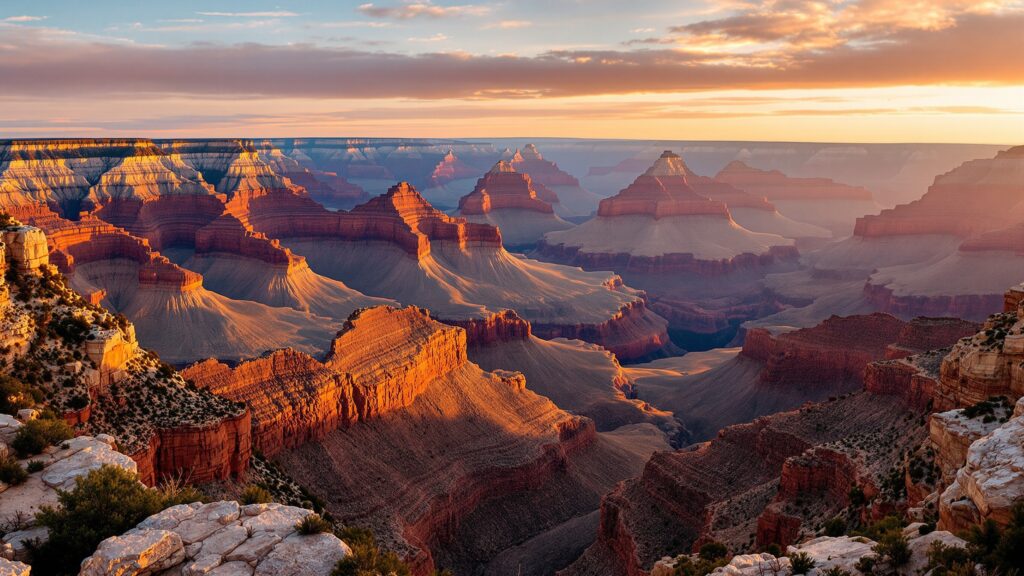
The Grand Canyon is located in northern Arizona, carved primarily by the Colorado River over millions of years. It sits on the Colorado Plateau, a massive uplifted region that allowed erosion to dig deeper rather than spread outward. This geological setting is key to the canyon’s size. Because the plateau rose while the river cut downward, the canyon became incredibly deep without collapsing inward. This rare combination of uplift and erosion allowed the Grand Canyon to grow into one of the largest natural chasms on Earth.
How Long Is the Grand Canyon?
The Grand Canyon stretches approximately 277 miles from Lees Ferry in northeastern Arizona to the Grand Wash Cliffs near Nevada. That’s longer than the distance between Los Angeles and San Diego, and nearly the length of the entire state of New Jersey.
What makes this length especially striking is that the canyon doesn’t run in a straight line. It winds and curves, following the ancient path of the Colorado River. From above, it resembles a massive scar etched across the landscape, twisting and branching into side canyons that extend the sense of scale even further.
How Wide Is the Grand Canyon?
The width of the Grand Canyon varies dramatically. At its narrowest point, it’s about 4 miles wide. At its widest, it stretches nearly 18 miles across. This variation adds to the canyon’s sense of mystery, as each viewpoint offers a completely different visual experience. From one rim, the opposite side may feel close enough to touch, while from another, it fades into distant haze. This changing width makes it difficult to comprehend the canyon as a single entity—it feels more like a vast collection of landscapes stitched together by the river below.
How Deep Is the Grand Canyon?
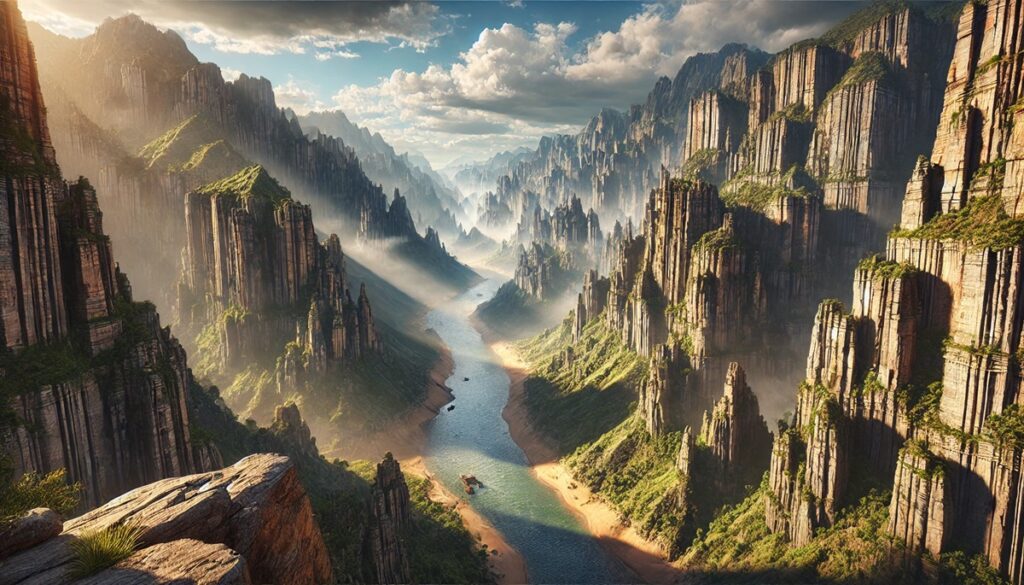
Depth is where the Grand Canyon truly becomes staggering. At its deepest point, the canyon plunges over 6,000 feet from rim to river. That’s more than a mile straight down.
To put that into perspective, the tallest skyscrapers in the world would barely reach halfway from the river to the rim. Standing at the edge, your brain struggles to process the vertical drop, especially as shadows obscure the bottom and distances blur.
What makes this depth even more remarkable is how gradually it was formed. The canyon wasn’t ripped open by a single event—it was patiently carved over millions of years, layer by layer, revealing Earth’s history like an open book.
The Grand Canyon as an Area, Not Just a Chasm
When people think of the Grand Canyon, they often imagine a single dramatic gorge. In reality, the Grand Canyon covers an area of about 1,902 square miles. That’s larger than the entire state of Rhode Island.
Within this massive area are countless side canyons, plateaus, buttes, mesas, and hidden valleys. The main canyon is only part of the story. Tributary canyons stretch outward like veins, expanding the canyon’s footprint far beyond what most visitors ever see.
Why the Grand Canyon Feels Bigger Than the Numbers
Even with all the statistics, the Grand Canyon feels bigger than its measurements suggest. That’s because scale isn’t just about size—it’s about comparison. Humans evolved in environments where distances were manageable and landscapes familiar. The Grand Canyon breaks those expectations. There are no buildings, no roads crossing the void, no reference points to anchor your sense of scale. The absence of familiar objects makes distances feel exaggerated. A rock formation that looks nearby might be miles away. A descent that seems short could take hours.
Time: The Canyon’s Fourth Dimension
One of the most astonishing aspects of the Grand Canyon’s size is its age. The rock layers exposed in its walls span nearly two billion years of Earth’s history. Walking through the canyon is like traveling backward through time, step by step.
This temporal scale adds another layer to the canyon’s immensity. It’s not just physically large—it represents an almost incomprehensible stretch of geological time. Each layer tells a story of ancient oceans, deserts, volcanic eruptions, and shifting continents.
The Colorado River: Small but Mighty
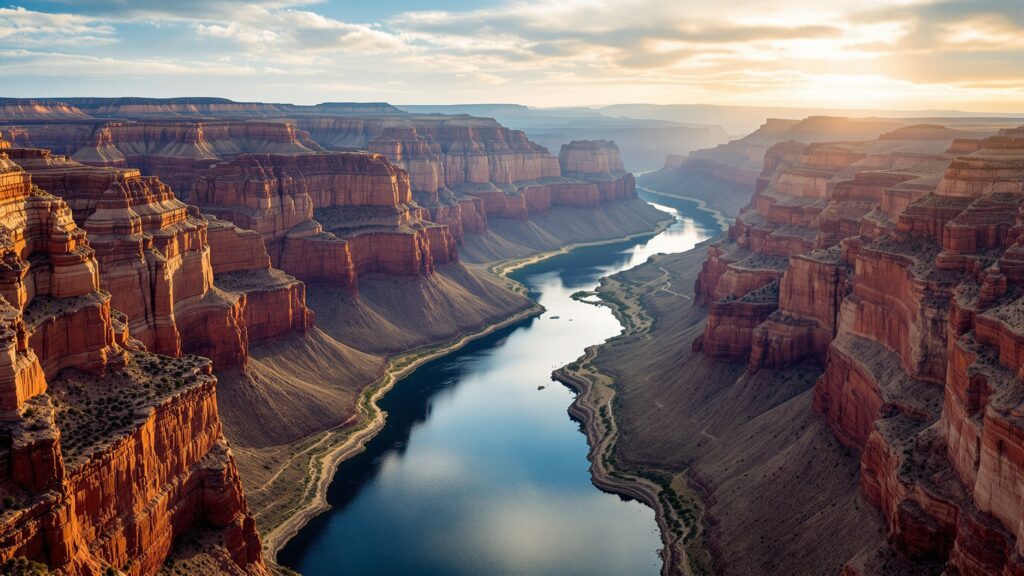
At the bottom of the Grand Canyon flows the Colorado River, the force responsible for carving this massive landscape. From above, the river looks almost insignificant—a thin ribbon winding through stone. Yet over millions of years, this river cut through solid rock, deepening the canyon inch by inch. Its size compared to the canyon is a powerful reminder of what persistent natural forces can accomplish over time. The canyon’s enormity is proof that size isn’t always about power in the moment, but persistence across ages.
How Big Is the Grand Canyon Compared to Cities?
Comparisons help bring the canyon’s size into focus. If the Grand Canyon were placed over a major city, it could swallow entire metropolitan areas whole. Its length exceeds the distance between many major urban centers, and its depth dwarfs man-made structures.
Even cities known for sprawling development feel small when measured against the canyon’s vast emptiness. Unlike cities, however, the Grand Canyon contains no artificial order—only natural complexity.
Can You See the Whole Grand Canyon at Once?
Despite its size, no single viewpoint shows the entire Grand Canyon. Its curves, depth, and vastness prevent any one location from capturing it all. Every overlook reveals a new composition of layers, shadows, and shapes. This is part of what makes the canyon endlessly fascinating. Even frequent visitors discover new perspectives, new colors, and new dimensions each time they return.
How Big Is the Grand Canyon National Park?
The Grand Canyon National Park itself spans over 1.2 million acres, making it one of the largest national parks in the United States. Within its boundaries are forests, deserts, rivers, wildlife habitats, and archaeological sites.
This massive protected area ensures that the canyon’s scale remains untouched by modern development, allowing visitors to experience its immensity much as people did centuries ago.
The Grand Canyon From Above
Seeing the Grand Canyon from the air adds another layer of understanding. From a plane or helicopter, the canyon appears as a massive rupture in the Earth’s surface, with endless branching canyons extending outward. Even from thousands of feet above, the canyon doesn’t shrink—it expands. The aerial view reveals how deeply it dominates the surrounding landscape, shaping everything around it.
Walking Into the Canyon Changes Everything
Descending into the Grand Canyon transforms how you perceive its size. From the rim, it looks vast. Inside it, the scale becomes personal. Walls tower overhead, distances stretch longer, and time slows down.
Hiking even partway into the canyon reveals how deceptive its size can be. What appears close is often hours away. What looks manageable can be physically demanding. The canyon doesn’t just look big—it demands respect.
Wildlife and Ecosystems Across Vast Space
The Grand Canyon’s size allows it to contain multiple ecosystems stacked vertically. From desert scrub near the river to alpine forests along the rim, the canyon supports a remarkable range of life. This ecological diversity is directly tied to its size. The vast changes in elevation and climate within the canyon create habitats that feel worlds apart, all within the same landscape.
Why the Grand Canyon Will Always Feel Bigger Than You Expect
No matter how many statistics you read or photos you see, the Grand Canyon always feels larger in person. Its sheer openness, its layered complexity, and its ancient silence combine to create an experience that defies expectation.
The canyon doesn’t overwhelm with noise or motion—it overwhelms with stillness and scale. It invites you to slow down, look longer, and realize just how small a single moment is in the context of deep time and vast space.
So, How Big Is the Grand Canyon?
The Grand Canyon is 277 miles long, up to 18 miles wide, and over a mile deep. It covers nearly 2,000 square miles and reveals nearly two billion years of Earth’s history. But those numbers only scratch the surface. The true size of the Grand Canyon isn’t just measured in miles or feet—it’s measured in awe. It’s a place where the planet reminds us of its power, its patience, and its incredible scale.