How Big Is the Asteroid Belt? A Vast Cosmic Highway of Ancient Rock
When people hear the phrase “asteroid belt,” many imagine a crowded cosmic obstacle course—like the chaotic asteroid fields seen in science fiction movies where spacecraft must weave between tumbling rocks. The reality, however, is both more surprising and far more awe-inspiring. The asteroid belt is not a tightly packed minefield of boulders. Instead, it is a vast region of space stretching millions of miles wide, populated by countless rocky remnants from the birth of our solar system. So just how big is the asteroid belt? The answer is enormous. In fact, the asteroid belt is so large that its scale is difficult to comprehend without stepping back and examining the structure of our solar system. Located between the orbits of Mars and Jupiter, this region forms a gigantic ring of ancient debris that spans hundreds of millions of kilometers. It contains millions of asteroids ranging from tiny pebbles to dwarf-planet-sized worlds, all orbiting the Sun in a broad band. To understand the true scale of the asteroid belt, we have to explore its size, its structure, and the ancient cosmic story that created it.
Where the Asteroid Belt Lives in the Solar System
The asteroid belt sits between two familiar planetary neighbors: Mars and Jupiter. Mars orbits the Sun at about 1.5 astronomical units (AU), while Jupiter travels much farther out at roughly 5.2 AU. An astronomical unit is the average distance between Earth and the Sun, about 93 million miles (150 million kilometers).
The asteroid belt stretches roughly from 2.1 AU to 3.3 AU from the Sun. That means the belt begins around 195 million miles (315 million kilometers) from the Sun and extends outward to about 307 million miles (495 million kilometers). In total, the asteroid belt spans a width of approximately 1.2 AU, or about 112 million miles (180 million kilometers).
To visualize this scale, imagine a ring around the Sun wider than the distance between Earth and Mars. This enormous band contains millions of objects, yet most are separated by hundreds of thousands of miles. Even though it contains many asteroids, the region is so vast that spacecraft can easily pass through it without encountering anything at all.
Not a Solid Ring of Asteroids
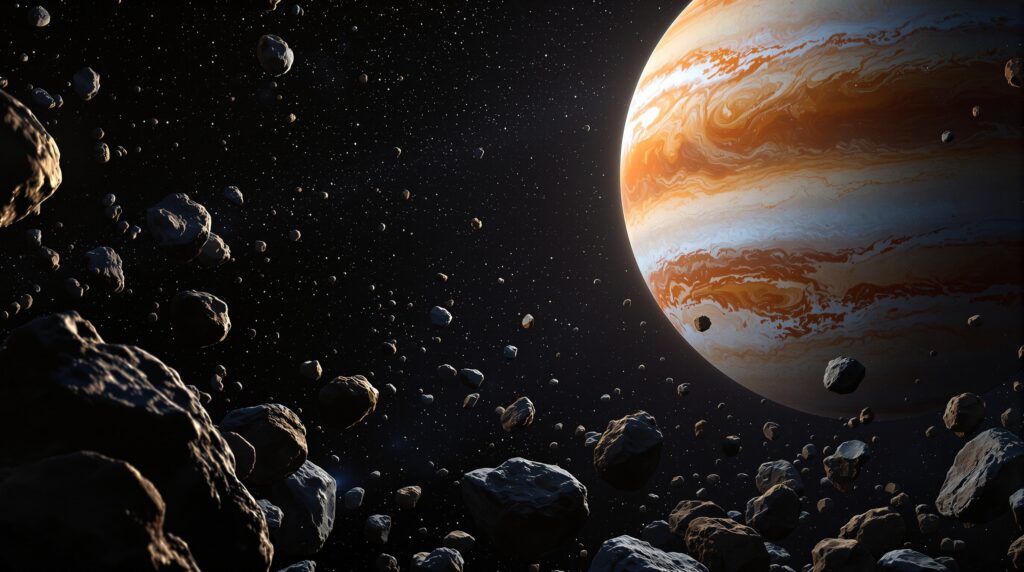
Despite its name, the asteroid belt is not a solid or densely packed ring. The asteroids are scattered across a huge region of space, each orbiting the Sun independently. If you were standing on an asteroid inside the belt, the nearest asteroid might be hundreds of thousands to millions of miles away. In fact, the asteroid belt is mostly empty space.
This surprises many people because movies often portray it as a dense swarm of rocks constantly colliding. In reality, collisions between asteroids are relatively rare because of the immense distances between them.
Space missions have crossed the asteroid belt many times without incident. Probes such as Pioneer 10, Voyager 1, Galileo, Cassini, and New Horizons all traveled through the region safely.
Rather than being a cluttered junkyard, the asteroid belt is more like a cosmic desert dotted with scattered relics from the earliest days of planetary formation.
The Largest Objects in the Belt
Although the asteroid belt contains millions of objects, most are quite small. Many are just rocks a few meters across. However, several asteroids are large enough to be considered miniature worlds.
The four largest objects dominate the mass of the entire belt.
Ceres, the largest, is actually classified as a dwarf planet. It measures about 590 miles (940 kilometers) in diameter and contains roughly one-third of the total mass of the asteroid belt. Ceres even has a thin atmosphere and possible subsurface ice.
Next comes Vesta, one of the brightest asteroids visible from Earth. Vesta is about 326 miles (525 kilometers) wide and has a differentiated interior similar to a small planet.
Pallas and Hygiea follow, each hundreds of miles across.
What is fascinating is that if you added up all the mass of every asteroid in the entire belt, the total would still be less than 5% of the Moon’s mass. In other words, despite its massive size in space, the asteroid belt contains surprisingly little material.
Why the Asteroid Belt Exists
To understand the size of the asteroid belt, we must go back 4.6 billion years to the birth of the solar system.
At that time, a swirling disk of gas and dust surrounded the newborn Sun. Over millions of years, particles within this disk collided and stuck together, gradually forming larger and larger bodies called planetesimals.
These planetesimals eventually merged into planets. However, the region where the asteroid belt exists today experienced a major problem. A giant neighbor was forming nearby: Jupiter.
Jupiter’s enormous gravitational influence disrupted the process of planet formation in this region. Instead of allowing planetesimals to combine into a full-sized planet, Jupiter’s gravity constantly stirred the area, increasing collision speeds and preventing stable growth.
As a result, the material that might have formed another planet remained scattered as countless smaller bodies.
The asteroid belt is therefore a fossil record of the early solar system—a leftover construction zone where a planet never finished forming.
The Asteroid Belt’s Thickness
When we imagine the asteroid belt, we often picture a flat ring like the rings of Saturn. But the belt actually has considerable vertical thickness.
Asteroids orbit the Sun on slightly tilted paths, meaning they move above and below the main orbital plane of the solar system.
The belt’s vertical thickness can reach over 1 AU in some regions, meaning asteroids may travel millions of miles above or below the central plane.
This creates a three-dimensional swarm rather than a simple flat disk.
Because of this thickness, the asteroid belt resembles a wide torus, or doughnut-shaped region of space.
Gaps in the Belt: Jupiter’s Gravitational Signature
The asteroid belt is not uniform. In fact, astronomers have discovered several strange gaps within the belt where very few asteroids exist.
These gaps are called Kirkwood Gaps, named after astronomer Daniel Kirkwood, who first identified them in the 1800s.
The gaps occur because of gravitational interactions with Jupiter.
At certain distances from the Sun, asteroids would orbit in precise ratios with Jupiter, such as completing one orbit for every two or three of Jupiter’s. These resonances gradually destabilize asteroid orbits, ejecting them from those regions.
Over millions of years, these gravitational interactions cleared out the gaps we see today.
In essence, Jupiter acts like a cosmic sculptor, shaping the structure of the asteroid belt through its immense gravitational pull.
How Many Asteroids Are There?
The number of asteroids in the belt is staggering.
Astronomers estimate that the asteroid belt contains:
- More than one million asteroids larger than 1 kilometer
- Millions more smaller objects
- Countless rocks and dust particles
New asteroids are still being discovered every year thanks to improved telescopes and sky surveys. Even though the belt contains so many objects, remember that they are spread across a region wider than 100 million miles. That enormous volume of space keeps the region relatively empty.
What Are Asteroids Made Of?
Asteroids come in several different types, each revealing clues about the early solar system.
Some asteroids are rocky, composed mainly of silicate minerals similar to Earth’s crust.
Others are metallic, containing large amounts of iron and nickel. These may be fragments of larger bodies that once had molten cores.
Another group consists of carbon-rich asteroids, which contain complex organic molecules and water-bearing minerals.
These carbonaceous asteroids are especially interesting because they may have helped deliver water and organic material to early Earth.
Studying these objects gives scientists valuable insight into how planets formed and how the building blocks of life may have spread across the solar system.
Space Missions to the Asteroid Belt
Several space missions have explored asteroids up close, revealing landscapes far more complex than scientists once imagined.
One of the most famous missions was NASA’s Dawn spacecraft, which visited both Vesta and Ceres.
Dawn revealed towering mountains, enormous impact craters, and strange bright salt deposits on Ceres that may have formed from briny water erupting onto the surface.
Other missions have studied asteroids that likely originated in the belt before drifting into near-Earth space.
Japan’s Hayabusa missions and NASA’s OSIRIS-REx have even returned samples of asteroid material to Earth for detailed study.
These missions help scientists understand the composition and history of these ancient objects.
A Gateway to the Outer Solar System
Because the asteroid belt lies between the inner rocky planets and the outer gas giants, it serves as a transition zone within our solar system.
Inside the belt, planets are primarily made of rock and metal: Mercury, Venus, Earth, and Mars.
Beyond the belt, giant planets dominate: Jupiter, Saturn, Uranus, and Neptune.
The asteroid belt therefore marks a boundary between two very different regions of planetary formation.
Many spacecraft heading to the outer planets must pass through the belt, making it a familiar milestone for deep-space exploration.
Could the Asteroid Belt Become a Resource?
Scientists and entrepreneurs have long speculated about the asteroid belt as a potential source of valuable materials. Some asteroids contain large amounts of iron, nickel, platinum, and other rare metals. Others contain water ice, which could be converted into drinking water, oxygen, or rocket fuel.
Future space industries might mine asteroids to support long-duration missions or build infrastructure in space. Because asteroids have extremely low gravity, extracting and transporting materials could be far easier than launching them from Earth. Although asteroid mining remains largely theoretical today, the idea highlights just how significant this vast region of space may become in humanity’s future.
Putting the Size of the Asteroid Belt in Perspective
The asteroid belt is so enormous that comparing it to familiar distances can help make sense of its scale.
If Earth were the size of a marble and placed on a football field representing the solar system, the asteroid belt would begin several fields away and stretch across a region wider than the entire stadium complex.
Another way to imagine it is this: if you could drive a car across the width of the asteroid belt at highway speed, the journey would take millions of years.
Despite its immense size, the combined mass of everything in the belt is tiny compared to planets.
This contrast makes the asteroid belt one of the most fascinating structures in our solar system: incredibly wide, sparsely populated, yet packed with scientific secrets.
A Time Capsule From the Dawn of the Solar System
Ultimately, the asteroid belt is more than just a region of scattered rocks. It is a time capsule preserving the earliest stages of planetary formation.
Every asteroid carries clues about the chemistry, temperature, and conditions that existed when the solar system first formed.
By studying these ancient remnants, scientists gain a better understanding of how Earth and the other planets came to be.
The belt’s enormous size and diversity make it one of the richest scientific laboratories in space.
The True Scale of the Asteroid Belt
So how big is the asteroid belt?
It stretches more than 112 million miles wide, occupies a massive region between Mars and Jupiter, and contains millions of ancient objects left over from the birth of the solar system. Yet despite its enormous size, the belt is mostly empty space, with asteroids separated by vast distances. In many ways, that contrast is what makes the asteroid belt so extraordinary. It is both immense and delicate, chaotic yet structured, ancient yet still evolving.
When we look up at the night sky, the asteroid belt may be invisible to the naked eye. But hidden between the orbits of two planets lies one of the largest and most fascinating regions in our solar system—a sprawling cosmic archive of planetary history. And as future missions explore deeper into space, the asteroid belt will continue to reveal new secrets about how our solar system began and where humanity might travel next.