The Largest Living Landscape on Earth
The Amazon Rainforest is so vast that it defies easy understanding. It is not just a forest, not just a collection of trees, and not even just a region. It is a living system on a continental scale, a place where rivers behave like oceans, trees shape the atmosphere, and distances stretch beyond the limits of imagination. When people ask how big the Amazon Rainforest is, they’re really asking how something so immense can exist in a single, continuous ecosystem. To grasp the size of the Amazon, you have to think bigger than maps, bigger than countries, and bigger than numbers. You have to think in terms of weather systems, time, and life itself.
The Numbers That Hint at Its Immensity
The Amazon Rainforest covers roughly 2.1 million square miles, making it the largest tropical rainforest on the planet. That’s an area so large it spans nearly half of South America. It stretches across nine countries, with the majority lying in Brazil, but also reaching into Peru, Colombia, Venezuela, Ecuador, Bolivia, Guyana, Suriname, and French Guiana. To put this into perspective, the Amazon is larger than the entire European Union. It is nearly as large as the contiguous United States west of the Mississippi River. You could fit multiple major countries inside its boundaries and still have room to spare. These numbers are staggering, yet they still fall short of conveying what the Amazon truly represents.
A Forest That Spans Countries, Not Borders
Unlike many natural landmarks that sit neatly within one nation, the Amazon Rainforest ignores political boundaries entirely. It flows seamlessly across borders, creating a shared ecological system that connects multiple countries. Rivers cross nations without pause. Wildlife migrates freely across invisible lines. Weather patterns formed in one region affect rainfall thousands of miles away.
Brazil holds the largest share of the Amazon, accounting for about 60 percent of the rainforest. Peru follows with the second-largest portion, while Colombia ranks third. Each country contains unique sections of the forest, yet all are interconnected, making the Amazon a truly international ecosystem. This borderless nature is one reason the Amazon feels so vast. It is not confined by human definitions of territory.
Rivers So Large They Resemble Seas
One of the most astonishing aspects of the Amazon’s size is its river system. The Amazon River itself is the second-longest river in the world and carries more water than the next several largest rivers combined. During the rainy season, it can expand to widths exceeding 30 miles in some places, swallowing forests and creating temporary aquatic worlds.
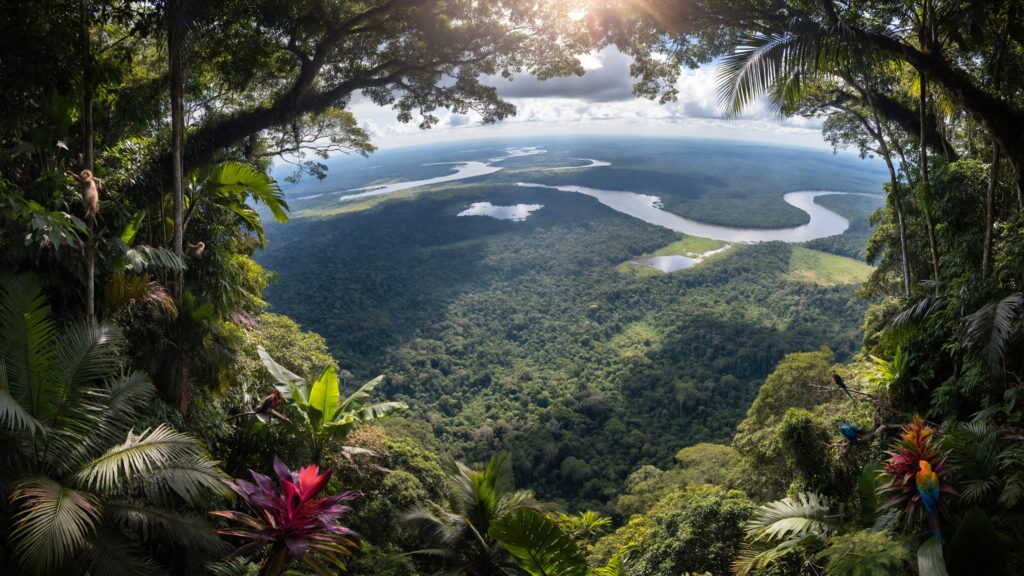
Thousands of tributaries branch off from the main river, forming a network that drains an area larger than any other river basin on Earth. These waterways act as highways through the forest, often serving as the only means of travel between remote communities. From above, the rivers look like vast, winding veins pumping life through the continent.
When you consider the rivers alone, the scale of the Amazon becomes almost oceanic.
A Canopy That Covers the Sky
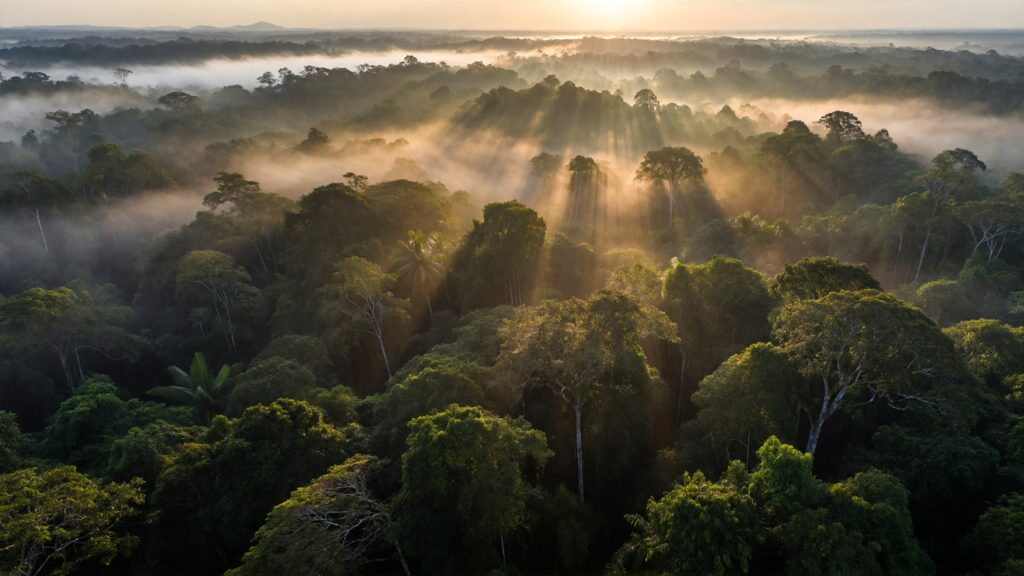
The Amazon’s forest canopy forms an unbroken green roof stretching for thousands of miles. In many places, the trees grow so densely that sunlight barely reaches the forest floor. This canopy is not just visually impressive; it plays a critical role in regulating climate and weather.
The trees release enormous amounts of moisture into the air through a process called transpiration. This creates “flying rivers,” invisible streams of water vapor that travel through the atmosphere and influence rainfall across South America. Some scientists estimate that the Amazon releases billions of tons of water vapor into the air every day. This means the forest doesn’t just occupy space on the ground. It extends upward into the sky, shaping weather patterns across an entire continent.
Comparing the Amazon to Familiar Places
Comparisons help translate the Amazon’s size into something more relatable. If you placed the Amazon Rainforest over North America, it would stretch from the East Coast deep into the Midwest. If laid over Europe, it would cover Spain, France, Germany, Italy, and beyond. Another way to imagine its scale is travel time. Flying over the Amazon from one end to the other can take several hours, even at cruising altitude. Traveling by boat through its rivers can take weeks. Many areas are so remote that they remain largely unexplored, even today. Few places on Earth make humans feel so small so quickly.
A Forest That Contains Millions of Forests
The Amazon is often spoken of as a single rainforest, but in reality, it contains countless distinct ecosystems. Flooded forests, dry upland forests, swampy lowlands, and river-edge environments all exist within its boundaries. Each has its own plant and animal communities adapted to specific conditions.
Some regions flood for months at a time, while others remain dry year-round. Elevation changes create subtle differences in temperature and rainfall. These variations multiply the sense of scale, making the Amazon feel less like one forest and more like an entire world of forests woven together. This internal diversity is one of the reasons the Amazon supports such extraordinary biodiversity.
Home to an Unmatched Diversity of Life
Size and biodiversity go hand in hand in the Amazon. The rainforest is believed to house around 10 percent of all known species on Earth. Millions of insects, thousands of bird species, countless plants, and iconic animals like jaguars, sloths, and pink river dolphins all call it home. Some areas contain more tree species in a single square mile than exist in all of North America. Many species remain undiscovered, hidden within remote corners of the forest. Scientists believe that the Amazon still holds secrets that could take centuries to fully understand. The forest’s vast size provides room for life to thrive, evolve, and adapt on an extraordinary scale.
Indigenous Lands Across a Massive Landscape
The Amazon is not an empty wilderness. It is home to hundreds of Indigenous groups, many of whom have lived there for thousands of years. Some communities live in large villages along rivers, while others remain isolated, choosing little or no contact with the outside world.
These cultures are deeply connected to the forest, relying on its plants, animals, and waterways for survival. The sheer size of the Amazon has allowed these cultures to persist, often far from modern development. In some regions, Indigenous territories cover areas larger than entire countries. Their presence adds a human dimension to the forest’s scale, reminding us that the Amazon is not just vast, but lived in.
Seeing the Amazon from Space
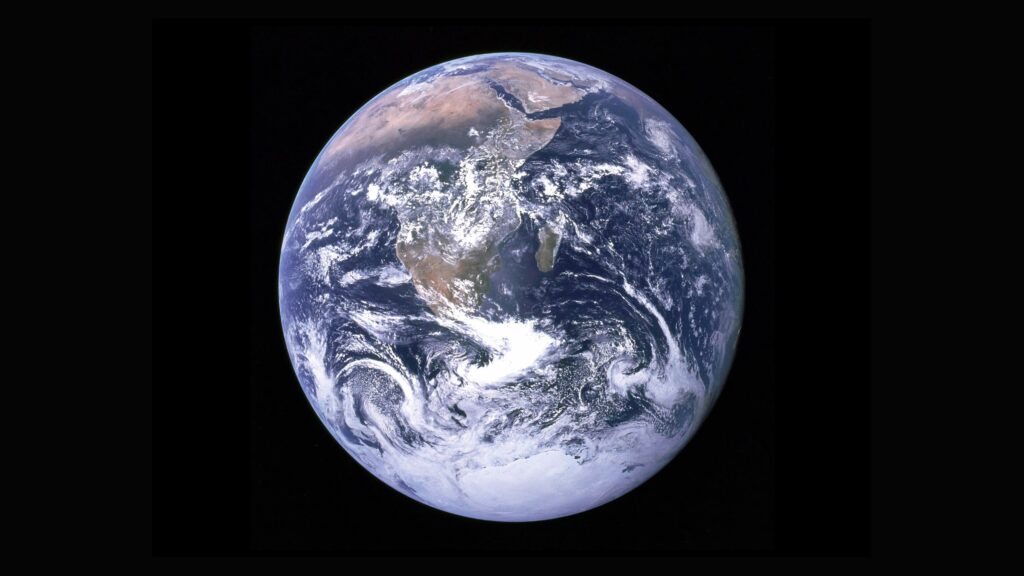
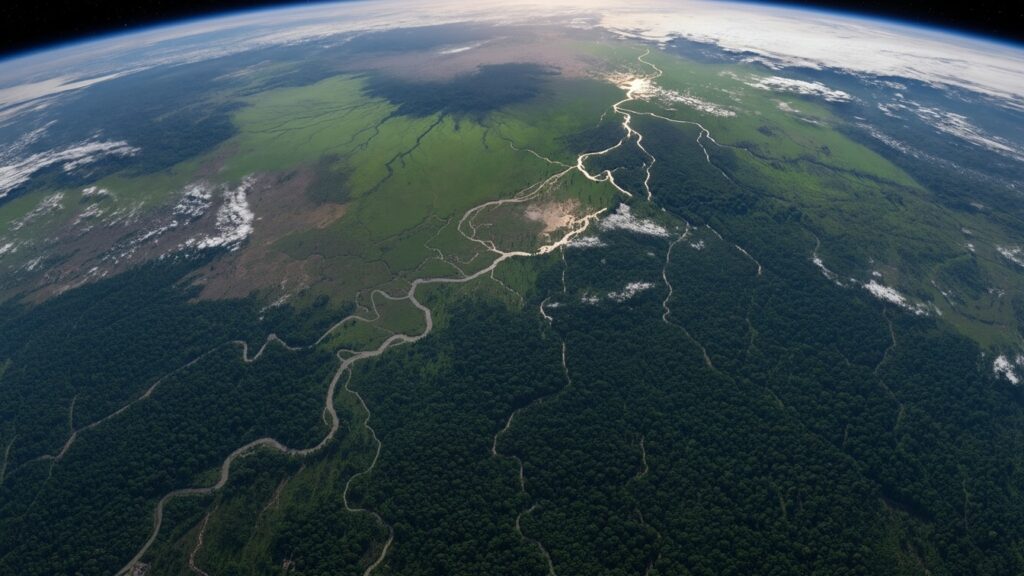
Satellite images provide one of the most powerful perspectives on the Amazon’s size. From orbit, the rainforest appears as an enormous green mass stretching across the northern half of South America. Rivers carve dark, winding paths through the greenery, while clouds form above the canopy, fed by moisture rising from the trees below.
These images reveal how the Amazon dominates the continent. It influences air currents, rainfall, and even global climate systems. The forest is so large that changes within it can be detected from space, making it one of the most closely monitored ecosystems on Earth. From above, the Amazon looks less like a forest and more like a living continent.
How the Amazon Shapes the Planet
The size of the Amazon gives it global influence. Often called the “lungs of the Earth,” the forest plays a major role in absorbing carbon dioxide and producing oxygen. While this phrase is a simplification, there is no doubt that the Amazon is a critical carbon sink. Its vast vegetation stores billions of tons of carbon, helping regulate global temperatures. The moisture it releases influences rainfall patterns as far away as North America and Europe. In this way, the Amazon’s size allows it to act as a stabilizing force for Earth’s climate. Few ecosystems have an impact that reaches so far beyond their physical boundaries.
The Fragility of Something So Vast
It may seem counterintuitive, but the Amazon’s immense size does not make it invincible. Deforestation, climate change, and development have already reduced significant portions of the forest. Roads and cleared land fragment the ecosystem, breaking it into smaller pieces.
Because the Amazon operates as a connected system, damage in one area can affect regions hundreds of miles away. Scientists warn that if deforestation reaches a critical threshold, large parts of the rainforest could transform into savanna, permanently altering the landscape. The scale of the Amazon means that its loss would not be local or regional, but global.
Why the Amazon’s Size Is Hard to Comprehend
Humans are not wired to easily understand vast scales. We live our lives within cities, neighborhoods, and regions. The Amazon operates on a scale that challenges those mental frameworks. Its distances, diversity, and complexity exceed everyday experience. Even maps can be misleading. On a flat map, the Amazon looks large, but it doesn’t convey the density of life, the vertical layers of the forest, or the endless repetition of trees stretching beyond the horizon. To truly feel its size, you would need to travel its rivers, fly above its canopy, and spend time within its depths. It is a place that resists simplification.
A Living Giant of the Natural World
So how big is the Amazon Rainforest? It is big enough to shape continents, influence weather across the globe, and support millions of species. It is big enough to contain countless ecosystems, cultures, and mysteries. It is big enough that even after centuries of exploration, much of it remains unknown. But beyond the numbers and comparisons, the Amazon’s true size lies in its significance. It is one of the most important natural systems on Earth, a living giant whose scale reminds us of the planet’s power, complexity, and fragility. Understanding how big the Amazon is isn’t just about measuring land. It’s about recognizing the vast, interconnected world that exists within its green expanse.