
Behind the Build of Luverne's World's Largest Nutcracker
WhiteClouds digitally designed, fabricated, sculpted, coated and painted the entire 65-foot nutcracker at our Utah facility. The finished landmark appears continuous, but it was created as approximately 21 major sections supported by a custom internal framework and delivered to Minnesota in six staged shipments.
WhiteClouds' work began in 2023 and continued through final delivery and installation support in June 2026. Our scope included the complete sculpted figure, four metal support platforms, sectional internal metalwork, attachment and assembly planning, a motorized jaw, protective coating and scenic paint.
The customer's on-site engineer designed the foundation, base, central tower and site-specific mounting needed for the wind loads. The engineer also reviewed and approved WhiteClouds' designs for fitting and attaching the nutcracker around that support. The on-site installation crew lifted the completed sections into place and tightened the planned hardware connections.
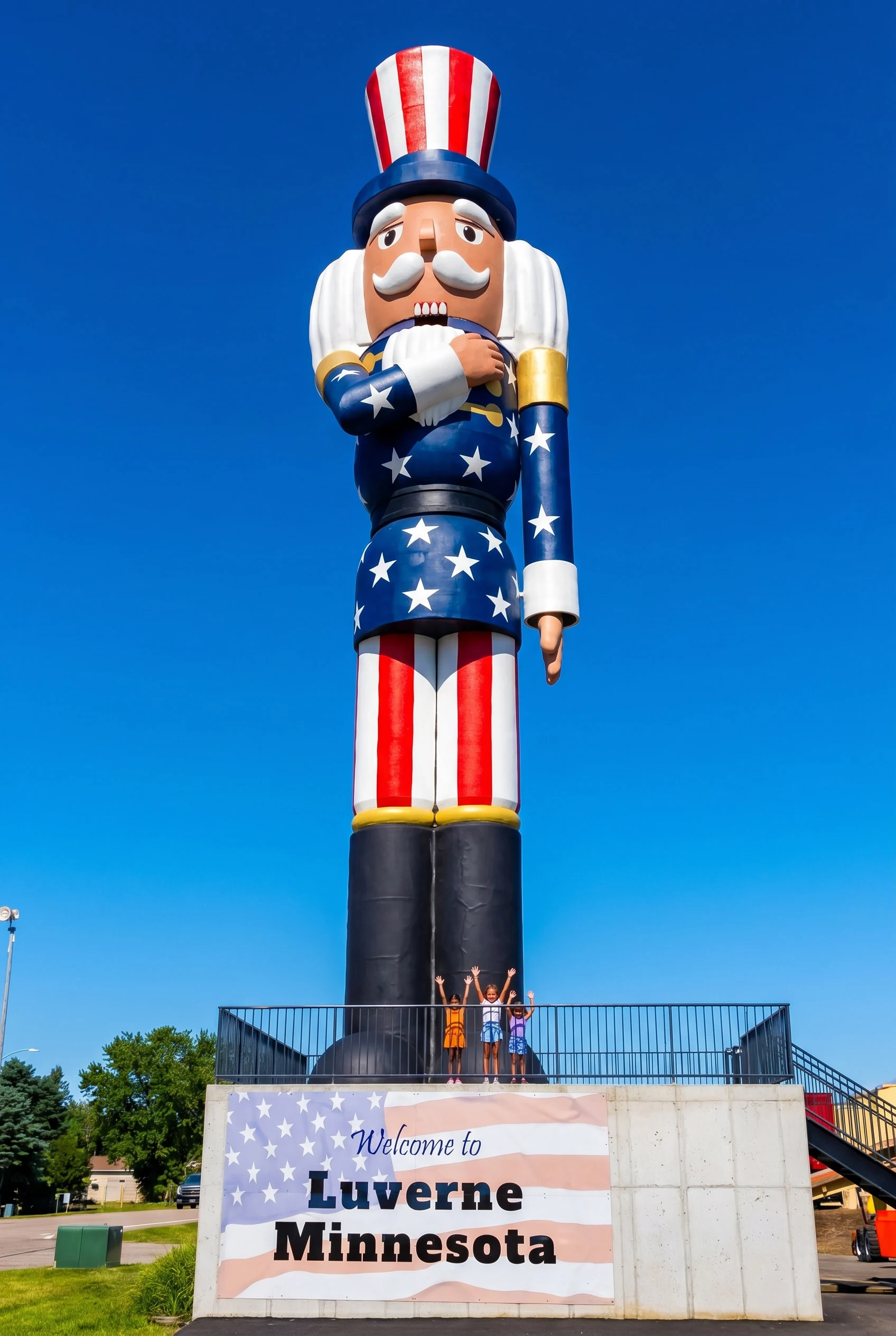
The completed nutcracker in Luverne, Minnesota. WhiteClouds digitally designed, fabricated, sculpted, coated and painted the entire figure in Utah.
WhiteClouds created the nutcracker; the site team installed it.
The project required close coordination, but the responsibilities were distinct. WhiteClouds completed the full character and its internal fabrication system in Utah, while the customer's engineer and installation team handled the permanent site structure, approvals and physical assembly.
Complete design and fabrication of the nutcracker
- Digital character modeling and production design
- Sectioning, connection details and assembly planning
- Sectional internal skeleton and four metal support platforms
- Approximately 3,079 pounds of fabricated metalwork
- All EPS foam fabrication, CNC cutting and hand sculpting
- Polyurea protective coating, scenic paint and final finish
- Motorized working jaw and internal mechanical coordination
- Freight preparation and animation-style assembly references
Permanent site structure and physical installation
- Foundation, concrete base and central support tower
- Site-specific wind-load and mounting design by the customer's engineer
- Review and approval of WhiteClouds' attachment and assembly designs
- Crane operation and movement of the completed sections into place
- Final alignment and tightening of the planned hardware connections
The sculpture had to be designed from the inside out.
The project began with reference artwork, the intended pose, site measurements and the existing support conditions. Early digital models focused on the patriotic character's silhouette and proportions. Later versions coordinated every visible form with the internal framework, section boundaries, working mouth, lifting needs and field-assembly sequence.
The customer's on-site engineer designed the foundation, base, central tower and mounting required to withstand the site's wind loads. That engineer also reviewed and approved WhiteClouds' designs for fitting and attaching the fabricated nutcracker sections around the central support.
As the structural concept developed, the customer decided to install a larger metal tube around the existing tower and extend its height. That solution provided a continuous central structure to which WhiteClouds' internal metalwork and four major support platforms could be securely attached.
WhiteClouds designed and fabricated the internal framework within the nutcracker itself. The four platforms supported and secured the stacked EPS sections while allowing the completed figure to accommodate the controlled movement expected in wind. Metal reinforcement, connections and attachment points were integrated into the sculpted assemblies rather than added after the exterior was complete.
The internal skeleton also had to be modular. It could not be shipped or installed as one continuous structure, so it was designed to travel with the sculpted sections and be assembled around the tower one piece at a time.
“The greatest challenge was dealing with the scale while accounting for safety at every stage. I had to create an internal skeleton that would securely support the finished sculpture but could still be assembled on-site one piece at a time.”
WhiteClouds production designer
Reference artwork established the patriotic character, pose and overall visual direction.
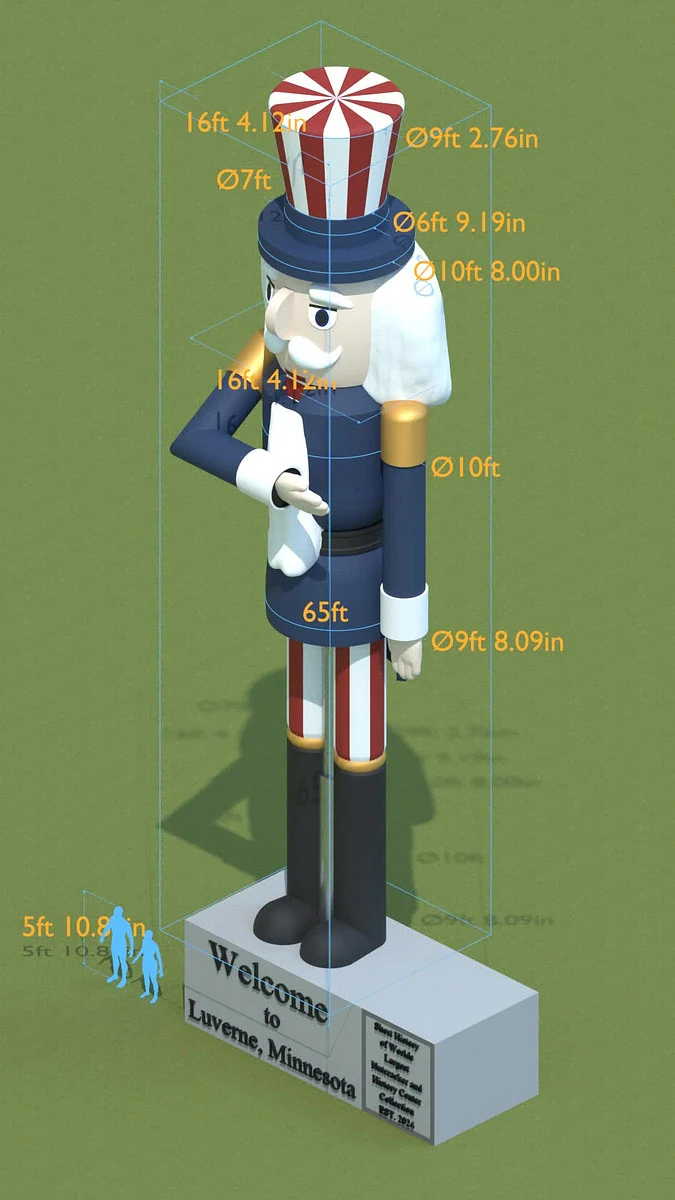
The developed model coordinated the character proportions with section boundaries, internal metalwork, site conditions and assembly planning.
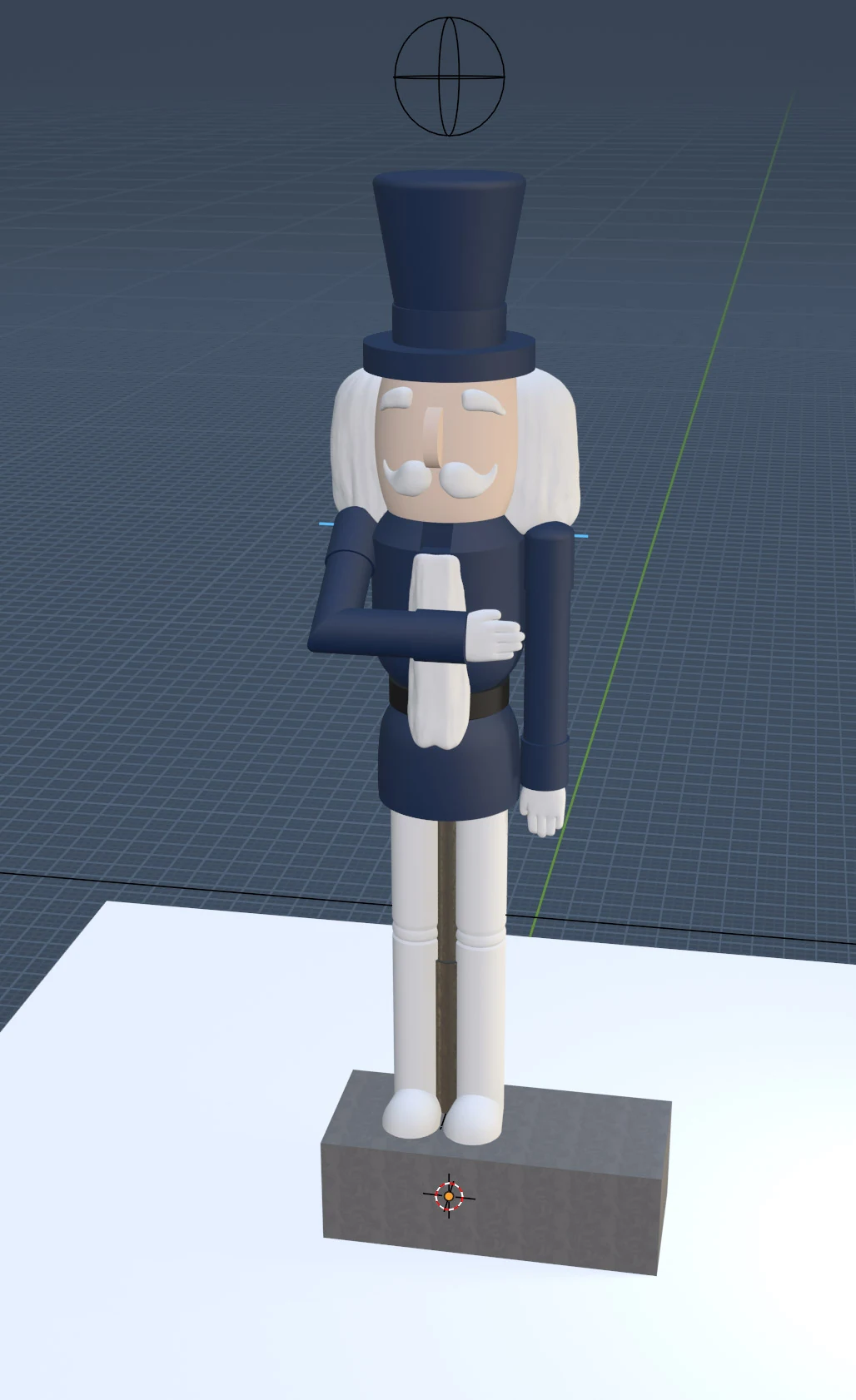
Early modeling focused on silhouette and proportion before the team committed to full production detail.
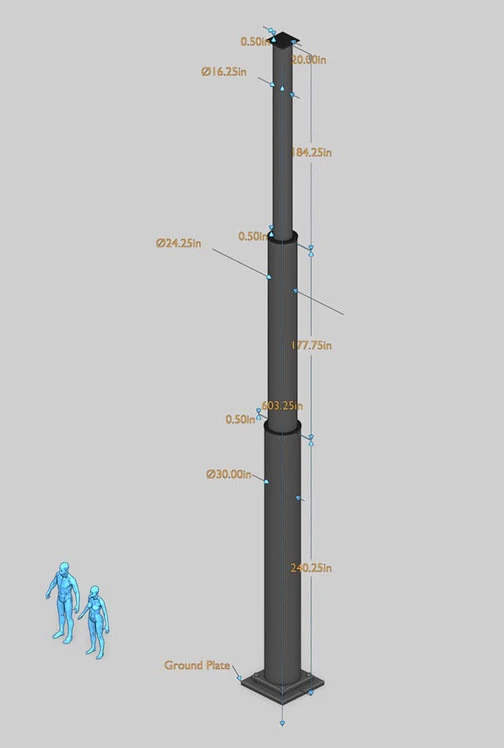
Site measurements helped WhiteClouds coordinate the sculpted exterior and attachment system with the existing support conditions.
The first problem was deciding where a 65-foot statue should come apart.
The nutcracker could not leave WhiteClouds as one object. Before fabrication could move forward, the team had to determine how the exterior, internal skeleton and four support platforms would be divided into transportable assemblies and reunited around the central tower.
Larger shop-built assemblies reduced the number of on-site connections, but they became harder to move through the facility, reach from every side, coat, protect and transport. Smaller pieces were easier to ship but created more lifting, alignment and field work.
The final plan used approximately 21 major sections delivered over six shipments. Section boundaries followed the character's geometry where possible, but they also reflected freight dimensions, section weights, access for finishing, lifting strategy and the order in which the internal framework could be safely assembled.
Each section had to work three times—as an individual object in the shop, as protected freight on a truck and as one precisely aligned part of the completed landmark.
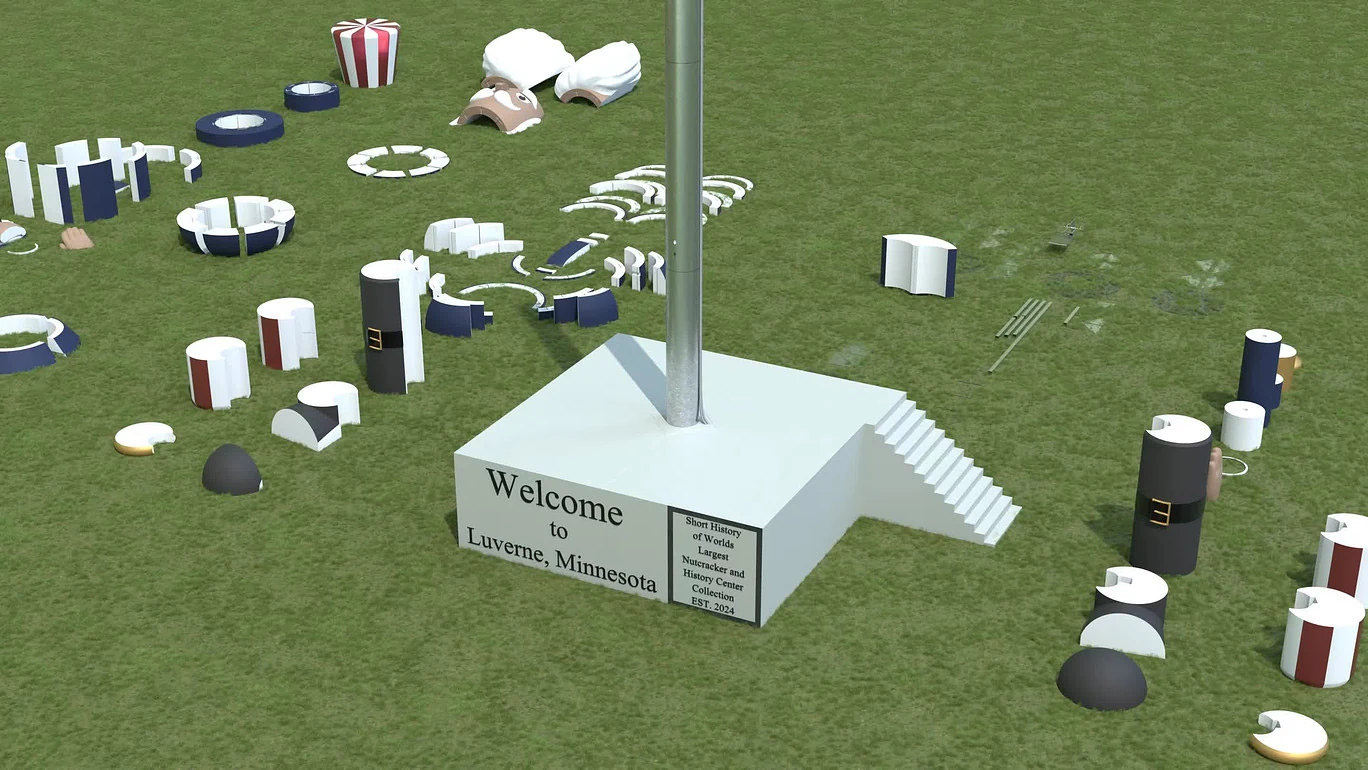
Assembly-reference animations showed how the sculpted sections, internal framework and four platform levels would come together around the central tower.
Why high-density EPS foam and polyurea made sense at this scale.
High-density EPS foam allowed WhiteClouds to create an enormous sculpted volume without the mass of solid construction. The material was dense enough to hold large forms and detailed carving, but comparatively lightweight for components that still had to be moved through production, shipped more than 1,000 miles and lifted during installation.
The material choice also responded to the exposed Minnesota environment. A large, rigid fiberglass shell can be vulnerable to cracking as a tall structure responds to wind and temperature changes. The EPS-based exterior created a less brittle sculpted body that could work with the internal support system rather than relying on a thin fiberglass shell to maintain the entire form.
The foam was rough-cut with hot-wire CNC equipment, then refined through hand sculpting and sanding. After the forms were approved, WhiteClouds applied a tough polyurea coating to protect the foam from moisture, abrasion, minor impacts and general outdoor exposure. Exterior primers, scenic paint and protective finish layers created the final patriotic colors and surface detail.
More than 4½ tons of WhiteClouds-built components
Production-model estimates provide a clearer picture of the amount of material concealed within the finished character.
These estimates were calculated from the production 3D model. They include only the components created and supplied by WhiteClouds and do not include the customer's foundation, concrete base or central support tower.
High-density EPS foam
Created monumental volume with manageable section weight and supported both CNC shaping and hand sculpting.
Four-platform internal system
A sectional metal skeleton and four major platforms secured the stacked foam assemblies to the central site support.
Polyurea coating
Formed a durable protective skin over the foam before the final exterior paint and scenic finish were applied.
Exterior scenic finish
Provided the stars, stripes, facial expression, uniform details and long-distance contrast needed for a roadside landmark.
An early compression problem led to a revised finishing method.
The sheer weight of some large foam sections created localized compression in the finish layers early in production. Rather than treating it as an isolated cosmetic issue, the team reproduced the condition inside the facility.
Test assemblies were placed under sustained compression and monitored over time to see how the foam, coating and support interface behaved. WhiteClouds then revised the way the affected areas were supported and finished, repeated the testing and applied the corrected approach to later sections. It was the kind of challenge that only became visible when digital plans turned into full-size objects carrying their own weight.
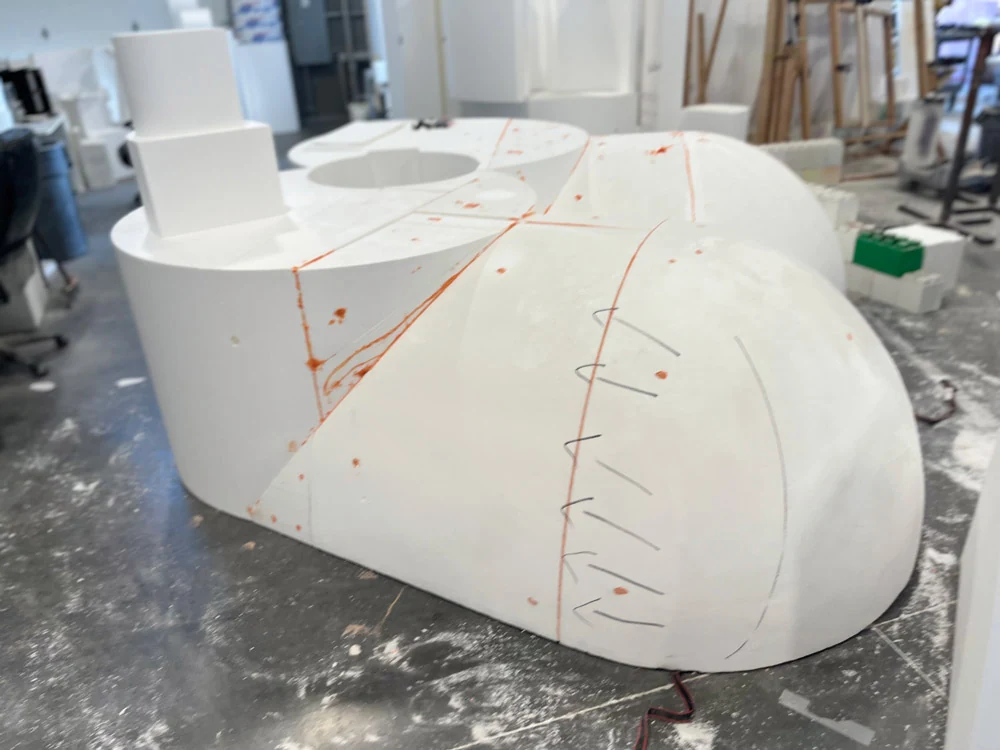
The approximately 14-foot boots began as large high-density EPS foam forms before hand refinement, coating and paint.
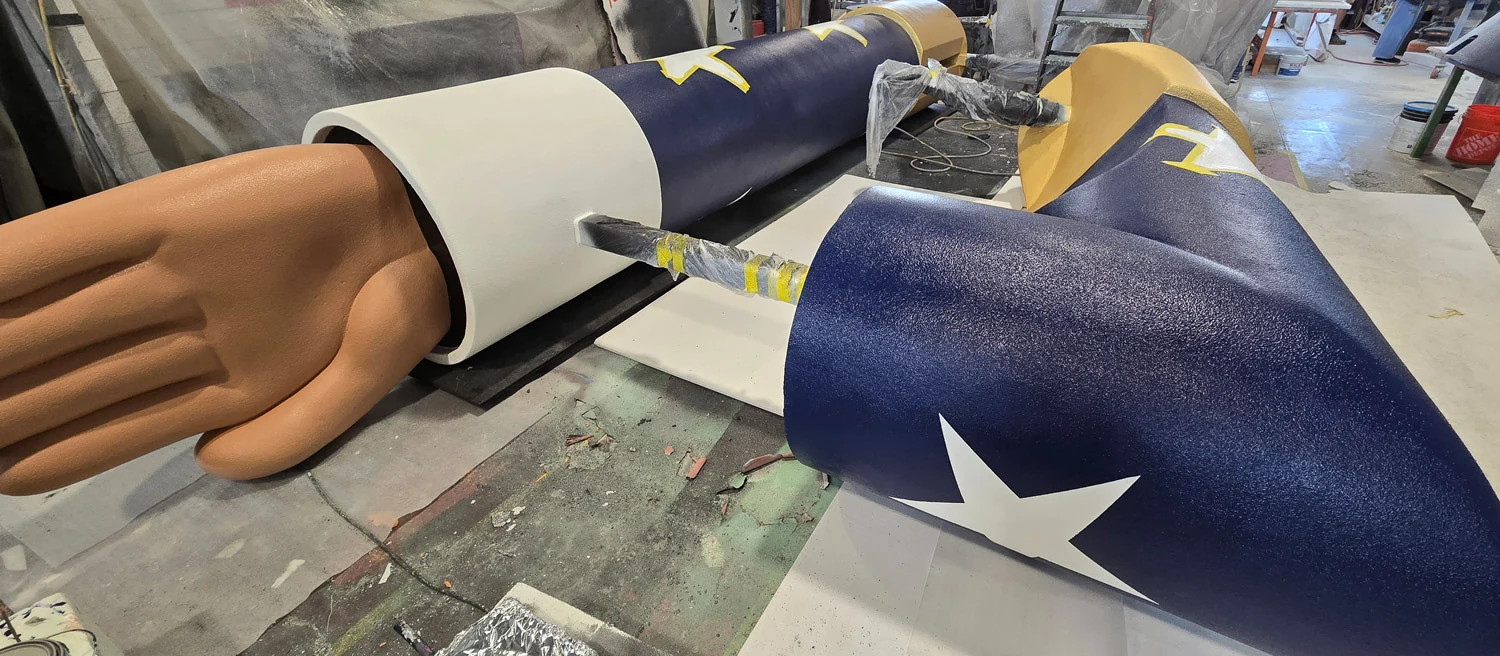
The arms and hands were built and finished as separate assemblies before shipment.
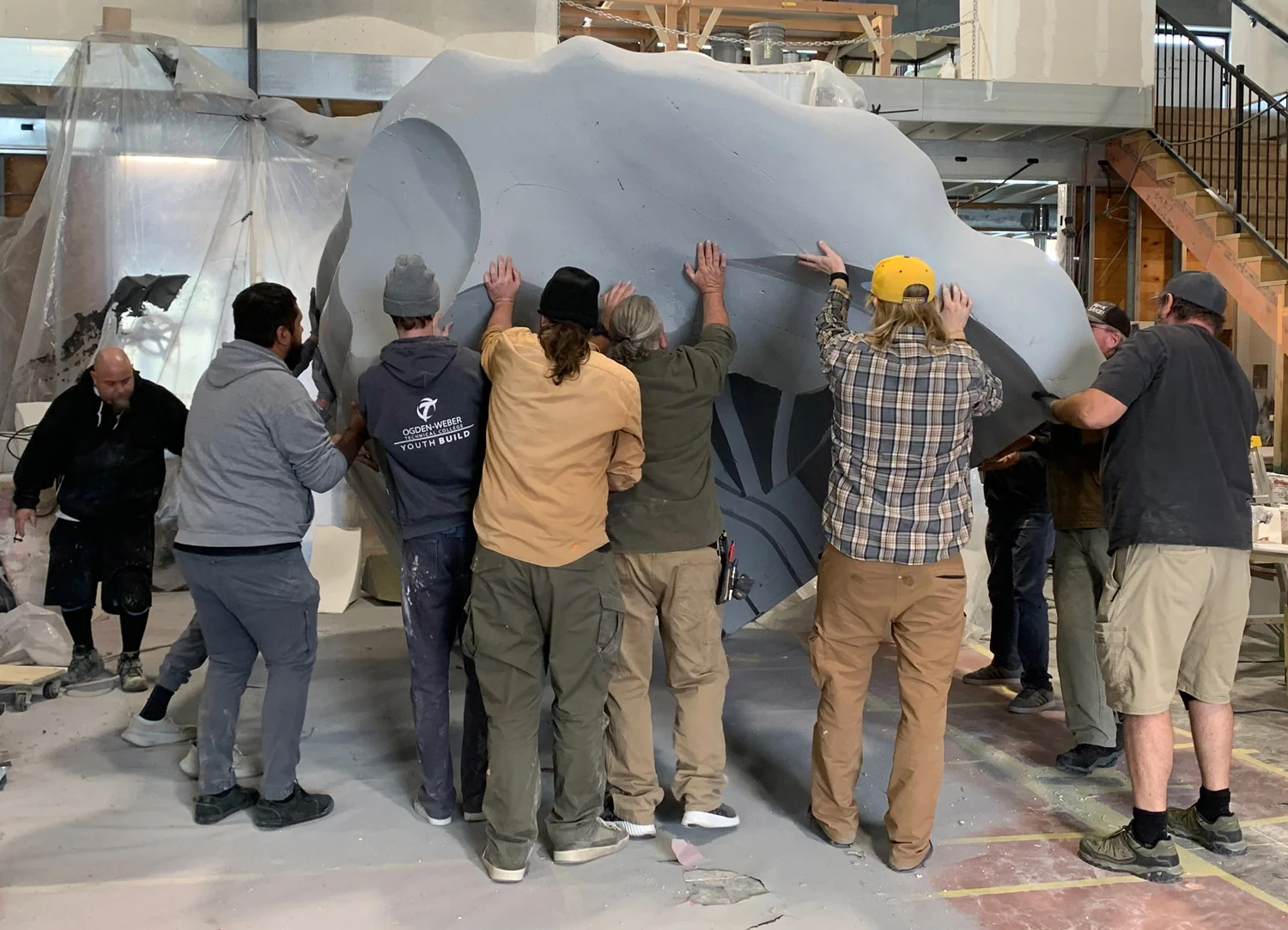
At this scale, moving a single section through production required coordinated handling and clear paths through the facility.
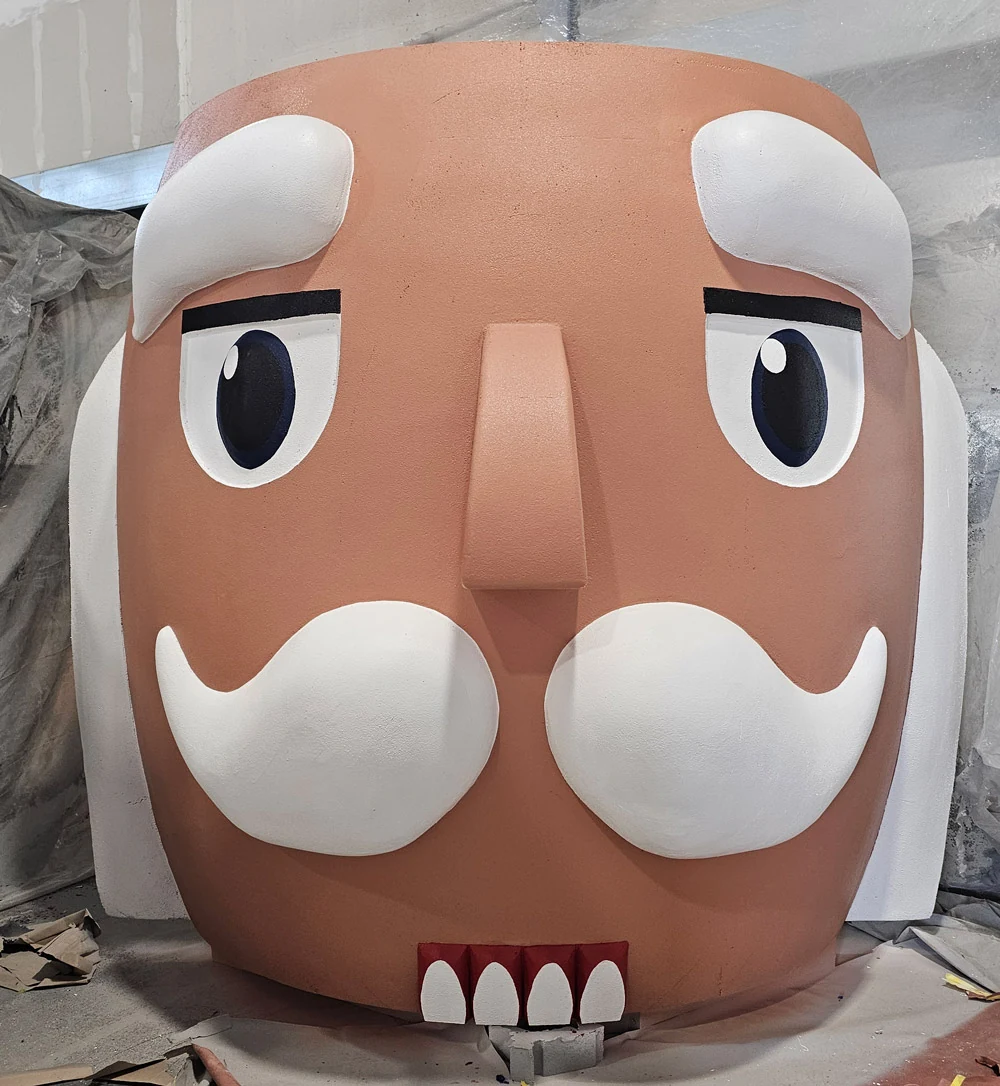
Facial forms, contrast and scenic paint were developed to remain readable from ground level.
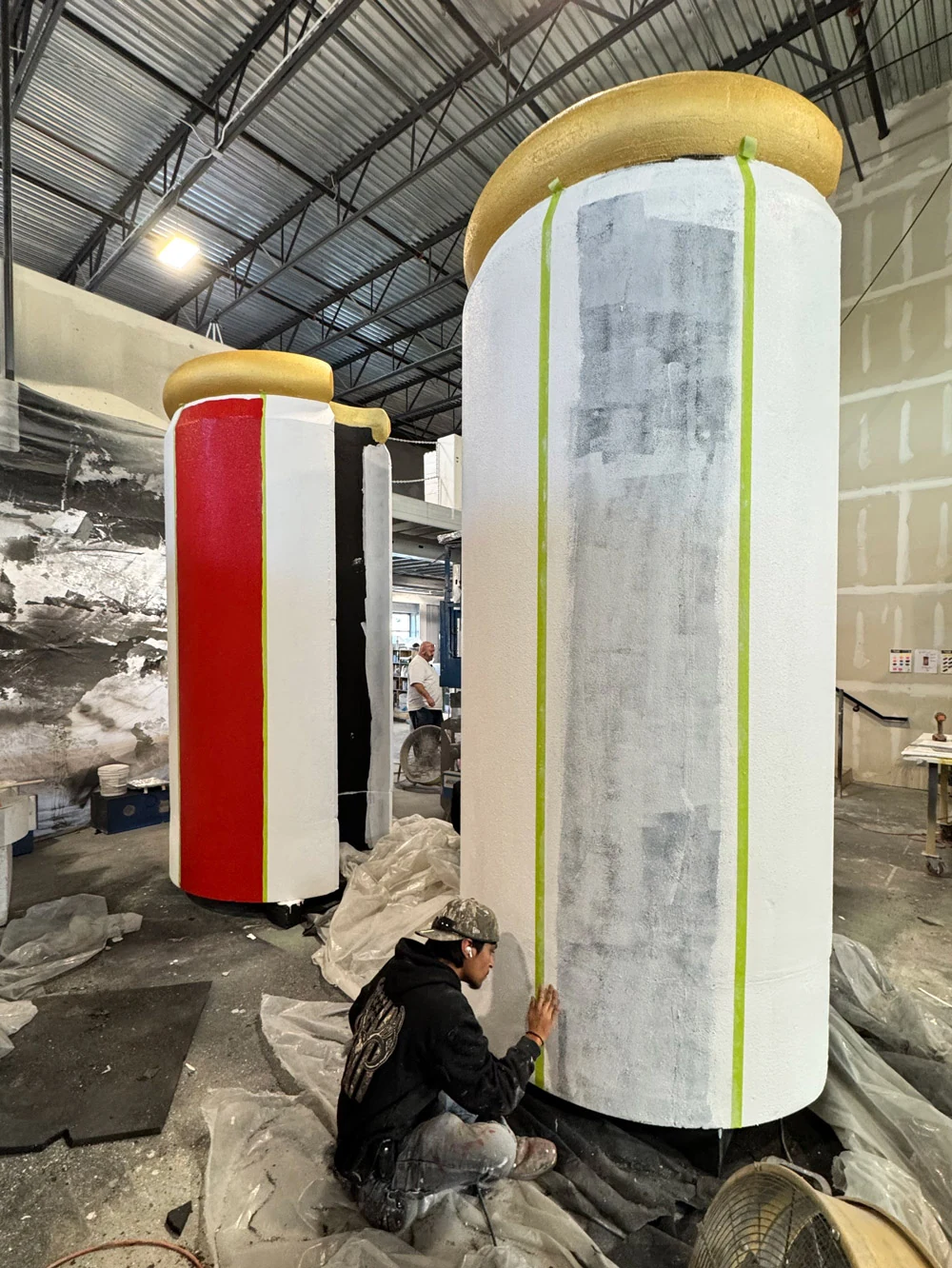
The tall leg sections were masked and painted in stages to maintain crisp red-and-white stripes across curved surfaces.
The face also had to function as a machine.
The completed nutcracker includes a motorized jaw. That turned the mouth from a decorative opening into a working assembly that had to fit within the available space inside the head.
The geometry of the cheeks, mustache, teeth and lower jaw affected the mechanism, while the mechanism affected access, concealed routing and the way the head was divided for fabrication and installation.
WhiteClouds developed cutaway models, coordinated the moving components with the sculpted face and tested the jaw before the head left the facility. The mouth was designed with enough force to crush something comparable to a pumpkin or watermelon.
It was not intended to crush substantially harder objects such as coconuts. The EPS teeth and sculpted exterior were optimized for lightweight monumental construction rather than that level of concentrated pressure.
A functional nutcracker: the moving mouth was designed to crush a pumpkin or watermelon, not merely open and close for display.
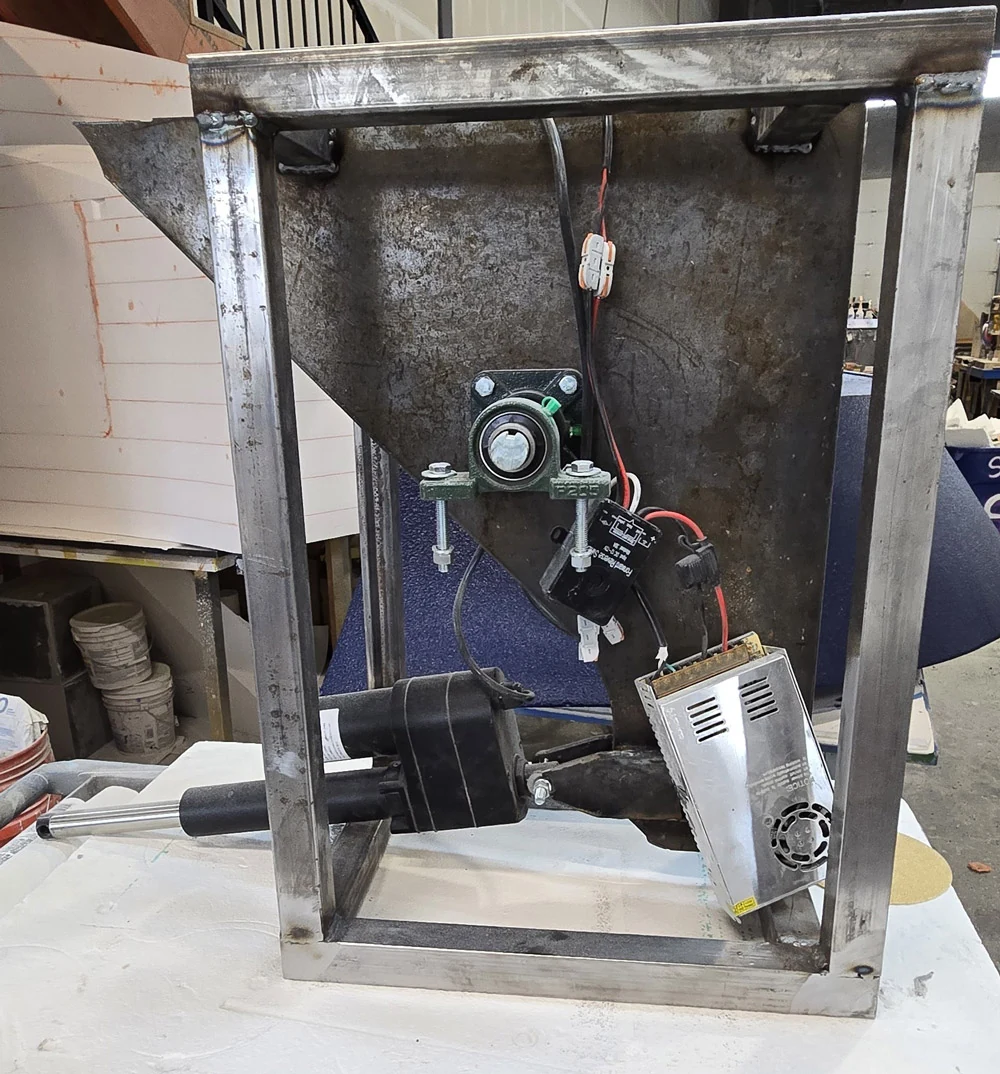
The jaw mechanism was integrated inside the head so the movement would not interrupt the finished character.
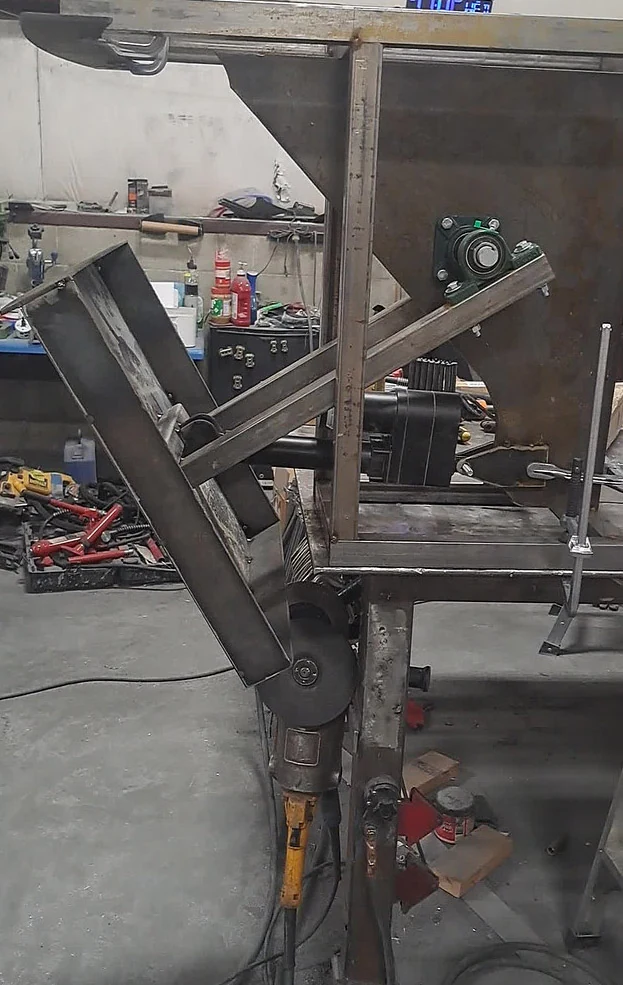
The jaw was tested as a working assembly before the completed head left WhiteClouds.
Shipping was not the final step. It shaped the fabrication plan.
The completed nutcracker traveled from Utah to Luverne in six staged shipments. By the time a component was ready to leave WhiteClouds, it had already been sculpted, coated and painted, and its shape had influenced its support cradle, protection, tie-down plan, truck selection and unloading needs.
Finished sculptural surfaces do not behave like ordinary rectangular freight. Straps and road movement can concentrate force on curved surfaces, projecting details and coated edges. Each load required protection suited to the particular pieces it carried.
Some assemblies that made sense in the digital model became too large for practical standard freight once full shipping dimensions were considered. Those sections were reconsidered before final assembly so the team could avoid unnecessarily complex oversized-load arrangements.
Staged delivery meant the lower sections reached Luverne while later assemblies were still moving through production. The landmark became visible at the site piece by piece rather than arriving for one final installation day.
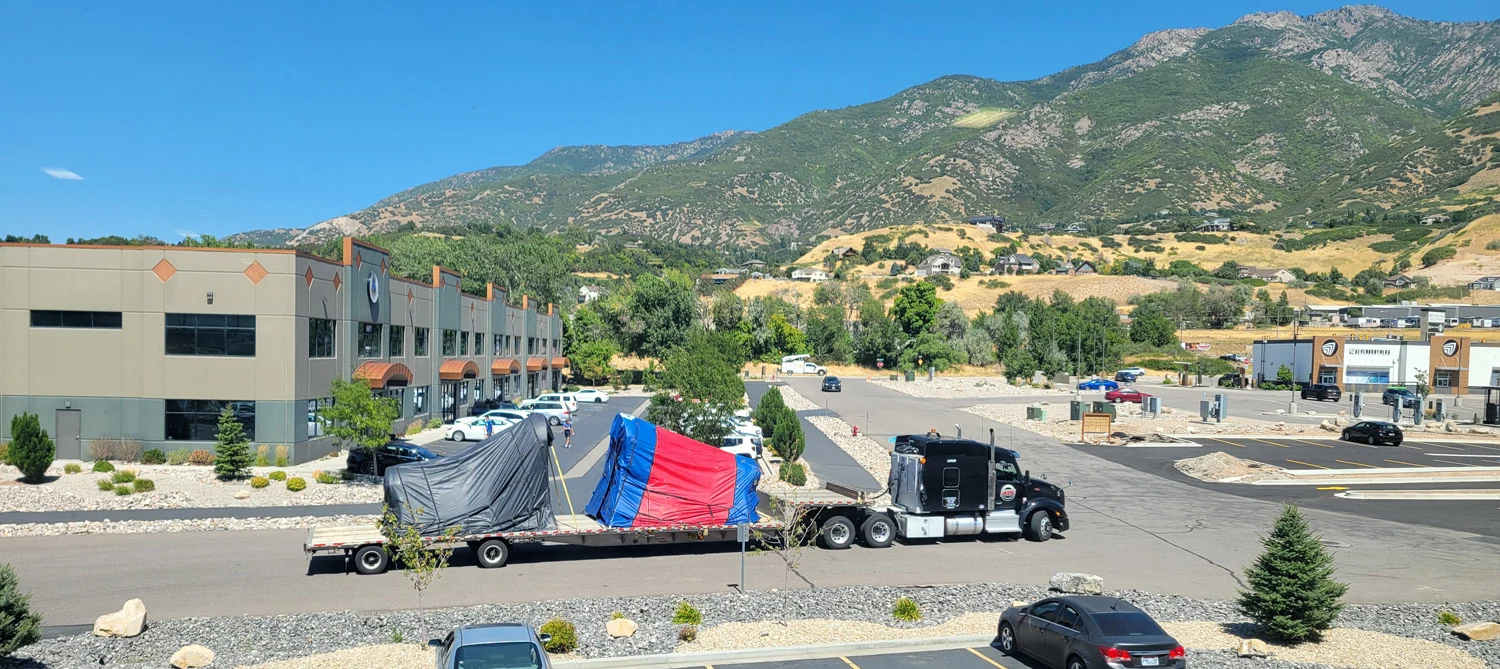
A completed section leaves WhiteClouds for one of six staged shipments to Luverne.
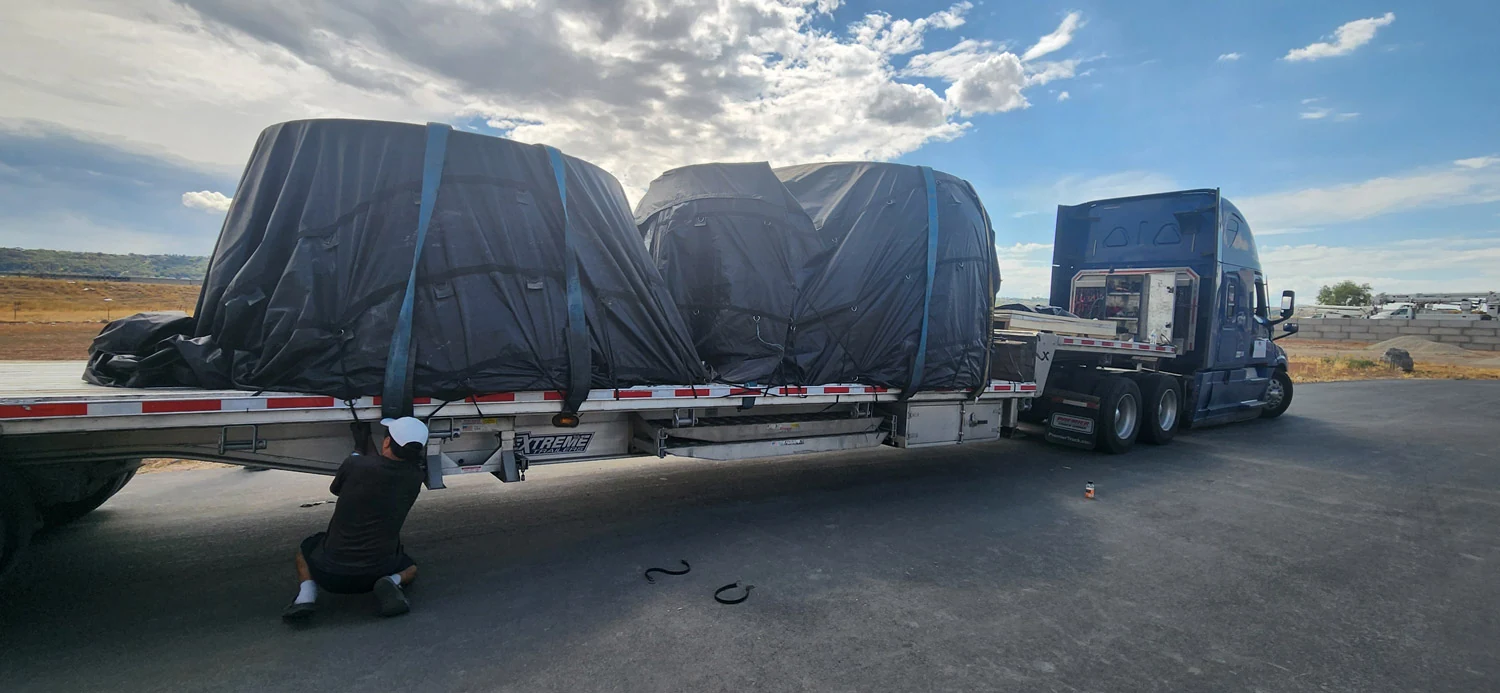
Finished sections were supported and protected according to their shape before the long trip to Minnesota.
The six shipments had to become one character again.
WhiteClouds completed the nutcracker in transportable sections and prepared animation-style references showing the intended order, alignment and connections. These visuals gave the customer's installation team a shared view of a build that did not resemble a standard construction detail.
WhiteClouds did not perform the physical installation. At the site, the installation crew used cranes to move the completed sections into position around the prepared central tower, align the exterior forms and tighten the hardware connections designed into the assemblies.
The lower body sections and internal platform levels were installed first, followed by the torso and upper assemblies. The head and striped hat required some of the final major lifts. Alignment had to preserve both the structural relationships inside the figure and the uninterrupted character lines on the exterior.
WhiteClouds' final sections were delivered in June 2026, and the on-site crew completed assembly later that month. Once the pieces were connected, the modular fabrication disappeared from normal viewing distance.
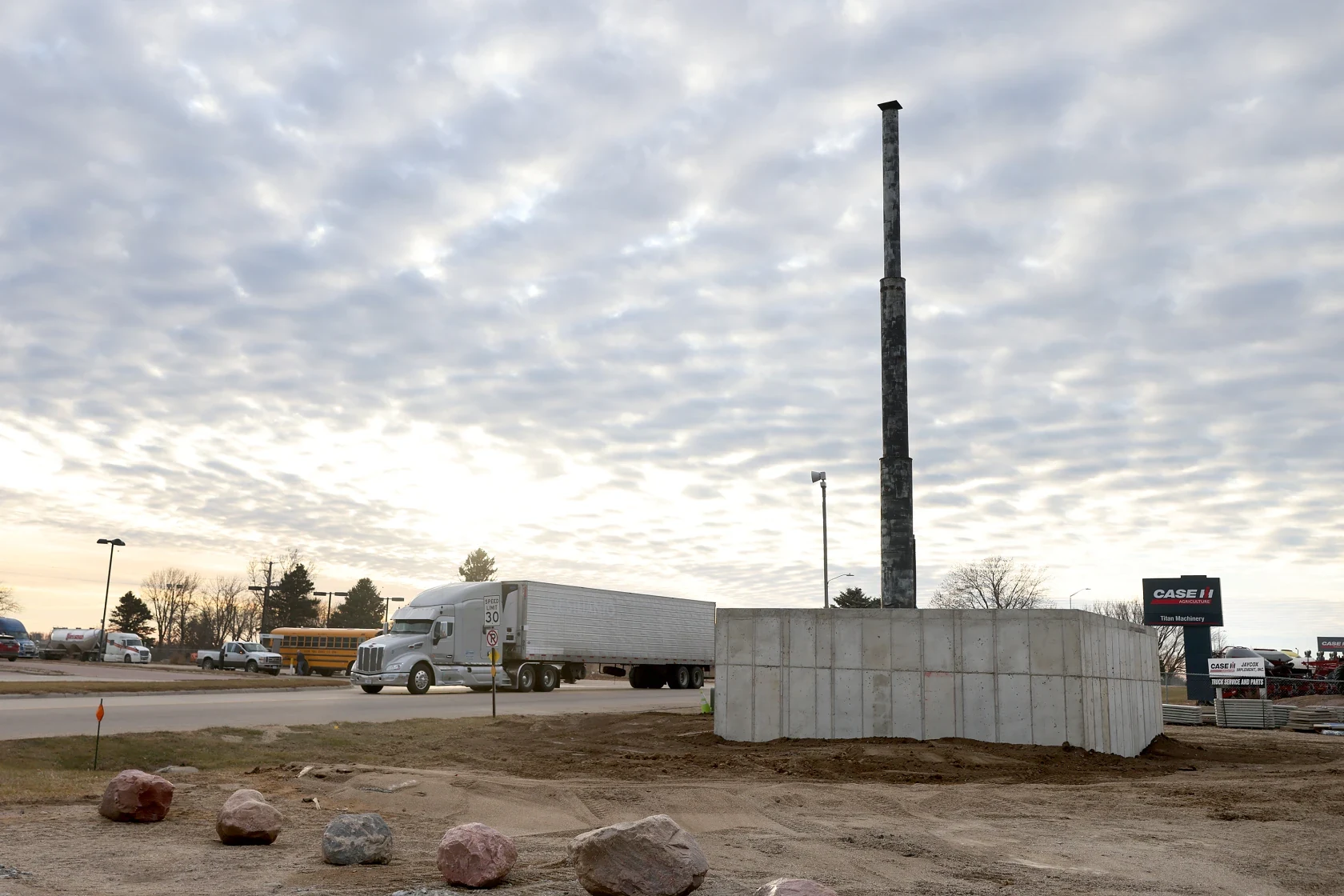
The site before the sculpted sections were installed around the prepared base and vertical support.
The on-site installation crew positioned WhiteClouds' completed lower sections around the prepared central support.
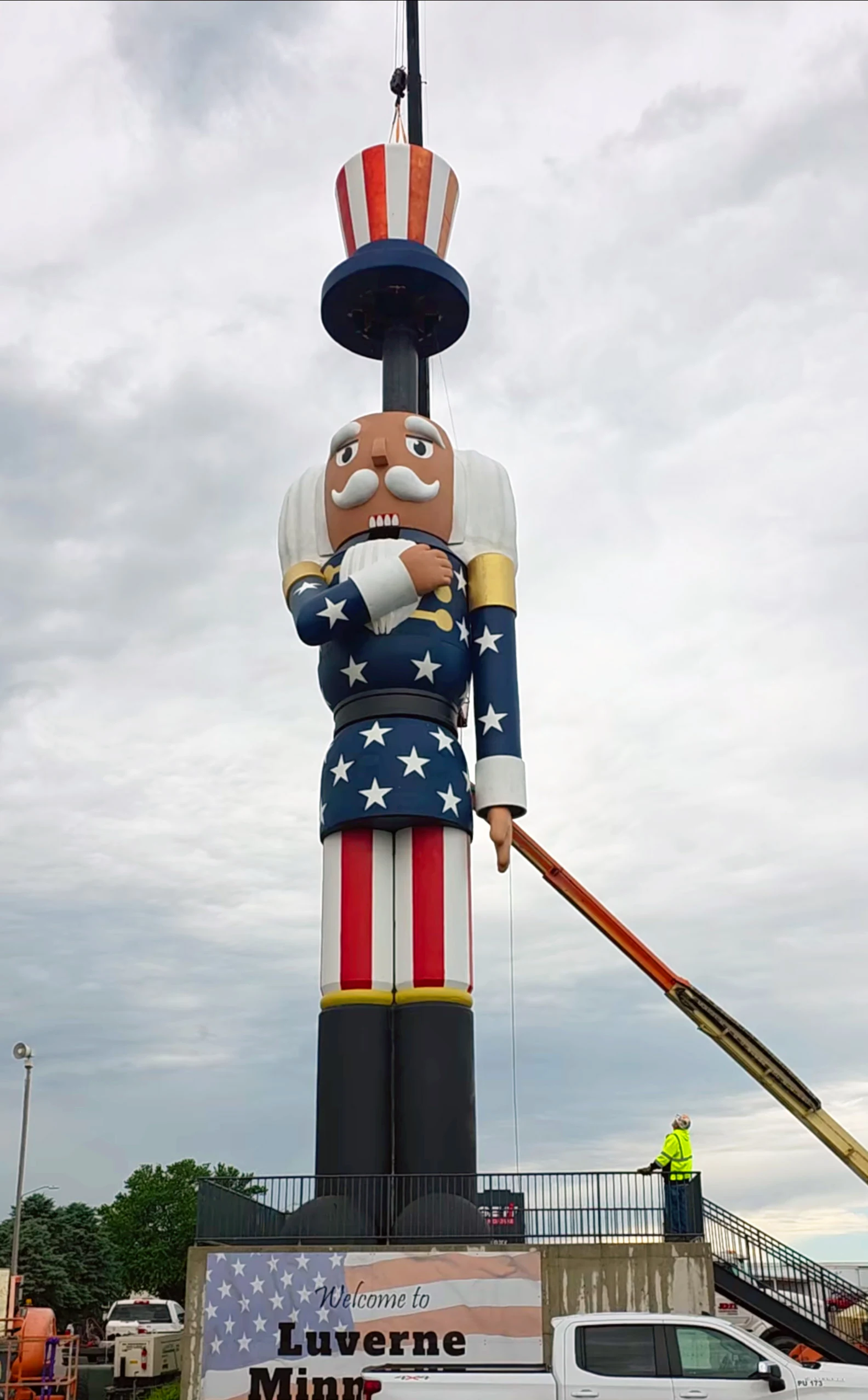
The on-site crew lifted the striped hat, one of WhiteClouds' completed final sections, into place.
A Utah-built sculpture became a Minnesota landmark.
WhiteClouds digitally designed, fabricated, sculpted, coated and painted the entire nutcracker in Utah. The WhiteClouds-built components weigh an estimated 9,053 pounds—just over 4½ tons—before accounting for the customer's foundation, base and central support tower.
With the on-site assembly completed in June 2026, Luverne held a community ribbon cutting in July and named the figure Verne the Patriot.
The completed landmark is widely reported as the world's largest nutcracker. It stands approximately 65 feet tall as a sculpted figure and about 73 feet from the ground when the concrete base is included.
The public sees a single patriotic character. Behind that appearance are years of digital development, internal framework design, approximately 5,000 pounds of sculpted foam, more than 3,000 pounds of WhiteClouds-fabricated metal, materials testing, scenic finishing and transportation planning.
That is the central lesson of the project: monumental fabrication is not simply a matter of enlarging a smaller object. The sculpture, internal structure, section boundaries, shipping and installation sequence must all be developed as one connected process.
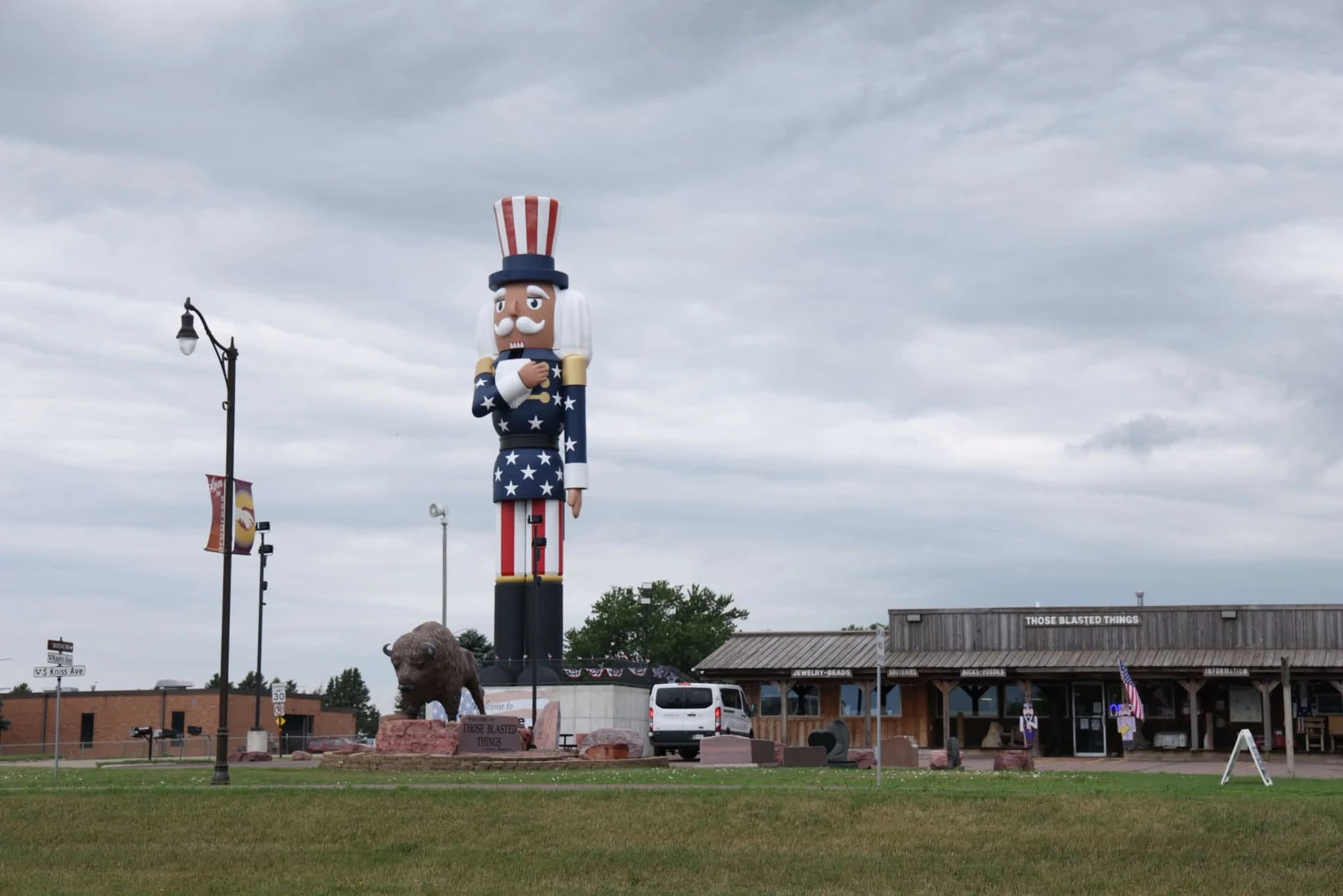
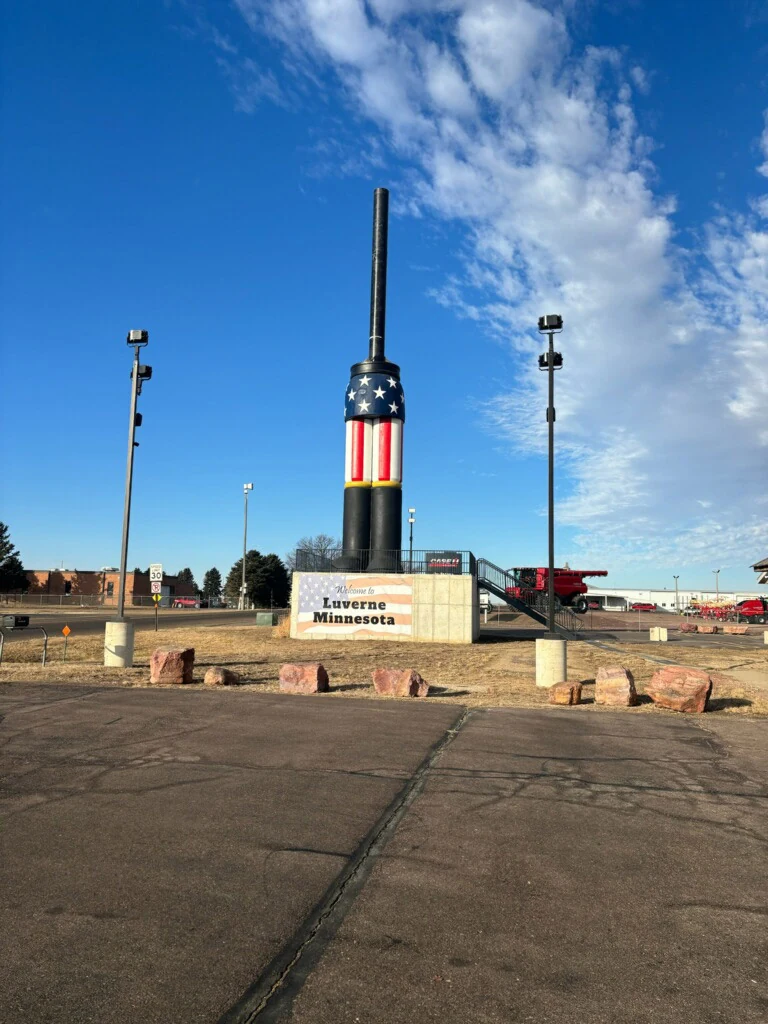
The completed landmark is visible across the surrounding Luverne streetscape.
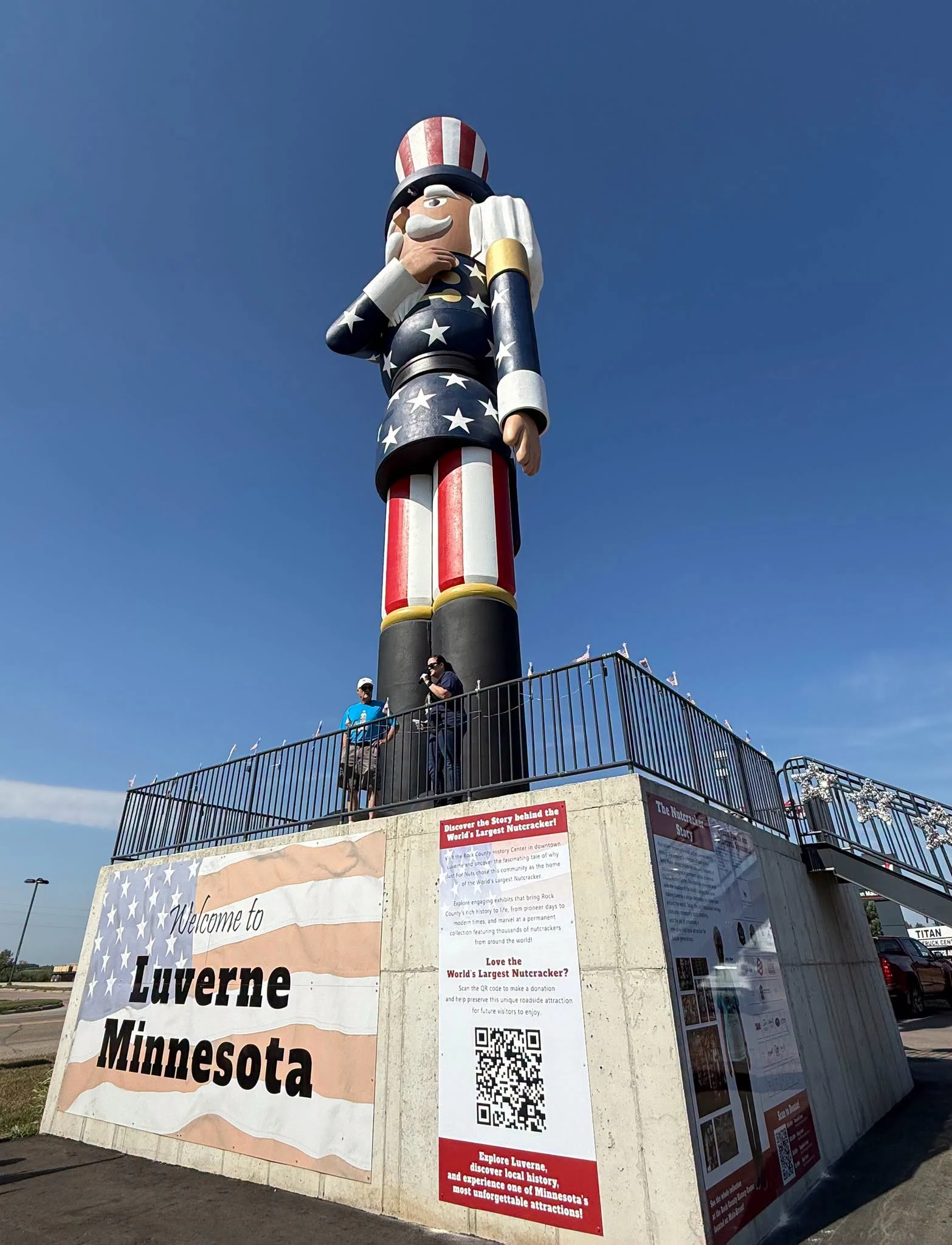
After the on-site crew completed the final lifts, WhiteClouds' separate fabricated sections read as one continuous 65-foot character.
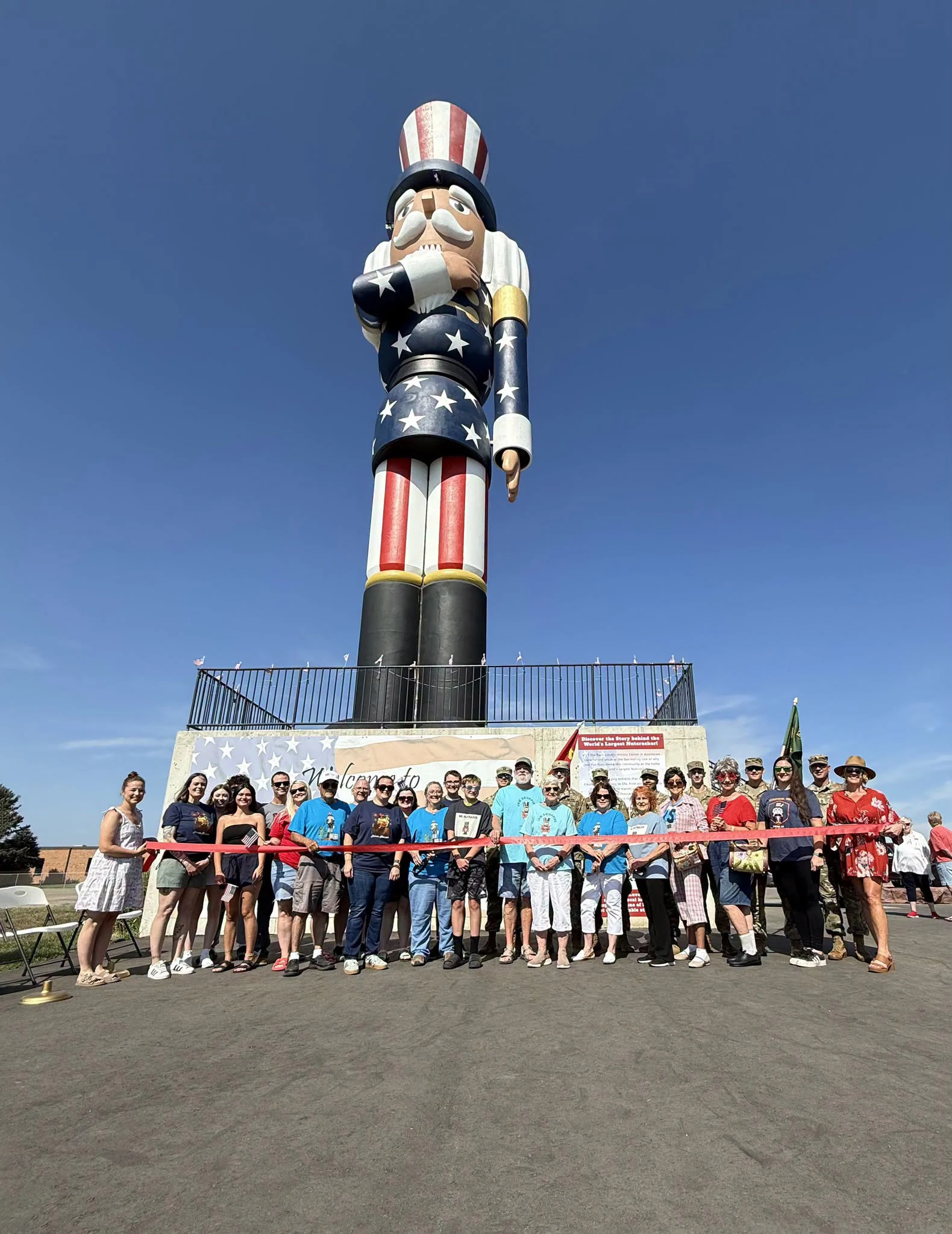
Luverne celebrated the completed landmark with a community ribbon cutting in July 2026.
Coverage of the completed landmark
National, regional and local reporting documented the final installation, community dedication, working jaw and the scale of the finished figure.
Tell us what you are trying to build.
For an oversized statue or permanent outdoor landmark, the best starting point is a clear description of the concept, approximate dimensions, intended environment, location and any interactive features.
- Artwork, sketches, photographs or existing 3D files
- Approximate dimensions and viewing distance
- Indoor, covered outdoor or fully exposed installation
- Permanent, temporary, portable or reusable display needs
- Lighting, motion, sound or public interaction
- Shipping destination, site access and installation expectations
A WhiteClouds project manager reviews the concept, identifies the main fabrication and logistics questions, and contacts you to discuss scope, budget and next steps.
Request project pricing
Share the basic project details below. A WhiteClouds project manager will review your request.