
Planning a Giant Skateboard Prop
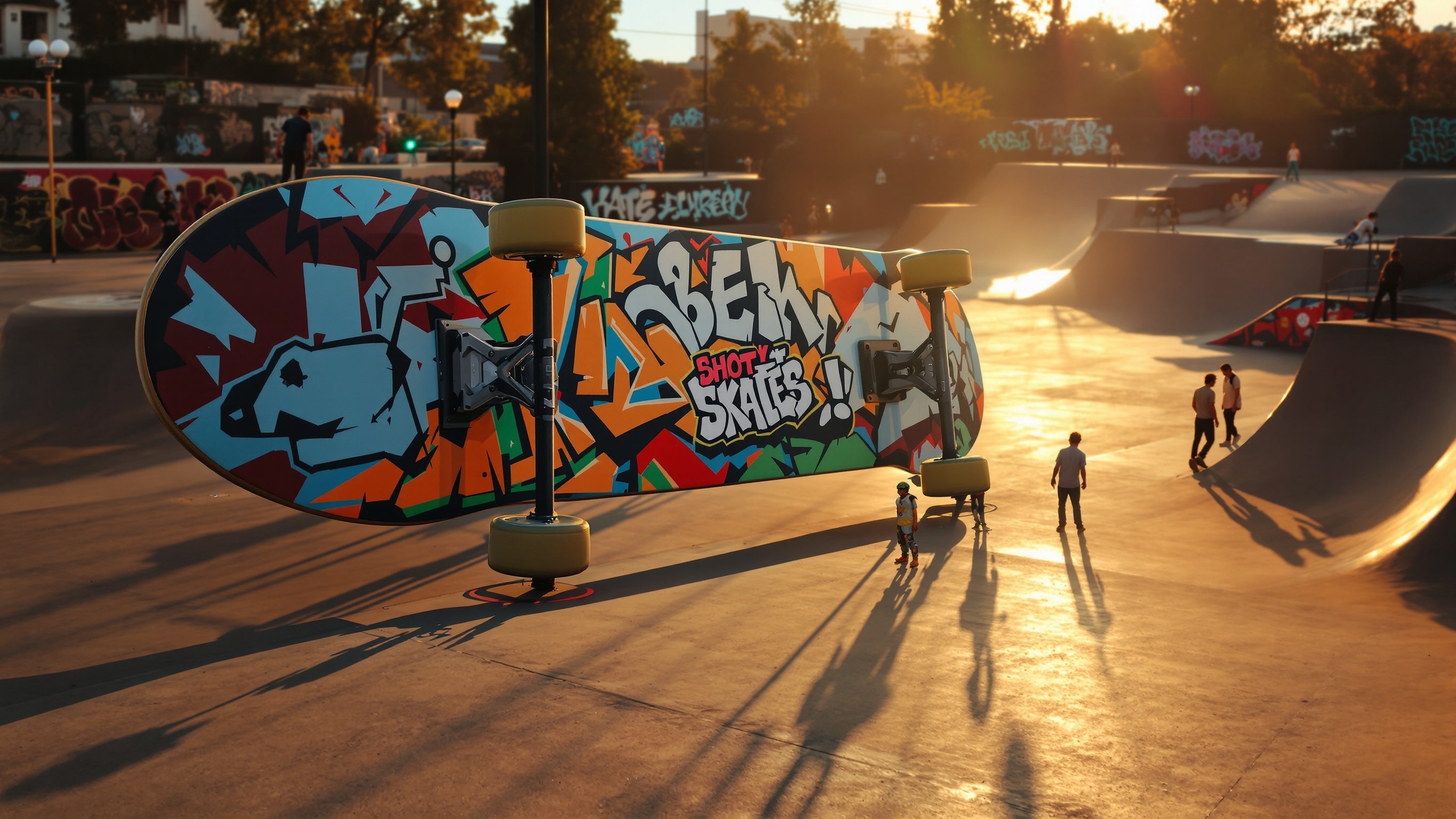
Giant Skateboard Prop: one oversized static skateboard prop with a supplied deck outline, raised ends, trucks, wheels, and underside graphics. Recognition depends on the long narrow deck, nose and tail rise, concave-looking profile, paired trucks, four wheels, axle relationship, and board graphics. The central scale question is that the thin deck and compact trucks must remain visible at scale without making the board look thick or structurally usable. The images are skateboard design concepts rather than photographs of completed WhiteClouds work.
Plan a Skateboard Display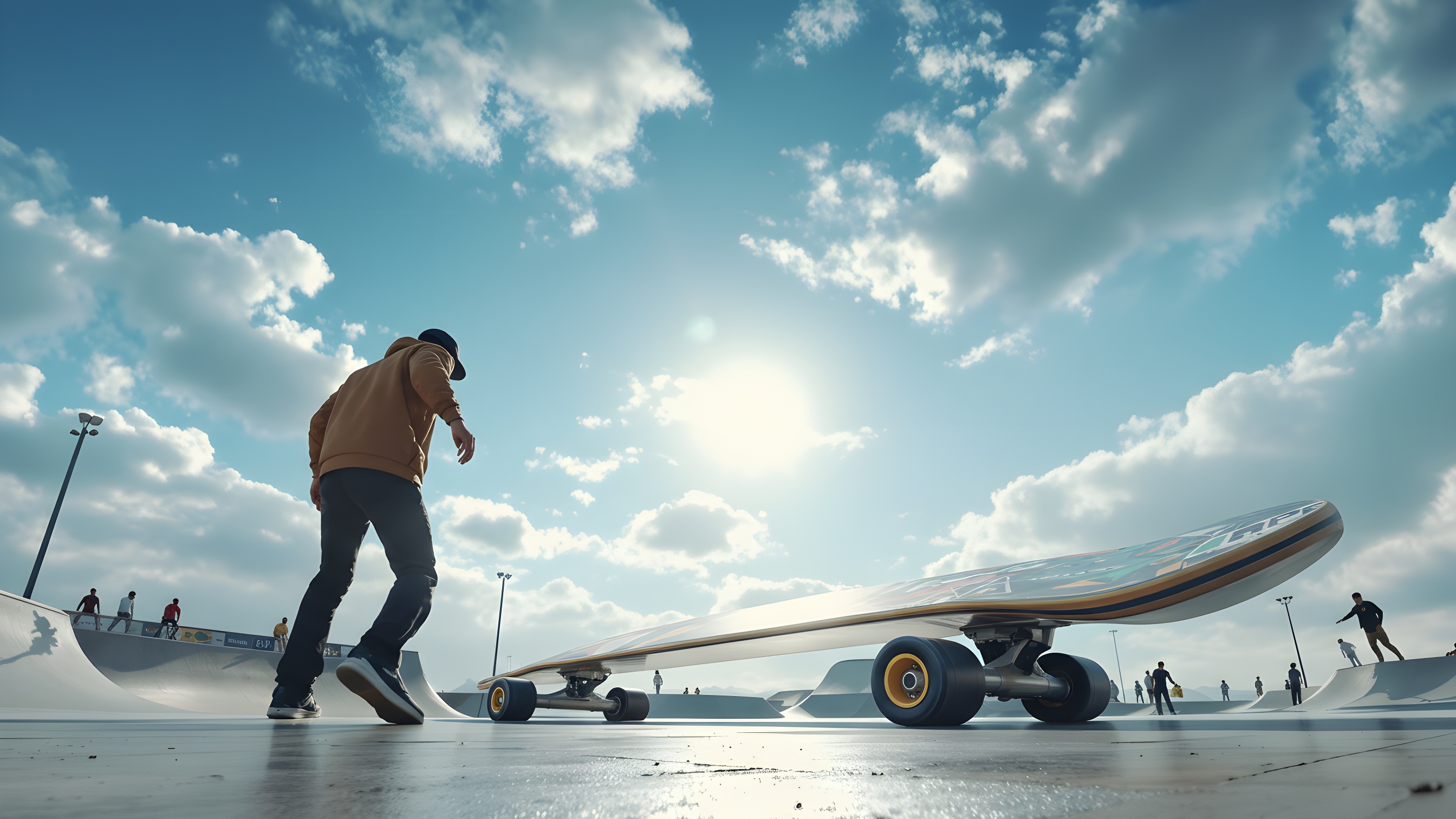
Define the Skateboard Form
Skateboard physical scope: one oversized static skateboard prop with a supplied deck outline, raised ends, trucks, wheels, and underside graphics. Its geometry includes overall length and width, deck thickness and curvature, nose and tail shape, truck spacing, wheel diameter, ground clearance, and support footprint. Its defining visual cues are the long narrow deck, nose and tail rise, concave-looking profile, paired trucks, four wheels, axle relationship, and board graphics.
Skateboard presentation: a nonrideable skateboard landmark staged flat, tilted, upright, or on a fixed support with deck and running gear readable. The visual treatment can use approved grip-like top treatment, underside artwork, edge color, and restrained metal-like and wheel-like visual cues. Keep the skateboard scope separate from rideability, rolling wheels, stunt use, load ratings, functional trucks, ordinary skate equipment, and unauthorized deck graphics.
Skateboard proportion is controlled by a thin deck over compact hardware. The brief should establish deck length, width, nose and tail rise, side concavity, wheel size, truck spacing, and the viewing face for artwork. A low horizontal pose shows the familiar ride orientation but can hide the trucks; an upright or tilted pose reveals more of the underside and creates a taller footprint. Grip-like texture, wheel color, and axle details are visual choices only. The enlarged object should never be presented as a platform for riding, standing, or moving under visitor weight.
Skateboard references should resolve the deck before the hardware. Mark overall length, widest deck point, nose and tail lengths, end rise, side concavity, edge thickness, truck-hole locations, and wheelbase. Then place the two truck assemblies, axles, hangers, bushings, and four wheels in relation to the underside. A side elevation shows kick and ground clearance; a top view controls deck graphics and grip-like fields; an underside view organizes the principal artwork and truck spacing. Longboard, street-deck, cruiser, and old-school pool shapes should not be combined unless the supplied design intentionally does so.
Pose determines which identifying parts remain visible. A flat deck reads immediately but conceals much of the underside. A nose-up tilt exposes trucks and artwork while increasing height. An upright board becomes a narrow sign-like object and needs the wheel profile preserved along an edge. Multiple boards, ramps, rails, shoes, or a complete skate scene are separate composition choices. The wheel and truck forms remain fixed scenery rather than operating running gear. Do not imply rolling, steering, grinding, jumping, standing, or rider capacity, and do not reproduce protected deck art without approved files and permission.
Control the Details That Identify the Skateboard
Skateboard planning variables include overall length and width, deck thickness and curvature, nose and tail shape, truck spacing, wheel diameter, ground clearance, and support footprint; the long narrow deck, nose and tail rise, concave-looking profile, paired trucks, four wheels, axle relationship, and board graphics; approved grip-like top treatment, underside artwork, edge color, and restrained metal-like and wheel-like visual cues; and a nonrideable skateboard landmark staged flat, tilted, upright, or on a fixed support with deck and running gear readable.
Skateboard form
For the skateboard, set overall length and width, deck thickness and curvature, nose and tail shape, truck spacing, wheel diameter, ground clearance, and support footprint. Show one oversized static skateboard prop with a supplied deck outline, raised ends, trucks, wheels, and underside graphics, and keep the complete outline readable from the primary approach.
Skateboard recognition
Preserve the long narrow deck, nose and tail rise, concave-looking profile, paired trucks, four wheels, axle relationship, and board graphics. Rank the skateboard cues for the expected viewing distance, and make every permitted simplification explicit.
Skateboard surface
Develop approved grip-like top treatment, underside artwork, edge color, and restrained metal-like and wheel-like visual cues. Place each requested skateboard graphic on the reference views with usable artwork, orientation, and scale.
Skateboard setting
Plan a nonrideable skateboard landmark staged flat, tilted, upright, or on a fixed support with deck and running gear readable. Record the footprint and visible sides for the skateboard, then add circulation around the skateboard, access limits, support preference, and fixed site constraints.
Plan Scale, Viewing, and Placement
Skateboard scale issue: the thin deck and compact trucks must remain visible at scale without making the board look thick or structurally usable. Resolve that relationship through overall length and width, deck thickness and curvature, nose and tail shape, truck spacing, wheel diameter, ground clearance, and support footprint, then test the skateboard against its principal view and available floor or site area.
Skateboard settings may include skate, youth, or apparel campaign; park, festival, or destination display; retail, exhibit, stage, or photo setting. Useful buyer inputs include skateboard reference and deck shape; overall dimensions; display pose; truck and wheel detail; approved deck artwork; site and date. State any requested skateboard contact, movement, lighting, or exterior exposure as a separate requirement.
Compare Skateboard Directions
Skateboard reference 1: Shows the complete deck-and-running-gear relationship. Skateboard reference 2: Provides a clear artwork plane and alternate display angle.
Compare the skateboard concepts as visual directions. They do not identify a prior skateboard customer or commission. Use the skateboard views to compare overall length and width, deck thickness and curvature, nose and tail shape, truck spacing, wheel diameter, ground clearance, and support footprint and approved grip-like top treatment, underside artwork, edge color, and restrained metal-like and wheel-like visual cues. The images do not establish final skateboard dimensions, construction, performance, transport, installation, or outcome.
Prepare the Skateboard Project Brief
Skateboard quote inputs should connect the defining skateboard cues with its intended dimensions and display setting. Include each applicable skateboard item below.
- skateboard reference and deck shape
- overall dimensions
- display pose
- truck and wheel detail
- approved deck artwork
- site and date
- Physical subject: one oversized static skateboard prop with a supplied deck outline, raised ends, trucks, wheels, and underside graphics
- Geometry: overall length and width, deck thickness and curvature, nose and tail shape, truck spacing, wheel diameter, ground clearance, and support footprint
- Recognition cues: the long narrow deck, nose and tail rise, concave-looking profile, paired trucks, four wheels, axle relationship, and board graphics
- Surface direction: approved grip-like top treatment, underside artwork, edge color, and restrained metal-like and wheel-like visual cues
- Display direction: a nonrideable skateboard landmark staged flat, tilted, upright, or on a fixed support with deck and running gear readable
- Scale issue: the thin deck and compact trucks must remain visible at scale without making the board look thick or structurally usable
- Skateboard setting: skate, youth, or apparel campaign
- Skateboard setting: park, festival, or destination display
- Skateboard setting: retail, exhibit, stage, or photo setting
- Excluded scope: rideability, rolling wheels, stunt use, load ratings, functional trucks, ordinary skate equipment, and unauthorized deck graphics
- Requested skateboard contact, movement, lighting, or exterior exposure
Request a Custom Quote
Send the skateboard reference, skateboard reference and deck shape, overall dimensions, display pose, truck and wheel detail, approved deck artwork, site and date, destination, and required date. Also describe a nonrideable skateboard landmark staged flat, tilted, upright, or on a fixed support with deck and running gear readable. WhiteClouds can review the defined scope and prepare a custom quote. The concept images support visual planning and do not depict a completed WhiteClouds project.