
Planning a Giant Rolling Luggage Prop
Giant Rolling Luggage Prop: one oversized rolling-luggage prop defined by a structured case, telescoping handle, wheel set, side or top handles, and supplied closure lines. Recognition depends on the upright case body, retractable-handle rails and grip, bottom wheels, corner treatment, zipper or shell seam, and selected case hardware. The central scale question is that the narrow handle rails and small wheels must enlarge enough to read while the case remains recognizably portable in form but nonfunctional. The images are rolling luggage design concepts rather than photographs of completed WhiteClouds work.
Plan a Rolling Luggage Display
Define the Rolling Luggage Form
Rolling Luggage physical scope: one oversized rolling-luggage prop defined by a structured case, telescoping handle, wheel set, side or top handles, and supplied closure lines. Its geometry includes overall height, width and depth, body radius or ribs, handle extension and rail spacing, wheel diameter and inset, side-handle projection, and support footprint. Its defining visual cues are the upright case body, retractable-handle rails and grip, bottom wheels, corner treatment, zipper or shell seam, and selected case hardware.
Rolling Luggage presentation: a static wheeled-case replica shown upright or at a defined travel pose with the extended handle and wheel relationship visible. The visual treatment can use approved hard-shell-like ribs or soft-case panel cues, authorized travel graphics, edge treatment, and restrained hardware-like accents. Keep the rolling luggage scope separate from backpack straps and pockets as the primary form, working wheels or handles, usable storage, travel certification, load capacity, lock performance, and invented brands.
Rolling-luggage planning starts with the case shell and handle system. Define whether the body is rigid, softly paneled, ribbed, split-shell, or front-opening; then place the seam or zipper path, corner guards, side handle, top handle, feet, wheel housings, and telescoping rails. An extended handle creates the full height, while a retracted view emphasizes the case itself. A front elevation controls graphics and rib spacing; a side view establishes depth and wheel inset. The display stays fixed and does not promise rolling, telescoping, locking, packing, or transport use.
Wheel configuration is part of the case identity. State two-wheel or four-spinner form, wheel diameter, wheel inset, corner housing, and whether all wheels remain visible in the chosen pose. The telescoping handle needs rail spacing, extension height, grip width, and a fixed raised or lowered position. Shell ribs, panel seams, zipper-like paths, corner guards, feet, and side handles should follow the supplied case rather than a generic travel image. Tags, stickers, destination graphics, and brand marks require approved files. A grouped luggage scene, baggage cart, airport counter, or travel character would be separate scope from this one rolling case.
Case architecture should be resolved before graphic styling. A clamshell case needs a perimeter split and two coordinated halves; a front-opening case needs a distinct lid panel; an aluminum-like trunk direction may use corner blocks and framed edges; a molded-shell direction can use a repeated rib field. Mark the stationary bottom edge, wheel centers, feet, carry handles, telescoping-handle recess, and lock-like details from the selected reference. The rectangular travel case should remain the dominant volume at every angle. Shoulder harnesses, loose daypack pockets, soft drawcord tops, and wearable bag cues belong to the separate backpack task and should not enter this article.
Control the Details That Identify the Rolling Luggage
Rolling Luggage planning variables include overall height, width and depth, body radius or ribs, handle extension and rail spacing, wheel diameter and inset, side-handle projection, and support footprint; the upright case body, retractable-handle rails and grip, bottom wheels, corner treatment, zipper or shell seam, and selected case hardware; approved hard-shell-like ribs or soft-case panel cues, authorized travel graphics, edge treatment, and restrained hardware-like accents; and a static wheeled-case replica shown upright or at a defined travel pose with the extended handle and wheel relationship visible.
Rolling Luggage form
For the rolling luggage, set overall height, width and depth, body radius or ribs, handle extension and rail spacing, wheel diameter and inset, side-handle projection, and support footprint. Show one oversized rolling-luggage prop defined by a structured case, telescoping handle, wheel set, side or top handles, and supplied closure lines, and keep the complete outline readable from the primary approach.
Rolling Luggage recognition
Preserve the upright case body, retractable-handle rails and grip, bottom wheels, corner treatment, zipper or shell seam, and selected case hardware. Rank the rolling luggage cues for the expected viewing distance, and make every permitted simplification explicit.
Rolling Luggage surface
Develop approved hard-shell-like ribs or soft-case panel cues, authorized travel graphics, edge treatment, and restrained hardware-like accents. Place each requested rolling luggage graphic on the reference views with usable artwork, orientation, and scale.
Rolling Luggage setting
Plan a static wheeled-case replica shown upright or at a defined travel pose with the extended handle and wheel relationship visible. Record the footprint and visible sides for the rolling luggage, then add circulation around the rolling luggage, access limits, support preference, and fixed site constraints.
Plan Scale, Viewing, and Placement
Rolling Luggage scale issue: the narrow handle rails and small wheels must enlarge enough to read while the case remains recognizably portable in form but nonfunctional. Resolve that relationship through overall height, width and depth, body radius or ribs, handle extension and rail spacing, wheel diameter and inset, side-handle projection, and support footprint, then test the rolling luggage against its principal view and available floor or site area.
Rolling Luggage settings may include travel or hospitality campaign; airport, destination, or tourism display; retail, trade-show, event, or photo setting. Useful buyer inputs include specific luggage reference; case and extended-handle dimensions; wheel and closure layout; viewing side and pose; approved colors and graphics; site and date. State any requested rolling luggage contact, movement, lighting, or exterior exposure as a separate requirement.
Compare Rolling Luggage Directions
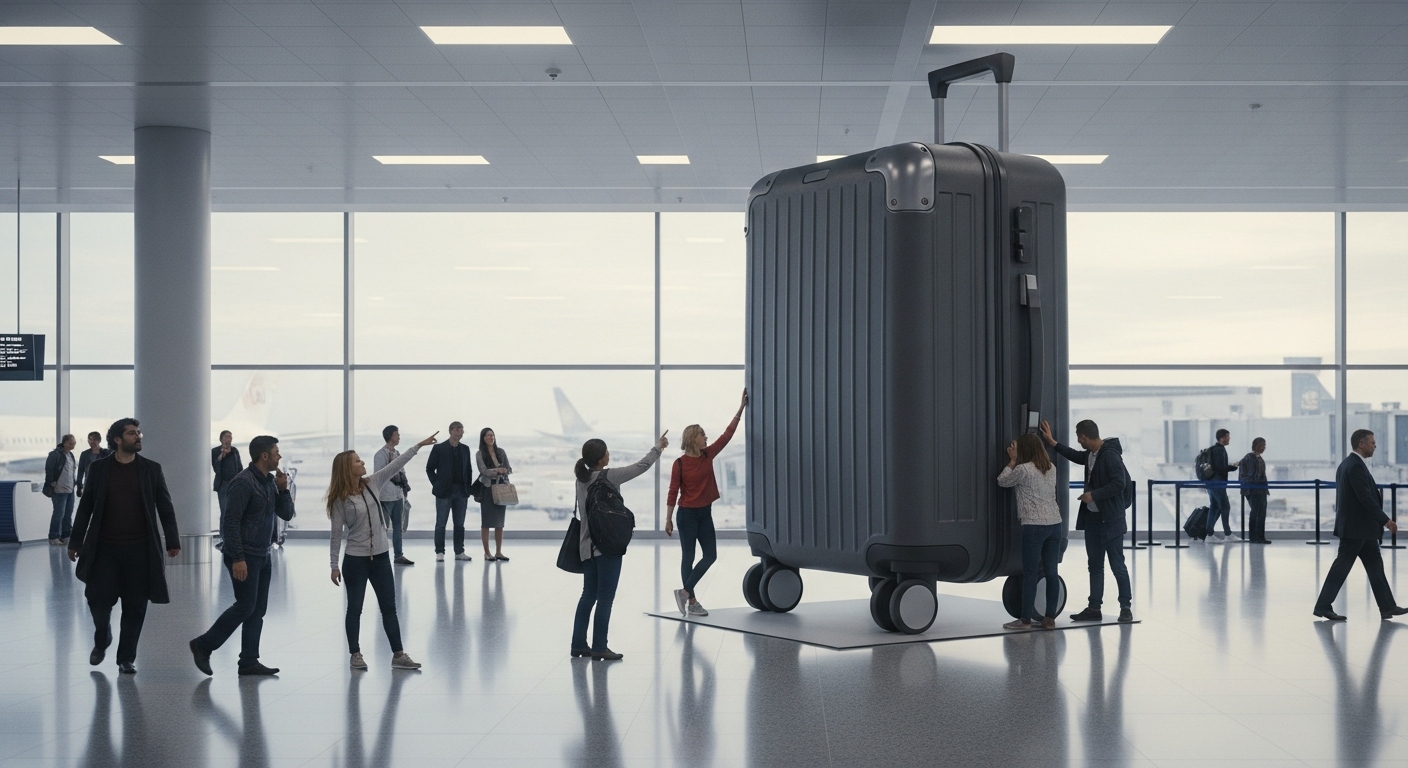
Rolling Luggage reference 1: Shows the case body, luggage identity, and visitor scale. Rolling Luggage reference 2: Provides the clearest handle-and-wheel silhouette for the planning page.
Compare the rolling luggage concepts as visual directions. They do not identify a prior rolling luggage customer or commission. Use the rolling luggage views to compare overall height, width and depth, body radius or ribs, handle extension and rail spacing, wheel diameter and inset, side-handle projection, and support footprint and approved hard-shell-like ribs or soft-case panel cues, authorized travel graphics, edge treatment, and restrained hardware-like accents. The images do not establish final rolling luggage dimensions, construction, performance, transport, installation, or outcome.
Prepare the Rolling Luggage Project Brief
Rolling Luggage quote inputs should connect the defining rolling luggage cues with its intended dimensions and display setting. Include each applicable rolling luggage item below.
- specific luggage reference
- case and extended-handle dimensions
- wheel and closure layout
- viewing side and pose
- approved colors and graphics
- site and date
- Physical subject: one oversized rolling-luggage prop defined by a structured case, telescoping handle, wheel set, side or top handles, and supplied closure lines
- Geometry: overall height, width and depth, body radius or ribs, handle extension and rail spacing, wheel diameter and inset, side-handle projection, and support footprint
- Recognition cues: the upright case body, retractable-handle rails and grip, bottom wheels, corner treatment, zipper or shell seam, and selected case hardware
- Surface direction: approved hard-shell-like ribs or soft-case panel cues, authorized travel graphics, edge treatment, and restrained hardware-like accents
- Display direction: a static wheeled-case replica shown upright or at a defined travel pose with the extended handle and wheel relationship visible
- Scale issue: the narrow handle rails and small wheels must enlarge enough to read while the case remains recognizably portable in form but nonfunctional
- Rolling Luggage setting: travel or hospitality campaign
- Rolling Luggage setting: airport, destination, or tourism display
- Rolling Luggage setting: retail, trade-show, event, or photo setting
- Excluded scope: backpack straps and pockets as the primary form, working wheels or handles, usable storage, travel certification, load capacity, lock performance, and invented brands
- Requested rolling luggage contact, movement, lighting, or exterior exposure
Request a Custom Quote
Send the rolling luggage reference, specific luggage reference, case and extended-handle dimensions, wheel and closure layout, viewing side and pose, approved colors and graphics, site and date, destination, and required date. Also describe a static wheeled-case replica shown upright or at a defined travel pose with the extended handle and wheel relationship visible. WhiteClouds can review the defined scope and prepare a custom quote. The concept images support visual planning and do not depict a completed WhiteClouds project.