
Planning a Giant Rocking Chair
Giant Rocking Chair: one oversized rocking-chair display defined by curved rocker rails, chair legs, seat, arms, and a tall back. Recognition depends on two long curved rockers, elevated seat, vertical back elements, arm profile, and an unmistakable side silhouette. Scale question: long rockers expand the footprint far beyond the seat and must remain visible from the primary approach. The images are rocking chair concepts, not completed-project records.
Plan a Rocking Chair Display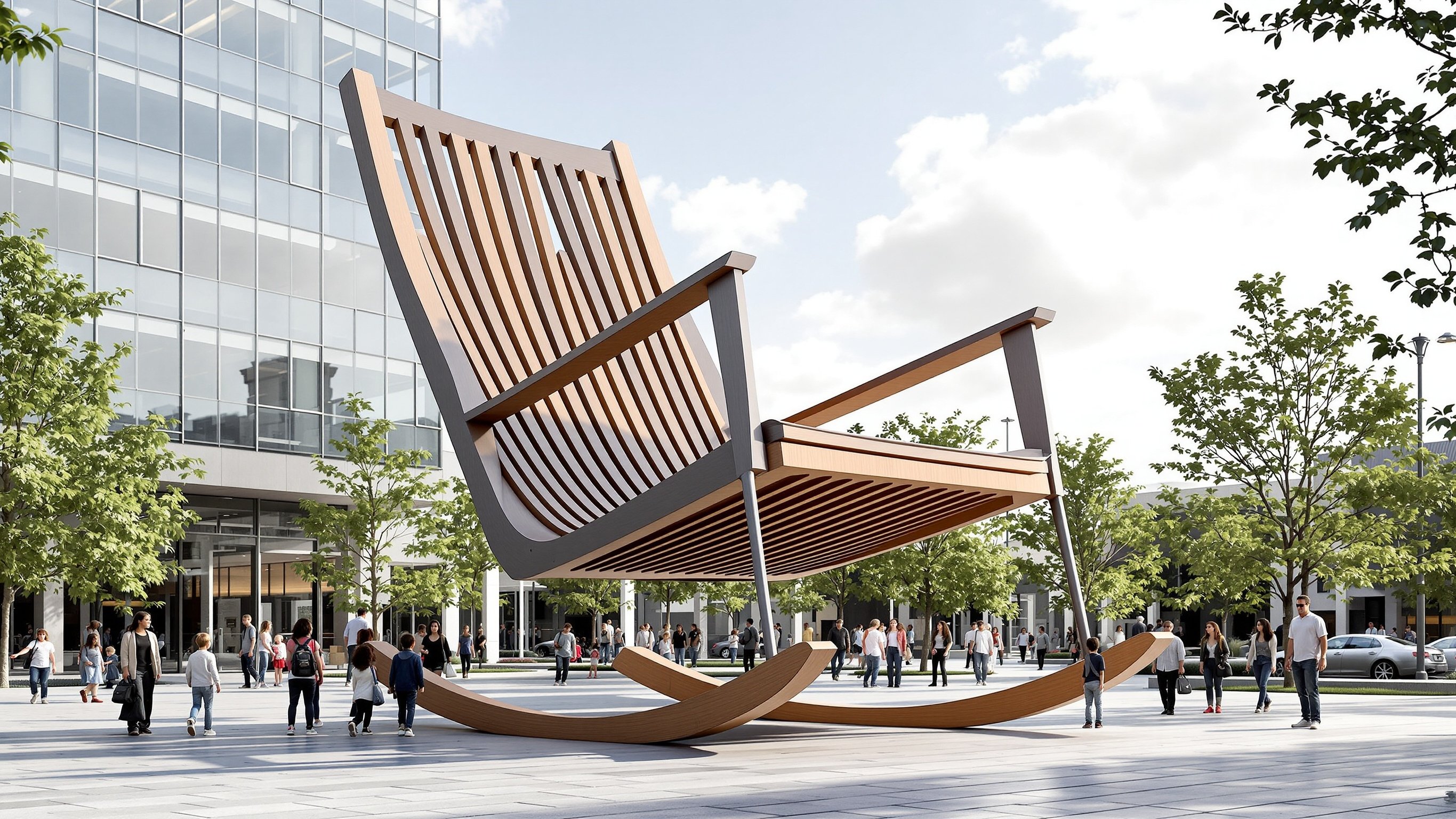
Define the Rocking Chair Form
Rocking Chair physical scope: one oversized rocking-chair display defined by curved rocker rails, chair legs, seat, arms, and a tall back. Rocking Chair geometry: overall height, rocker length and curvature, seat width, back angle, leg positions, and occupied footprint. Rocking Chair identity: two long curved rockers, elevated seat, vertical back elements, arm profile, and an unmistakable side silhouette.
Rocking Chair presentation: a roadside, campus, civic, retail, or scenic landmark with movement and visitor contact treated as separate requirements. Rocking Chair visual treatment: wood-like, painted, branded, or supplied visual treatment with controlled slat and joint details. Exclude from this rocking chair request: Adirondack-chair geometry, unsupported rocking operation, certified seating claims, and fictional public projects.
Rocking-chair identity depends on two long curved rails connecting the chair legs below the seat. Set the rocker arc, front rise, rear extension, leg attachment, seat level, arm sweep, and tall back profile as one side-view system. Slats, spindles, broad panels, woven-looking inserts, or an original graphic treatment can create different heritage or contemporary directions. The rail tips expand the footprint beyond the visible seat and require open circulation at both ends. A porch, civic square, highway stop, campus, or attraction can establish scale. State whether the display is static and view-only. Exclude Adirondack geometry, guaranteed rocking action, ordinary furniture sales, occupancy ratings, and undocumented landmark history.
Control the Details That Identify the Rocking Chair
Rocking Chair planning variables: overall height, rocker length and curvature, seat width, back angle, leg positions, and occupied footprint; two long curved rockers, elevated seat, vertical back elements, arm profile, and an unmistakable side silhouette; wood-like, painted, branded, or supplied visual treatment with controlled slat and joint details; and a roadside, campus, civic, retail, or scenic landmark with movement and visitor contact treated as separate requirements.
Rocking Chair form
Plan overall height, rocker length and curvature, seat width, back angle, leg positions, and occupied footprint. Show one oversized rocking-chair display defined by curved rocker rails, chair legs, seat, arms, and a tall back. Keep the rocking chair outline readable from the primary view.
Rocking Chair recognition
Preserve two long curved rockers, elevated seat, vertical back elements, arm profile, and an unmistakable side silhouette. Rank the rocking chair details for the expected viewing distance. Mark any permitted simplification.
Rocking Chair surface
Use wood-like, painted, branded, or supplied visual treatment with controlled slat and joint details. Supply authorized rocking chair artwork and mark each graphic location on the reference views.
Rocking Chair setting
Plan a roadside, campus, civic, retail, or scenic landmark with movement and visitor contact treated as separate requirements. Include the rocking chair footprint, approach, circulation, support preference, and fixed site limits.
Plan Scale, Viewing, and Placement
Rocking Chair scale issue: long rockers expand the footprint far beyond the seat and must remain visible from the primary approach. Resolve it through overall height, rocker length and curvature, seat width, back angle, leg positions, and occupied footprint. Relate those measurements to a roadside, campus, civic, retail, or scenic landmark with movement and visitor contact treated as separate requirements.
Rocking Chair settings: roadside attraction or destination; campus or community photo landmark; heritage, retail, or scenic promotion. Rocking Chair buyer inputs: rocking-chair reference; overall height and rocker length; seat and back proportions; visual finish; static or movement expectation; site and access plan. State requested rocking chair movement, lighting, contact, or exterior exposure separately.
Compare Two Rocking Chair Directions
Rocking Chair concept one: Shows the rocker footprint, side silhouette, back height, and public circulation. Rocking Chair concept two: Compares a different back pattern, setting, and principal viewing angle.
Compare overall height, rocker length and curvature, seat width, back angle, leg positions, and occupied footprint. Compare wood-like, painted, branded, or supplied visual treatment with controlled slat and joint details. These rocking chair concepts support visual selection only. No rocking chair customer or commission is documented. Final rocking chair dimensions, construction, performance, transport, installation, and outcome remain unconfirmed.

Prepare the Rocking Chair Project Brief
Rocking Chair quote inputs should connect two long curved rockers, elevated seat, vertical back elements, arm profile, and an unmistakable side silhouette with overall height, rocker length and curvature, seat width, back angle, leg positions, and occupied footprint. Include each applicable item below.
- rocking-chair reference
- overall height and rocker length
- seat and back proportions
- visual finish
- static or movement expectation
- site and access plan
- Physical subject: one oversized rocking-chair display defined by curved rocker rails, chair legs, seat, arms, and a tall back
- Geometry: overall height, rocker length and curvature, seat width, back angle, leg positions, and occupied footprint
- Recognition cues: two long curved rockers, elevated seat, vertical back elements, arm profile, and an unmistakable side silhouette
- Surface direction: wood-like, painted, branded, or supplied visual treatment with controlled slat and joint details
- Display direction: a roadside, campus, civic, retail, or scenic landmark with movement and visitor contact treated as separate requirements
- Scale issue: long rockers expand the footprint far beyond the seat and must remain visible from the primary approach
- Rocking Chair setting: roadside attraction or destination
- Rocking Chair setting: campus or community photo landmark
- Rocking Chair setting: heritage, retail, or scenic promotion
- Excluded scope: Adirondack-chair geometry, unsupported rocking operation, certified seating claims, and fictional public projects
- Requested contact, movement, lighting, or exterior exposure for the rocking chair
Request a Custom Quote
Send the rocking chair reference, rocking-chair reference, overall height and rocker length, seat and back proportions, visual finish, static or movement expectation, site and access plan, destination, and required date. Also identify a roadside, campus, civic, retail, or scenic landmark with movement and visitor contact treated as separate requirements. WhiteClouds can review that defined rocking chair scope and prepare a custom quote. The concept images support visual planning only and are not evidence of a prior customer project.