
Planning a Giant Paperclip Prop
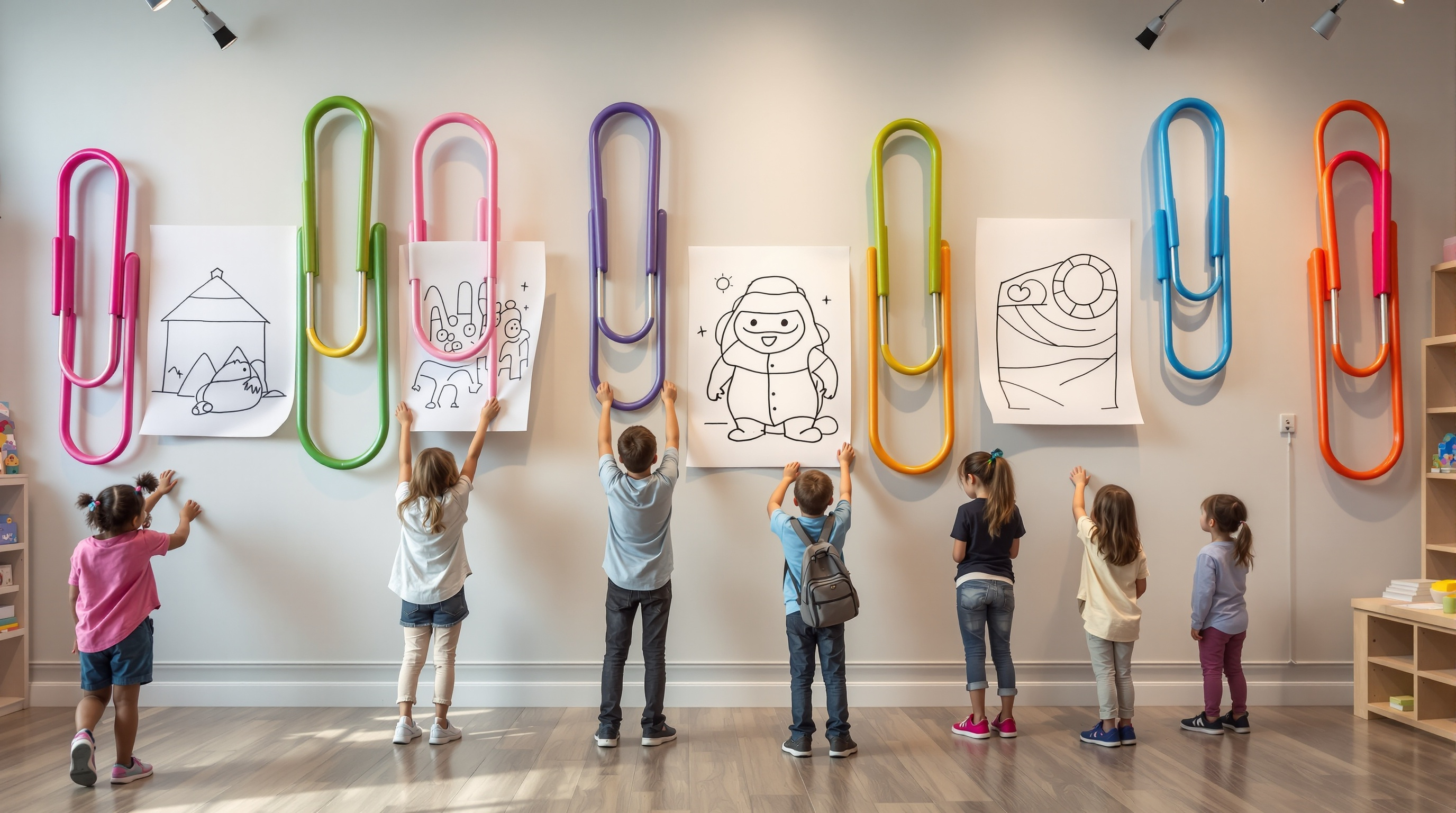
Giant Paperclip Prop: one oversized paperclip prop formed by a continuous doubled loop with a supplied wire profile and freestanding orientation. Recognition depends on the long outer loop, nested inner return, parallel side runs, rounded ends, open gap, consistent wire thickness, and selected standing angle. The central scale question is that the narrow repeated loop must retain even spacing and clear negative space while standing securely at monumental scale. The images are paperclip design concepts rather than photographs of completed WhiteClouds work.
Plan a Paperclip Display
Define the Paperclip Form
Paperclip physical scope: one oversized paperclip prop formed by a continuous doubled loop with a supplied wire profile and freestanding orientation. Its geometry includes overall height and width, wire diameter, inner-loop offset, end radii, gap size, depth, base contact, and tilt. Its defining visual cues are the long outer loop, nested inner return, parallel side runs, rounded ends, open gap, consistent wire thickness, and selected standing angle.
Paperclip presentation: a static office-object landmark planned as one clearly readable clip rather than a chain, sculpture set, or functional fastener. The visual treatment can use approved metal-like, painted, patterned, or branded treatment without implying bendable wire. Keep the paperclip scope separate from a working spring clip, flexible wire, load-bearing fastening, chains of clips, binder mechanisms, generic abstract sculpture, and invented customers.
A paperclip is recognized by negative space as much as by its outer outline. The inner return should track the outer loop with consistent separation, and both rounded ends need radii that remain related to the enlarged wire diameter. Decide whether the clip stands perfectly vertical, leans, or lies at a low angle because that choice changes the base and sightline. A front view should preserve the full doubled path; an oblique view can reveal depth without merging the parallel runs. Surface color and graphics come after the continuous-loop geometry is resolved.
A classic paperclip uses one continuous path that doubles back on itself. Trace that path from the outside rounded end through the long parallel run, inner return, shorter inner loop, and open termination. The separation between adjacent runs should remain even enough that the negative spaces do not close when viewed from the front. Wire diameter, outer height, outer width, inner-loop offset, end radii, and the two termination points are the essential dimensions. A Gem-style oval, triangular clip, rounded rectangle, or supplied novelty profile should be named rather than blended into one generic outline.
Orientation changes how the simple loop is perceived. An upright clip creates a tall narrow landmark; a slight lean introduces depth; a low horizontal pose spreads across the floor; a wall-like arrangement prioritizes front graphics. If several clips are requested, define count, overlap, order, color, and whether each remains a separate fixed object. The quote should not assume that the enlarged loop bends, clamps paper, springs closed, hangs weight, or functions as wire. Branding can follow the broad front-facing runs, but dense artwork near the inner turns may become difficult to read and should be mapped at the intended camera distance.
Control the Details That Identify the Paperclip
Paperclip planning variables include overall height and width, wire diameter, inner-loop offset, end radii, gap size, depth, base contact, and tilt; the long outer loop, nested inner return, parallel side runs, rounded ends, open gap, consistent wire thickness, and selected standing angle; approved metal-like, painted, patterned, or branded treatment without implying bendable wire; and a static office-object landmark planned as one clearly readable clip rather than a chain, sculpture set, or functional fastener.
Paperclip form
For the paperclip, set overall height and width, wire diameter, inner-loop offset, end radii, gap size, depth, base contact, and tilt. Show one oversized paperclip prop formed by a continuous doubled loop with a supplied wire profile and freestanding orientation, and keep the complete outline readable from the primary approach.
Paperclip recognition
Preserve the long outer loop, nested inner return, parallel side runs, rounded ends, open gap, consistent wire thickness, and selected standing angle. Rank the paperclip cues for the expected viewing distance, and make every permitted simplification explicit.
Paperclip surface
Develop approved metal-like, painted, patterned, or branded treatment without implying bendable wire. Place each requested paperclip graphic on the reference views with usable artwork, orientation, and scale.
Paperclip setting
Plan a static office-object landmark planned as one clearly readable clip rather than a chain, sculpture set, or functional fastener. Record the footprint and visible sides for the paperclip, then add circulation around the paperclip, access limits, support preference, and fixed site constraints.
Plan Scale, Viewing, and Placement
Paperclip scale issue: the narrow repeated loop must retain even spacing and clear negative space while standing securely at monumental scale. Resolve that relationship through overall height and width, wire diameter, inner-loop offset, end radii, gap size, depth, base contact, and tilt, then test the paperclip against its principal view and available floor or site area.
Paperclip settings may include office or stationery campaign; education, library, or creativity exhibit; trade-show, retail, or photo display. Useful buyer inputs include paperclip profile; overall dimensions and wire diameter; upright or angled pose; base and visible sides; approved color or graphics; venue and date. State any requested paperclip contact, movement, lighting, or exterior exposure as a separate requirement.
Compare Paperclip Directions
Paperclip reference 1: The clearest single-object view for the hero. Paperclip reference 2: Supports visual comparison while the page remains focused on one clip per custom brief.
Compare the paperclip concepts as visual directions. They do not identify a prior paperclip customer or commission. Use the paperclip views to compare overall height and width, wire diameter, inner-loop offset, end radii, gap size, depth, base contact, and tilt and approved metal-like, painted, patterned, or branded treatment without implying bendable wire. The images do not establish final paperclip dimensions, construction, performance, transport, installation, or outcome.
Prepare the Paperclip Project Brief
Paperclip quote inputs should connect the defining paperclip cues with its intended dimensions and display setting. Include each applicable paperclip item below.
- paperclip profile
- overall dimensions and wire diameter
- upright or angled pose
- base and visible sides
- approved color or graphics
- venue and date
- Physical subject: one oversized paperclip prop formed by a continuous doubled loop with a supplied wire profile and freestanding orientation
- Geometry: overall height and width, wire diameter, inner-loop offset, end radii, gap size, depth, base contact, and tilt
- Recognition cues: the long outer loop, nested inner return, parallel side runs, rounded ends, open gap, consistent wire thickness, and selected standing angle
- Surface direction: approved metal-like, painted, patterned, or branded treatment without implying bendable wire
- Display direction: a static office-object landmark planned as one clearly readable clip rather than a chain, sculpture set, or functional fastener
- Scale issue: the narrow repeated loop must retain even spacing and clear negative space while standing securely at monumental scale
- Paperclip setting: office or stationery campaign
- Paperclip setting: education, library, or creativity exhibit
- Paperclip setting: trade-show, retail, or photo display
- Excluded scope: a working spring clip, flexible wire, load-bearing fastening, chains of clips, binder mechanisms, generic abstract sculpture, and invented customers
- Requested paperclip contact, movement, lighting, or exterior exposure
Request a Custom Quote
Send the paperclip reference, paperclip profile, overall dimensions and wire diameter, upright or angled pose, base and visible sides, approved color or graphics, venue and date, destination, and required date. Also describe a static office-object landmark planned as one clearly readable clip rather than a chain, sculpture set, or functional fastener. WhiteClouds can review the defined scope and prepare a custom quote. The concept images support visual planning and do not depict a completed WhiteClouds project.