
Planning a Giant Full Moon Prop
A giant Moon prop begins with a basic physical choice: should the audience see a shallow round face, a deep disc, or a complete sphere? That decision controls the visible edge, the number of finished sides, the placement of scenic crater texture, and the space the Moon occupies in the room.
Plan a Giant Moon Prop
Choose a disc or sphere before adding surface detail
A front-facing Moon can be a shallow round panel, a thick disc with a visible edge, or a complete sphere. Mark the primary audience or camera view on the site plan, then show whether people will also see the side, back, or underside.
The choice changes more than depth. A shallow face can integrate with a wall or set, while a sphere needs a full circular envelope and a deliberate relationship to its base or surrounding scenery. Define that relationship before refining the craters.
Set the physical Moon around its public views
The useful format follows the actual sightlines rather than an astronomy diagram.
Shallow round face
Use a limited depth when the Moon is read primarily from the front and its edge can disappear into a wall or scenic layer.
Deep scenic disc
A substantial edge gives the object more presence from angled views without requiring a complete finished sphere.
Complete sphere
A freestanding round object suits multiple viewing sides, but its diameter, base relationship, and rear treatment all remain visible decisions.
Set intersection
A cloud, platform, wall, horizon, or other supplied scenic element can conceal part of the support while leaving the approved circular outline intact.
Use crater texture as scenery rather than mapped terrain
Choose a realistic-looking, softly stylized, graphic, or original surface direction. Large tonal regions and a few readable crater cues usually matter more from a distance than dense small detail. Provide a reference for the visible face and identify any artwork that must remain in a particular orientation.
This page does not reproduce lunar elevation data or teach Moon geography. When accurate terrain, a named region, measurable relief, or data fidelity is the goal, the Moon Topographies page and Topographical Models service address that different physical task.
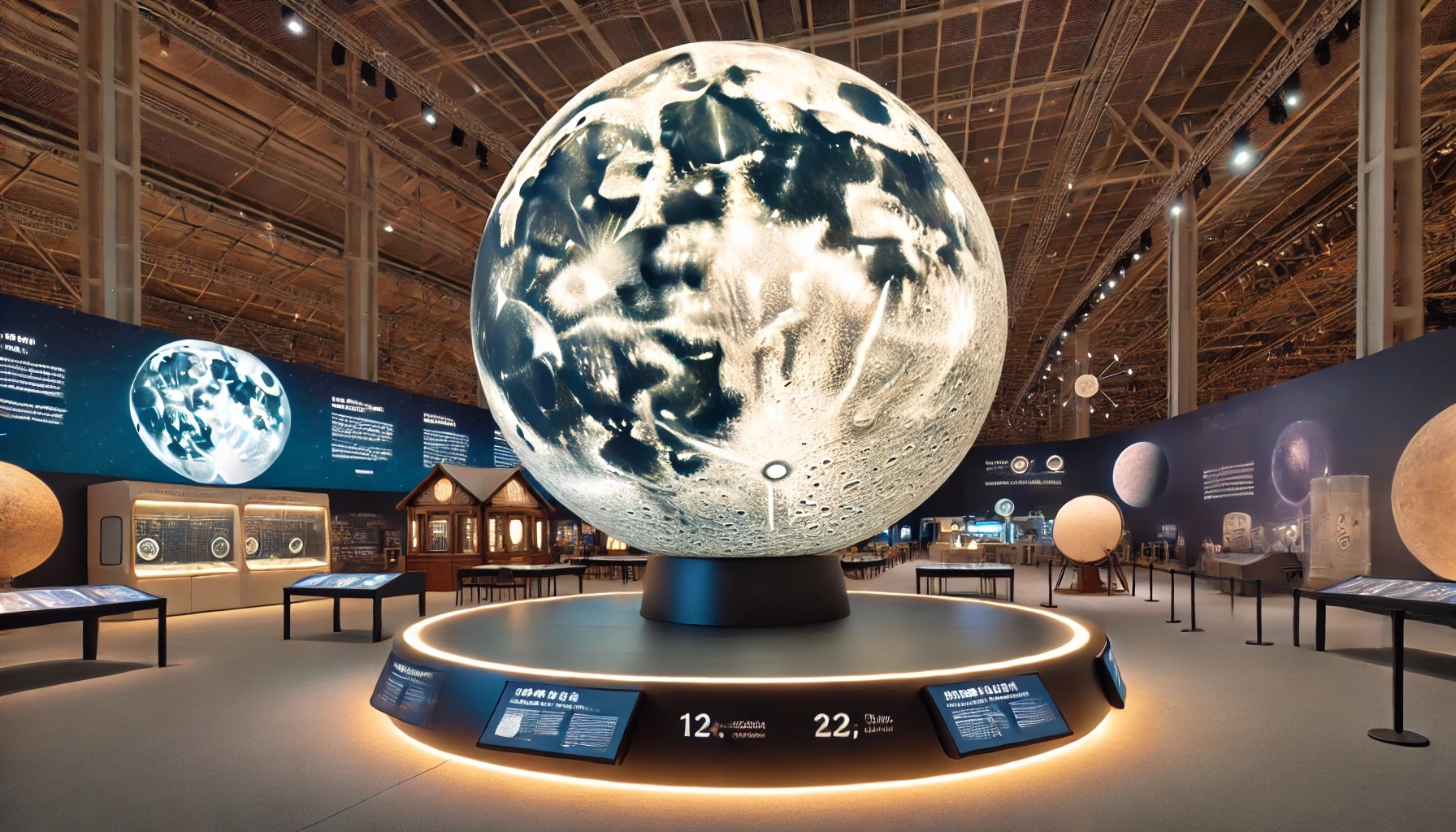
Compare an open-room sphere with a presentation display
One concept treats the Moon as a large sphere in an open exhibit setting. The other places a dimensional full Moon on a defined display base, making the front, edge, and overall presentation part of one composition.
Both images are conceptual directions only. Neither represents a completed WhiteClouds commission, and neither should be used to infer a material, internal structure, lighting system, or final size.
Define the round form and its setting
A useful request makes the scenic Moon physically specific without turning it into a lunar science model.
- Shallow face, deep disc, near-full form, or complete sphere
- Overall diameter and maximum depth
- Primary view plus every visible side, edge, and rear area
- Realistic, stylized, graphic, or original scenic surface reference
- Required artwork orientation and principal crater cues
- Floor, platform, wall, set, or other approved placement
- Interior, sheltered, or weather-exposed placement
- Delivery path, destination, installation window, and required completion date
Request pricing for a giant scenic Moon prop
Send the approved Moon reference, disc-or-sphere format, dimensions, visible sides, surface direction, placement plan, display conditions, access information, destination, and schedule.