
Planning a Giant Measuring Tape Prop
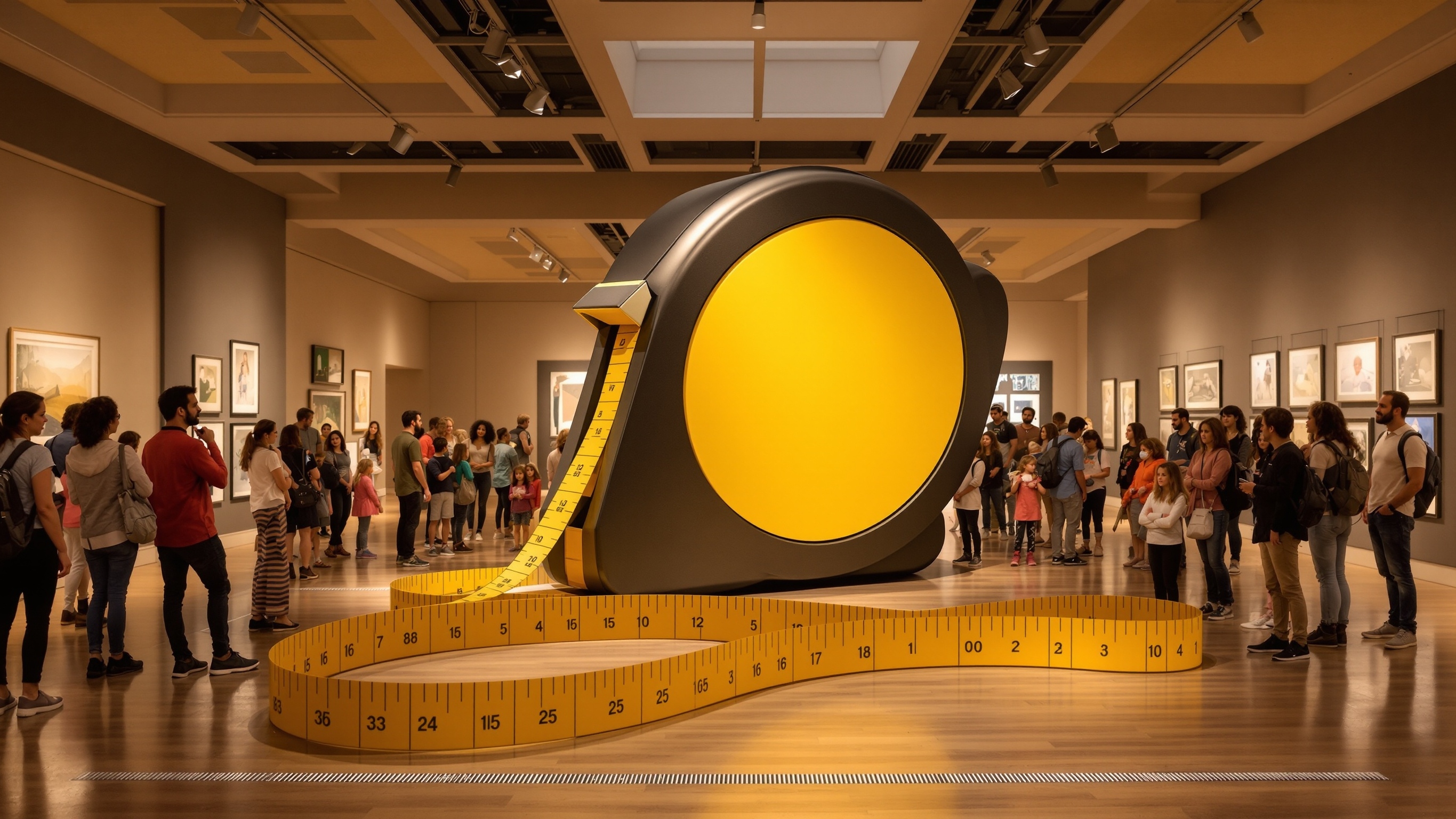
Giant Measuring Tape Prop: one oversized retractable measuring-tape prop with a shaped case and a fixed length of graduated tape extending from it. Recognition depends on the rounded or angular case, tape exit, broad ribbon, repeated measurement marks, end hook, lock area, and belt-clip or grip cues. The central scale question is that the long thin tape must remain readable and supported while the case stays visually dominant enough to identify the object. The images are measuring tape design concepts rather than photographs of completed WhiteClouds work.
Plan a Measuring Tape Display
Define the Measuring Tape Form
Measuring Tape physical scope: one oversized retractable measuring-tape prop with a shaped case and a fixed length of graduated tape extending from it. Its geometry includes case height, width and depth, tape width and extension, mark spacing, hook size, case opening, display angle, and base contact. Its defining visual cues are the rounded or angular case, tape exit, broad ribbon, repeated measurement marks, end hook, lock area, and belt-clip or grip cues.
Measuring Tape presentation: a static measurement-tool composition planned around the relationship between the case and one intentionally posed tape extension. The visual treatment can use approved case colors, restrained metal-like tape treatment, accurate supplied markings, and authorized graphics. Keep the measuring tape scope separate from working retraction, certified measurement accuracy, load-bearing tape, ordinary rulers or yardsticks, sharp hooks, and invented brands.
The case and exposed tape need to be planned together. Case proportion establishes the recognizable handheld-tool body, while tape width, extension length, curve, and end hook determine the overall footprint. Measurement marks should come from approved artwork with a declared unit system and sequence; they should not be improvised as decorative numbers. A short upright extension emphasizes the case, while a long floor-level sweep creates a wider installation and more support points. The object remains a fixed display, so retraction, calibrated accuracy, and a working lock are not implied by the visible details.
Treat the case and ribbon as two connected geometries. The case reference should establish its rounded or angular perimeter, front recess, grip contour, lock-button location, tape mouth, belt-clip cue, fasteners, and edge depth. The exposed ribbon then needs a fixed width, extension length, path, curvature, mark interval, numeral orientation, and end-hook shape. If the tape arcs upward or sweeps across the floor, diagram its high and low points so the support path and camera view are understood. A short straight extension keeps the case dominant; a long curve turns the ribbon into most of the installation footprint.
Measurement artwork should be provided deliberately. State inches, feet, centimeters, another unit system, or a purely graphic scale, then supply the exact sequence that should be visible. Enlarged tick hierarchy, fraction marks, numeral spacing, and reading direction can be tested on a flat proof before the ribbon is posed. The end hook is a recognition cue and should remain fixed and visually blunt. It is not represented as grabbing, retracting, measuring accurately, or carrying load. Rulers, yardsticks, survey equipment, and architectural scales use different object forms and do not belong in this retractable-tape planning page.
Control the Details That Identify the Measuring Tape
Measuring Tape planning variables include case height, width and depth, tape width and extension, mark spacing, hook size, case opening, display angle, and base contact; the rounded or angular case, tape exit, broad ribbon, repeated measurement marks, end hook, lock area, and belt-clip or grip cues; approved case colors, restrained metal-like tape treatment, accurate supplied markings, and authorized graphics; and a static measurement-tool composition planned around the relationship between the case and one intentionally posed tape extension.
Measuring Tape form
For the measuring tape, set case height, width and depth, tape width and extension, mark spacing, hook size, case opening, display angle, and base contact. Show one oversized retractable measuring-tape prop with a shaped case and a fixed length of graduated tape extending from it, and keep the complete outline readable from the primary approach.
Measuring Tape recognition
Preserve the rounded or angular case, tape exit, broad ribbon, repeated measurement marks, end hook, lock area, and belt-clip or grip cues. Rank the measuring tape cues for the expected viewing distance, and make every permitted simplification explicit.
Measuring Tape surface
Develop approved case colors, restrained metal-like tape treatment, accurate supplied markings, and authorized graphics. Place each requested measuring tape graphic on the reference views with usable artwork, orientation, and scale.
Measuring Tape setting
Plan a static measurement-tool composition planned around the relationship between the case and one intentionally posed tape extension. Record the footprint and visible sides for the measuring tape, then add circulation around the measuring tape, access limits, support preference, and fixed site constraints.
Plan Scale, Viewing, and Placement
Measuring Tape scale issue: the long thin tape must remain readable and supported while the case stays visually dominant enough to identify the object. Resolve that relationship through case height, width and depth, tape width and extension, mark spacing, hook size, case opening, display angle, and base contact, then test the measuring tape against its principal view and available floor or site area.
Measuring Tape settings may include construction or home-improvement campaign; education or measurement exhibit; retail, trade-show, or photo display. Useful buyer inputs include measuring-tape reference; case and tape dimensions; extension length and curve; marking system and units; approved colors and graphics; site and deadline. State any requested measuring tape contact, movement, lighting, or exterior exposure as a separate requirement.
Compare Measuring Tape Directions
Measuring Tape reference 1: Shows the familiar case-and-tape composition in a retail setting. Measuring Tape reference 2: Clarifies the wide footprint created by an extended tape.
Compare the measuring tape concepts as visual directions. They do not identify a prior measuring tape customer or commission. Use the measuring tape views to compare case height, width and depth, tape width and extension, mark spacing, hook size, case opening, display angle, and base contact and approved case colors, restrained metal-like tape treatment, accurate supplied markings, and authorized graphics. The images do not establish final measuring tape dimensions, construction, performance, transport, installation, or outcome.
Prepare the Measuring Tape Project Brief
Measuring Tape quote inputs should connect the defining measuring tape cues with its intended dimensions and display setting. Include each applicable measuring tape item below.
- measuring-tape reference
- case and tape dimensions
- extension length and curve
- marking system and units
- approved colors and graphics
- site and deadline
- Physical subject: one oversized retractable measuring-tape prop with a shaped case and a fixed length of graduated tape extending from it
- Geometry: case height, width and depth, tape width and extension, mark spacing, hook size, case opening, display angle, and base contact
- Recognition cues: the rounded or angular case, tape exit, broad ribbon, repeated measurement marks, end hook, lock area, and belt-clip or grip cues
- Surface direction: approved case colors, restrained metal-like tape treatment, accurate supplied markings, and authorized graphics
- Display direction: a static measurement-tool composition planned around the relationship between the case and one intentionally posed tape extension
- Scale issue: the long thin tape must remain readable and supported while the case stays visually dominant enough to identify the object
- Measuring Tape setting: construction or home-improvement campaign
- Measuring Tape setting: education or measurement exhibit
- Measuring Tape setting: retail, trade-show, or photo display
- Excluded scope: working retraction, certified measurement accuracy, load-bearing tape, ordinary rulers or yardsticks, sharp hooks, and invented brands
- Requested measuring tape contact, movement, lighting, or exterior exposure
Request a Custom Quote
Send the measuring tape reference, measuring-tape reference, case and tape dimensions, extension length and curve, marking system and units, approved colors and graphics, site and deadline, destination, and required date. Also describe a static measurement-tool composition planned around the relationship between the case and one intentionally posed tape extension. WhiteClouds can review the defined scope and prepare a custom quote. The concept images support visual planning and do not depict a completed WhiteClouds project.