
Defining a Giant Mallet Prop
A giant mallet is distinguished by a broad, usually balanced head with two striking faces and a handle centered through or beneath it. Head cross-section, face shape, handle proportion, pose, and any game or scenic relationship should remain separate from claw-hammer or metal-hammer planning.
Plan a Mallet Prop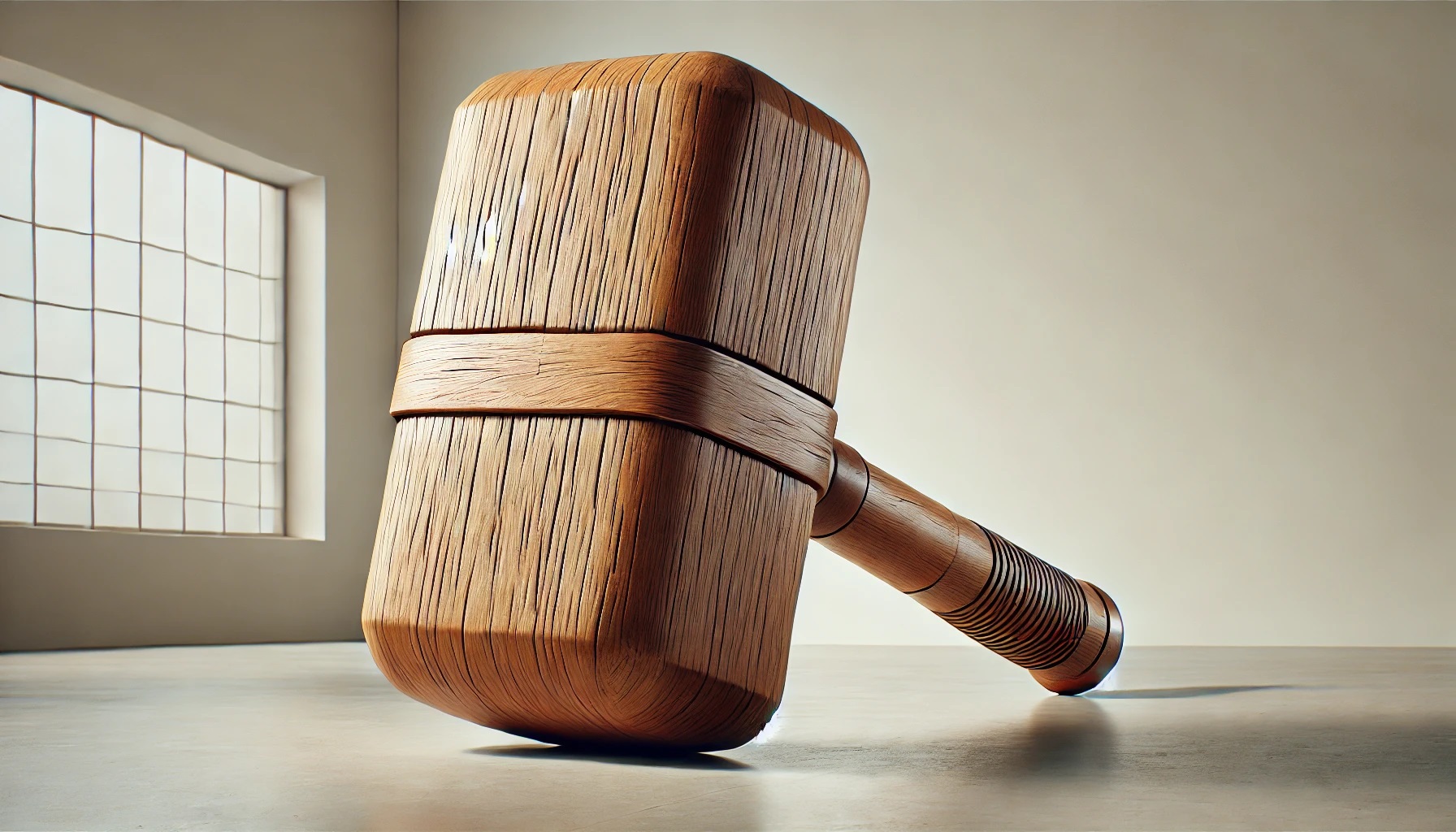
Choose the mallet before setting proportions
The head shape determines whether viewers see a mallet, gavel, hammer, or fantasy weapon.
Cylindrical
A round body with equal faces creates the clearest balanced silhouette and requires a diameter and total head width.
Barrel
A crowned center or tapered ends adds curvature that should be shown in both elevation and section.
Block
Rectangular or square faces produce a heavier graphic form and need defined edge treatment.
Soft-faced look
Contrasting end caps or padded-looking faces can identify a specialty mallet without asserting any working material.
Balance head width with handle length
Set the handle centerline and the exact point where it enters or meets the head. A handle that is too short can make the object read as a gavel; one that is too long can weaken the visual weight of the mallet head. Provide grip-end and shaft profiles rather than one overall length.
If the reference includes bands, wedges, logos, or color breaks, place them on the elevation. Do not add hardware or a visible construction method unless it belongs to the supplied design.
Define whether the mallet rests or appears in action
A head resting on one face uses a compact base but sends the handle diagonally into the surrounding space. A horizontal pose exposes both the handle and head length. A raised-looking position needs a clearly defined scenic relationship and overhead envelope.
State whether visitors only view the prop, stand beside it, or have another separately evaluated relationship. A familiar carnival association does not establish a functional striking game.
Compare upright and resting head relationships
The concept images show cylindrical wooden-style mallet forms. They are not fabricated WhiteClouds projects and do not establish material or function. Use them to compare face diameter, head width, handle alignment, and display pose.

Define the head, handle, and position
A useful brief states which features make this a mallet rather than another hammer.
- Approved mallet reference or sketch
- Head type, width, diameter, and face profile
- Handle length, cross-section, and grip end
- Centered or intentionally offset handle relationship
- Bands, graphics, colors, or surface direction
- Resting, horizontal, upright, hanging, or raised-looking pose
- Viewer contact limits and clearance envelope
- Access route, destination, and required date
Request pricing for a custom giant mallet
Send the head and handle reference, dimensions, face profile, pose, graphics, interaction limits, support and clearance conditions, access route, destination, and schedule.