
Planning a Scenic Giant Hammock Stand
A scenic giant hammock stand is the frame around a suspended-looking sling, not a promise of functional furniture. Span, end supports, upper connection points, base contact, apparent tension, and visitor clearance must be defined around the intended display view.
Define a Hammock Stand
Draw the complete stand in elevation and plan
Set the total span, end height, widest base points, and frame depth. A smooth arc, paired posts, angular truss-like profile, or other original silhouette changes both the visual character and the occupied space. Show the centerline and the farthest projection on each side.
If the piece is viewed from several directions, provide the desired frame thickness and rear treatment. A narrow front view can conceal substantial depth, while a broad side view may expose every connection and base transition.
Coordinate the frame with the suspended-looking element
Treat the stand and sling as two related scopes.
Upper connections
Mark the apparent attachment height and direction at both ends, including any visible rope, ring, hook, or original connector shape.
Center sag
Define the lowest visual point of the hammock and the open distance beneath it without implying a usable seat.
Base zones
Show each ground-contact area and any scenic plinth, landscape edge, or floor transition.
Asymmetry
If the ends differ in height or angle, provide both elevations so the frame is not estimated as a mirrored form.
State what visitors may and may not do
A display that only looks inviting has a different scope from an object intended to carry people. Describe the desired photographs and audience distance, and state whether the sling is view-only. Do not rely on the familiar use of a hammock to communicate contact requirements.
Place camera positions, queuing, barriers, signs, and circulation on the site plan. The open center may attract visitors, so clearance and access expectations should be explicit even for a nonfunctional scenic composition.
Compare two long-span scenic arrangements
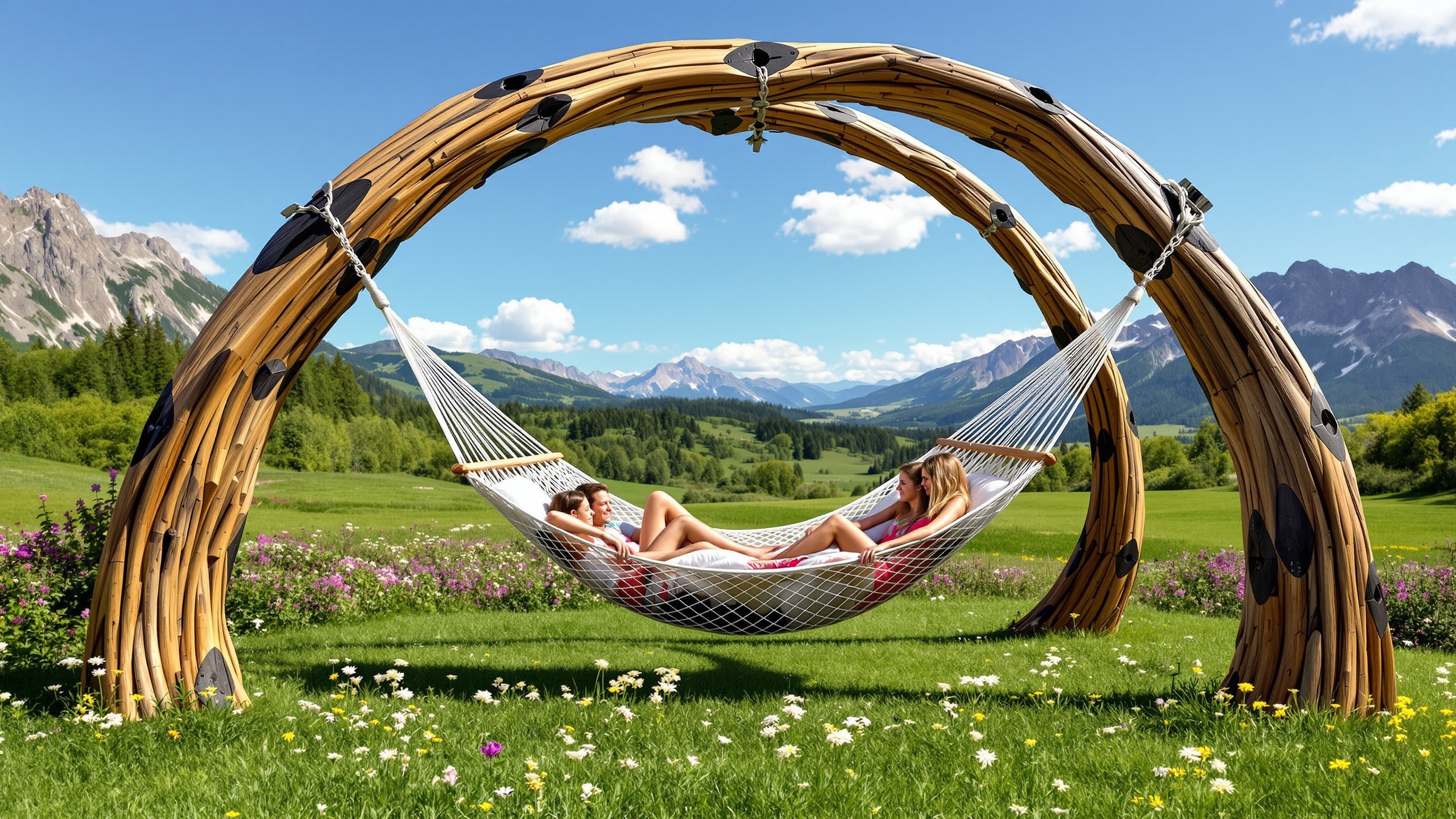
The concept images illustrate curved frame profiles in outdoor settings. They do not establish a fabricated WhiteClouds project, material, anchoring system, or load capacity. Use them only to discuss span, arch, connection height, and the visual position of the hammock.
Specify the frame before requesting pricing
The stand should be described independently from the sling or net.
- Overall span, height, depth, and base footprint
- Curved, angular, post-and-beam, or original frame profile
- Connection-point height and direction
- Scenic hammock shape and lowest visual point
- Finished sides and rear treatment
- View-only or separately evaluated contact requirement
- Floor, landscape, platform, and visitor-clearance plan
- Access route, destination, and required date
Request pricing for a scenic giant hammock stand
Send the frame profile, span and height, base plan, connection points, scenic sling position, audience-contact limits, site and access dimensions, destination, and schedule.