
Planning Giant Fruit Props
Fruit looks simple until it is enlarged. The asymmetry of a berry, taper of a pear, crown of a pineapple, or interior pattern of a citrus slice carries much of the identity. A giant fruit prop should begin with the exact variety and whether it appears whole, cut, peeled, clustered, or combined with other pieces.
Plan a Giant Fruit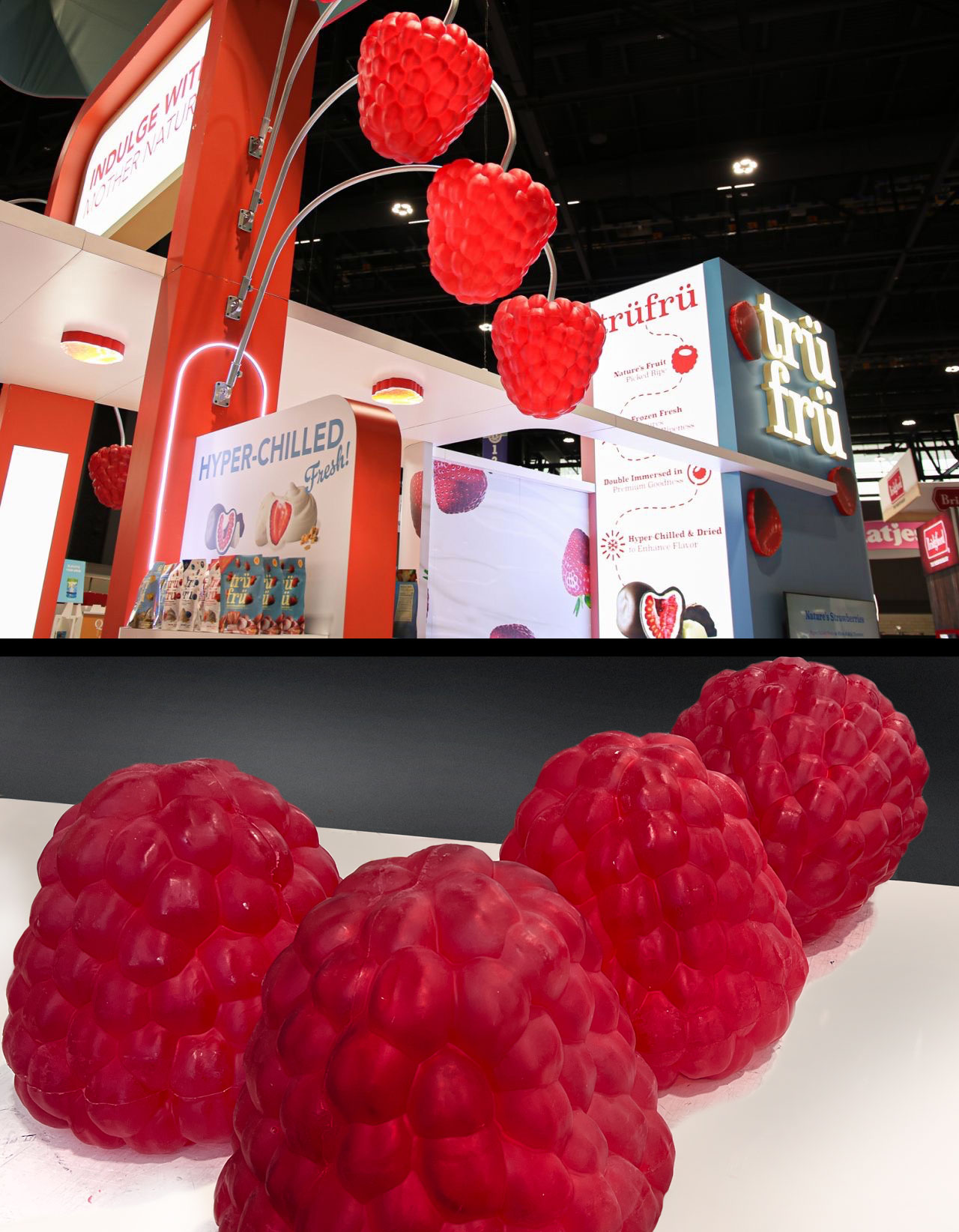
Choose the variety and stage of the fruit
An apple cannot be planned from a generic red sphere, and a berry cluster is not defined by color alone. Gather references for the actual variety, including profile, stem end, blossom end, skin markings, and the way the fruit naturally rests. Ripeness can change color, sheen, spotting, and shape.
Next define its state. A whole fruit emphasizes outer profile and skin. A half or slice introduces rind thickness, seeds, segments, flesh color, and a wet or dry visual direction. A peeled or bitten fruit needs a clear transition between exterior and interior. These choices alter both the visible information and the physical balance.
Set the relationship among pieces
One large fruit creates a concise object, while a cluster introduces overlap, varied rotation, and contact points. A grouped display may combine several sizes to avoid a mechanical repeated pattern. If multiple varieties are requested, decide whether they form one connected composition or separate props with independent bases.
Stems, leaves, crowns, and vines often extend beyond the main body and can determine the maximum footprint. Identify which of those parts must detach for shipping or storage. For a hanging, wall-mounted, or tilted fruit, provide the final orientation instead of assuming the natural resting position shown in reference photographs.
Scale the surface cues to the viewing distance
A few accurate traits usually explain the fruit better than uniform texture across every inch.
Skin pattern
Speckles, pores, stripes, bloom, or mottling should follow the selected variety and remain legible at display scale.
Color transition
Approved references can map gradients between ripe and shaded areas without assuming a single flat color.
Cut interior
Flesh, rind, core, segments, and seeds need separate depth and color direction when exposed.
Stem and leaves
Attachment angle, length, edge shape, and front-to-back visibility should be shown in the design references.
Study a real enlarged raspberry form
The pictured raspberry display is a completed WhiteClouds project. It provides an exact giant-fruit reference with repeated berry cells and leaf details. One strong project image is retained because weaker concepts would not add useful physical information. The image also makes the irregular outline and relationship between the clustered body and upper leaves easy to compare without assigning its construction to another fruit.
Inputs for a focused fruit estimate
The initial request should describe the fruit as a three-dimensional specimen, not merely name a flavor or color.
- Fruit variety and ripeness
- Whole, cut, peeled, or bitten state
- Single piece, cluster, or set
- Overall dimensions and orientation
- Skin and interior references
- Stems, leaves, crowns, or vines
- Viewing sides and support preference
- Access route, destination, and deadline
Request a quote for giant fruit props
Provide the fruit variety, state, dimensions, grouping, color references, surface traits, stems or leaves, orientation, viewing sides, and display conditions. Add access measurements, ship-to location, and needed date so each prop can be scoped at its intended scale.