
Giant Flamingo Statue Ideas
A giant flamingo statue gets most of its character from a long neck curve, compact elevated body, narrow legs, and the relationship between beak and eye. The design must settle whether the bird stands alone, balances on one leg, joins a pair, or becomes part of an illuminated or scenic composition.
Plan a Flamingo Statue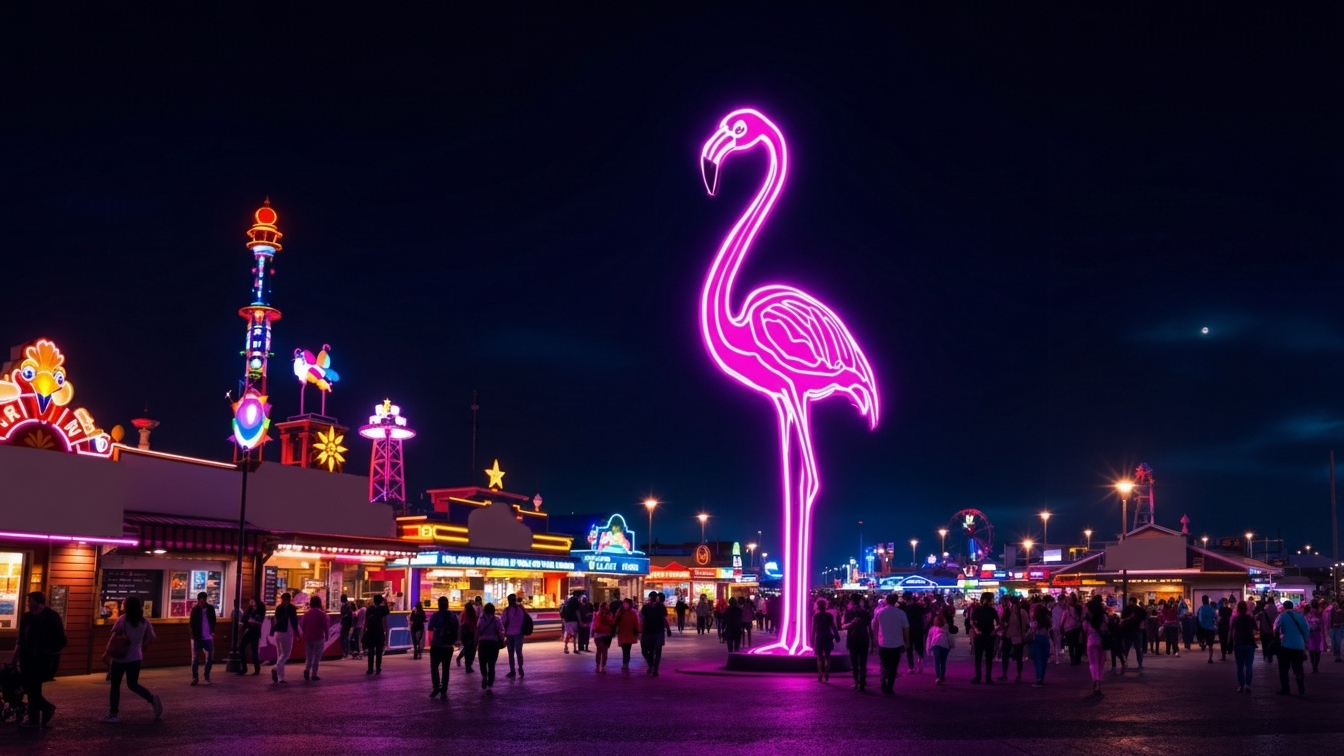
Draw the neck and leg rhythm before adding feathers
A flamingo's outline is a sequence of curves and narrow transitions. Establish the neck path, head angle, beak break, body oval, leg spacing, and foot position on one elevation. Then review a three-quarter view to make sure the neck has convincing depth and the legs do not merge visually.
Choose the intended degree of realism. A naturalistic bird may use restrained feather texture and specific coloration, while a graphic resort or retail figure may rely on clean pink fields and a simplified beak. In either case, the eye and beak should remain legible at the closest important viewing distance.
Use the neck direction to organize the scene
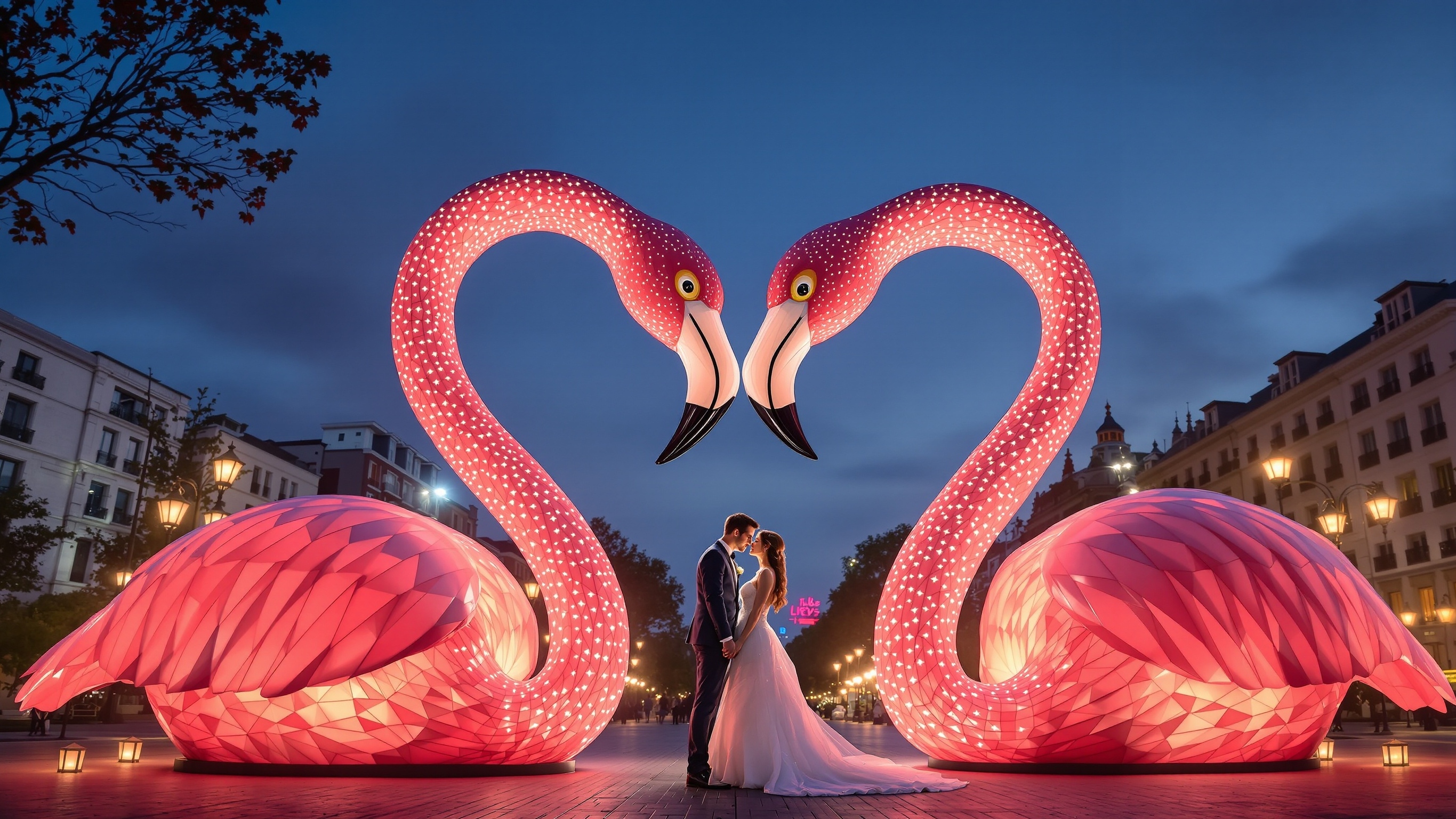
The boardwalk illustration treats one upright flamingo as a tall nighttime marker. The paired illustration turns two inward neck curves into a heart-shaped photo composition. Neither image is a completed project, but together they show why a single bird and a pair require different footprints, support positions, and camera views.
Choose the leg arrangement around the display job
The pose affects the visual lightness, ground contact, and space available for visitors.
Two-leg stance
Two visible legs create a calm vertical rhythm and can suit a single landmark viewed from several directions.
One-leg pose
The familiar lifted-leg silhouette increases asymmetry and requires the body, raised foot, and ground relationship to be composed together.
Feeding posture
A lowered neck shifts the head toward the ground or water edge and changes both visitor sightline and overall height.
Facing pair
Two birds can create an arch or heart-like opening, but their neck curves, eye lines, bases, and person position must be planned as one unit.
Plan what remains visible after daylight
Pink tone, wing contrast, black beak area, and eye placement should follow the selected visual direction. If the statue is intended as a nighttime marker, provide the ambient lighting conditions and describe the desired illuminated effect as a separate requirement. Do not assume that a bright daytime surface will produce the same outline after dark.
For a photo display, mark where a person stands and whether the camera frames one bird or both. Keep the body and head visible around people rather than letting the neck opening do all the work. Nearby signs, railings, planting, and umbrellas should appear on the layout because they can interrupt the slender silhouette.
Details that establish height, span, and interaction
The neck curve and visitor relationship need dimensions as much as the overall bird.
- Single bird, pair, or larger group
- Standing, one-leg, feeding, or facing pose
- Neck curve and head direction
- Target body height and full projection span
- Realistic or graphic color treatment
- Photo opening and camera position
- Day-only or requested nighttime effect
- Site, access route, environment, destination, and date
Request a quote for a giant flamingo statue
Share the single or paired composition, pose, neck and beak references, target dimensions, color direction, visitor and camera positions, any requested lighting behavior, site constraints, access, destination, and deadline.