
Planning a Giant Cabbage Prop
A giant cabbage prop is organized as one rounded head made from overlapping leaves. Its outer spread, nested middle layers, compact center, vein pattern, and base all affect whether the enlarged object reads as cabbage. Planning that progression gives the display a clear structure without turning the page into a general vegetable assortment.
Plan a Giant Cabbage Prop
Choose the Cabbage Shape and Degree of Closure
Select one cabbage reference that clearly shows the overall head. Some examples are nearly round, while others sit lower and wider with outer leaves that flare onto the ground. Define the target height and maximum diameter, then mark where the profile begins to curve inward toward the center.
Decide how tightly the head should close. A compact center creates a dense nested pattern; a looser version exposes more folds and interior color. The leaf-built head is separate from cauliflower curds, broccoli branches, and a loose spinach bunch. Front, side, and upper-angle views help keep those choices consistent around the complete object.
Build the Leaf Progression From Base to Center
A cabbage head should read as an ordered sequence of wrapping leaves, not as interchangeable green panels.
Outer spread
Set the number, width, curl, and reach of the lowest leaves. These elements establish the footprint and frame the denser head above them.
Middle layers
Show where each broad leaf overlaps the next and how the folds rise toward the center. Vary the visible edges without losing the rounded mass.
Central closure
Define the size and direction of the innermost leaves. The center may form a tight spiral, a small folded crown, or another approved arrangement visible from above.
Veins and ridges
Identify the primary vein paths and a limited amount of secondary texture that will read at the expected distance. Keep relief subordinate to the leaf silhouette.
Set the Viewing Angle and Ground Relationship
An eye-level view emphasizes the round head and broad exterior leaves; a higher view reveals more of the central closure. Name the principal audience or camera position and note whether guests can walk around the display. The selected view determines how much of the center, base, and rear layers require detail.
Provide the available floor area and state whether a visible platform is acceptable. The lower leaves can appear to rest on the display surface, curl upward, or gather around a compact base, but that relationship should be drawn rather than left to assumption.
Compare Two Layered Cabbage Concepts
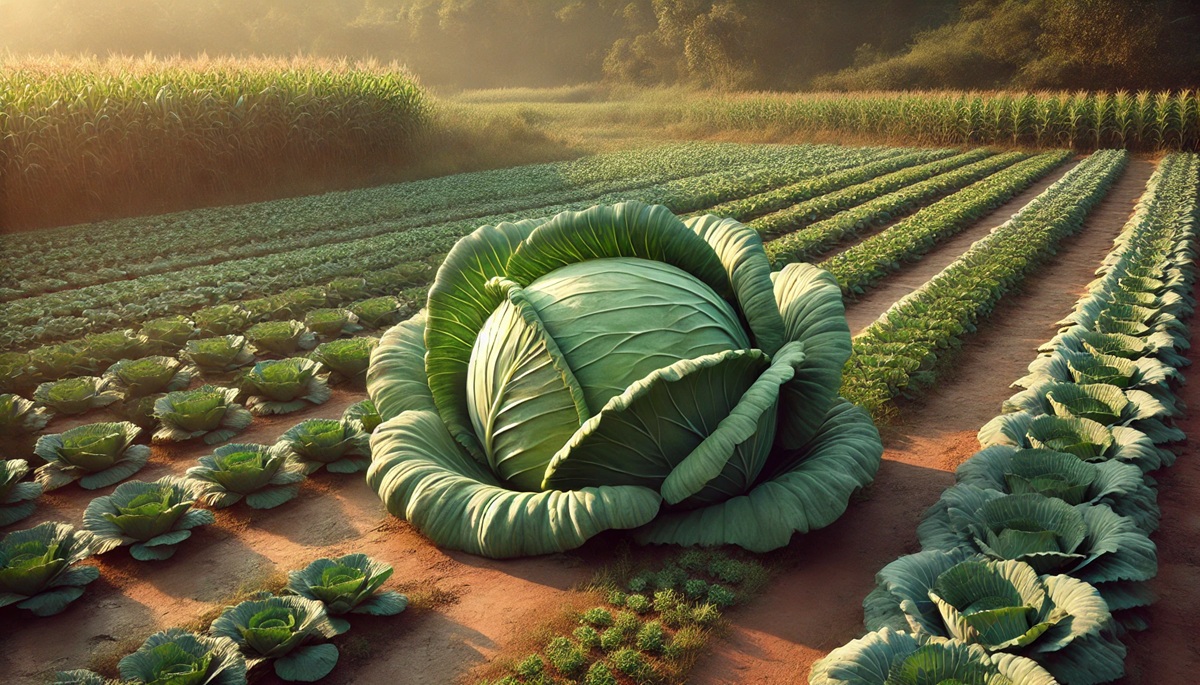
One concept uses broad upright leaves around a tight central head in a market setting. The second sits lower in the field and places more emphasis on the spreading base. They offer different balances among head height, outer reach, center visibility, and support concealment.
These are concept images for visual comparison. They do not establish a WhiteClouds project, a real customer, botanical accuracy, dimensions, materials, fabrication details, or outdoor performance.
Prepare the Cabbage Prop Brief
The most useful references explain how the leaves assemble into one head.
- Approved whole-cabbage front, side, and upper-angle references
- Overall height, maximum diameter, and usable floor area
- Rounded, low-wide, or other approved head profile
- Outer-leaf reach, middle-layer overlap, and center closure
- Primary veins, folds, edge curls, and required viewing detail
- Green palette, lighter ribs, darker recesses, and supplied graphics
- Principal view, every exposed side, and acceptable base visibility
- Access route, destination, placement conditions, and required date
Request a Custom Prop Quote
Provide the cabbage references, dimensions, degree of closure, leaf pattern, vein detail, colors, viewing sides, base preference, site conditions, access information, destination, and schedule for review and quoting.