A Stunning Look at Coastal Terrain in Three Dimensions
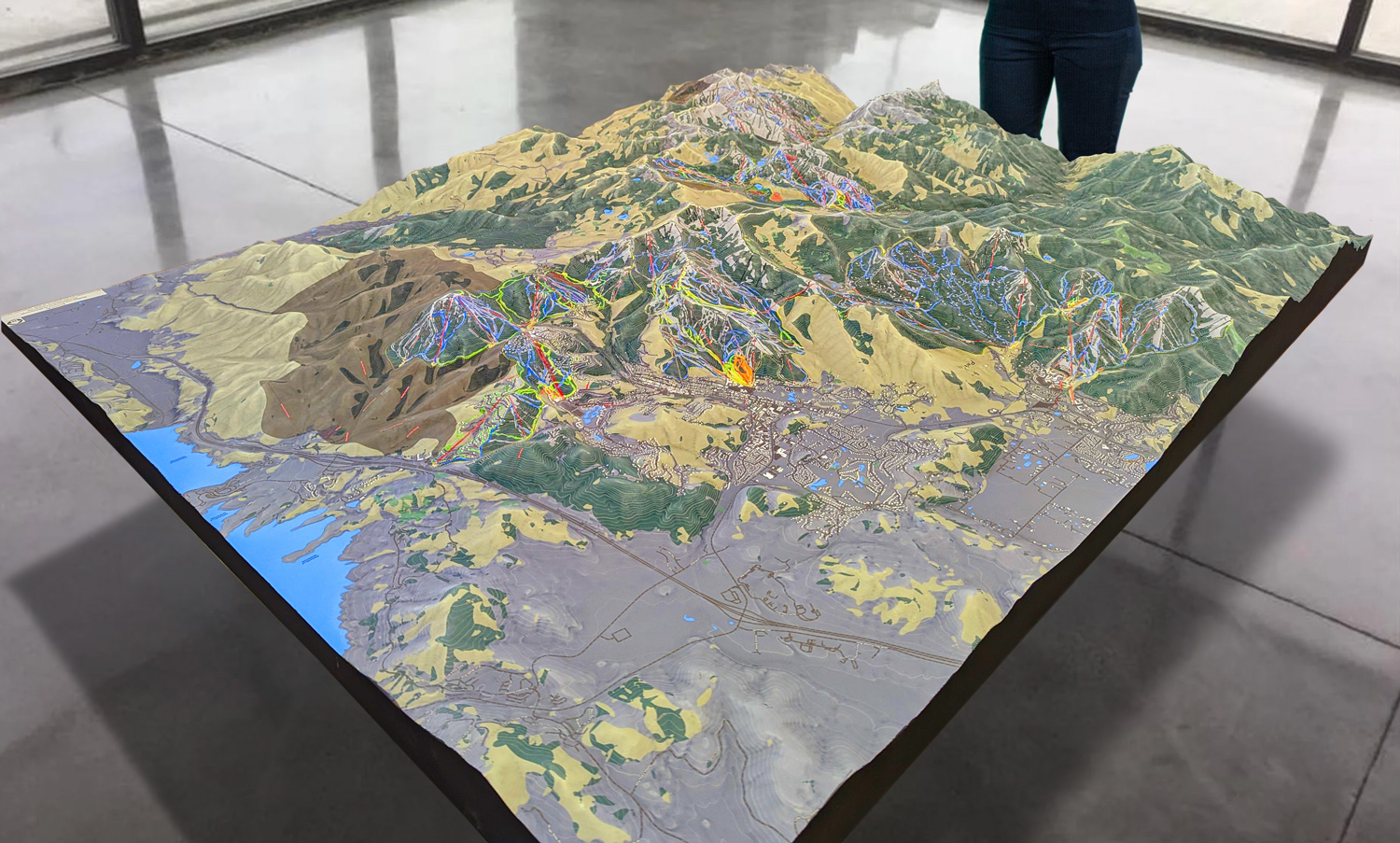
Long Beach, California, is a city with personality—its skyline unmistakable, its waterfront iconic, and its terrain surprisingly dynamic for a place known primarily for sunshine, beaches, and port traffic. A 3D topographic map of Long Beach transforms those familiar features into an extraordinary visual experience. Instead of seeing Long Beach as a flat grid or a simple coastal layout, a 3D topo map reveals the city’s subtle elevation shifts, coastal contours, urban textures, and natural transitions in a way that brings the landscape to life. It becomes less of a map and more of a sculptural portrait of the city. From Signal Hill’s rise above the rooftops to the long, sweeping curve of the coastline near Belmont Shore, and from the quiet wetlands of the Los Cerritos area to the engineered might of the Port of Long Beach, a 3D topographic map captures every shape and shadow. These maps invite exploration, ignite curiosity, and offer a striking fusion of geography, art, and engineering. In this deep and engaging look at Long Beach’s terrain, we’ll explore what a 3D topographic map really is, why Long Beach makes for such an exceptional subject, how the city’s physical features become sculptural form, and how one might fabricate such a piece as a real, physical model. Whether for educational spaces, geography enthusiasts, interior designers, local historians, real estate professionals, or prop builders, a 3D map of Long Beach is a coastal masterpiece waiting to be created.
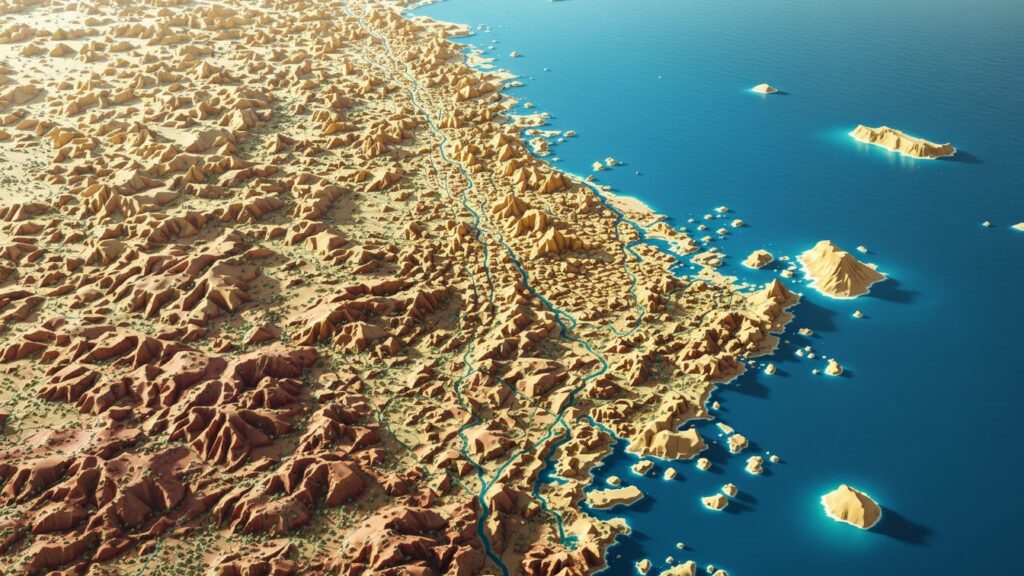
Understanding the Allure of 3D Topographic Maps
A topographic map introduces viewers to the shape of the land—hills, valleys, slopes, ridges, and plains. When this information is translated into three dimensions, the terrain becomes tactile and intuitive. Instead of deciphering contour lines, your eyes instantly follow real rises and real depressions, as if you’re looking down at a scaled mini-world.
The human brain naturally gravitates toward dimensionality. We understand depth instinctively. That’s why a 3D topographic map of Long Beach is not merely a tool—it’s experience-based geography. It blends art, science, engineering, and storytelling into one cohesive visual.
Long Beach, with its combination of natural landscapes, urban footprints, port infrastructure, coastal formations, and inland elevations, is uniquely suited to 3D treatment. The topography here tells a full story. The land doesn’t scream with dramatic mountains, but its quieter, more subtle terrain offers incredible sophistication and contrast when rendered in three dimensions.
Why Long Beach Makes a Fascinating 3D Topographic Subject
Long Beach is a city of edges—shorelines, riverbeds, wetlands, ridges, bluffs, and engineered surfaces. Its topography is a mosaic of natural and manmade form. In a 3D map, each section becomes a character in a larger narrative.
The coastline is the star of the show. The gentle arc of sandy beachfront meets the Pacific with a delicate sweep, while the engineered structures of the port introduce sharp geometry. A 3D rendering exaggerates the interplay between the organic and the industrial, placing the soft curves of Belmont Shore beside the hard lines of container terminals and breakwaters.
Inland, the terrain lightly rises and falls, with the most notable feature being Signal Hill, the geological surprise perched in the middle of the city. Its 360-degree panorama becomes a dramatic centerpiece on a 3D map—almost like a miniature island climbing out of the urban fabric.
The Los Angeles River corridor provides a contrasting topographic moment as it carves its well-defined path toward the ocean. Wetlands and marshy areas around the El Dorado and Los Cerritos regions create textured transitions that are as meaningful in a topographic map as they are in ecological studies.
The result is a story-rich landscape: part coastal, part urban, part industrial, and part ecological. A 3D map highlights this diversity in a way no flat map can.
The Geography of a Coastal City in Three Dimensions
Long Beach’s terrain appears subtle when walking or driving the streets. But from above—or in a 3D model—the variations reveal themselves clearly.
The coastline undulates gently, broken by piers, marinas, beaches, and the impressive arc of the Shoreline Aquatic Park peninsula. In a 3D map, this becomes an elegant curve filled with small elevation changes that track the contours of both the waterline and the engineered land.
The inland neighborhoods tell a different story. These areas transition from coastal lowlands to slightly higher plateaus. Streets tilt upward around Bixby Knolls, while the land gradually slopes down again toward the river corridor. A 3D map translates these slopes into a subtle yet readable sculpture.
Signal Hill becomes the star. Rising around 360 feet above downtown, it stands as a singular topographic feature whose rounded peak delivers stunning shadows in a 3D model. When rendered properly, Signal Hill feels like a geological monument rather than simply a hill.
The wetlands, golf courses, and natural preserves in the eastern part of the city add soft dips and transitions. The San Gabriel River along the edge of Long Beach provides long, textured channels that create a dramatic contrast with urban development.
Finally, the port area—the Port of Long Beach and its connecting channels—adds a powerful interplay of straight lines, structured shapes, and artificial terrain shifts. A 3D map captures the dredged depths, breakwaters, islands, and container-yard layouts in an architectural-meets-geographical display.
Urban Form Meets Natural Topography
One of the joys of a 3D topo map is how it expresses the dialogue between human development and natural terrain. Long Beach exemplifies this relationship.
The city’s grid overlays the contours of the land with geometric precision. Streets stretch straight over subtle rises and dips, reflecting human insistence on order despite complex terrain below. In three dimensions, this creates a fascinating juxtaposition: the land appears fluid and organic, while the urban grid seems rigid and predictable. Neighborhoods around Bluff Heights show this interplay beautifully. The natural bluff becomes an elevated ribbon running parallel to the coastline. On a 3D map, this ridge creates dramatic shadowing that intersects gracefully with the manmade structures above and below.
The port area becomes a sculptural representation of human engineering. Land expansions, dredged channels, artificial islands like Naples, and shoreline reinforcements show up vividly in 3D form. Industrial areas gain visual depth, dramatic angles, and architectural clarity. Parks and preserve lands introduce soft pockets of calm within the urban grid. On a 3D map, their lowered or elevated surfaces become sanctuaries of texture, providing relief from the uniformity of the surrounding streets.
This interplay—natural versus built, organic versus engineered—is what makes Long Beach a topographic treasure.
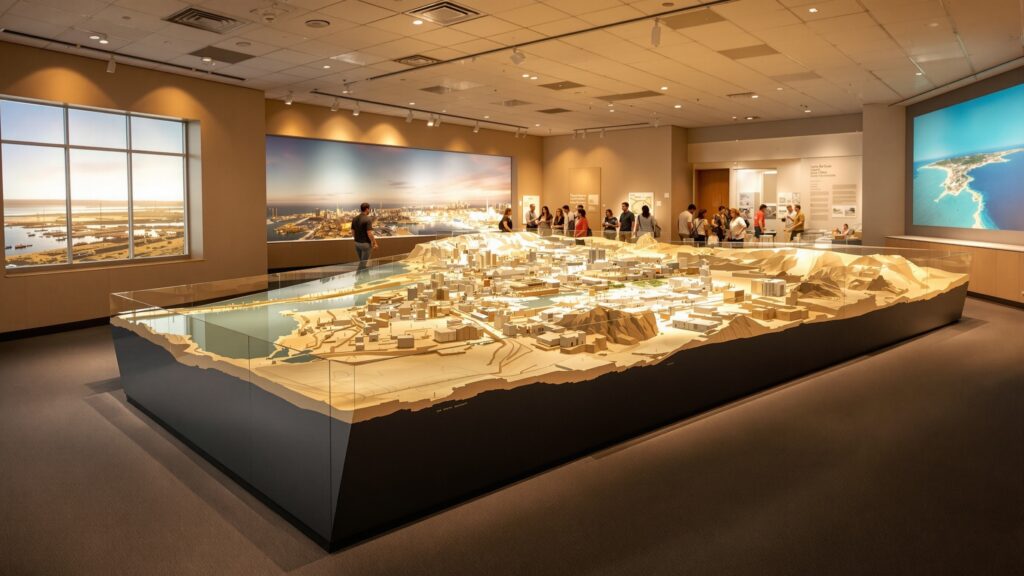
What a 3D Topographic Map of Long Beach Can Be Used For
A 3D topographic map isn’t just visually stunning—it’s meaningful and useful. In educational environments, it teaches geography, geology, infrastructure design, and coastal science. Students see the relationships between landforms and city planning instantly.
For real estate professionals, a 3D topographic model becomes a powerful display tool, highlighting the elevation differences and environmental features that influence development. Clients understand terrain at a glance, without needing to interpret contour lines.
Interior designers often use 3D maps as statement art pieces. In a coastal city like Long Beach, a beautifully fabricated map becomes a striking decorative feature in offices, lobbies, retail stores, hotels, or private homes.
For city planners, engineers, and environmental researchers, the map becomes a reference model for understanding flood zones, erosion patterns, coastal engineering, transportation planning, and watershed behavior.
And for the general public, it’s simply captivating. There’s something magical about seeing a familiar city transformed into a sculptural display.
How a 3D Topographic Map of Long Beach Might Be Fabricated
A physical 3D topographic map can be built in many ways, but professional fabricators typically follow a multi-stage process involving digital modeling, material carving, structural engineering, and hand-finishing.
Step 1: Gather Accurate Elevation Data
The process begins with acquiring detailed elevation information, often pulled from USGS LiDAR scans or official government terrain datasets. This raw data is cleaned, scaled, and converted into a high-resolution digital terrain model that serves as the blueprint for every hill, valley, slope, and shoreline.
Step 2: Create and Slice the Digital 3D Model
Fabricators use the digital terrain file to generate a 3D model, which is then sliced into layers or relief sections. These slices are prepared for CNC routing, 3D printing, or laser cutting. Materials such as foam, wood, acrylic, and composite panels are chosen based on the size, weight, and finish of the final piece. For large models, a stacked-layer technique may be used, with each laser-cut sheet representing an elevation level that builds upward like a topographic puzzle.
Step 3: Assemble the Base Terrain
Once the layers are cut, they are assembled into the full terrain structure. Each piece is carefully aligned and bonded to form the complete landform. As the layers come together, the natural contours of the region—ridges, slopes, channels, and coastal edges—begin to take shape in three dimensions.
Step 4: Refine and Sculpt the Surface
Fabricators refine the terrain through sanding, smoothing, shaping, and reinforcing key areas. This stage ensures that the surface flows naturally and avoids visible step lines from the layering process. Additional geographic or architectural elements—such as islands, breakwaters, bluffs, or built structures—may be added as raised components to enhance realism.
Step 5: Apply Artistic Finishing and Color
Finishing transforms the raw structure into a lifelike map. Artists use soft gradients to convey elevation changes, natural coastal hues to blend blues into sandy shoreline tones, and subtle shadows to enhance depth and contrast. The Long Beach coastline especially benefits from delicate tonal transitions that highlight its gentle curves and engineered waterfront features.
Step 6: Add Labels, Protection, and Presentation Features
Depending on the purpose of the map, labels, borders, frames, or protective coatings can be added. Some high-end models remain unlabeled, allowing the terrain itself to serve as a sculptural art piece. The final result is a vivid, professionally crafted 3D topographic display that balances scientific accuracy with artistic expression.
Why 3D Topography Brings Long Beach to Life
When a city is rendered in three dimensions, viewers gain a relationship to the land that flat maps rarely provide. They see the city as a landscape—a terrain—rather than a set of disconnected streets or landmarks.
Long Beach becomes a place of gradients and textures. Its neighborhoods unfold like a physical story. Signal Hill becomes a miniature mountain; the coastline a flowing ribbon; the port a monumental engineered expanse. Inland ridgelines and subtle valleys appear with clarity, illustrating how water flows, how development evolved, and how the land naturally behaves over time.
A 3D topographic map becomes a celebration of the physical foundation of Long Beach. It honors both the city’s natural beauty and its bold, engineered identity. For anyone who lives in, studies, or simply loves Long Beach, a 3D topographic map is a treasure—one that turns the city’s quiet terrain into a striking, sculptural work of art.
A City Transformed Through Dimensional Mapping
A 3D topographic map of Long Beach, CA, is more than an informational tool. It’s a visual journey through coastline curves, inland elevations, engineered marvels, and geological stories. It gives viewers a new way to appreciate one of California’s most layered and dynamic coastal cities. Whether used for education, design, civic communication, environmental study, or artistic display, a 3D topographic map becomes a lasting testament to how geography shapes identity. In Long Beach’s case, the blend of natural and human-made topography makes for a uniquely compelling model—one that reveals the hidden beauty beneath the city’s sunshine-drenched surface.