Exploring The Immense Scale, Engineering Brilliance, and Global Significance of The Tallest Statue Ever Built.
When people imagine colossal structures, they often think of skyscrapers, bridges, or towering mountains. But statues—those artistic, symbolic monuments built to honor history, culture, and identity—can reach truly staggering heights. The largest statue in the world isn’t just big—it’s almost unbelievable in scale. Standing so tall it rivals modern buildings, it redefines what we think a “statue” can be. The title of the world’s largest statue belongs to the Statue of Unity, a monumental tribute to Indian statesman Sardar Vallabhbhai Patel. But just how big is it? And how does it compare to other famous statues across the globe? Let’s explore the immense scale, engineering, and imagination behind the largest statue ever built.
The Statue of Unity: The Current Record Holder
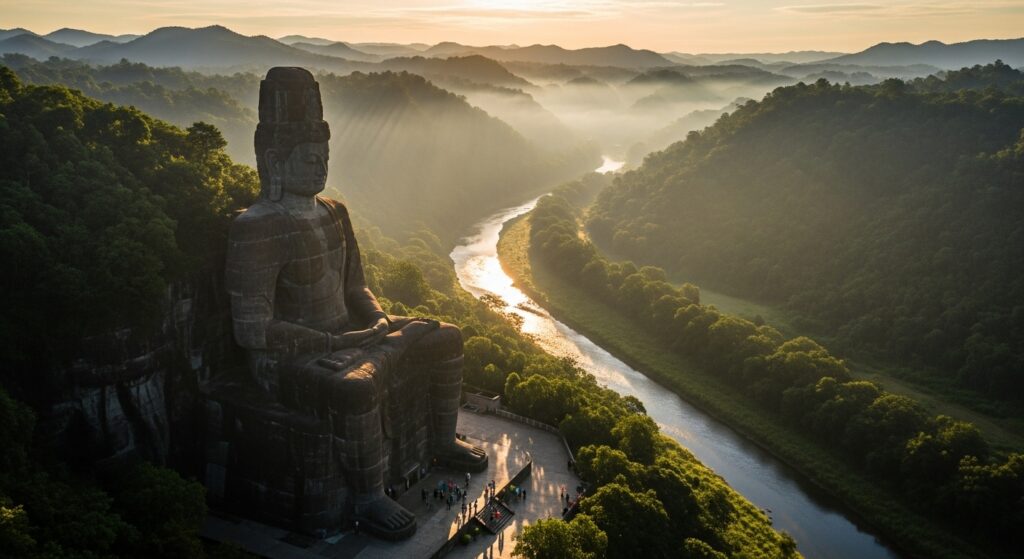
Completed in 2018, the Statue of Unity rises to an astonishing height of 597 feet (182 meters). To put that into perspective, that’s nearly twice the height of the Statue of Liberty (including its pedestal), and taller than many skyscrapers found in major cities.
Located in the Indian state of Gujarat, the statue overlooks the Narmada River and the surrounding landscape, creating a dramatic and awe-inspiring presence. Visitors approaching the monument often describe a sense of scale that’s difficult to grasp until you’re standing at its base, craning your neck upward.
What makes the Statue of Unity even more remarkable is that the figure itself—the likeness of Sardar Patel—is 182 meters tall, not including additional structures around it. This means the statue alone holds the record, not just the full monument.
Visualizing the Scale: How Big Is 597 Feet?
Numbers alone don’t always capture the true enormity of something this large, so let’s translate that height into more relatable terms.
At nearly 600 feet tall, the Statue of Unity is roughly the height of a 60-story building. Imagine stacking ten average houses on top of each other—then doing that six times. That’s the kind of vertical scale we’re talking about.
Compared to the Eiffel Tower, which stands at about 1,083 feet (330 meters), the Statue of Unity reaches more than halfway up. While not quite as tall, it is far more massive in volume and visual impact due to its solid sculptural form.
Another way to understand the scale is to consider the human element. A person standing at the statue’s feet looks almost microscopic. Even large crowds appear as tiny moving dots, emphasizing just how monumental the structure truly is.
Engineering a Colossus
Building the largest statue in the world is not simply a matter of making something bigger—it requires overcoming enormous engineering challenges. The Statue of Unity is a marvel of modern construction, blending art with cutting-edge technology.
The statue is constructed using a reinforced concrete core, a structural steel framework, and an outer cladding of bronze panels. These bronze sheets give the statue its distinctive appearance while protecting it from the elements.
One of the biggest challenges engineers faced was wind resistance. At nearly 600 feet tall, the statue must withstand high-speed winds, earthquakes, and environmental wear over time. Advanced modeling ensured that the structure could remain stable even under extreme conditions.
Inside the statue, there are elevators that carry visitors up to a viewing gallery located around chest height. From there, guests can look out across the surrounding valley, gaining a unique perspective both of the landscape and the statue itself.
A Global Tradition of Monumental Statues
While the Statue of Unity currently holds the record, it is part of a long tradition of building massive statues around the world. Many of these are religious or cultural icons designed to inspire awe and reverence.
For example, the Spring Temple Buddha stands at 420 feet (128 meters), making it one of the tallest statues ever built. Similarly, the Laykyun Sekkya rises to 381 feet (116 meters), towering over the surrounding countryside.
Japan’s Ushiku Daibutsu and Thailand’s Great Buddha of Thailand are also among the world’s largest statues, each representing spiritual figures and attracting millions of visitors annually.
These monumental works show that the desire to build large statues is not new—it spans cultures, religions, and centuries.
Why Build Something This Big?
The question naturally arises: why create a statue on such an enormous scale?
Part of the answer lies in symbolism. Large statues are meant to represent powerful ideas—unity, freedom, faith, or national pride. By building something so massive, creators ensure that the message cannot be ignored. The sheer size commands attention and respect.
In the case of the Statue of Unity, the monument honors Sardar Patel’s role in unifying India after independence. The statue’s size reflects the magnitude of his contribution to the nation’s history.
There’s also a practical element. Giant statues often become major tourist attractions, drawing visitors from around the world. This can boost local economies, create jobs, and put regions on the global map.
Finally, there’s the human fascination with pushing limits. Just as we build taller buildings and longer bridges, constructing the world’s largest statue is a way of demonstrating what modern engineering and creativity can achieve.
The Experience of Standing Beneath a Giant
Standing at the base of the largest statue in the world is an experience unlike any other. The scale is so immense that it can feel disorienting at first. Your eyes struggle to take in the entire structure, and your sense of proportion shifts dramatically.
As you look up, the statue seems to stretch endlessly into the sky. Details that would be prominent on a smaller sculpture—facial features, folds of clothing—become massive architectural elements in their own right.
Visitors often describe a mix of awe and humility. The statue’s size can make you feel small, but it also connects you to something larger—a shared history, a cultural identity, or a collective achievement.

From Ancient Wonders to Modern Marvels
The idea of building massive statues is not new. Ancient civilizations also created monumental works, such as the Colossus of Rhodes, which was once considered one of the Seven Wonders of the Ancient World.
Although the Colossus no longer stands, it set an early benchmark for what was possible in terms of scale. Today’s statues, however, benefit from advanced materials, engineering techniques, and global collaboration, allowing them to reach heights that ancient builders could only dream of.
The progression from ancient stone and bronze figures to modern mega-statues reflects humanity’s evolving capabilities—and our enduring desire to create something that lasts.
How It Was Built: A Modern Feat of Fabrication
Creating a statue like the Statue of Unity involves years of planning, design, and construction. Engineers and artists must work together to ensure that the final product is both structurally sound and visually accurate.
The process begins with detailed 3D modeling, often based on historical photographs and artistic interpretations. From there, scaled prototypes are created to refine proportions and details.
During construction, massive sections are fabricated and assembled on-site. Cranes, scaffolding, and specialized equipment are used to lift and position components with precision.
The outer bronze panels are carefully shaped and attached, giving the statue its final appearance. Each panel must align perfectly to maintain the integrity of the design.
This combination of artistry and engineering is what makes such projects so remarkable—they are not just buildings, but sculptures on an architectural scale.
Comparing the World’s Largest Statues
Even among giant statues, the Statue of Unity stands out. Its 182-meter height places it well above its closest competitors, creating a clear distinction between it and other monumental works.
What’s fascinating is not just the height, but the diversity of styles and purposes among these statues. Some represent religious figures, others honor historical leaders, and still others celebrate cultural icons.
Despite their differences, they all share a common goal: to inspire awe and leave a lasting impression.
The Future of Giant Statues
As technology continues to advance, it’s likely that even larger statues will be built in the future. New materials, improved construction methods, and ambitious design concepts could push the limits even further.
However, building bigger is not always the primary goal. Future projects may focus more on sustainability, cultural significance, and integration with the surrounding environment.
Still, the race to create the next record-breaking monument is far from over. Somewhere in the world, plans are likely already underway for a statue that could surpass even the Statue of Unity.
Final Thoughts: More Than Just Size
So, how big is the largest statue in the world? At 597 feet tall, the Statue of Unity is a towering achievement that redefines the boundaries of art and engineering.
But its true significance goes beyond its size. It represents history, culture, and the power of human creativity. It stands as a reminder that when people come together with a shared vision, they can create something truly extraordinary.
Whether you see it in person or simply learn about it from afar, the largest statue in the world is more than just a number—it’s a symbol of what’s possible when ambition meets imagination.