The Giant Guardian of the Giza Plateau
Few monuments on Earth create the same sense of awe as the Great Sphinx of Giza. It is ancient, mysterious, weathered by millennia, and still somehow larger in person than most people imagine. Photos flatten it. History books summarize it. But standing near the Sphinx—or even studying its dimensions closely—reveals something much more impressive: this is not just a famous statue. It is a colossal monument carved on a scale that still feels bold even in the modern world. So, how big is the Great Sphinx of Giza? The short answer is that it is about 240 feet long, around 66 feet high, and roughly 63 feet wide at its broadest point. Those numbers alone are striking, but they only tell part of the story. The real fascination begins when you translate those measurements into something human, physical, and unforgettable. The Great Sphinx is longer than many blue whales, taller than a six-story building, and massive enough to dominate the desert edge beside the pyramids of Giza. Its size is one of the main reasons it has held humanity’s imagination for so long. The Sphinx is not simply an old sculpture. It is an enormous feat of vision, labor, symbolism, and endurance. Carved directly from the limestone bedrock of the Giza Plateau, it merges architecture, sculpture, religion, kingship, and mythology into one monumental form. And despite thousands of years of erosion, burial, excavation, restoration, and debate, it still stares across the sands with astonishing presence.
The Basic Dimensions of the Great Sphinx
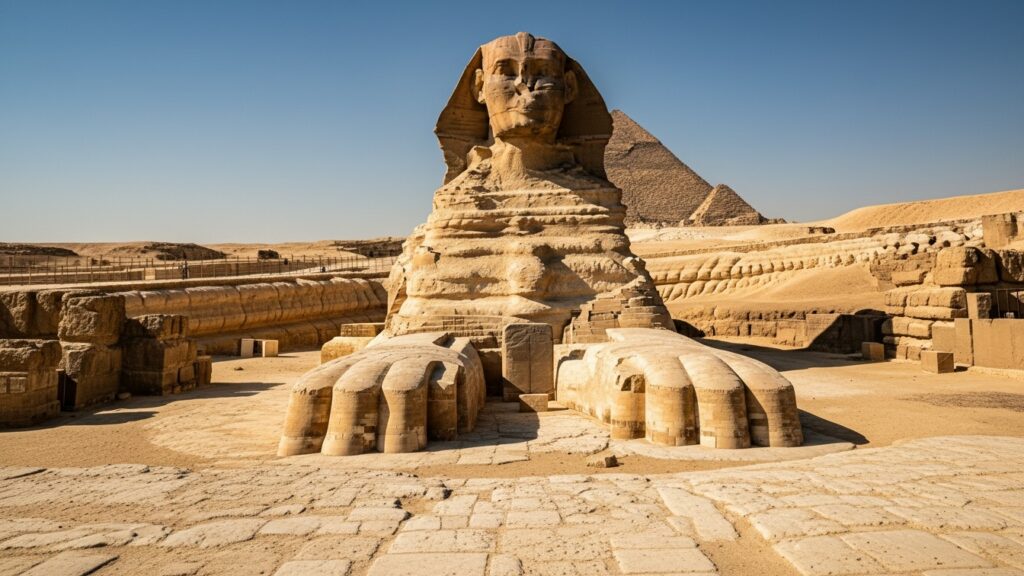
When people ask how big the Great Sphinx of Giza is, they usually want the core measurements first. The monument is approximately 240 feet long from paw to tail. Its height is about 66 feet from the base to the top of the head. The face itself measures around 13 feet wide, and the ears are roughly 4 feet tall. The paws stretch far forward, adding significantly to the statue’s dramatic profile. At its widest body point, the Sphinx measures about 63 feet across.
These numbers make it one of the largest and most recognizable monolithic statues in the world. It is important to remember that the Sphinx was not assembled from stacked blocks in the same way the nearby pyramids were built. Instead, much of it was carved directly from a single outcrop of natural limestone. That means its enormous size was not only a matter of design, but also a matter of finding, shaping, and preserving a massive piece of living rock.
The dimensions become even more impressive when you picture the monument not as an isolated object in a museum-like setting, but as part of a larger sacred landscape. The Sphinx sits low on the plateau near the pyramid complexes, which makes its length especially dramatic. It stretches horizontally across the desert floor like a reclining lion with a human head, appearing both grounded and monumental at the same time.
Why the Sphinx Feels Even Bigger Than the Numbers Suggest
Some monuments are technically large but do not feel emotionally large. The Great Sphinx does the opposite. Even before you know the measurements, it looks immense. Part of that comes from its proportions. Its body is long and low, its head rises sharply above the torso, and its paws extend forward with ceremonial power. The shape creates a strong visual rhythm that draws the eye from front to back and makes the statue seem to unfold across the sand. Another reason is its location. The Sphinx is set on the Giza Plateau, where the openness of the landscape gives the monument room to breathe. There are no city blocks crowding it, no dense forests obscuring it, and no neighboring structures that shrink it through visual competition. The sky above it is broad, the desert around it is stark, and the nearby pyramids amplify its grandeur rather than diminish it. In that setting, the Sphinx feels like part of the earth itself. Its age also changes how we perceive its size. A giant modern statue is impressive, but a giant statue that has existed for thousands of years carries a different emotional weight. The viewer is not only responding to height and length, but to survival. The Sphinx feels bigger because it has lasted. It feels bigger because so many civilizations have looked at the same face and wondered the same things. Time, in a way, enlarges it.
Comparing the Great Sphinx to Things We Know
To really understand how big the Great Sphinx of Giza is, comparisons help. At around 66 feet tall, it is about as high as a six-story building. Its length of roughly 240 feet is close to the length of a large commercial airplane. If laid alongside a basketball court, the Sphinx would cover most of the court and stretch beyond it. Its face alone is taller than many people are wide across their entire body length.
The paws by themselves are substantial enough to make a person appear tiny. The head, although proportionally smaller than the body, still rises with commanding scale. This is one of the most interesting visual aspects of the monument: the head seems modest compared to the huge lion body, yet in human terms it is still absolutely enormous.
It also helps to compare it to other famous statues. The Great Sphinx is not as tall as the Statue of Liberty with pedestal, but it has a broader, more earthbound monumentality. Unlike many later statues built from metal frameworks or assembled stone sections, the Sphinx gains extra drama from being carved from bedrock. That makes its size feel more elemental, almost geological rather than purely artistic.
Carved from the Desert Itself
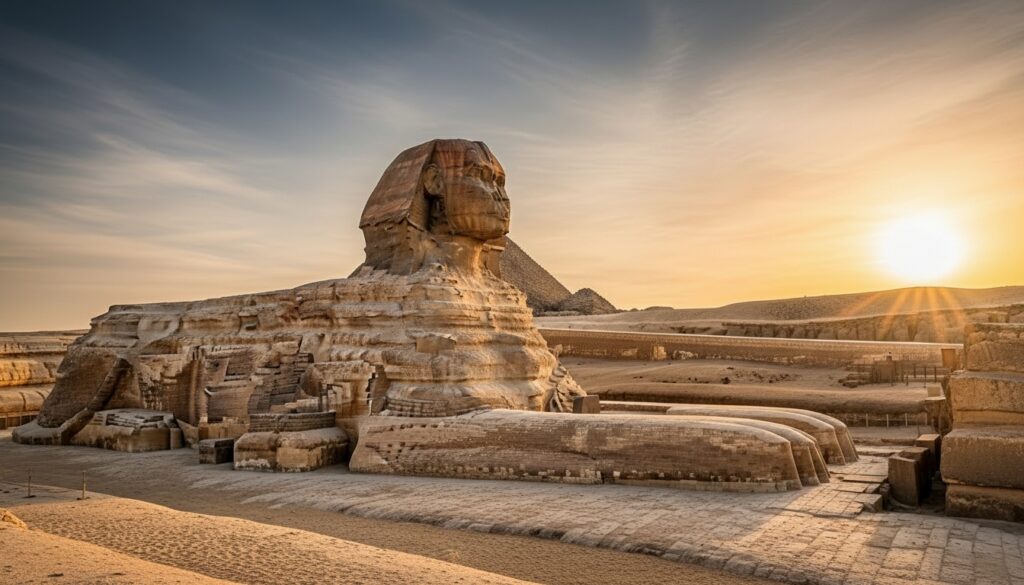
One of the most fascinating parts of the Sphinx’s scale is that it was carved directly out of limestone bedrock. That single fact transforms how we understand its size. When you build a statue from separate pieces, you can transport materials, revise shapes, and replace sections. When you carve a monument from a rock formation, you work with what nature gives you. The scale of the Sphinx reflects a remarkable decision to turn part of the plateau itself into sacred sculpture.
This carving method also explains some of the monument’s shape and weathering.
- The limestone layers varied in hardness, which means some parts eroded more quickly than others over time.
- The body, exposed to the desert environment for millennia, shows different textures and degrees of wear.
- The head, made from somewhat harder stone and proportionally smaller, has survived with more definition than much of the torso.
There is something especially dramatic about the idea that the ancient builders looked at this natural mass of stone and saw a royal guardian sleeping inside it. The final monument was not just placed in the landscape. It emerged from the landscape. That connection between sculpture and geology is one reason the Sphinx feels so permanent, even as it bears the marks of age.
How the Ancient Egyptians Used Scale to Create Power
The size of the Great Sphinx was not accidental. In ancient Egypt, monumental scale was a language of power. Large forms expressed cosmic order, royal authority, divine protection, and the ability of a ruler to command labor and resources on a nearly unimaginable level. The Sphinx, with the body of a lion and the head of a king, projected strength, intelligence, and sacred guardianship all at once.
A lion was already a potent symbol. It suggested dominance, courage, vigilance, and command over territory. By combining a lion’s body with a human head, the monument became more than an animal image. It became a statement about kingship itself—controlled strength, divine presence, and eternal watchfulness. Making that image colossal elevated its meaning further. This was not a decorative sculpture. It was a declaration in stone.
Its immense dimensions also tied it to the neighboring pyramids, which were themselves built to overwhelm the senses and reinforce the idea of eternal rulership. The Sphinx worked within that monumental environment, likely serving both symbolic and ceremonial functions. Its size was part of the message: the king’s power was not fleeting, and the sacred landscape was built to endure beyond a single lifetime.
The Face of the Sphinx and the Mystery of Proportion
One detail that surprises many people is that the head of the Great Sphinx appears relatively small compared to the body. Some people notice this immediately in photographs, while others only recognize it after visiting. The disproportion has sparked speculation for years. Some have suggested recarving, later modifications, or artistic choices tied to engineering limits. Regardless of the cause, the effect is striking. The head may look smaller than expected, but it is still massive in absolute terms. The face is around 13 feet wide, the ears are approximately 4 feet tall, and the royal headdress adds to its visual height and presence. Standing near the head, no one would describe it as small. It is only when compared to the long lion body that it appears reduced. This contrast actually adds to the monument’s peculiar power. It feels slightly unreal, almost dreamlike. The Sphinx is not trying to mimic ordinary anatomy. It is a symbolic hybrid. The tension between human and animal, between facial detail and bodily mass, gives it a strange and unforgettable silhouette. The dimensions are not merely measurements. They are part of the monument’s emotional effect.
Buried for Centuries, Yet Still Colossal
Another astonishing part of the Sphinx’s story is that for long stretches of history, much of its body was buried in sand. The head remained visible for extended periods, but the rest of the monument could disappear beneath desert drifts. Imagine a statue so large that even when buried to the neck, its remaining visible portion still commands attention. That alone says something about scale.
This periodic burial probably helped preserve some parts of the monument while also complicating its history. Excavation campaigns over the centuries uncovered, studied, and restored different sections. The image most people have today of the fully visible reclining Sphinx is the result of repeated efforts to free it from the sands that accumulated around it.
The buried history adds another layer to the question of size. The Sphinx is not only big when fully exposed. It was still monumental even in partial concealment. That is a rare quality. Few sculptures remain iconic when most of their mass is hidden. The Great Sphinx managed to do exactly that.
How Big Is the Great Sphinx Compared to the Pyramids?
Because the Sphinx sits near the pyramids of Giza, people sometimes assume it is smaller than it really is. The pyramids are so enormous that they can visually dominate the entire plateau. Next to those giants, almost anything might appear secondary. But the Sphinx holds its own through shape, symbolism, and horizontal reach. It is true that the Great Pyramid towers far above the Sphinx in height. But the Sphinx has a very different kind of presence. It spreads across the ground with a sculptural drama the pyramids do not share. The pyramids are geometric and abstract in their mass. The Sphinx is animate. It has a face, a posture, a direction of gaze. It feels alive in a way few monuments do. That difference matters. The pyramids impress through sheer scale and formality. The Sphinx impresses through personality as well as size. It is one thing to stand near a vast stone mountain built by human hands. It is another to stand before a giant guardian figure that seems to watch, endure, and remember. The Sphinx may not outgrow the pyramids in height, but it rivals them in presence.
Weathering, Damage, and the Monument We See Today
When we talk about how big the Great Sphinx of Giza is, we are usually talking about the monument as it survives today. But the original appearance would have been different in important ways. The nose is famously missing. Parts of the beard that once adorned the face are gone from the statue itself, though fragments survive in museums. Surface details that may once have been sharper have softened under centuries of wind, salt, moisture, and human intervention.
Even with that damage, the remaining scale is extraordinary. In fact, the weathering almost enhances the monument’s mystique. The worn surfaces remind us that the Sphinx is not simply large. It is ancient large. It has absorbed time physically. Every eroded contour carries a sense of endurance.
Restoration efforts have attempted to protect and stabilize the monument, especially where softer stone layers deteriorated. These efforts are part of an ongoing attempt to keep the Sphinx standing against natural and environmental pressures. That conservation story is another reminder that colossal monuments are never entirely finished. Their size does not make them invincible. It makes them all the more precious.
Why People Never Stop Asking About Its Size
There is a reason the question “How big is the Great Sphinx of Giza?” keeps returning generation after generation. It is not just curiosity about numbers. It is a way of trying to make the unbelievable feel real. Ancient Egypt can seem distant, almost mythic, and the Sphinx sits right at the center of that feeling. Knowing its dimensions helps bridge the gap between legend and physical reality.
When someone learns that the Sphinx is about 240 feet long and 66 feet high, the monument shifts from abstraction to fact. Suddenly it becomes imaginable as labor, stone, design, and human ambition. But at the same time, those facts do not make it less mysterious. They make it more impressive. The measurements ground it, yet its presence still seems larger than measurement can explain.
That is part of the monument’s genius. You can study the dimensions, compare the scale, read the history, and still feel that some essential part of the Sphinx escapes easy explanation. It is measurable, but not exhaustible. It is physically defined, yet emotionally immense.
The Enduring Greatness of the Great Sphinx
So, how big is the Great Sphinx of Giza? It is about 240 feet long, around 66 feet tall, and approximately 63 feet wide. But the fuller answer is that it is as big as an idea that refused to disappear. It is as big as an ancient civilization’s confidence in stone. It is as big as a monument can be while still feeling intimate enough for people to search its face for meaning. The Great Sphinx is not merely one of the largest statues of the ancient world. It is one of the most unforgettable. Its reclining body, human face, lion strength, desert setting, and immense scale combine into something far more powerful than a list of numbers. The measurements matter, absolutely. They tell us how astonishing the monument is in practical terms. But they do not fully capture what it feels like to encounter it, even from afar. That may be why the Sphinx has remained such a powerful symbol across centuries. It is gigantic, yes, but it is also concentrated. It takes vastness and gives it a face. It takes stone and gives it memory. It takes the silence of the desert and turns it into presence. The Great Sphinx of Giza is big in every literal sense, but its true scale lives in the imagination. That is where it has always been largest.