Exploring the Vast Size, Extreme Landscapes, and Hidden Wonders of America’s High Desert
The Mojave Desert feels endless when you’re standing in it. The horizon shimmers. Mountains rise in jagged layers. Creosote bushes stretch in every direction like a living carpet. But how big is the Mojave Desert, really? Is it just a patch of sand between Los Angeles and Las Vegas, or is it something far more vast and complex? The answer surprises most people. The Mojave Desert covers roughly 47,000 square miles, or about 121,000 square kilometers. That makes it larger than the entire state of Pennsylvania and nearly twice the size of Ireland. It spans four U.S. states—California, Nevada, Arizona, and Utah—and includes some of the most dramatic landscapes in North America. Yet its size is only part of the story. To truly understand how big the Mojave Desert is, you have to explore its geography, ecosystems, cities, elevation extremes, and cultural footprint. Because the Mojave isn’t just large in landmass. It’s large in presence. Let’s step into the heat and see what “big” really means here.
Where Exactly Is the Mojave Desert?
The Mojave Desert sits primarily in southeastern California but extends into southern Nevada, northwestern Arizona, and a small corner of southwestern Utah. It lies between the Sierra Nevada mountains to the west and the Colorado Plateau to the east.
To the north, it transitions toward the Great Basin Desert. To the south, it blends into the Sonoran Desert. These boundaries aren’t marked by fences or signs. Instead, they shift gradually through changes in elevation, plant life, and climate.
Major cities within or on the edge of the Mojave include Las Vegas, Palmdale, Lancaster, Barstow, and Victorville. Even parts of Los Angeles brush against its western fringe.
When you drive Interstate 15 from Los Angeles to Las Vegas, you are cutting directly through its heart. And that drive alone gives a hint of its scale. It feels long because it is long.
Visualizing the Scale
Numbers can feel abstract. Forty-seven thousand square miles doesn’t mean much until you compare it to something familiar.
At 47,000 square miles:
- It’s larger than Portugal.
- It’s nearly the size of Greece.
- It’s more than twice the size of West Virginia.
- It could swallow multiple East Coast states whole.
If the Mojave were its own country, it would rank among the larger nations in Europe. From above, the Mojave looks like an enormous tapestry of valleys, mountain ranges, dry lakebeds, and winding highways. Its vastness becomes undeniable in satellite images. There are huge stretches where you can drive for miles without seeing a building.
And yet, it isn’t empty. It is alive in subtle, powerful ways.
Elevation Extremes: The Desert of Highs and Lows
One of the reasons the Mojave feels so immense is its vertical drama. It contains both the lowest point in North America and towering mountain ranges. Within the Mojave lies Death Valley, home to Badwater Basin, which sits at 282 feet below sea level. That’s lower than New Orleans, lower than the Dead Sea shoreline, lower than most people expect dry land to be.
Not far away, peaks rise above 11,000 feet. The desert floor can sit at 2,000 to 4,000 feet in elevation, giving the Mojave a “high desert” climate. This higher elevation is one reason it’s cooler than the Sonoran Desert during winter nights. So how big is the Mojave Desert vertically? It stretches from below sea level to alpine conditions. That elevation range adds physical depth to its horizontal size. It’s not a flat sea of sand. It’s a layered world of basins and mountain ridges.
Climate: Big Heat, Big Sky
The Mojave is often described as the hottest desert in North America. That title largely comes from Death Valley, where temperatures have soared above 130°F. But the Mojave’s climate is more nuanced than simply “hot.” It is defined by its winter rainfall pattern. Unlike the Sonoran Desert, which receives summer monsoon rains, the Mojave gets most of its precipitation during winter storms. Annual rainfall is typically between 2 and 6 inches.
Because it sits at higher elevations, winter nights can drop below freezing. Snow sometimes dusts the mountains. That seasonal range contributes to its size in experience. The Mojave is not one temperature or one season. It’s expansive in weather patterns.
And the sky? The sky feels infinite. With low humidity and minimal cloud cover, visibility can stretch for dozens of miles. On clear days, mountains appear etched against the horizon with startling clarity. Big land. Bigger sky.
Protected Lands and National Parks
The Mojave Desert’s size becomes even more impressive when you look at its protected areas. Huge swaths are preserved as parks, wilderness areas, and national monuments.
Joshua Tree National Park straddles the Mojave and Sonoran deserts and covers nearly 800,000 acres. Death Valley National Park is the largest national park in the contiguous United States at over 3.4 million acres. Mojave National Preserve alone spans 1.6 million acres.
Then there’s Red Rock Canyon National Conservation Area just outside Las Vegas, and countless designated wilderness areas scattered across the region.
When you add all of these together, the Mojave becomes not just a desert but a massive network of preserved wild land. You could spend years exploring it and still not see everything.
The Joshua Tree: Symbol of Scale
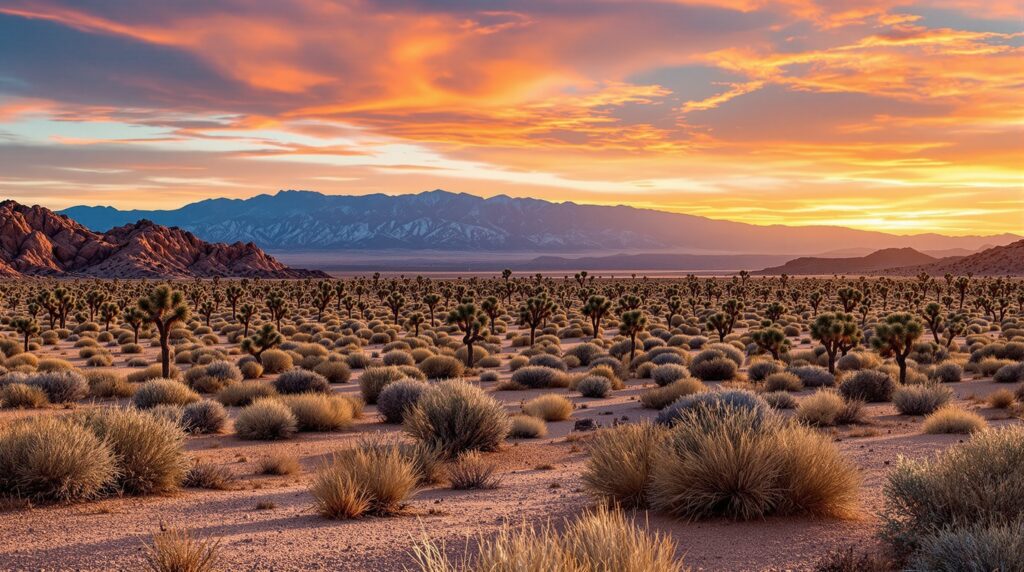
If the Mojave had a mascot, it would be the Joshua tree. These spiky, twisting trees are found almost exclusively in this desert. Their presence defines the Mojave’s boundaries.
Joshua trees can live for hundreds of years. They grow slowly, patiently, in open expanses. When you see a field of them stretching across the valley floor, it reinforces the desert’s scale. Each tree stands alone, spaced apart, yet collectively they fill the horizon.
Their very spacing is a reminder of how vast the land must be to support such wide distribution.
Cities in the Desert: Big Urban Footprints
The Mojave isn’t uninhabited. In fact, it contains one of the fastest-growing metropolitan regions in the United States.
Las Vegas sits squarely in the Mojave Desert and has a metropolitan population of over two million people. That means millions of residents live inside this desert’s boundaries.
Large solar farms dot the landscape. Military installations occupy wide expanses. Transportation corridors slice across valleys. The Mojave supports industry, tourism, and urban life on a massive scale.
So when asking how big the Mojave Desert is, you’re also asking how much human activity it contains. The answer is: more than most deserts anywhere.
Comparing the Mojave to Other Deserts
To understand its true scale, comparisons help. The Mojave is smaller than the Sahara, which spans over 3.6 million square miles. But compared to other North American deserts, it holds its own.
It is smaller than the Chihuahuan Desert but more iconic in popular culture. It is cooler and higher than much of the Sonoran Desert. And it is ecologically distinct from the Great Basin Desert to the north.
The Mojave’s identity comes not just from area but from character. It’s the desert of alien landscapes, roadside art, ghost towns, and endless highways. Its size is geographic, but its influence is cultural.
Geology: A Landscape Built on Tectonics
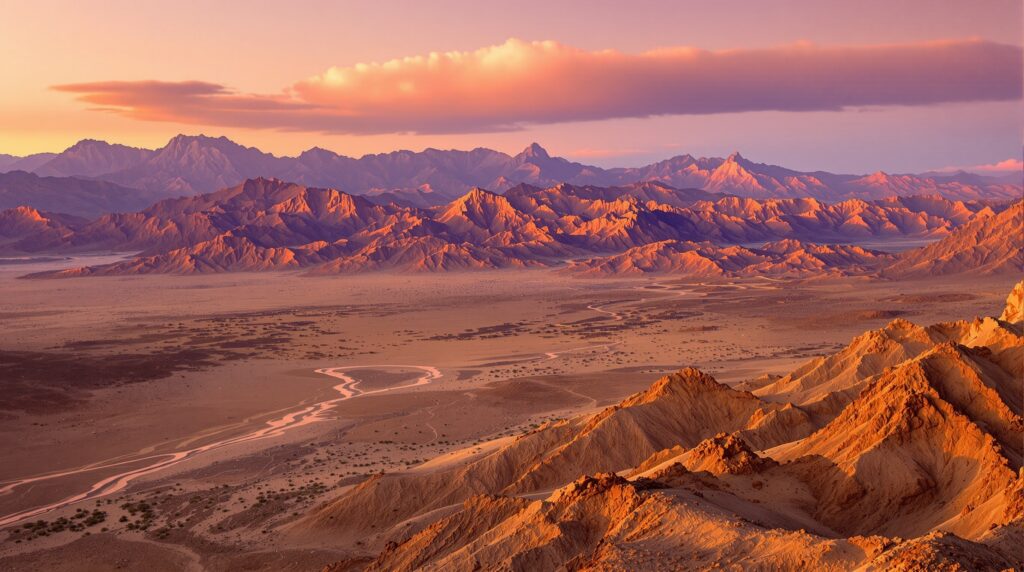
The Mojave Desert sits within the Basin and Range Province, a geologic region defined by stretched crust. Over millions of years, tectonic forces pulled the land apart, creating parallel mountain ranges separated by wide valleys. This stretching created the desert’s distinctive look: long ridges rising from flat basins. Some valleys contain dry lakebeds, also known as playas. Others hold salt flats that shimmer white under the sun. Its geology amplifies its size. Because mountain ranges run in parallel lines, your view is rarely blocked by one massive wall. Instead, you see layer after layer fading into blue haze. That repetition of ridges creates a visual echo of infinity.
Wildlife Across a Vast Terrain
Despite harsh conditions, the Mojave supports a surprising array of wildlife. Desert tortoises move slowly through scrubland. Coyotes roam at dusk. Bighorn sheep climb rocky slopes. Golden eagles soar overhead.
Because the desert spans multiple states and elevations, habitats vary widely. Some areas host sand dunes. Others contain volcanic rock fields. Still others hold seasonal wildflower blooms after winter rains.
The Mojave’s biodiversity stretches across its 47,000 square miles in complex patterns. It is not uniform. It is diverse, layered, and dynamic.
The Human Story: Ancient and Modern
Long before highways and casinos, Native American tribes thrived in the Mojave. The Mojave people themselves lived along the Colorado River. Other groups used trade routes that crossed the desert. Later came Spanish explorers, gold miners, railroad builders, and homesteaders. Ghost towns remain scattered across the landscape, silent reminders of boom-and-bust cycles. Today, artists, scientists, and adventurers continue to shape the Mojave’s story. It has become a place of experimentation, from aerospace testing to renewable energy projects. Its size makes it a laboratory of possibility.
How Long Would It Take to Cross?
If you drove straight across the Mojave from west to east, the journey could easily exceed 200 miles depending on your route. North to south, it stretches similarly vast distances. But crossing the Mojave isn’t simple. Roads weave around mountain ranges and protected areas. Some regions are accessible only by dirt tracks.
On foot, traversing it would take weeks. On a bicycle, days of endurance. Even by car, you can feel its breadth. Gas stations are spaced far apart in some regions. Cellular service fades in valleys. The desert reminds you of its size by demanding preparation.
Why It Feels Even Bigger Than It Is
Forty-seven thousand square miles is large. But the Mojave feels larger. Part of that sensation comes from minimal visual clutter. Without forests or skyscrapers blocking the view, distances appear exaggerated. Mountains that are 30 miles away look close enough to touch. Silence also expands perception. In quiet spaces, time slows. With fewer reference points, the brain struggles to measure scale. The Mojave leverages openness to create a psychological sense of infinity.
Final Perspective: So, How Big Is the Mojave Desert?
The Mojave Desert covers about 47,000 square miles across four states. It contains the lowest point in North America, massive national parks, thriving cities, and remote wilderness. It is larger than many countries. It spans hundreds of miles in every direction. It rises from below sea level to alpine peaks. But its true size isn’t only geographic. It’s experiential. It’s the scale of the sky, the depth of silence, the stretch of highway disappearing into heat shimmer. The Mojave is big in land, big in story, and big in feeling. Stand in it once, and you’ll understand.