How Much Space Does Golf Really Take? A Deep Dive into Course Size
If you’ve ever stood on the first tee at sunrise, watching mist lift off the fairway as sprinklers click in the distance, you’ve probably felt it: a golf course is big. Not just wide-open big, but layered big. Big in acreage. Big in design. Big in ambition. Big in the way it reshapes the land beneath it. But exactly how big is a golf course? The answer depends on what kind of course you’re talking about. A compact executive layout tucked inside a neighborhood feels very different from a sprawling championship venue that hosts a major tournament. Some courses fit into 30 acres. Others stretch beyond 250. And that’s just the land footprint—before we even factor in driving ranges, practice greens, clubhouses, parking lots, and natural buffers. Let’s break it down in a way that’s practical, visual, and genuinely interesting.
The Average Size of a Golf Course
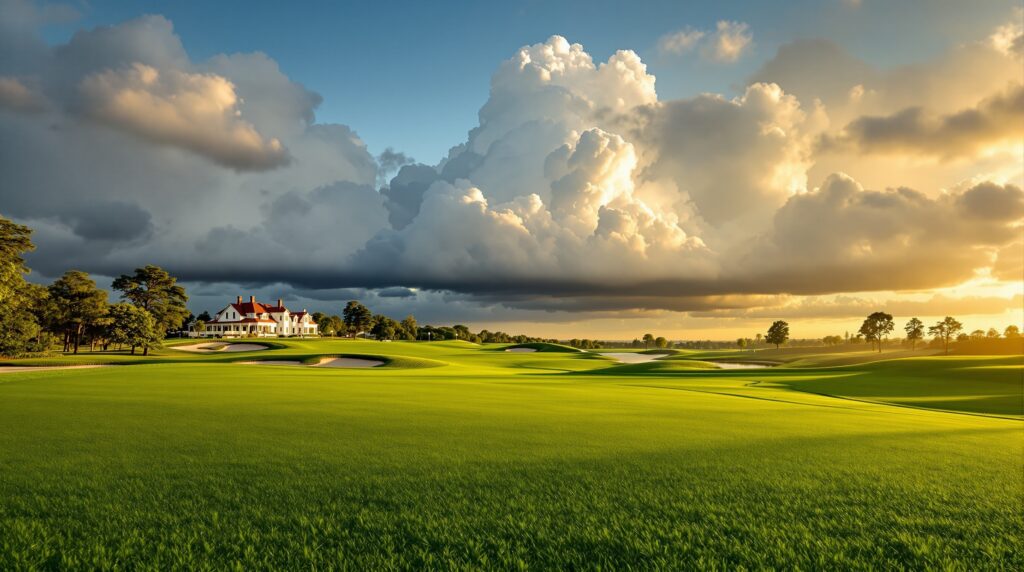
A standard 18-hole golf course typically covers between 120 and 200 acres. Most full-length courses fall somewhere in the 150-acre range, which has become a common benchmark in modern golf course development.
To put that into perspective, 150 acres is roughly equivalent to:
- About 113 American football fields
- Nearly 6.5 million square feet
- Around 0.23 square miles
That’s a lot of land dedicated to turf, trees, bunkers, water features, and rolling terrain. However, not all 18-hole courses are built the same. A traditional parkland-style course with wide fairways and generous spacing between holes will require more acreage than a compact layout with tighter routing. Designers can stretch a course across a vast landscape—or cleverly weave it into a smaller footprint.
Why Golf Courses Need So Much Space
At first glance, golf doesn’t seem like a land-hungry sport. After all, players take turns hitting a single ball. But when you zoom out, the scale becomes obvious.
Each hole must accommodate:
- A teeing ground
- A fairway
- Rough areas
- Hazards like bunkers or water
- A putting green
- Safe spacing from adjacent holes
Safety is a major factor in golf course size. Designers must ensure that errant shots don’t endanger players on neighboring holes. That means strategic spacing, directional routing, and buffer zones.
Then there’s terrain. Elevation changes, wetlands, natural tree lines, and environmental preservation areas can expand the overall footprint. Many courses intentionally leave large portions undeveloped to preserve ecosystems or maintain aesthetic beauty. The result? Golf courses become massive green corridors across the landscape.
How Big Is an 18-Hole Golf Course?
An 18-hole course is the gold standard in golf. It’s what you see on television during events like the Masters Tournament or U.S. Open.
In terms of acreage:
- Compact 18-hole course: 120–140 acres
- Average 18-hole course: 140–170 acres
- Championship-level course: 170–220+ acres
Some luxury or resort courses exceed 250 acres when they incorporate dramatic routing across natural terrain, especially in coastal or desert settings. The actual playing area—the turf used for tees, fairways, and greens—may only account for about 60–90 acres. The rest includes rough, natural land, water bodies, wooded areas, and infrastructure. So when someone asks how big a golf course is, the honest answer is: bigger than it looks on TV.
How Big Is a 9-Hole Golf Course?
A 9-hole course is generally about half the size of an 18-hole course, but not exactly half in acreage. That’s because facilities, parking, and clubhouse areas still take up space. Most 9-hole golf courses range between 50 and 100 acres.
These courses are popular in:
- Smaller communities
- Municipal developments
- Beginner-friendly facilities
- Urban environments with limited land
A 9-hole course can feel just as scenic and enjoyable as an 18-hole layout, especially when thoughtfully designed.
Executive and Par-3 Course Sizes
Not every golf course is championship-length. Executive and par-3 courses are shorter and far more compact. Executive courses, which include shorter par-4s and par-5s, usually occupy 30 to 90 acres, depending on hole count and spacing. Par-3 courses can be even smaller, often fitting into 20 to 50 acres.
These layouts are ideal for:
- Beginners learning the game
- Time-conscious players
- Urban or resort settings
- Practice-focused facilities
Their smaller size also reduces maintenance and operational costs, which can make them more financially sustainable in certain markets.
What Makes a Golf Course “Long”?
A golf course’s size isn’t just about acreage—it’s also measured in yardage. When golfers talk about how long a course is, they’re referring to the total playing distance from tee to green across all holes.
Here’s how that typically breaks down:
- Beginner-friendly course: 5,000–6,000 yards
- Standard course: 6,200–6,800 yards
- Championship course: 7,000–7,600+ yards
Professional tournament setups can exceed 7,700 yards. But here’s the twist: a longer yardage doesn’t always require dramatically more acreage. Designers can stretch holes lengthwise without necessarily expanding the overall property footprint—especially on narrow parcels of land.
The Hidden Space Beyond the Fairways
When people picture a golf course, they imagine manicured greens and sand traps. But that’s only part of the story.
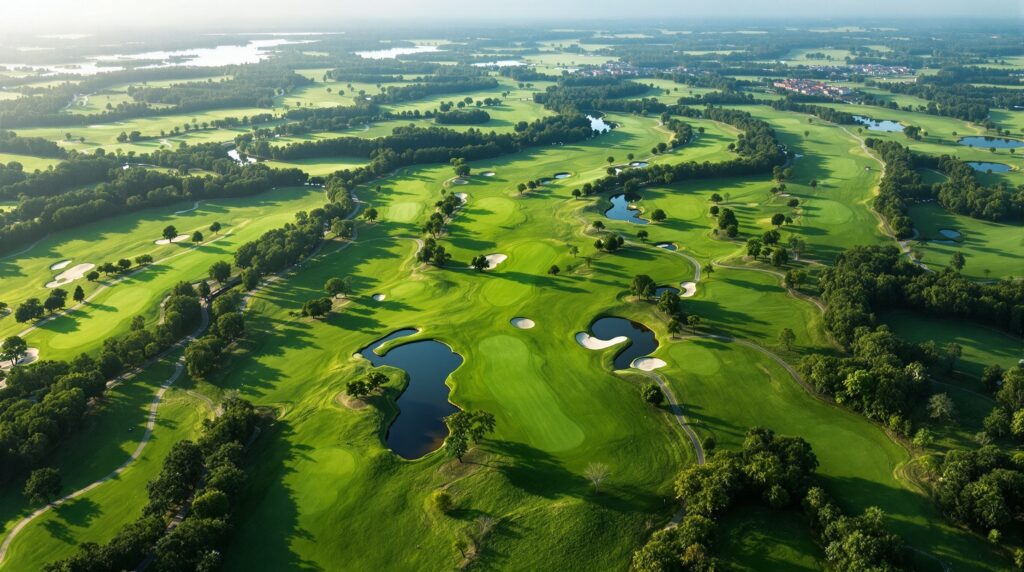
Large portions of a golf course may include:
- Woodlands
- Native grasslands
- Wetlands
- Lakes and ponds
- Environmental conservation zones
Many modern golf developments emphasize sustainability. Architects may preserve natural habitats or integrate the course around existing terrain rather than bulldozing everything flat. This often increases total acreage while reducing the intensively maintained turf area.
In some regions, golf courses serve as de facto wildlife corridors—supporting birds, deer, foxes, and countless other species.
How Big Is the World’s Largest Golf Course?
Some courses redefine scale entirely.
The longest golf course in the world is Nullarbor Links in Australia, which stretches across nearly 850 miles between towns. It’s a unique outback course where holes are located in different communities across a massive distance. Of course, that’s a novelty layout rather than a single contiguous property. But it demonstrates how flexible the definition of “golf course size” can be.
In terms of traditional, continuous championship courses, sprawling resort properties can exceed 250 acres, especially when built across dunes, deserts, or mountainous terrain.
Golf Course Size Compared to Other Land Uses
To understand how big a golf course really is, it helps to compare it to other spaces.
- A typical suburban neighborhood development might use 3 to 5 homes per acre. On 150 acres, that could mean 450 to 750 homes.
- A shopping mall complex might occupy 40 to 80 acres.
- A city park might span anywhere from 10 acres to several hundred.
Golf courses sit somewhere between parkland and private sports complex. They combine recreation, landscaping, and environmental space on a scale few other facilities match.
How Much Land Is Used for Golf in the United States?
The United States has roughly 15,000 to 16,000 golf courses. If we assume an average of 150 acres per course, that equates to more than 2 million acres devoted to golf. That’s larger than some entire U.S. states’ park systems. Golf is deeply embedded in American land use planning, particularly in suburban and resort communities.
The Role of Design in Golf Course Footprint
Golf course architects are artists with acreage. Routing a course across rolling terrain requires careful balance. Designers consider wind patterns, natural water flow, soil conditions, and existing vegetation. Some legendary architects are known for minimalist designs that move very little earth. Others embrace dramatic shaping, moving millions of cubic yards of soil to sculpt bold landscapes.
A course built on flat farmland may require more acreage to create variety. A mountainous course might use elevation changes to fit holes more compactly. Design philosophy heavily influences how big a golf course becomes.
How Big Is a Golf Course in Square Feet?
For readers who prefer hard numbers, let’s convert acreage to square footage. One acre equals 43,560 square feet.
So:
- 120 acres = 5,227,200 square feet
- 150 acres = 6,534,000 square feet
- 200 acres = 8,712,000 square feet
That’s millions of square feet of land shaped, irrigated, and maintained.
Maintenance Area vs. Total Property Size
Not every acre of a golf course is intensively managed turf. In fact, only a portion is regularly mowed and maintained at high standards.
Typical breakdown for an 18-hole course:
- Greens: 3–5 acres
- Tees: 3–5 acres
- Fairways: 25–35 acres
- Rough: 40–70 acres
- Natural/native areas: 20–80 acres
This distribution affects water use, maintenance costs, and environmental impact.
Golf Courses in Urban vs. Rural Settings
Urban golf courses tend to be smaller due to land constraints. They may occupy 100–140 acres and feature tighter routing.
Rural or resort courses can stretch far wider, incorporating scenic vistas and dramatic landscapes.
Coastal courses, in particular, often use expansive dune systems and open space, which increases total acreage.
The Economic Side of Size
Land is expensive. That means golf course size directly impacts development cost. At 150 acres, even modest land prices can result in millions of dollars in acquisition costs alone. Add design, construction, irrigation systems, drainage, turf establishment, and clubhouse facilities—and the investment quickly climbs. This is one reason many new golf developments include residential communities. Homes surrounding the course help offset land costs.
So, How Big Is a Golf Course?
Here’s the clear answer:
Most 18-hole golf courses are between 120 and 200 acres, with 150 acres being a common average. Nine-hole courses typically range from 50 to 100 acres. Executive and par-3 courses may fit into 20 to 90 acres. But acreage only tells part of the story. A golf course is big in experience. Big in visual impact. Big in environmental footprint. Big in community influence. It’s a landscape designed not just for sport—but for atmosphere, challenge, and memory.
Next time you stand on a tee box and look down the fairway, you’re not just seeing grass. You’re seeing hundreds of acres of carefully shaped terrain stretching around you. And that’s what makes golf courses feel as vast as they truly are.