
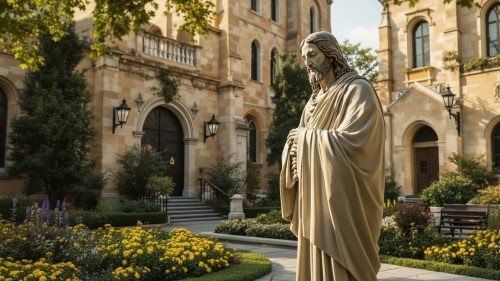
The Giant Jesus Statue: A Monument of Faith, Art, and Human Ingenuity
Across the world, monumental statues rise above city skylines, mountain ridges, and coastal cliffs, commanding attention from locals and travelers alike. Among them, the Giant Jesus Statue stands as one of the most awe-inspiring creations of human devotion. With arms stretched wide in a gesture of welcome and peace, this towering figure is not merely stone and steel—it is a story of faith, artistry, and cultural identity immortalized in physical form. To stand at the base of such a statue is to feel small in the grandest sense, reminded not only of the spiritual but also of the vast creative power of humankind. This article will journey through the history, symbolism, global significance, and even the engineering marvels that go into fabricating a Giant Jesus Statue, weaving together a narrative that is as inspiring as the statue itself.

A Brief History of Monumental Jesus Statues
The concept of erecting colossal Jesus statues is not new. One of the most famous, Christ the Redeemer in Rio de Janeiro, Brazil, was completed in 1931 and stands 98 feet tall atop Mount Corcovado. It has become an iconic symbol not only of Christianity but also of Brazil itself. Inspired by its grandeur, many other nations have followed suit, building their own monumental tributes. From the Cristo Rey in Colombia to the Christ of the Pacific in Peru, and the towering Christ the King in Poland, these statues serve as visual declarations of faith and cultural pride. What unites them is their universal symbolism: a larger-than-life representation of love, forgiveness, and hope. These monuments invite reflection for believers, while at the same time impressing visitors of all backgrounds with their sheer scale and beauty.
Why Build So Big?
At first glance, the size of these statues may seem excessive. But monumental art has always been about scale as symbolism. In ancient times, civilizations built pyramids, ziggurats, and temples to bridge the human with the divine. In much the same way, a Giant Jesus Statue stands tall to connect the heavens with the earth, symbolizing the all-encompassing reach of faith.
The arms of such statues are often outstretched, not just as an artistic choice but as a theological message: an embrace large enough to welcome all of humanity. The very size of the statue is meant to make viewers stop, reflect, and be humbled by the magnitude of the message it carries.
The Artistic Expression Behind the Statue
Though religious in essence, a Giant Jesus Statue is also a work of art. Sculptors carefully balance anatomical detail with stylized design, ensuring that the figure conveys serenity, authority, and compassion all at once. The face is perhaps the most challenging feature. Sculptors aim for a universal expression—gentle, timeless, and approachable. The folds of the robe, meanwhile, are carved or cast in flowing shapes, giving the illusion of fabric moving with the wind. The sheer height of the statue requires adjustments in proportion, as features must be exaggerated slightly so that from the ground, they appear harmonious and true to life. Every curve, line, and angle is chosen deliberately to evoke a sense of reverence. In this way, the statue functions as both religious symbol and artistic masterpiece.
Famous Examples Around the World
The idea of a Giant Jesus Statue has taken root across continents. Some of the most iconic examples include:
- Christ the Redeemer (Brazil): Perhaps the most recognized, overlooking Rio with arms open wide, it is a global icon of peace and welcome.
- Christ the King (Poland): Completed in 2010, this statue rises to 108 feet, making it one of the tallest statues of Jesus in the world.
- Cristo de la Concordia (Bolivia): At 112 feet tall, this statue dominates the skyline of Cochabamba, with a staircase inside that allows visitors to climb into the figure itself.
- Christ of the Ozarks (USA): In Arkansas, a more modernist design portrays Christ in stark simplicity, overlooking the rolling hills.
Each of these monuments carries its own cultural and historical meaning, reflecting the communities that built them. Some were funded through local donations, others through church initiatives or even government-backed projects, but all of them share the same central aim: to inspire awe and devotion.
Pilgrimage and Tourism
Giant Jesus Statues are not merely religious icons—they are also powerful magnets for tourism. Millions of visitors every year climb mountain paths, ride cable cars, or drive winding roads to reach these statues. The journey often becomes a pilgrimage in itself, blending physical effort with spiritual reflection. Local communities benefit from the influx of visitors, as hotels, restaurants, and shops thrive near the sites. Beyond economics, however, the statues often foster a shared sense of pride, becoming symbols of local identity. For many travelers, the chance to stand at the feet of a Giant Jesus Statue is not only a bucket-list experience but also a deeply emotional one.
The Challenges of Building a Giant Jesus Statue
Constructing such a monument is far from simple. Engineers and architects face unique challenges that combine artistry with technical brilliance.
- Location: Many statues are placed on mountains or hills, requiring creative solutions for transporting massive construction materials.
- Scale: Designing proportions that look natural at 100 feet tall is an art in itself, demanding specialized knowledge in both sculpture and structural engineering.
- Weather Resistance: Wind, rain, and even lightning are constant threats to a structure that towers into the sky.
- Materials: From reinforced concrete to bronze, the choice of material affects not only the appearance but also the durability of the statue.
Overcoming these challenges requires interdisciplinary collaboration among artists, engineers, contractors, and community leaders.
How a Giant Jesus Statue Might Be Fabricated
The process of fabricating a Giant Jesus Statue is a feat of modern engineering and artistry combined. Here’s how such a monumental project could unfold:
- Concept and Design The first step is vision. Sculptors create small-scale clay or digital models, perfecting every detail. These maquettes are then scanned or measured to produce accurate digital blueprints that can be scaled up.
- Foundation and Support Because the statue is so heavy, the foundation must be deep and reinforced, often involving hundreds of tons of concrete. Engineers calculate the forces of wind and gravity to ensure stability.
- Framework Inside the statue lies a hidden skeleton of steel. This internal framework acts as the bones of the figure, supporting the outer layers and ensuring the statue can withstand environmental pressures.
- Outer Shell Depending on the design, the outer shell may be cast in concrete, bronze panels, or even advanced composites. Each piece is fabricated in manageable sections, then hoisted into place and joined seamlessly.
- Detailing Artisans work on the finishing touches, ensuring that facial features, hands, and folds of fabric carry the intended expression. For concrete statues, molds may be created for repeated textures. For metal-clad designs, panels are polished or treated to resist corrosion.
- Safety and Accessibility Many statues include interior staircases or elevators, allowing visitors to climb inside. Safety systems, lightning rods, and regular maintenance protocols are also built into the design.
The end result is not only a structure but a monument that blends art, faith, and science into one unforgettable creation.
Symbolism in Stone and Steel
A Giant Jesus Statue is more than a towering figure—it is a story in solid form. The raised arms represent a universal embrace. The serene face conveys peace. The lofty height points upward, reminding humanity to look beyond earthly struggles. In a world often divided, these statues stand as silent yet powerful reminders of unity. Even for those outside the Christian faith, the symbolism of compassion, forgiveness, and welcome transcends boundaries.
The Emotional Impact
Ask anyone who has stood at the base of one of these statues, and they will describe a sense of awe. The experience is both humbling and uplifting, making one feel at once small in the vastness of the universe and embraced by something far greater. This emotional resonance explains why these statues continue to be built. They are not just physical structures—they are emotional anchors, cultural symbols, and spiritual beacons.
The Future of Giant Jesus Statues
As technology advances, the future holds fascinating possibilities. Digital design and 3D printing could allow for more intricate details at massive scales. Sustainable materials may reduce environmental impact, while augmented reality could enhance the visitor experience, overlaying stories and teachings as one gazes up at the statue. What remains constant, however, is the enduring human desire to create monuments that inspire. Whether in concrete, bronze, or futuristic composites, the Giant Jesus Statue will continue to rise as a timeless symbol of devotion.
Conclusion: More Than Just a Monument
The Giant Jesus Statue is not only a colossal figure on a hill—it is a living story, sculpted in faith and steel, stone and hope. It is an intersection where art meets religion, where engineering meets inspiration, where communities rally together to create something bigger than themselves. To visit such a statue is to take part in a tradition that spans centuries and continents. It is a reminder of what humanity can achieve when driven by vision and belief, and of the messages of love and peace that remain as vital today as ever. Standing beneath the outstretched arms of a Giant Jesus Statue, you realize that it is not only a monument to Christ but also a monument to human creativity, resilience, and yearning for connection with the divine.
Check out WhiteClouds’ 3D Statues for more information.
Contact us today to learn more about our 3D services and how we can help you achieve your goals.