
Planning a Giant Rugby Ball Prop
A rugby ball prop uses a prolate form with pointed ends, a smooth continuous shell, and sport-specific panel or seam treatment. Those proportions must remain distinct from an American football before graphics, team colors, or a display base are added.
Plan a Rugby Ball Display
Preserve the rugby ball's long prolate silhouette
Set overall length, maximum diameter, end taper, and the centerline curve from an approved rugby ball. The ends should narrow continuously rather than adopting the blunter football profile or prominent raised laces associated with another sport.
Choose the exact ball type and product reference before mapping seams, panels, marks, and colors. Different rugby balls may use different graphic layouts, but the supplied reference should control the prop.
Coordinate the seam map, artwork, and fixed pose
The simple volume makes small proportional and graphic errors visible from a distance.
Length and diameter
Record the full point-to-point length, widest section, and end taper on both elevation and cross-section views.
Panel and seam map
Trace every visible seam around the complete body and distinguish it from decorative graphics or unsupported lace details.
Authorized artwork
Provide current marks, team or event graphics, color values, and a chosen hero face with documented permission.
Display orientation
Choose vertical, horizontal, or angled presentation and include the base, highest point, and full occupied envelope.
Check sightlines around a long pointed form
A vertical rugby ball emphasizes height and uses a compact footprint, while a horizontal or angled version occupies more floor area and exposes different graphics. Show the primary audience approach and any camera position on the site plan.
The enlarged object is a static display unless a separate requirement defines movement, suspension, visitor contact, exterior exposure, or another performance. It should not be represented as playable sports equipment.
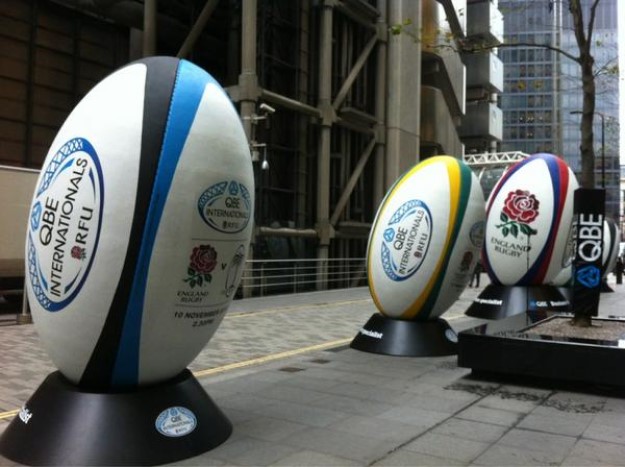
Use physically correct rugby-ball references
These physical displays show the required prolate body and pointed ends. Their graphics are examples only; a new project should use the exact authorized ball and artwork supplied for that display.
Define the exact ball and display pose
The reference set should distinguish rugby geometry from nearby ball types before production artwork is prepared.
- Exact rugby ball or approved product reference
- Point-to-point length and maximum diameter
- End taper and complete panel or seam map
- Authorized logos, marks, colors, and hero face
- Vertical, horizontal, angled, or suspended-looking fixed pose
- Base, platform, or surrounding scenery
- Primary view, site footprint, and access route
- Destination and required date
Request pricing for a giant rugby ball prop
Send the exact rugby ball reference, dimensions, seam and artwork files, fixed pose, site plan, destination, and schedule.