
Planning a Giant Artichoke Prop
A giant artichoke prop is defined by concentric layers of pointed bracts that close toward the crown. Planning those layers as one measured form helps the enlarged object remain unmistakably artichoke-shaped while establishing its height, diameter, degree of closure, primary view, and display footprint.
Plan a Giant Artichoke Prop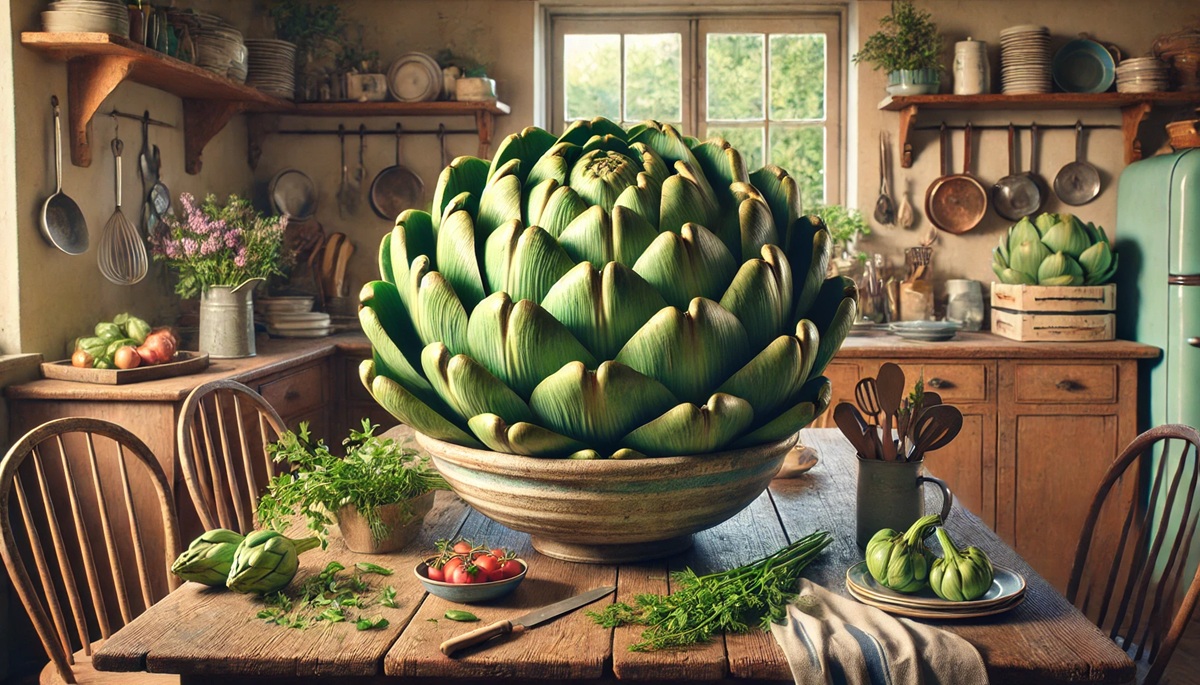
Choose the Artichoke Reference and Degree of Closure
Start with one approved artichoke reference. The outer profile can be low and broad, tall and tapered, or nearly spherical, and the crown can appear tightly closed or slightly open. Front, side, and upper-angle references help define a single consistent form before the bracts are enlarged or simplified.
Record the target height and maximum diameter together. Then identify the widest bract ring, the point where the profile begins to taper, and the amount of the crown visible from the principal view. These decisions establish a physical subject that is different from a cabbage head, cauliflower crown, or mixed vegetable arrangement.
Organize the Bracts From Base to Crown
An artichoke reads through repetition with controlled variation. Each ring should contribute to the same bud rather than look like a collection of unrelated leaves.
Outer bracts
Set the width, length, point shape, outward angle, and overlap of the lowest visible layer. This ring establishes the maximum diameter and the transition into the display base.
Intermediate rings
Define how each successive layer becomes smaller, steeper, and more tightly spaced. A measured progression keeps the enlarged form organized from several viewing angles.
Crown closure
Choose how much the central bracts overlap and where their points converge. A tight crown creates a compact bud; a more open center changes both the top view and the overall height.
Veins and edge detail
Mark the few ridges, veins, edge breaks, and tip accents that need to remain visible at the planned viewing distance. Avoid adding fine botanical detail that is not part of the approved reference.
Set the Scale, Orientation, and Footprint
A straight upright presentation emphasizes the radial symmetry of the bud. A slight angle can reveal more of the crown and the overlap between layers, but it also changes the footprint and the way the base meets the form. Identify the main audience or camera position, every exposed side, and whether the display will sit on the floor, a platform, or another supplied setting.
Provide the available floor area, nearby circulation, doorway and loading constraints, and the intended viewing distance. Also state whether a visible base is acceptable and whether the lowest bracts should appear to touch the display surface. Any request for movement, lighting, handling, or audience interaction should be identified separately for evaluation rather than assumed from a concept image.
Compare Two Artichoke Display Directions
One concept uses a bowl-like supporting element and a broad profile, making the lower bract ring and crown easy to compare from a near-level view. The other presents the artichoke as a freestanding object and shows how a tighter footprint can keep the complete layered silhouette visible.
Use the views to compare profile, bract rhythm, crown closure, orientation, and support visibility. Specify the target dimensions, placement conditions, handling needs, and any requested function separately so those requirements can be evaluated for the actual project.

Plan Color Transitions and Bract Detail
Supply color references for the overall green range, darker recesses, lighter ridges, tip accents, and any intentional variation between the outer and inner layers. The treatment can follow a specific natural reference or use an approved brand palette, but the direction should be explicit so the layered geometry remains clear.
If the artichoke will carry a logo, label, or other graphic, show its exact position on an elevation and provide production-ready artwork. Curved, overlapping surfaces can interrupt a large mark, so the graphic location should be considered with the primary view rather than added after the physical form has been settled.
Send the Artichoke Prop Brief
A useful request connects the visual reference to the size and conditions of the real display.
- Approved front, side, and upper-angle artichoke references
- Target height, maximum diameter, and available footprint
- Broad, tapered, rounded, or other approved overall profile
- Desired degree of crown closure and visible bract layers
- Required veins, ridges, tip accents, colors, and graphics
- Upright or angled orientation and the principal viewing side
- Every exposed side and whether a visible base is acceptable
- Indoor, sheltered, or weather-exposed placement details
- Access route, destination, installation window, and required date
- Any requested lighting, movement, handling, or interaction for separate review
Request a Custom Prop Quote
Send the artichoke reference, target dimensions, degree of closure, bract details, colors, primary view, placement conditions, footprint, access information, destination, and schedule. WhiteClouds can review the scope and prepare a custom quote.