
Shaping a Giant Eyeball Display
A giant eyeball display combines a near-spherical body with a precisely placed iris, pupil, surface markings, and a chosen direction of gaze. Its success depends on controlling the viewing face, roundness, support, and optional cutaway or surrounding features without becoming a general page about eyes or medical topics.
Plan an Eyeball Display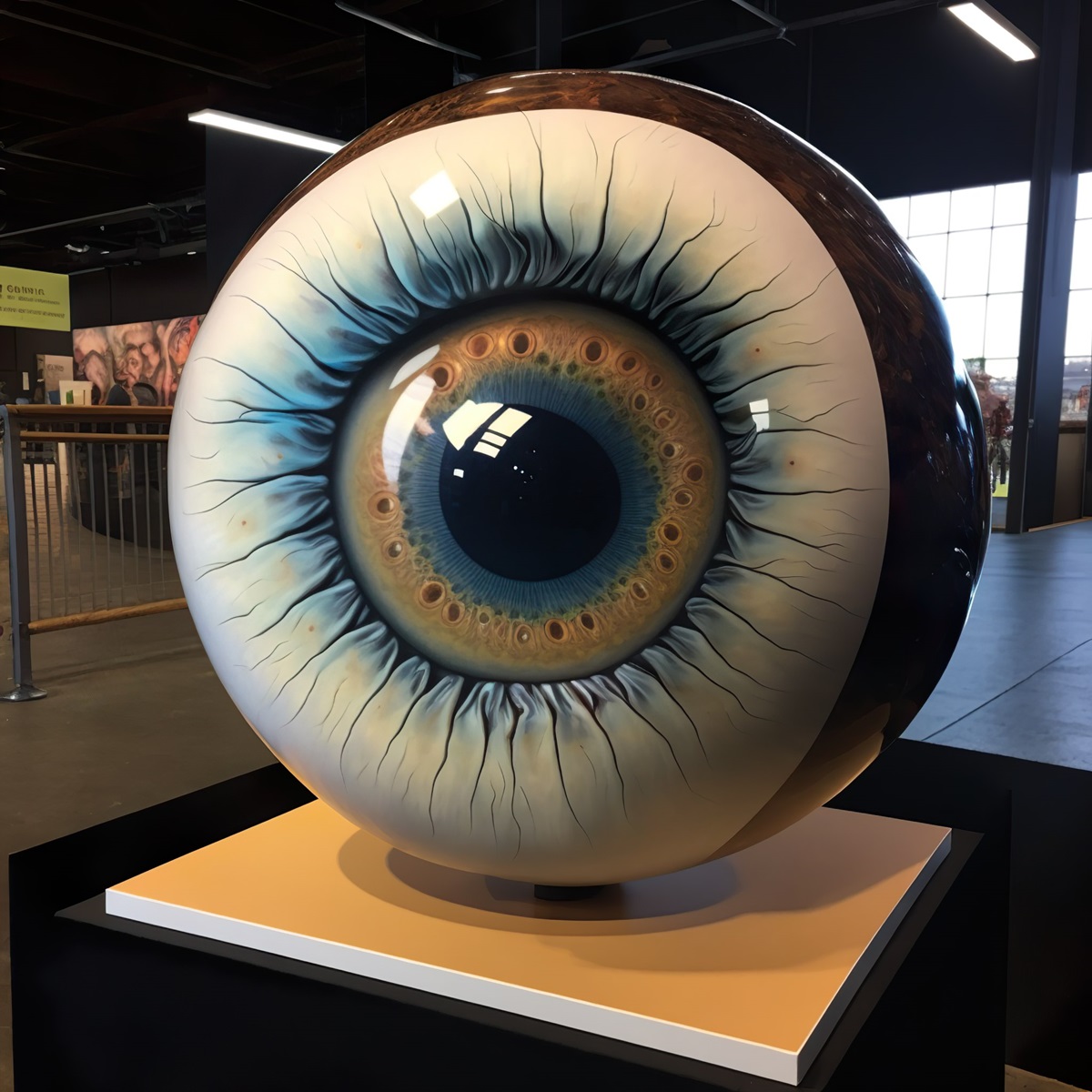
Decide how much of the eye exists in three dimensions
A complete sphere creates a strong walk-around object but uses the greatest depth. A partial sphere can sit closer to a wall or scenic surface. A front-facing disc may reproduce the iris clearly yet lose the unmistakable volume of an eyeball. Choose the configuration before sizing the artwork.
Show the diameter, rear projection, and any flattened contact area in section. If a cutaway is needed, define the removed portion and the visible interior as a separate composition rather than cutting into the finished sphere without a planned viewing angle.
Place the iris for the actual audience approach
The iris and pupil do not have to sit on the geometric front of the support. Set the intended gaze toward the primary camera, aisle, stage position, or visitor path. Then check how the eye reads from the edges of that viewing zone.
Provide approved iris art or a close visual reference. Dimension iris diameter, pupil diameter, color rings, highlights, and any branching surface lines. Large markings that work from across a room may need a different level of detail than a close-view scientific display.
Resolve the eye's physical behavior
The support and rear treatment depend on the selected display mode.
Fixed floor display
Identify the hidden or visible contact area, finished viewing sides, and the exact gaze that the support must maintain.
Wall or scenic mount
Show the depth projecting from the background and define how the eyelid, socket, sign, or supplied scenery meets the eye.
Controlled rotation
If movement is required, state the desired range, operating method, speed expectation, and viewer separation as explicit project requirements.
Open cutaway
Define the cut plane, selected interior features, labels, and the direction from which the open section is meant to be read.
See how graphics organize a round display
The pictured physical display uses a blue iris, dark pupil, and branching red marks against a white spherical body. Those high-contrast features remain clear while the round silhouette supplies the recognizable volume.
The photograph does not identify the fabricator or establish how the object was made. A new concept should be based on its own art, sphere depth, gaze, support, setting, and interaction requirements.
Coordinate the artwork with the physical sphere
Useful estimating information connects the visible eye to the space around it.
- Complete sphere, partial sphere, disc, or cutaway choice
- Overall diameter and maximum rear depth
- Iris and pupil artwork with exact dimensions
- Gaze direction and primary audience position
- Surface markings, highlights, labels, or interior features
- Fixed, rotating, wall-mounted, scenic, or freestanding arrangement
- Finished sides, viewer distance, and interaction limits
- Access dimensions, destination, and required date
Request pricing for a custom giant eyeball
Send the configuration, diameter and depth, iris artwork, gaze, markings or cutaway content, support arrangement, viewing conditions, interaction requirements, access information, destination, and schedule.