
Planning an Oversized Jaw Display
An oversized jaw display is organized around the arch, tooth arrangement, opening angle, hinge region, and the relationship between upper and lower forms. Defining those parts as one physical object keeps the task separate from a single giant tooth, a complete skull, or a broad medical-prop page.
Plan a Jaw Display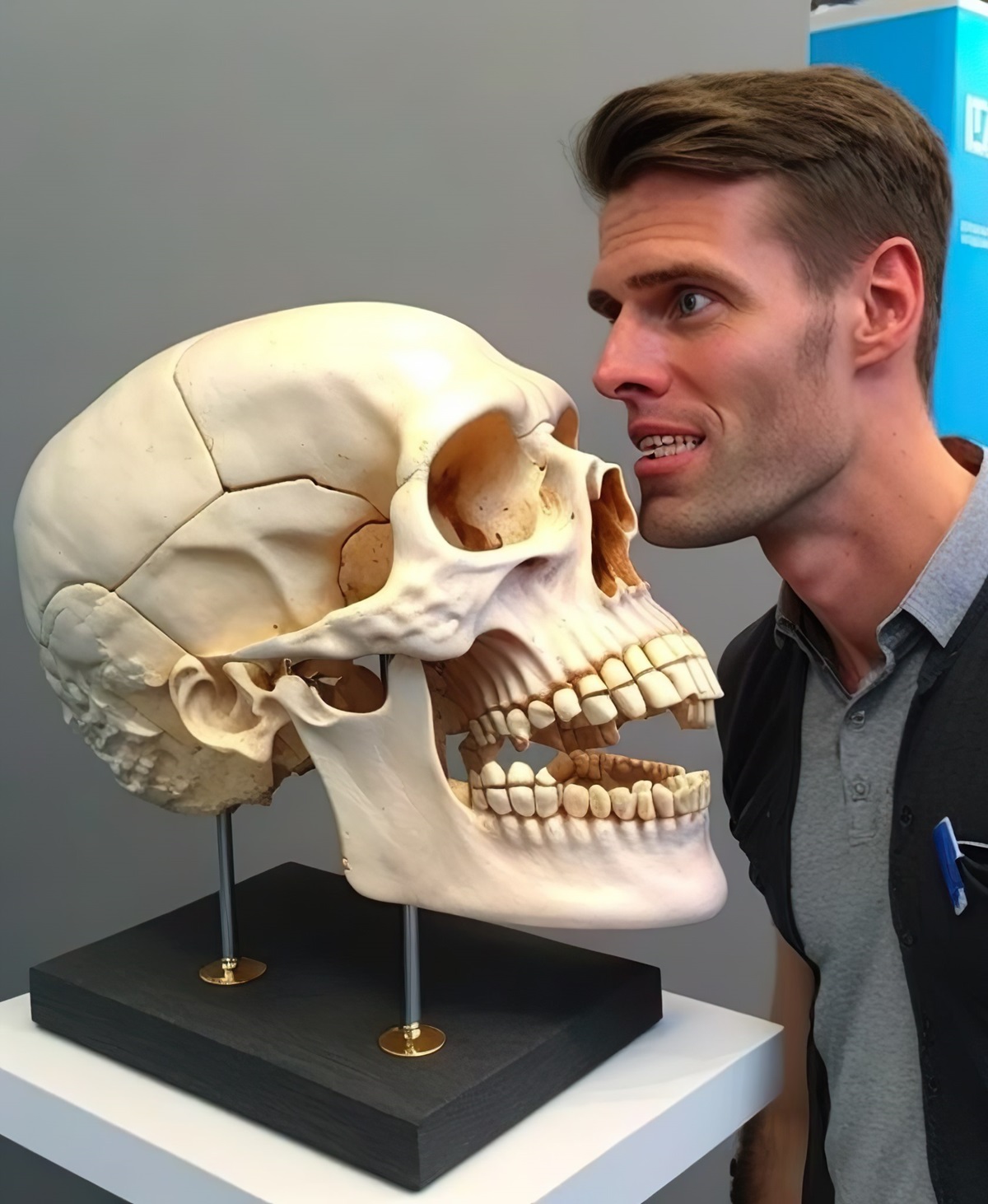
Compare a physical arch with a graphic open mouth
The physical reference shows an open jaw and skull-scale arrangement beside a standing person. It makes the arch depth, repeated teeth, hinge area, and open space easy to compare at display scale. The illustrative mouth concept uses a front-facing dental arch and tongue.
Neither image supplies the specifications for a new project. The request should establish its own configuration, opening angle, tooth detail, surrounding forms, support, and viewer relationship.

Choose which parts make up the display
The selected configuration determines both content and occupied space.
Paired open jaws
Define upper and lower arches, hinge relationship, opening angle, and visible inner surfaces.
Single arch
Identify whether the upper or lower jaw is shown and how its curved base, teeth, and rear edge are presented.
Complete mouth
Add gums, lips, tongue, palate, or surrounding facial forms only when they belong to the approved visual brief.
Cutaway or labels
Show the exact section, roots, callouts, or removable features required without expanding into general instruction.
Set the arch before detailing individual teeth
Draw the upper and lower arch curves in plan and elevation. Then place the tooth sequence, widths, heights, spacing, and any intentionally enlarged feature. The repeated forms should remain distinct from the principal viewing distance rather than collapsing into a uniform white band.
Choose how much gum, inner-mouth color, tongue, or surrounding structure is visible. These elements can clarify depth and scale, but they should not obscure the arch or turn a jaw display into a full head unless that broader form is explicitly requested.
Use the mouth space deliberately
A small opening emphasizes the outer jaw line. A wide opening exposes the tooth rows and inner surfaces while increasing overall height and depth. Set the angle in a side drawing and mark the closest audience line.
If the mouth frames a photo position, define where people stand, the clear opening, and the surfaces they may approach. If parts move or remove, describe the exact action and access requirement instead of assuming functional articulation from the visual design.
Specify the arches, teeth, and viewer relationship
The initial package should show the jaw from enough directions to resolve the opening.
- Upper jaw, lower jaw, paired jaws, complete mouth, or cutaway choice
- Overall width, depth, height, and selected opening angle
- Arch curves, tooth count, spacing, size, and level of detail
- Gum, tongue, palate, facial, label, or callout elements
- Fixed, removable, or separately specified moving parts
- Principal viewing face and finished sides
- View-only, photo-opening, or other defined interaction
- Support condition, access route, destination, and required date
Request pricing for a custom giant jaw
Send the configuration, arch and tooth references, opening angle, dimensions, gums or surrounding elements, labels, support arrangement, viewing access, interaction requirements, destination, and schedule.