
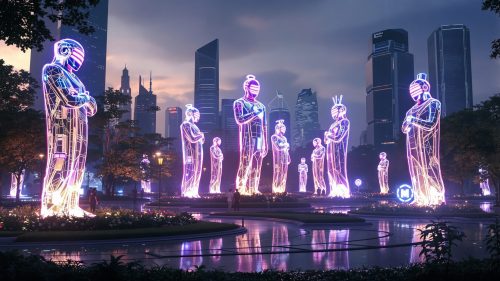
Humanity’s Habit of Immortalizing Itself
Walk through any city square, park, or plaza, and you’ll notice one recurring thread across civilizations and centuries—statues. Silent yet expressive, they stand as storytellers in metal and marble, revealing who we once worshiped, admired, or wanted to become. From ancient emperors and mythical deities to modern activists and abstract forms, statues are our most enduring conversation with time itself. The story of public statues isn’t just about art; it’s about power, memory, rebellion, and rebirth. As cultures evolve, so too do the forms we carve into permanence. Let’s explore how statues have transformed from sacred relics into social mirrors—and how the next generation of sculptors might literally build history from the ground up.

Ancient Origins: Worship, Power, and Permanence
The earliest known statues weren’t created to decorate—they were built to deify. The Venus of Willendorf, a tiny limestone figurine dating back over 25,000 years, may not have been public art, but it set the precedent: sculpture as reverence. By the time the Egyptians erected colossal figures of Ramses II, humanity had learned that scale itself could be a language of authority.
Ancient Greece refined this relationship between man and monument. Statues like the Discobolus and the Venus de Milo celebrated the beauty and potential of the human form. To walk through the Agora of Athens was to stroll through a marble archive of philosophy and athleticism—an outdoor museum that still shapes how we imagine public art.
Rome amplified the propaganda. Bronze and marble busts immortalized emperors in every forum, letting Caesar’s gaze follow his subjects long after his death. These statues weren’t merely portraits—they were instruments of statecraft. To destroy a statue was to challenge authority itself, a political act as potent as rebellion.
The Middle Ages: When Statues Found Their Faith
When the Roman Empire crumbled, religious devotion replaced political grandeur. Christianity reshaped sculpture into a vessel for divine storytelling. Gargoyles, saints, and angels adorned cathedrals, turning architecture into a living sermon.
Public statues became less about the individual and more about faith. Gothic artisans sculpted heaven’s hierarchy along the facades of Notre-Dame and Chartres, reminding citizens that salvation—and damnation—were always watching. In contrast to classical realism, medieval sculptors sought emotional truth over anatomical perfection. These figures bent and leaned, weeping or praying, showing the rise of empathy in stone. It was art in service of spirituality, not sovereignty.
The Renaissance: Rebirth of the Human and the Hero
Then came the Renaissance, and with it, the reawakening of self. Statues once again celebrated humanity’s power, intellect, and ambition. Michelangelo’s David captured an ideal of courage, intelligence, and grace so profoundly that it redefined what public art could be. Cities like Florence competed to commission sculptors, turning squares into open-air galleries of civic pride. Bronze and marble ceased to serve the church alone—they began to serve the citizen. Sculpture in this era achieved something radical: it democratized beauty. Every passerby could encounter genius in a plaza. Every statue became an invitation to think, to aspire, to belong to a cultural conversation that outlived its makers.
The Age of Empires: Conquest and Commemoration
As Europe’s powers expanded their reach, statues became tools of colonial display. Monumental figures of kings, generals, and explorers filled capitals from London to Madrid to Paris, symbolizing dominion and destiny. Across the Atlantic, new nations adopted the language of monumentality to define their identities.
The Statue of Liberty, gifted from France to the United States in 1886, was both a symbol of freedom and a statement of industrial capability. Its copper skin, forged in Paris and assembled in New York, spoke of technology as much as ideology. But not all monuments were welcome. Colonized regions saw statues as emblems of foreign rule—a visual reminder of subjugation. Many of those same statues would later face removal or reinterpretation as cultures reclaimed their narratives. This age cemented the statue’s dual role: as both a beacon of pride and a battleground of memory.
The Modern Era: From Marble Men to Movements
By the 20th century, the world had changed faster than any sculptor could carve. Industrialization, world wars, and social revolutions challenged who deserved to stand on a pedestal. Traditional monuments—uniform men on horses—felt out of step with modern values. Artists began experimenting with abstraction, minimalism, and emotion instead of grandeur. Rodin’s “The Thinker” invited introspection, not worship. Henry Moore’s organic forms emphasized humanity’s fragility instead of its dominance. Public statues evolved into public dialogues. Memorials like Maya Lin’s Vietnam Veterans Memorial in Washington, D.C., replaced literal figures with reflective surfaces that forced viewers to confront their own image. The statue became participatory—less an object to admire, more a question to answer.
The Digital Century: Interactivity, Protest, and the Power of Presence
Today, the meaning of statues is more contested—and more creative—than ever. We’ve seen global debates about who gets remembered and how. From the toppling of Confederate generals in the U.S. to the recontextualization of colonial-era statues in Europe and Africa, the conversation has moved from admiration to accountability.
Simultaneously, artists have embraced new media and materials to redefine the idea of permanence. Augmented reality (AR) statues can now appear in digital overlays, accessible through smartphones. Projection mapping turns buildings into living canvases. Temporary installations pop up overnight, transforming streets into platforms for activism.
Modern statues aren’t always carved or cast—they’re coded, printed, or projected. The question has shifted from “Who should we honor?” to “How do we represent change itself?”
Material Matters: How Statues Are Made (Then and Now)
For thousands of years, statues were shaped by the same basic processes: carving, casting, or modeling. Ancient sculptors chiseled marble with bronze tools, while Renaissance masters refined the lost-wax technique to cast bronze masterpieces. Each method was slow, expensive, and required extraordinary skill.
Today’s sculptors operate in a completely different technological ecosystem. Digital modeling allows artists to design intricate forms in CAD software before ever touching a physical material. These virtual blueprints can then be brought to life using 3D printing, CNC milling, or even robotic carving arms.
For large-scale public works, fabrication often becomes a collaboration between artists, engineers, and material scientists. Modern statues might combine stainless steel frameworks, carbon fiber shells, LED lighting, and weather-resistant composites. This fusion of art and engineering gives sculptors the freedom to experiment with scale and interactivity unimaginable in earlier eras.
Imagine a contemporary monument that changes color based on air quality, or a kinetic sculpture powered by the wind—each movement a real-time reflection of the environment it inhabits. These are no longer static forms of commemoration; they are living systems, responsive and aware.
Fabrication Spotlight: From Concept to Concrete Reality
Let’s walk through what it actually takes to fabricate a modern public statue.
First comes concept design, often involving digital sculpting software like ZBrush or Blender. The artist builds a 3D model, exploring shape, posture, and emotion. Once approved, engineers translate that design into fabrication-ready data, calculating stress loads, internal supports, and anchoring systems.
If the piece is monumental—say, 20 feet tall—it may be divided into modular sections for transport. Fabricators cut or print these components using materials such as resin-infused fiberglass, bronze alloys, or recycled aluminum. The pieces are welded or bonded together, surface-treated for durability, and sometimes hand-finished for texture and realism.
Finally, installation transforms fabrication into spectacle. Cranes lift sections into place, welders spark under floodlights, and within hours, a new symbol joins the skyline.
Modern public art fabrication often merges artistry with sustainability. Recycled metals, renewable energy during production, and even eco-concrete (which absorbs CO₂) are now part of the conversation. The statue has evolved from static hero worship to ecological awareness—a reflection of not just who we are, but what we owe the planet.
The Social Shift: Monuments Under Review
Statues no longer sit silently. They spark protests, petitions, and policy debates. Around the world, communities are rethinking who should be celebrated in public space. Statues once erected to honor conquerors are being replaced—or reimagined—to highlight artists, scientists, women, and marginalized voices previously excluded from history’s marble canon. Some cities have chosen to contextualize rather than destroy controversial monuments, adding plaques or digital AR layers that explain their historical complexities. Others have embraced ephemeral monuments, designed to decay over time as a reminder that memory itself is not permanent. The trend is toward dialogue rather than dominance. In this new era, statues aren’t about freezing history—they’re about framing it, challenging it, and expanding it.
Art Meets Technology: The Rise of the Interactive Monument
Emerging technologies are blurring the boundaries between physical and digital sculpture. 3D scanning allows existing statues to be replicated, resized, or transformed into immersive virtual experiences. Holographic projections can place historical figures alongside modern activists in the same public square.
Interactive statues—those that respond to touch, sound, or even social media input—turn passive observation into participation. Imagine a sculpture that glows brighter with every mention of its message online, or one that speaks snippets of recorded history when approached. In the digital century, the statue has evolved into a platform for conversation, an art form that listens as much as it speaks.
Global Perspectives: Cultural Voices Reclaimed
The democratization of public art is also globalizing its vocabulary. In Ghana, Nigeria, and South Africa, contemporary sculptors fuse traditional aesthetics with modern commentary, producing statues that celebrate African identity beyond colonial narratives.
In Asia, massive Buddha figures and modern abstractions coexist, blending ancient spirituality with futuristic design. Latin American artists reinterpret indigenous iconography with recycled materials, turning waste into witness.
Even small communities are reclaiming the right to define their own heroes—activists, healers, teachers—through statues that speak to local pride rather than imperial legacy. The result is a more inclusive landscape of memory, one where every culture contributes its own monument to meaning.
The Future of Public Sculpture: Living, Breathing, Evolving
What might the next century of statues look like? Perhaps they’ll be less about stone and more about story—monuments that change over time, reflecting shifting social values. AI-driven kinetic art could track environmental data, morphing with seasons or community activity.
Biodegradable materials might replace permanent bronze, reminding us that impermanence itself can be beautiful. 3D printing could allow small towns to fabricate hyper-local monuments on demand—personal histories cast in eco-resin rather than marble. We might even see statues that grow—living sculptures made from vines or fungi, blending nature and art in literal symbiosis. These would not just stand in public spaces; they would become part of them.
The Emotional Core: Why We Still Need Statues
Even as materials and meanings evolve, the impulse remains the same. Humans need symbols. We crave touchstones that anchor identity in a world that changes too fast to comprehend. A statue, at its best, isn’t just an object—it’s a heartbeat made visible. It’s a story frozen in form, an embodiment of belief. Whether cast in bronze or rendered in pixels, the statue continues to do what it always has: hold up a mirror to the human condition. From ancient temples to digital town squares, statues remind us of something profound—that to build is to believe in tomorrow.
From Pedestals to Participation
The evolution of statues in public spaces tells a story as old as civilization and as current as your social feed. We began by carving gods from stone to make sense of the unknown. We ended up projecting holograms onto skyscrapers to make sense of ourselves. Every age leaves its likeness in sculpture—its heroes, its fears, its ideals. Today’s statues may be less permanent, but they’re more alive than ever. They challenge, provoke, and invite us to participate in the ongoing art of collective memory. The statue has evolved from the silent witness of power to the interactive pulse of public voice. And in that transformation, it has never been more human.
Check out WhiteClouds’ 3D Statues for more information.
Contact us today to learn more about our 3D services and how we can help you achieve your goals.