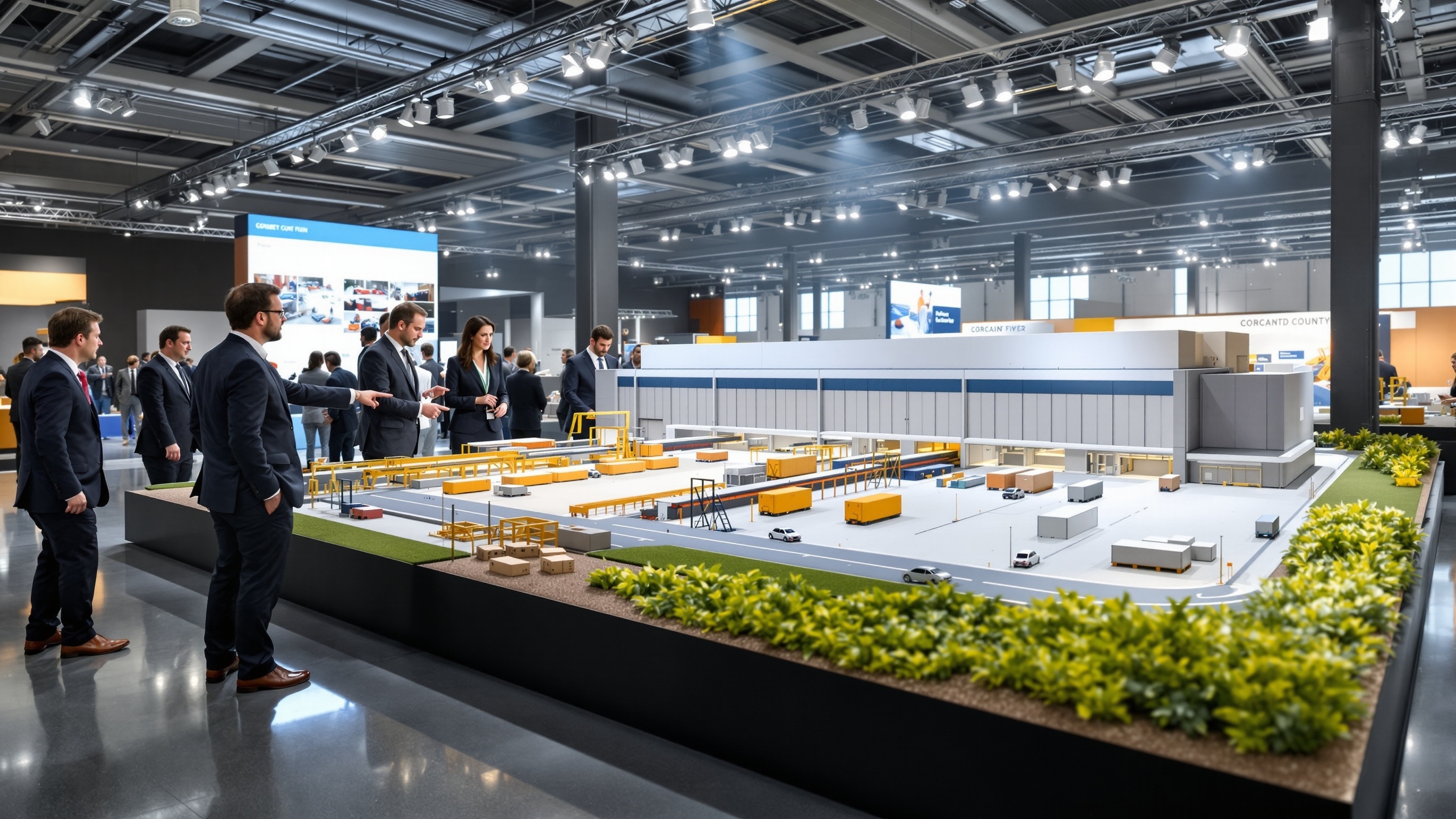
Warehouse and Logistics Models
We Build Custom Scaled 3D Industrial Models
Did you know we make
custom
3D industrial models?
The Art of Organizing Movement: Where Motion Meets Design
Every product you buy — from sneakers to smartphones — takes a carefully choreographed journey through invisible worlds of movement: warehouses, sorting centers, and distribution hubs humming with precision. Long before a forklift hums or a conveyor carries a package, these facilities are born as models — blueprints of logistics brought to life. A warehouse and logistics model is more than a map of racks and forklifts; it’s a three-dimensional philosophy of motion. It defines how space breathes, how goods flow, and how human and machine work in rhythm. Whether it’s a 100,000-square-foot fulfillment center or a compact micro-warehouse for last-mile delivery, the story always begins in the model — digital, physical, or hybrid — where efficiency takes shape.

The Beating Heart of Global Commerce
Warehouses used to be seen as simple storage spaces — vast boxes filled with shelves and forklifts. Today, they’re dynamic, high-tech ecosystems where time is the most precious commodity. E-commerce giants, manufacturers, and logistics companies depend on optimized layouts and modeled systems that squeeze seconds out of every motion and meter. Every step inside a modern warehouse is calculated. Where does a pallet enter? How does it move to storage? How fast can a robotic arm pick and place? What’s the optimal travel path for human workers? The answers come not from guesswork but from simulation and modeling — the digital prototypes that turn chaos into choreography.
Warehouse models define not just space but behavior. They map airflow for temperature control, simulate equipment collisions to prevent downtime, and analyze order frequency to determine where every SKU should sit. In a world where customers expect next-day delivery, a few extra steps or seconds can make or break profitability. Modeling transforms logistics into an exact science — and a visual art.
The Language of Layouts
Every efficient warehouse starts with layout philosophy — a language of movement built on geometry and strategy. The model acts as translator, converting theory into tangible space. Engineers and planners experiment with several fundamental layouts before committing to a final form. Some mimic linear assembly flow, others hub-and-spoke distribution or modular grid systems. What matters most is how the design aligns with product type, throughput volume, and automation level.
For example, a warehouse that stores heavy industrial equipment requires wide aisles, reinforced flooring, and direct loading-dock access. A fulfillment center shipping thousands of small consumer goods every hour needs dense shelving, ergonomic packing zones, and conveyor arteries that behave like veins — feeding constant motion. Through modeling, every shelf, mezzanine, and workstation is placed deliberately. Nothing is random. The layout becomes a living algorithm — a blend of mathematics, material science, and spatial storytelling.
Digital Twins: The Future of Logistics Design
In the digital age, warehouse models are no longer static blueprints. They’re digital twins — virtual replicas that mirror every sensor, shelf, and machine in real time.
These digital twins simulate everything: inventory velocity, worker fatigue, equipment wear, even temperature and lighting conditions. They can predict where congestion might occur during peak hours or how a single conveyor breakdown might ripple across operations. By combining AI, IoT, and simulation software, engineers can re-model a warehouse daily. Need to add an automated storage and retrieval system? Adjust the racking heights? Redirect forklift traffic? The twin updates instantly, testing scenarios before a single wrench is turned.
Companies like Amazon, DHL, and Maersk use this approach to optimize global supply chains — virtual modeling entire networks of warehouses as interconnected systems. Digital modeling transforms logistics into a continuous experiment — one where every improvement compounds into faster deliveries, lower costs, and safer workplaces.

The Power of Visualization
One of the greatest strengths of warehouse modeling is visualization. It allows teams to see efficiency before it exists. Imagine standing before a screen showing your facility as a glowing 3D environment — forklifts tracing colored paths, pallets sliding down conveyors, robotic arms sorting items, and sensors pulsing with live data. You can walk through aisles virtually, change camera angles, and spot bottlenecks that floor plans would never reveal.
Visualization also bridges communication between disciplines. Engineers, architects, financiers, and operations teams speak different technical languages — but everyone understands a 3D model. For clients, investors, or corporate leaders, this visualization becomes a persuasion tool. It transforms abstract logistics into a story they can grasp — a narrative of movement, control, and innovation.
From Warehouse to Wonder: The Rise of Automated Systems
The modern warehouse isn’t just efficient; it’s alive with motion and intelligence. Automated systems — from conveyors and AGVs (automated guided vehicles) to robotic pickers and drones — redefine how we think about storage and retrieval. Modeling these systems ensures harmony between humans and machines. For example, engineers use digital simulations to determine the ideal travel zones for robots, preventing traffic jams and ensuring safety. A logistics model might show how pallets glide through the receiving dock, get scanned and sorted by AI, lifted to racking by autonomous lifts, then descend to packaging via conveyor spirals — all while workers handle oversight and maintenance in optimized ergonomic zones. In this interplay, the warehouse becomes a symphony, and the model is the sheet music.
Flow: The Invisible Ingredient of Efficiency
If efficiency were a flavor, flow would be its secret spice. In logistics, flow means everything moves logically and continuously, without dead ends or collisions. Flow isn’t just physical — it’s informational. Data flows from sensors to control systems, orders flow from servers to workers, and products flow through conveyor arteries like blood in a living body.
Modeling allows engineers to study this flow in virtual reality, identifying turbulence long before it costs time or energy. They can test new routes, rearrange picking zones, or change the position of packaging stations in simulation before construction even begins. The goal is a seamless choreography — where every action complements the next, and the entire warehouse hums with natural rhythm.
The Human Element: Designing for People, Not Just Packages
While automation headlines dominate logistics, people still play the starring role. Forklift operators, packers, and supervisors form the human backbone of the system, and warehouse models must serve them too.
Human-centered design is a growing trend in industrial modeling. It prioritizes safety, comfort, and productivity — from ergonomic workstations to natural light access and clear sightlines. By simulating human movement, designers can predict fatigue patterns, identify potential trip hazards, and position rest areas where they’re most needed.
A warehouse that flows well for machines but confuses people fails as a system. Modeling ensures harmony between technology and the human experience — a balance of precision and empathy.
Sustainability in Motion
Sustainability is now a core driver in warehouse design. The best models consider energy, waste, and lifecycle efficiency from the very start.
By modeling airflow and sunlight, designers can plan natural ventilation, reduce HVAC loads, and incorporate skylights or solar panels. Routing and layout modeling minimizes forklift travel, cutting emissions and battery usage. Even materials can be modeled for sustainability — from polished concrete that reflects light and reduces energy use to recyclable racking and modular components that can be repurposed.
In logistics, green design isn’t just ethics — it’s economics. Sustainable layouts often reduce long-term costs, making modeling an essential tool for smart energy planning.
How Warehouse and Logistics Models Are Fabricated
Long before digital twins dominated design, physical scale models served as the tangible heart of logistics planning — and they remain invaluable today. These handcrafted miniatures bring complex operations to life on a tabletop, perfect for presentations, training, and architectural reviews.
Step 1: Concept and Scaling
The process begins with CAD blueprints of the facility, scaled to ratios like 1:100 or 1:200, depending on space. Designers choose key zones to represent — receiving docks, racking systems, conveyor paths, and shipping bays.
Step 2: Base and Structure
A base platform, usually MDF or foam board, is cut to shape using laser or CNC tools. Walls, loading docks, and mezzanines are constructed from acrylic sheets or precision-cut plastic panels. Terrain and flooring textures are airbrushed to resemble concrete or warehouse epoxy finishes.
Step 3: Equipment Miniatures
Conveyors, shelving, forklifts, and robotic systems are modeled from 3D-printed resin or laser-cut acrylic. These components are meticulously painted to match real-world materials — matte gray for metal, gloss for machinery housings, and clear for windows or control panels.
Step 4: Lighting and Interaction
LED lighting strips can simulate active aisles or moving conveyors. Some models feature tiny motion indicators or interactive elements controlled by touchscreens, allowing users to visualize product flow or robotic paths.
Step 5: Assembly and Presentation
Finally, the model is assembled, detailed, and mounted on a polished display base. Clear covers protect it while allowing full visibility. Many are paired with digital screens projecting animated overlays — showing heat maps, order flow, or transport paths superimposed on the miniature.
The finished piece is both art and engineering — a tactile conversation starter that turns abstract logistics into something people can literally see and touch.
Why Physical Models Still Matter
In a digital world, physical models hold emotional and communicative power that software can’t replicate. They make logistics accessible to non-technical audiences, from investors to trainees. Standing over a tangible model gives stakeholders an immediate sense of proportion, movement, and potential. They can trace a route with a finger, visualize traffic paths, and intuitively grasp how the system breathes.
Fabricated models also shine at trade shows and client presentations, where they serve as magnets for curiosity. They demonstrate craftsmanship, transparency, and vision — three things that every logistics company wants to project. And for design teams, having a real object to examine often sparks new ideas. Physical models reveal relationships and opportunities that screens can hide — helping teams iterate creatively before final construction.
Technology in Model Fabrication
Model fabrication has entered its own digital renaissance. Modern studios combine 3D printing, CNC machining, and laser etching to achieve stunning realism. High-precision resin printers create miniature robots, pallets, and vehicles with millimeter accuracy. Laser-engraved acrylic replicates warehouse grating and glass office partitions. CNC routers carve mezzanine decks, while automated plotters print surface graphics like safety lines and inventory zones.
Many modern models now integrate AR (augmented reality). Pointing a tablet at the model can trigger virtual animations — drones flying above aisles, forklifts moving, or product paths glowing with digital overlays. This hybrid fabrication blends the best of both worlds: physical presence and digital interactivity. The result is immersive storytelling that turns warehouse design into an experience, not just a plan.
Warehousing in the Age of Robotics and AI
Warehouse models are evolving alongside the technologies they represent. As AI-driven automation spreads, designers model not just space but intelligence. AI modeling predicts inventory surges, learns seasonal patterns, and even simulates “what if” scenarios — what happens if demand spikes by 30%? If a robot fails mid-route? The model runs the math instantly.
Autonomous mobile robots (AMRs) now dominate warehouse logistics, zipping between racks in swarm-like efficiency. Modeling these systems ensures their paths don’t conflict and that power-charging stations are optimally placed. Some next-generation warehouses even include drone integration, modeled to simulate air traffic lanes for inventory counting or small-item transport. Every layer — from floor to ceiling — becomes part of the modeled ecosystem. It’s not just about storing goods anymore; it’s about orchestrating intelligent motion.
Human + Machine: Designing the Symbiosis
Tomorrow’s warehouse is neither purely robotic nor entirely human — it’s a hybrid ecosystem where both excel at what they do best. Modeling this partnership ensures smooth transitions: robots handle repetition, humans handle judgment. The model defines “handoff zones” where workers and machines interact safely and efficiently. Lighting, signage, and visual cues are also modeled to guide human operators intuitively. By simulating this human-machine dance, designers reduce errors, injuries, and downtime. In the end, warehouse modeling becomes a study in human ergonomics and robotic choreography — an art form in balance.
Sustainability and Circular Logistics
As supply chains go green, warehouse models now extend beyond storage to reverse logistics — the flow of returns, recycling, and waste reduction. Digital simulations track packaging recovery, reusable pallet circulation, and optimized delivery routes that minimize emissions. Physical models, in turn, use sustainable materials — recycled acrylics, biodegradable foams, and eco-resins — to mirror the sustainability they promote. Some companies even model net-zero warehouses — complete with solar roofing, wind-powered conveyors, and rainwater harvesting systems — long before the first beam is raised. Modeling becomes the rehearsal for a more responsible industrial future.
Education and Demonstration: Teaching Logistics Through Models
For universities, logistics training centers, and trade schools, physical and digital models are indispensable teaching tools.
Students learn to trace the flow of goods, identify inefficiencies, and redesign systems hands-on. A miniature warehouse can demonstrate inventory management better than hours of slides or spreadsheets ever could. These models inspire new thinkers to see warehousing as more than boxes and forklifts — as living systems where physics, technology, and creativity collide.
For companies, demo models train employees in process understanding and safety awareness. By walking through a scaled replica, workers visualize emergency exits, storage logic, and production flow. Education through modeling builds a generation fluent in the art of logistics.
The Future of Logistics Modeling
The next decade will see warehouse models grow smarter, smaller, and more dynamic. Portable holographic projections may replace monitors. AI will build real-time self-updating facility twins. We’ll soon model not just single buildings, but entire logistics ecosystems — ports, factories, warehouses, and delivery hubs linked in live data chains.
Imagine a network of interconnected digital twins spanning continents, showing real-time cargo movements and predictive demand modeling. That future starts now — with the models we design today. And physical models will remain the storytellers of that future: tangible, visual, and undeniably human.
The Invisible Art of Moving Everything
From the outside, a warehouse might look ordinary — a gray box at the edge of town. But step inside its model, and you see something else entirely: a symphony of movement, logic, and precision. Warehouse and logistics models are the unsung heroes of modern commerce. They turn empty space into engines of global efficiency, visualize the flow of goods as if it were music, and help engineers, architects, and dreamers alike sculpt the unseen networks that keep our world turning. Every parcel delivered, every product stocked, and every shipment tracked is a victory of design — modeled, tested, and perfected long before the first box moved. From foam to factory, from simulation to steel, these models remind us that organization is an art form — and the warehouse is its masterpiece.