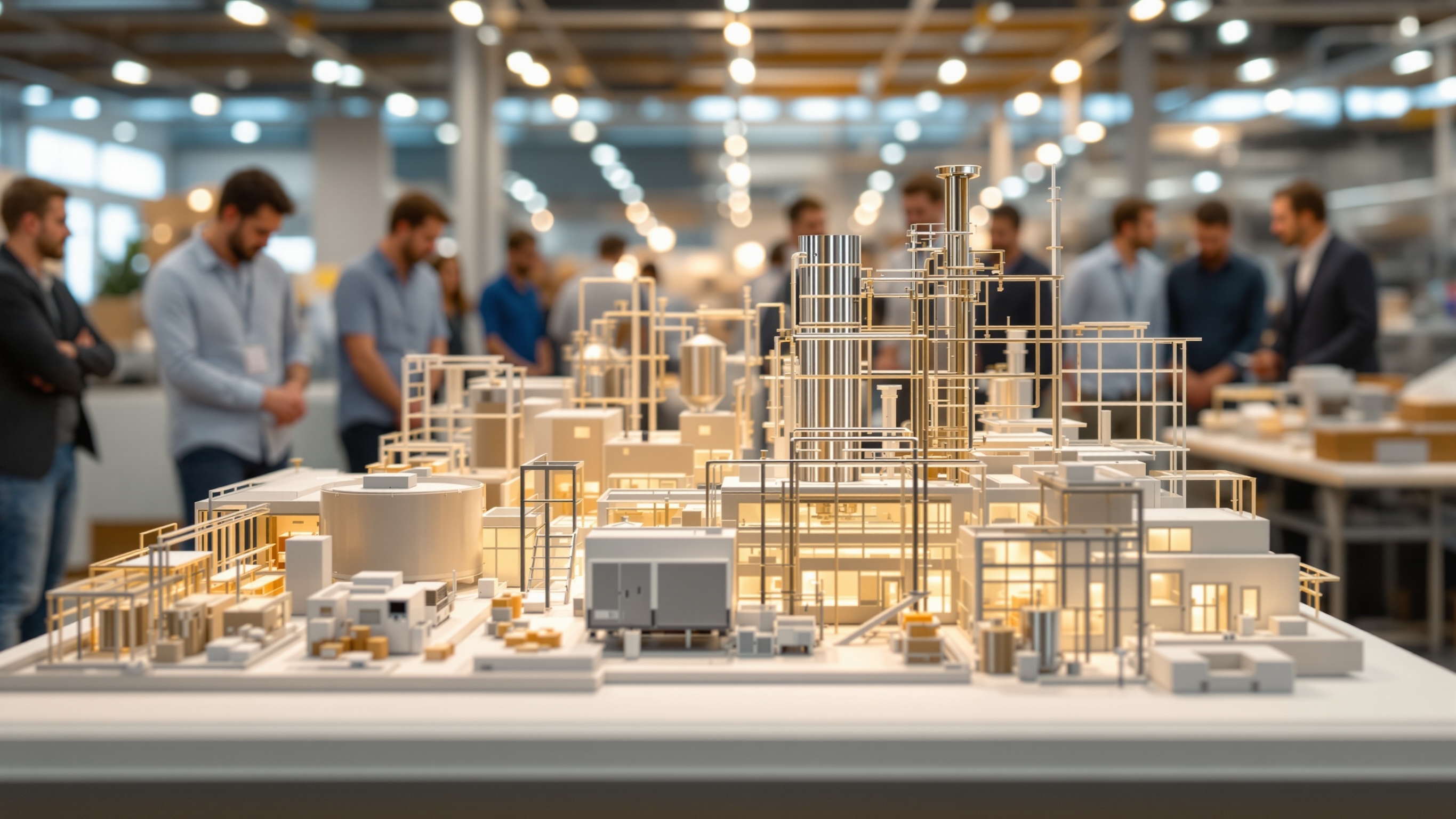
Food Processing Plant Models

Food Processing Plant Models

We Build Custom Scaled 3D Industrial Models

Did you know we make

custom

3D industrial models?

Industrial Plant Scale Model

How Scaled Design and Smart Fabrication Shape the Future of Food Manufacturing

Behind every bag of chips, carton of milk, or jar of peanut butter is a world of choreography—machines humming in perfect timing, conveyors gliding, and precision engineering turning raw ingredients into consistent, safe, and irresistible products. But before these factories ever see a single ingredient, they exist as something far more controlled and imaginative: food processing plant models. These models—both digital and physical—are where efficiency, safety, and creativity blend. They reveal how food moves, how equipment connects, and how workers navigate space. A good plant model doesn’t just look impressive—it solves logistical puzzles, eliminates waste, and tells a story of how food gets from farm to fork. From large-scale dairy plants to boutique chocolate makers, every successful food facility starts as a model. This is where engineers, architects, and food scientists collaborate to design the unseen backbone of the culinary world.

Food Processing Plant Models

The Hidden Engine of the Food Industry

Food processing plant models serve as the backbone of modern food manufacturing. They represent not just buildings, but entire systems of transformation. These systems turn perishable, often unpredictable ingredients into products that are safe, consistent, and scalable. Creating a plant layout isn’t just about fitting machines into a building—it’s about flow. Every piece of equipment, every pipe, and every aisle has a purpose. Ingredients enter, get sorted, washed, cooked, cooled, packaged, and distributed—all through a meticulously designed sequence that minimizes contamination and maximizes efficiency.

A well-modeled plant mirrors the rhythm of a kitchen—scaled up a thousand times. And just as a chef arranges tools and ingredients for smooth workflow, engineers arrange machinery and conveyors for perfect process flow. These models help predict outcomes, prevent costly mistakes, and communicate ideas across teams. They’re the bridge between vision and reality—the master plan behind the global food system’s quiet precision.

From Concept to Layout: The Anatomy of a Food Processing Model

Before fabrication begins, engineers and designers build a conceptual framework. This often starts with process mapping—understanding the journey from raw material intake to finished product packaging.

Each model integrates core design principles that define success in the food industry:

  • Product flow: Raw materials move in one direction, finished goods in another—reducing cross-contamination.
  • Zoning: Facilities are divided into “clean” and “non-clean” areas, maintaining strict hygiene standards.
  • Efficiency: Equipment and piping are arranged for the shortest, most logical path of movement.
  • Scalability: Space is left for future expansion as production volumes grow.

Digital 3D models allow teams to visualize every process in real-time. They test airflow, temperature zones, and even cleaning cycles. Simulation tools can predict bottlenecks or sanitation risks long before ground is broken. Every square foot is planned with purpose—from ingredient intake docks to temperature-controlled storage zones, mixing rooms, filling lines, and packaging stations. In short, the plant model is a recipe for efficiency—and one misstep in the recipe can ruin the entire dish.

Why Modeling Is the Secret Ingredient to Success

Food safety and quality depend on repeatable precision. Plant models make that possible by anticipating problems before they happen.

Reducing Downtime and Costs – A physical or digital layout lets designers identify wasted motion, unnecessary transport, or maintenance issues. Adjusting in a virtual environment saves far more than rebuilding after installation.

Enhancing Food Safety – Flow models separate raw and cooked products, ensure washdown zones are accessible, and maintain hygienic design standards. By visualizing these before construction, plants can meet regulatory compliance from day one.

Training and Communication – Models help workers, managers, and inspectors understand a plant’s function. They serve as training tools for operating procedures, safety drills, and quality control.

Sustainability and Energy Efficiency – By optimizing airflow, refrigeration, and material flow, plant models contribute to reduced energy use and minimal waste—a growing priority in the modern food sector.

A great model is more than an architectural plan—it’s a living map of the food industry’s heartbeat.

Digital Twin Revolution: Smart Modeling for Smart Food Plants

The future of food processing isn’t built on paper—it’s built on digital twins. These virtual replicas of entire facilities replicate real-time conditions, allowing engineers to monitor, test, and optimize operations from anywhere. Imagine adjusting conveyor speeds or simulating sanitation cycles without touching a single piece of machinery. Digital twins integrate sensors, data analytics, and AI-driven forecasting to keep plants performing at peak efficiency. They also allow predictive maintenance—detecting potential issues like pump failures or temperature inconsistencies before they halt production.

In food safety, digital modeling can even simulate microbial growth under certain humidity and temperature conditions—offering insights that protect both product and reputation. With these tools, the food industry is no longer reactive—it’s proactively intelligent.

Versatility of Food Plant Models

The diversity of the food industry means plant models must adapt to wildly different needs.

  • Dairy Processing Models: Focused on hygiene and temperature control, with stainless-steel pipe networks for pasteurization and bottling.
  • Meat and Poultry Models: Require complex refrigeration zones, segregation of clean and raw areas, and sterilization tunnels.
  • Snack and Cereal Plants: Emphasize bulk material handling—mixers, extruders, dryers, and packaging lines, all linked in continuous loops.
  • Beverage Facilities: Integrate carbonation, filling, and labeling systems with automated quality assurance.
  • Bakery and Confectionery Layouts: Feature ovens, cooling conveyors, and enrobing stations in carefully timed sequences.

Each sector presents unique challenges, and plant models bring clarity to those complexities—ensuring the result is not only efficient but deliciously consistent.

Food Processing Plant Models

Human-Centered Design: The People Behind the Process

While automation drives modern food manufacturing, people remain its soul. The best plant models consider not only machinery but human flow—how workers move, interact, and stay safe. Ergonomics is critical. Workstations are modeled for comfort and efficiency. Lighting, access to tools, and safety routes are built into every plan. 

Communication visibility—such as clear lines of sight between operators and supervisors—is modeled too. These subtle choices boost morale, reduce fatigue, and improve productivity. A food processing plant is not just a mechanical organism; it’s a living environment. Designing with people in mind ensures not only efficiency but pride in craftsmanship.

Sustainability Built In

Modern plant models place sustainability at their core. Designers now model airflow for energy-efficient HVAC, water reuse systems, and zero-waste processing zones. In some facilities, waste byproducts from one line are modeled to feed into another—for example, using fruit pulp from juice processing in energy recovery systems or animal feed. Plant modeling also allows for life-cycle analysis, simulating energy costs and carbon impact over decades. The result: cleaner, leaner factories that meet both environmental and economic goals. Renewable integration—such as solar panels or biogas digesters—is also modeled early, ensuring seamless energy distribution across the facility. The future of food is sustainable—and modeling is how we plan it intelligently.

Fabricating Food Processing Plant Models: From Concept to Showcase

Creating a physical model of a food processing plant is a blend of precision engineering and artistry. These scaled representations bring complex facilities to life—perfect for client presentations, trade shows, investor pitches, and training simulations.

Step 1: Planning and Scaling

The first step is defining scale—usually 1:50 to 1:200, depending on the complexity and footprint. CAD blueprints are simplified and translated into miniature layouts, maintaining all major production zones and pathways.

Step 2: Base Construction

The model base is built from MDF or high-density foam board, cut to the exact floor plan. Laser-cut panels define walls, partitions, and equipment placement. If the facility involves multiple levels, structural layers are stacked to represent mezzanines and pipe racks.

Step 3: Equipment Fabrication

Miniature machines—mixers, conveyors, pasteurizers, tanks, ovens—are crafted using 3D printing, resin casting, or precision acrylic cutting. Metallic paints simulate stainless steel surfaces, while transparent elements suggest glass or liquid contents.

Step 4: Color Coding and Zoning

Different processing zones (wet, dry, clean, packaging) are color-coded for clarity. LED lighting can be added beneath translucent surfaces to represent active systems or power lines.

Step 5: Detailing and Assembly

Technicians assemble components by hand, ensuring accurate spatial relationships. Details like walkways, staircases, ventilation ducts, and signage elevate realism.

Step 6: Presentation and Integration

Finished models often include interactive features—removable sections, digital overlays, or augmented reality projections showing product flow or sanitation processes. These hybrid displays turn static models into dynamic learning tools.

A well-fabricated plant model doesn’t just show a layout—it tells the story of innovation, discipline, and taste meeting technology.

The Role of Scale Models in Training and Communication

In a world increasingly dominated by screens, physical plant models offer something unique: tangible understanding.

For plant managers and trainees, seeing a physical representation of their facility builds spatial awareness. It helps teams visualize emergency exits, process sequences, and maintenance routes.

Investors and clients also respond better to physical models—they can see, touch, and understand the vision. In an industry where hygiene and safety are paramount, this physical representation builds trust and transparency.

Many food manufacturers now keep their models as permanent installations in visitor centers or corporate offices, symbolizing their commitment to innovation and craftsmanship.

Technology and Fabrication Merge

The fabrication of plant models has evolved dramatically with digital technology. Today, model builders use 3D scanning and CNC routing to achieve perfect precision. A virtual layout from AutoCAD or SolidWorks can be directly translated into physical form via laser cutting and additive manufacturing. This ensures that every tank, duct, and walkway aligns exactly with the digital design. Some studios even integrate AR and projection mapping, where digital animations overlay physical models to demonstrate ingredient flow, heat mapping, or cleaning cycles. The result: immersive, educational, and visually stunning representations of one of the world’s most complex industries.

Case Example: The Chocolate Factory Model

Consider a large confectionery producer developing a new chocolate facility. The project begins with a digital twin simulating everything from cocoa roasting to wrapping. The model helps identify bottlenecks—too much spacing between tempering and molding areas, inefficient packaging loops, and limited storage access. Adjustments are made digitally, then translated into a 1:100 physical model for stakeholder review. This miniature factory includes LED-lit flow paths to show chocolate’s journey from bean to bar. When presented to investors, the model not only demonstrates efficiency but sparks emotion—it makes the process tangible, enchanting, and deeply human. This is the magic of plant modeling: it turns engineering into experience.

Food Processing Plant Models as Educational Tools

Beyond engineering and sales, food plant models play a major role in education and outreach. Universities, trade schools, and research institutes use them to teach process design, hygiene zoning, and automation principles. Students can physically trace the path of food materials through preparation, cooking, and packaging areas, gaining insights that 2D diagrams can’t offer. 

For public exhibits or science museums, these models provide visual narratives about how everyday foods are made—turning invisible industrial processes into engaging storytelling. By combining function with fascination, these educational models cultivate a new generation of food technologists who see manufacturing as both an art and a science.

Evolving Trends: Automation, Robotics, and Smart Systems

Modern plant layouts now integrate robotics, AI, and smart sensors from the ground up. Modeling these systems early ensures seamless automation.

Pick-and-place robots for packaging, automatic ingredient dosing systems, and AI-driven quality inspection cameras are all now standard inclusions in food plant design. Plant models visualize not only the physical equipment but the flow of information—how data from machines feeds into centralized control rooms for real-time decision-making.

This convergence of physical and digital worlds is shaping the food plant of tomorrow—a facility that is intelligent, self-regulating, and continuously learning.

Designing for the Future of Food

Tomorrow’s food plants will look and operate differently. Smaller, modular, and flexible facilities will replace monolithic factories. 3D printing of foods, personalized nutrition products, and localized micro-processing centers will demand agile design models. Future plant models will likely incorporate bioreactors, precision fermentation tanks, and sustainable packaging loops—visualizing food innovation that goes beyond traditional processing. Sustainability will remain central: models will simulate water reclamation, energy loops, and carbon-neutral operations. They’ll help us visualize a world where manufacturing and environmental stewardship finally coexist.

Building the Invisible Kitchens of the World

The next time you unwrap a snack or pour a drink, remember: that convenience and consistency didn’t happen by accident. It began as a scaled, simulated, and carefully orchestrated vision of how ingredients become products at massive scale.

Food processing plant models are more than technical tools. They are expressions of ingenuity, discipline, and collaboration. They connect the creative world of culinary arts with the precision world of industrial design. Whether digital or physical, static or smart, each model tells a story of flow, function, and flavor. It’s the quiet art behind the global food supply—an art that feeds billions and inspires the next evolution of sustainable manufacturing.

The factory may be the body of the food industry, but the model? That’s its soul.

Check out WhiteClouds’ 3D Industrial Models for more information.
 
Contact us today to learn more about our 3D services and how we can help you achieve your goals.   

Get a Free Quote on a Custom 3D Billboard

Get a Free Quote