
The Geometry of Instant Recognition
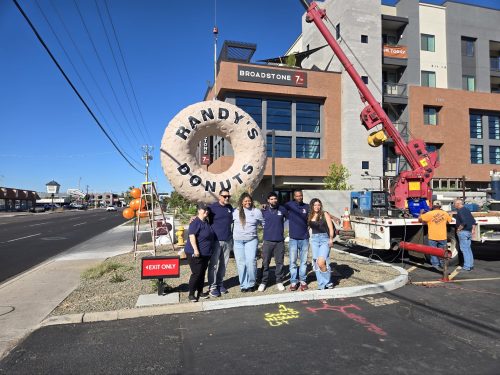
The power begins with shape. A donut’s profile is so archetypal that the brain recognizes it at a glance, even in peripheral vision. That ring-within-a-ring acts like a built-in logo, elegantly simple and surprisingly versatile. At human scale, the geometry reads as approachable and fun; at architectural scale, it reads as confident and iconic. The negative space—the hole—does half the narrative work for you. It frames skylines and faces, it invites a peek-through shot, it turns passersby into participants. In a world of visual clutter, the donut’s clarity is an advantage. It’s not trying to outcomplicate the street; it’s trying to calm it, to offer a clear focal point around which small moments of delight can happen. Designers call this “low cognitive load.” Photographers call it a perfect subject. Audiences call it irresistible.
From Kitchen Spectacle to World Spotlight
Donuts were born in kitchens and backrooms, where timing, temperature, and feel are the secret ingredients no recipe can fully encode. But every so often, bakers and event teams push that craft into public theater. The result is a hybrid of culinary art and civic spectacle: a colossal ring lifted by a crane, a translucent glaze poured like sugar rain, a measurement ceremony that turns crowd awe into a recorded fact. These moments, half science experiment and half parade, demonstrate how edible feats become community memories. If you’re curious about how record-worthy donut milestones are planned, witnessed, and archived, pop into Guinness World Records Spotlight: Donuts for a guided tour of the triumphs that made pastry history. Records aren’t just numbers; they’re stories with a unit of measure, proof that joy can be both felt and counted.
Roadside Royalty: The Donut as Destination
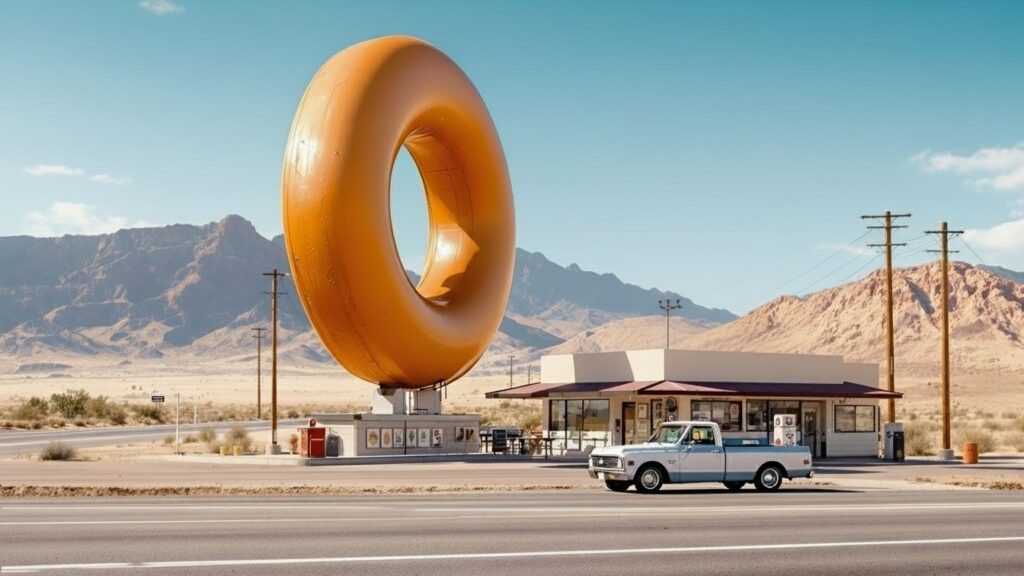
Long before hashtags, roadside America perfected shareable design. A giant rooftop donut on a corner lot could do what a dozen radio spots could not: stop a car, spark a laugh, and sell a dozen. Those facades and signs are more than relics; they’re the roots of modern place-branding. A single, oversized ring says “treats ahead” in every dialect spoken by travelers, and the best of these icons have aged into genuine civic landmarks. Their silhouettes creep into local T-shirts and team mascots; their glow anchors countless first-date stories. If you’re building a donut pilgrimage, or a case study in effective urban whimsy, stroll through Famous Giant Donut Shops and Signs to see how architecture, signage, and pastry nostalgia combine into a beacon you can spot from the far lane.
Sculpture, Public Art, and the Seriousness of Play
When a donut leaves the realm of advertising and enters the world of sculpture, something enchanting happens. The same form that sells coffee at 7 a.m. can, when treated as art, slow a plaza at 7 p.m. A monumental torus rendered in composite, bronze, or meticulously finished foam invites a different kind of attention. The glaze becomes a study in light; the sprinkles become color theory; the hole becomes a portal. Children race through it; photographers build portfolios around it; neighbors adopt it as a meeting point. The piece becomes not just a picture in someone’s feed but a place in someone’s week. For examples that span whimsical to museum-grade, explore Giant Donut Statues and Sculptures, a gallery of works that prove pop joy and artistic rigor are not opposites but allies.
Records Without Borders
Not all donut icons are static and not all are American. Around the world, bakers and builders are inventing new ways to make the humble ring a headline. Speed records, flavor marathons, chains of donuts that weave through public squares—these feats become cultural postcards that travel with a link or a statistic. People repeat numbers because numbers translate across languages, and a good story loves a good stat. If you’re hungry for a global sampler of audacity, the anthology Donut Records Around the World gathers feats that are as inventive as they are delicious, proof that pastry play is a universal dialect.
Why the Donut Works (Better Than Almost Anything Else)
Plenty of foods are photogenic. So why does the donut outperform them as an icon? Part of the answer is compositional. A slice of cake is a triangle; a burger is a stack; a coffee cup is a cylinder. Each can be beautiful, but none creates the participatory aperture the donut does. The ring’s inner circle is an instant stage. Place a skyline there, a saxophonist, a parade, a sunset—your photo gains depth and story without a single extra prop. And then there’s texture. The human brain reads gloss as fresh and matte as soft; a donut’s glaze and crumb provide both. At large scale, those textures exaggerate: specular highlights bloom like moons, micro-shadows under sprinkles give a sense of crispness, and the warm undertone of “dough” peeking through translucent “glaze” triggers crave-ability even from across the street.
The Marketing Mathematics of Delight
When brands commission a giant donut for a plaza, a conference, or a multi-city tour, they’re not just chasing likes. They’re investing in a machine that converts curiosity into advocacy. The math is simple but potent: every person who photographs themselves with your installation becomes a micro-broadcaster to their friends. Because the subject is playful rather than pushy, the message feels like a gift instead of an ad. That soft power extends the life of a campaign beyond its calendar. People remember where they posed with the ring; they revisit with guests; they return for seasonal re-skins. No coupon required, just an invitation to smile. A well-designed installation also improves on classic out-of-home advertising by creating its own audience flow. Place it where foot traffic converges, and the donut becomes a crowd thermostat, warming the mood in a radius measured in selfies.
Fabrication, Finish, and the Illusion of Edibility
If you’ve ever stood in front of a not-actually-edible donut and felt your stomach flip anyway, credit the craft. The most successful public pieces borrow tricks from pastry and photography alike. Translucent layers in the paint stack let a warm base glow through, mimicking real glaze. Gloss and satin are balanced so the highlight sings without turning the surface into a mirror. Edges “brown” ever so slightly where you expect a fry line, and drips thicken just at their tips because gravity would do that. Even the sprinkles tell the story: slightly beveled, spaced as if tossed by a generous hand, casting tiny shadows that make them read as candy rather than paint. Behind the scenes, structural armatures keep the fantasy safe, and durable clearcoats keep it camera-ready through weather, fingerprints, and the eternal test of children who want to touch the shiny thing—because of course they do.
From Pop-Up to Ritual: How Icons Root Themselves
Temporary installations can become permanent rituals with surprising speed. Host a reveal once, and you’ve created an anecdote; host it twice, and you’ve created a tradition. People time their walks to golden hour to watch the evening lights come up on the glaze. Families promise visiting cousins a photo “through the hole.” Couples return each year to recreate a picture that has quietly become a relationship timeline. In urban design, this is the holy grail: a piece that not only draws a crowd but also stitches itself into local life. Donuts do this well because they are generous symbols. They don’t ask you to come as a connoisseur or critic. They ask you to come as you are.
Festivals: The Ecosystem of a Giant Donut
At the biggest donut festivals, the ring isn’t merely a prop; it’s the gravity that pulls the day together. Tasting alleys spiral out from it. Demo stages align their schedules so foot traffic pulses and returns. Sponsors position interactive moments along the sightlines that point to the hero piece, so every stroll feels intentional and serendipitous at once. The inevitable headline—the crane lift, the glaze pour, the stat reveal—gives the event a heartbeat, a crescendo to anticipate and remember. And after the confetti settles, the ring remains as a perfect backdrop for hundreds more micro-moments. The long tail of a festival is not just sales; it’s memory: the child who learned to pipe icing, the couple who danced near the uplights, the family portrait that replaced a school picture on the fridge.
Nostalgia as Strategy (and Kindness)
Nostalgia is often described as a soft-focus lens, but it’s also a clever design tool. A donut’s nostalgia is inclusive rather than exclusive. You don’t need to have grown up near a famous shop to feel the tug; any morning with a paper bag and a warm ring will do. When cities and brands invest in donut icons, they’re investing in a universal callback to comfort. This is especially valuable during stressful times, when people crave places and moments that lower anxiety instead of heightening it. A ring on a corner is a civic way of saying: here, for a few minutes, you can savor the simple. In strategy terms, that’s loyalty. In human terms, it’s kindness.
Sustainability, Accessibility, and the Sweet Future
Icons that endure do so because they evolve. The next generation of donut landmarks is pairing delight with stewardship and inclusion. Fabricators are specifying UV-stable, low-VOC finishes that extend life and reduce repaint cycles. Event teams are diverting fryer oil into recycling streams and celebrating those numbers on stage the way they celebrate record stats. Designers are baking accessibility into the first sketch: clear approaches, ADA viewing areas, stroller parking, softer music blocks for sensory-friendly hours. None of this dilutes the fun; it amplifies it by widening the circle of who gets to enjoy it. When joy is sustainable and accessible, it lasts longer—and so does the legend.
The Global Language of the Ring
Travelers love to collect donut stories because they travel well. A snapshot from a rooftop icon in one city pairs perfectly with a memory of an edible record in another and a sculpture visit in a third. The ring becomes a throughline, a personal anthology of civic play. That portability is why donut icons have found homes far beyond their original cultural context. They don’t require translation. They require a glance, a smile, and sometimes a line for the perfect shot through the middle. The more cities that adopt the form – on rooftops, in plazas, at festivals—the richer the global conversation becomes. It’s a dialogue conducted in glaze highlights and shadowed crumbs, in sprinkles that shift from pastels to neons to match local palettes.
How to Read a Donut (Like an Art Critic, Sort Of)
Stand in front of a donut icon and try this experiment. First, let yourself react like everyone else: grin, pose, shoot. Then slow down. Notice where the highlight is sharpest and where it softens—someone chose that balance to guide your gaze. Notice how the ring sits in its site—someone angled it to catch both the skyline and the afternoon crowd. Notice how the palette plays with its surroundings—someone tuned those sprinkles to complement autumn trees or city brick. You’ll begin to see the hidden choreography between the piece and the place. That’s when the donut stops being a prop and becomes a landmark, not because it’s big but because it’s in conversation with the world around it.
Bringing It All Together
From the hush of a kitchen at 4 a.m. to the roar of a crane reveal at 4 p.m., donuts live many lives. In one, they are comfort and routine; in another, they are ambition and theater; in a third, they are sculpture and civic pride. The magic of the form is that it can be all three without contradiction. It offers an uncomplicated shape that carries complicated feelings. It invites play from children, nostalgia from elders, and strategy from marketers—all while asking only for a glance and, maybe, a grin. If you’re mapping your own donut journey—through records, sculptures, signs, and feats—you’re not just collecting pastry lore. You’re collecting proof that joy scales.
To trace the record-making chapters that pushed pastry into the headlines, start with Guinness World Records Spotlight: Donuts. To see how artists and fabricators turn a simple torus into public art that anchors plazas and memories, wander Giant Donut Statues and Sculptures. To plan a pilgrimage to the facades and rooftop icons that made roadside history, bookmark Famous Giant Donut Shops and Signs. And for a whirlwind tour of the achievements that keep pastry fans cheering across continents, savor Donut Records Around the World.
For the master map of colossal rings, edible milestones, sculptural showstoppers, and festival playbooks, begin at the hub: World’s Largest Donut.