
How Los Angeles Became Donut-Sign Central
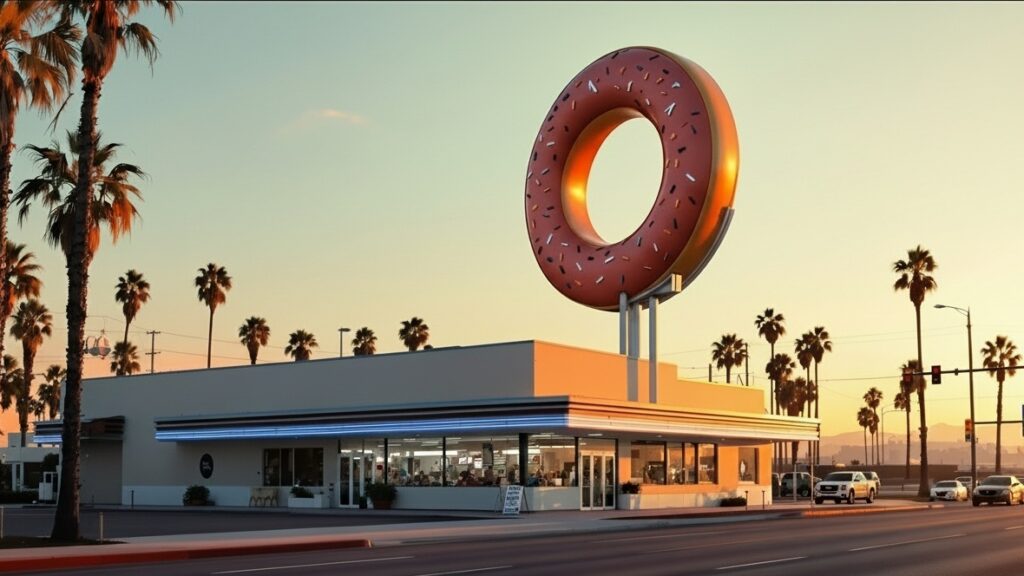
The story begins in mid-century Los Angeles, where programmatic (a.k.a. novelty) architecture exploded alongside car culture. If your business sold donuts, why not build a building that looked like a donut—or at least hoist a donut the size of a studio apartment onto the roof? Enter Russell C. Wendell, a donut-machine salesman who founded the Big Do-Nut Drive-In chain around 1950. Ten locations sprouted across the region, each crowned with a monumental ring. Time thinned the herd, but the sight of a giant donut at the curb still means you’re in a city that turned snack food into sculpture.
You don’t have to be an architecture buff to appreciate these treats on stilts, but it helps to know what you’re looking at. Randy’s Donuts in Inglewood—designed by architect Henry J. Goodwin and completed in 1953—became the most famous heir of the Big Do-Nut era. It’s the location most people picture when they think “giant donut,” and for good reason: you can spot it from planes on final approach to LAX, and it’s been framed by film crews more times than a Hollywood starlet.
Randy’s Donuts (Inglewood) — The Global Icon
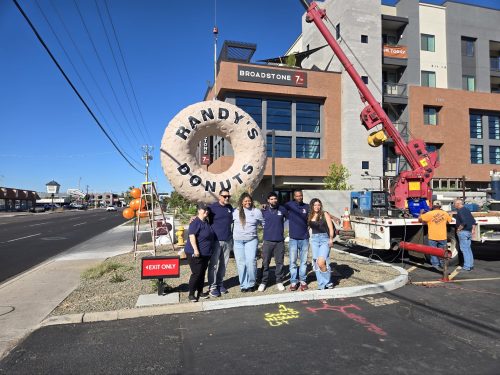
Stand beneath Randy’s 32-foot ring at 805 W. Manchester Blvd. in Inglewood and you’re in the presence of a mascot that somehow became a monument. Opened during the Big Do-Nut boom and renamed “Randy’s” in the 1970s, the shop still draws locals, travelers, and camera crews by the busload. Its star power is bona fide: from Iron Man 2 (Tony Stark munching donuts inside the ring) to endless cameos across TV and music videos, Randy’s has turned a roof ornament into a household name. Today the brand has expanded far beyond Los Angeles, but the original remains the pilgrimage site.
Planning tip: If you want the classic shot with the San Diego (405) Freeway in the background, arrive just after sunrise for softer light and fewer cars. And if the main line is long, check for the walk-up window on the north side—it can move faster.
The Donut Hole (La Puente) — Drive Through the Pastry
Nothing prepares you for the moment your car literally enters a donut. The Donut Hole in La Puente is a drive-through tunnel formed by two enormous donuts, a surviving example of full-on programmatic architecture from the late 1960s. You enter one chocolate-frosted ring, roll past the ordering window, then exit through another—arguably the most theatrical way to buy a cruller in America. Built in 1968 and continuously operating ever since, this is among the most photographed donut shops in the country. Bring a wide-angle lens and a sense of fun.
Planning tip: Go at off-peak hours and switch your phone to a wide lens before you pull in. If you have passengers, have them film from the back seat to capture the full tunnel effect.
Kindle’s Donuts (Westmont) — Where the Big Do-Nut Began
At 10003 S. Normandie Ave., Kindle’s Donuts sits on the site widely cited as the first Big Do-Nut Drive-In. The hyphenated “Do-Nuts” on older signage is a charming giveaway, and the 22-foot rooftop ring still telegraphs its mid-century DNA to everyone cruising Century and Normandie. More low-key than Randy’s, Kindle’s is the connoisseur’s stop: less movie-famous, equally authentic.
Planning tip: The morning rush is all business. For photos, late afternoon golden hour bathes the donut and facade in warm light—great for close-ups that reveal the texture of the “icing.”
Donut King II (Gardena) — The Time-Capsule Ring
Donut King II at 15032 S. Western Ave. feels like a time capsule: a classic Big Do-Nut survivor still doing what it’s always done—calling out to drivers with a 30-ish-foot ring hovering over a humble shop. You’ll find a steady trickle of regulars, a drive-through, and a reliable perch for that quintessential “me-and-the-donut” portrait.
Planning tip: The sign photographs best from across Western Ave. Bring a moderate zoom to compress the scene and make the ring feel even larger in frame.
Long Beach’s Pink Donut (E. 7th Street) — Saved by Locals
In 2014, a beloved pink-frosted donut perched on a former Daily Grind coffee shop faced removal when the site became a Dunkin’. Locals rallied, preservationists called, and the company ultimately agreed to restore and keep the landmark, a rare victory for roadside history. Today, the donut still rises above 5560 E. 7th St., greeting motorists with a splash of bubble-gum nostalgia. If you love the culture of big, sculptural signs, this survivor is worth the detour.
Planning tip: Swing by at night—LED spill light from nearby storefronts gives the pink “icing” a neon glow, and long exposures turn passing cars into streaks beneath the ring.
Mrs. Chapman’s Angel Food Donuts (Santa Fe Ave., Long Beach) — Vintage Metal Magic
While Wendell’s Big Do-Nut rings are the best known, Mrs. Chapman’s Angel Food Donuts produced slightly smaller but equally charismatic giant donuts—sheet-metal wonders with their own following. One of the best remaining examples sits at 3657 Santa Fe Ave. in Long Beach, still telegraphing donutty goodness to passing traffic and delighting roadside-architecture spotters. If the Big Do-Nut rings are the blockbuster, Angel Food’s signs are the cult classic.
Planning tip: Park along Santa Fe Ave. and shoot upward from a low angle to silhouette the ring against the sky; you’ll get a heroic, poster-worthy profile.
Bellflower Bagels & Java — The Donut That Became a Bagel
Once a bona fide Big Do-Nut site, Bellflower Bagels & Java (17025 Bellflower Blvd.) wears a seeded bagel where a donut used to sit—a cheeky transformation that nods to the location’s past while keeping the mega-ring tradition alive. It’s a fun stop for completists tracing the whole family tree of giant pastry signs.
Planning tip: If you’re stitching a multi-stop day, pair Bellflower with the Long Beach signs; they’re close enough that you can chase a loop of “donut archaeology” before lunch.
What About Dale’s Donuts (Compton)?
For years, Dale’s Donuts at 15904 S. Atlantic Ave. was one of the quintet of surviving Big Do-Nut sites and an essential stop for fans. In recent seasons, however, reports and local chatter indicate the shop has been closed since 2021—even though the giant ring is still recognizable in photos and video from the corner. If you’re sightseeing, you can still view the sign from the street, but check current status before planning a pastry stop.
New-Build Giant Donuts: The Tradition Continues
The old rings endure, but the big-donut tradition hasn’t vanished—it’s evolving. Randy’s has added modern locations with newly built giant donuts, including Downey (a 26-foot rooftop ring) and a sign-base ring in Las Vegas, while continuing to grow across California and abroad. The Inglewood original remains the photo magnet, yet the newer sites prove the oversized pastry still works as irresistible wayfinding.
Film, TV, and the Donut in Pop Culture
Giant donuts are natural born scene-stealers. From Iron Man 2’s rooftop gag to Californication, Arrested Development, and an endless list of cameos, the Inglewood ring especially has done serious time in front of the camera. It’s a perfect shorthand for “Los Angeles”—sunny, pop-arty, a little ridiculous, a lot delightful. If you’re chasing pop-culture frames, line up the ring with a wide street scene to mimic the cinematic compositions you’ve seen on screen. And if you love the idea of spectacular pastry in movies, don’t miss this companion read on Donut Props in Pop Culture and Movies—a curated tour of film-worthy donuts that leap off the set and into memory.
Planning Your Giant Donut Road Trip
- Build your loop by geography. A classic day starts at Randy’s in Inglewood, arcs east to The Donut Hole in La Puente, then swings south to Long Beach for the pink donut and the Angel Food ring on Santa Fe Ave. On the return, bend north through Bellflower to see the bagelized ring, or cut back west via Gardena for Donut King II. You’ll zigzag through neighborhoods where the mid-century impulse to shout “we sell donuts!” in 30-foot letters remains somehow practical—and completely charming.
- Aim for golden hours. Sunrise and late afternoon give the rings depth and warmth; mid-day sun can flatten the texture that makes these signs so sculptural.
- Bring a short list and a big appetite. Not every stop needs a dozen. Split a classic glazed at Randy’s, grab a novelty flavor at Kindle’s, then do your drive-through moment at The Donut Hole.
- Check status. Operating hours and site conditions can change; for example, Dale’s in Compton has reportedly been closed for several years even as the sign remains a familiar landmark on that corner.
When a Donut Becomes Sculpture (and Vice Versa)
Spend a day with these rings and you realize they’re not merely signs; they’re public art—cheerfully unpretentious, rooted in the streetscape, and designed to delight at 35 miles per hour. If that intersection of art and advertising fascinates you, continue your rabbit hole with Giant Donut Statues and Sculptures, where donuts leave the roofline to occupy plazas, parks, and galleries. The lineage is clear: these rooftop rings trained us to love outsized pastries as objects, clearing the way for standalone works with the same wink and wonder.
Bringing the Donut Spectacle to Your Event
One reason these rings endure is simple: nothing pulls a crowd like a giant donut. That’s just as true at trade shows and festivals as it is at freeway interchanges. If you’re planning a launch, pop-up, or themed activation, explore Big Donut Props for Events and Advertising for ideas on scale, materials, and how to create that stop-the-scroll moment. The formula hasn’t changed since the 1950s: go big, be playful, and make it easy to photograph.
Chasing Superlatives? The Donut Record Book Awaits
From most gigantic glaze to longest cruller line, donut records are as joyful as the pastry itself. If your road trip leaves you hungry for stats and world-beaters, flip to Donut Records Around the World. It pairs nicely with this travel list: after standing under a 30-foot rooftop ring, reading about record-breaking donuts feels like paging through a family album of overachieving cousins.
Why They Still Matter
It’s easy to file giant donut signs under “fun kitsch,” but they’ve earned something closer to respect. They’re time capsules of a democratic design impulse—the idea that everyday places can be whimsical, that the drive-through window can sit beneath a sculpture, and that cities should be legible (and lovable) at car speed. Organizations like the L.A. Conservancy have chronicled these rings as part of the region’s design heritage, and local coalitions have fought to save them, like the community that rallied to keep Long Beach’s pink donut aloft. When you visit, you’re not just grabbing a snack; you’re participating in an ongoing preservation story.
Sample One-Day Itinerary (Eastbound Loop)
Start at dawn at Randy’s in Inglewood for sunrise photos and a classic glazed; hop the 105 east to La Puente and drive through The Donut Hole for coffee and a donut-hole sampler; swing south to Long Beach for the pink donut on E. 7th Street and then over to Santa Fe Ave. for Mrs. Chapman’s metal donut sign; if you’ve still got room (for pastries or pictures), angle north to Bellflower to see the bagelized Big Do-Nut sign—or cut back via Gardena to salute Donut King II. It’s a circuit that blends “must-eat” with “must-see,” and in just a few hours you’ll have ticked off the greatest pastry-shaped landmarks the freeway age ever baked. And for the master overview (and your next rabbit hole of wondrous pastry trivia), head back to the World’s Largest Donut.