

The Visual Backbone of Every Legal Battle
Step into any courtroom drama—whether it’s a high-stakes criminal trial or a complex civil lawsuit—and you’ll find one universal truth: visuals matter. Courtroom exhibits are the unsung heroes of persuasion, transforming abstract legal arguments into tangible, compelling stories. They don’t just support a case—they show it. From blown-up photographs and surveillance clips to digital renderings and forensic models, courtroom exhibits are the bridge between evidence and understanding. In this deep dive, we’ll unpack what courtroom exhibits really are, how they work, why they hold such persuasive power, and even how they can be fabricated. By the end, you’ll see why exhibits are more than “props”—they’re the visual language of justice.
The Basics: What Counts as a Courtroom Exhibit?
At its simplest, a courtroom exhibit is any piece of evidence that can be physically or visually presented during a trial. Think of it as the tangible counterpart to witness testimony. While a witness can say what happened, an exhibit can show it.
Exhibits typically fall into two broad categories:
Real or Physical Evidence: These are actual objects involved in the case—like a weapon, a damaged vehicle part, a torn garment, or even a handwritten note. Jurors can often touch, examine, or closely observe these items. Physical evidence creates immediacy—it transforms abstract claims into real-world proof.
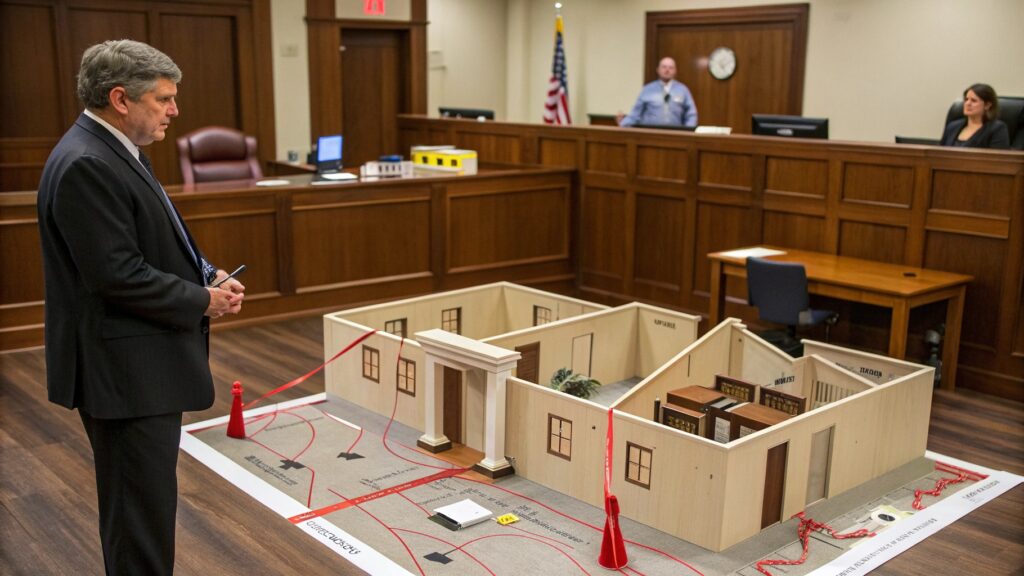
Demonstrative Evidence: These are visual aids that illustrate or explain the facts rather than being the facts themselves. Charts, diagrams, animations, maps, timelines, and 3D models all fall into this category. A demonstrative exhibit doesn’t have to be the literal object; it needs only to clarify what happened.
For example, if an attorney wants to explain how a car crash unfolded, they might use a 3D reconstruction or a scaled-down diagram of the intersection. The exhibit doesn’t prove the accident happened—but it helps the jury visualize it.
Why Exhibits Matter: The Psychology of Persuasion in Court
The human brain loves visuals. Studies in cognitive psychology show that people remember visual information six times better than spoken words alone. In the pressure cooker of a courtroom—where jurors must absorb hours of complex testimony—visual exhibits are memory anchors.
They also add emotional resonance. A photograph of an accident scene can trigger empathy or shock. A financial chart can make patterns of fraud suddenly obvious. A map of a crime scene can make jurors feel like they’re standing in the middle of the event.
Exhibits also equalize understanding. Not everyone on a jury has legal, medical, or technical expertise. But almost everyone can interpret a photo, a timeline, or a model. Exhibits translate expert jargon into plain language—and that’s where persuasion lives.
From Filing Cabinets to Flash Drives: The Evolution of Exhibits
Once upon a time, courtroom exhibits were mostly paper, photos, and physical items rolled in on carts. Today, trials are increasingly digital—and so are the exhibits. The modern courtroom might feature large LED screens, 3D interactive maps, touch-screen evidence boards, or even virtual reality demonstrations. Attorneys can now zoom into digital photos, layer forensic data over maps, and synchronize video evidence with timestamps—all in real time. What used to be a cumbersome poster board is now a multimedia experience.
Digital exhibits also make it easier to organize, retrieve, and authenticate files. A well-prepared trial team can instantly pull up an email thread, a text exchange, or a metadata log with a single click—saving time and keeping jurors engaged. But digital convenience also brings challenges: authenticity, chain of custody, and potential for manipulation (more on that later).
How Courtroom Exhibits Are Created
The creation of a courtroom exhibit is both a technical and creative process. It starts with strategy—understanding what story the attorney needs to tell—and ends with precision, ensuring that every pixel, label, and angle aligns with the facts.
Step 1: Identify What Needs to Be Shown
The legal team begins by asking: What is confusing, complex, or invisible about this case that visuals could clarify? It might be a medical injury, a sequence of financial transactions, or the layout of a construction site.
Step 2: Gather Source Material
Raw materials come from police reports, expert testimony, photographs, surveillance footage, or forensic scans. Every exhibit must be grounded in evidence that can be authenticated.
Step 3: Collaborate with Experts
Attorneys often partner with specialists—graphic designers, animators, forensic illustrators, and trial technologists. These professionals turn raw data into digestible visuals that comply with courtroom standards.
Step 4: Design for Clarity and Impact
Good exhibits are not cluttered or confusing. They’re simple, focused, and persuasive. The best trial graphics follow a storytelling arc: setup, conflict, and resolution. Every color, font, and motion cue should guide the viewer’s eyes toward what matters most.
Step 5: Authenticate and Approve
Before an exhibit can be shown in court, it must be “authenticated,” meaning a witness must confirm that it accurately represents what it claims to depict. Without that verification, even the most stunning animation is useless.
The Art of Storytelling in the Courtroom
At its core, every trial is a battle of narratives. The prosecution and defense aren’t just presenting facts—they’re telling competing stories. Courtroom exhibits are the visuals that give those stories structure, rhythm, and emotional gravity. A timeline of events can turn chaos into sequence. A medical illustration can transform abstract anatomy into human pain. A 3D reconstruction can turn a dry technical point into a dramatic re-enactment.
The best exhibits blend logic and emotion. They help the jury not only understand but feel what happened. When done right, they’re cinematic—not manipulative, but captivating. That’s why trial graphics often borrow techniques from film and journalism. They use perspective, composition, and pacing to keep attention and drive home a point. Some even include subtle animation—like a car sliding across an intersection or a timeline filling in over time—to maintain engagement.
Rules of the Game: Admissibility and Authenticity
Not every visual is fair play in court. The rules of evidence—especially under the Federal Rules of Evidence in the U.S.—set clear boundaries on what can and cannot be shown to a jury.
To be admitted, a courtroom exhibit must meet a few key standards:
- Relevance: It must relate directly to an issue in the case.
- Authenticity: A qualified witness must verify that the exhibit is accurate and unaltered.
- Probative Value vs. Prejudice: It must inform, not inflame. Judges can reject exhibits that are overly graphic, misleading, or emotionally manipulative.
This balance is delicate. A powerful photo might help explain a fact—but if it’s too shocking, the judge might exclude it for unfairly swaying emotions. Attorneys often argue pre-trial motions over whether certain exhibits can even be shown.
The Rise of Digital Fabrication: When Reality Gets Reconstructed
Here’s where things get interesting—and ethically complicated. The same technologies that make courtroom exhibits so vivid also make them easier to fabricate. “Fabrication” doesn’t always mean deception, but it sits in a gray zone between illustration and imagination. For example, a forensic animator might reconstruct a crime scene based on partial data—police reports, witness testimony, and physics models. The resulting animation looks realistic, but it’s still an interpretation.
So, how are courtroom exhibits fabricated—and where’s the line?
Computer-Generated Imagery (CGI) CGI allows experts to recreate scenes that no longer exist: collisions, explosions, surgeries, or building collapses. These visuals can be stunningly lifelike, built frame by frame with forensic precision. But they also risk overstating certainty. A juror might assume an animation proves something, when it’s actually a simulation.
Photo and Video Editing Even minor color adjustments or cropping can change how evidence is perceived. That’s why metadata, timestamps, and chain-of-custody protocols are so crucial. Forensic experts often verify that images haven’t been altered before they reach the courtroom screen.
Deepfakes and AI-Generated Evidence We’ve entered a new frontier. AI can now generate videos or audio clips so realistic that even experts struggle to detect manipulation. Imagine a “recording” of someone confessing—or a “photo” that never existed. Courts are now scrambling to establish digital authenticity frameworks to prevent such fraud.
Reconstruction from Incomplete Data Sometimes, exhibits are fabricated in the literal sense—built from missing pieces. A crash reconstruction might rely on partial skid marks or damaged parts, and the rest is mathematically interpolated. The final exhibit is persuasive but must be labeled as a representation, not a photograph of truth.
In legitimate cases, fabrication is about illustration, not deception. The goal is to clarify, not distort. But as visual tools grow more advanced, the line between truth and artifice can blur—and that’s why expert testimony is essential to keep the record honest.
Famous Cases Where Exhibits Stole the Spotlight
Courtroom exhibits have shaped some of history’s most famous verdicts.
- In the O.J. Simpson trial, the image of the defendant struggling to fit a bloody glove became an unforgettable visual moment that arguably swayed the jury.
- In the Enron scandal, complex financial charts were turned into clean, digestible graphics that helped jurors grasp the magnitude of corporate deception.
- And in medical malpractice suits, 3D anatomical models have allowed jurors to “see” inside the human body—transforming testimony from abstract to visceral.
The lesson? A single image can redefine the trajectory of a trial.
How Lawyers Use Exhibits Strategically
A good trial lawyer thinks like a stage director. Every exhibit is a prop in a larger performance designed to hold attention and persuade. Timing, tone, and sequence matter.
Some attorneys introduce visuals early to establish credibility. Others save them for dramatic cross-examination moments. Exhibits can be tools for impeachment (contradicting a witness), clarification (explaining an expert’s theory), or emotional impact (giving jurors a sense of loss or injustice).
Technology now enables even more control. With presentation software like TrialDirector or Sanction, lawyers can highlight, zoom, and annotate exhibits in real time, guiding the jury’s eyes to the exact detail that matters most.
Inside the Modern Exhibit Workshop
Behind every polished exhibit is a hidden army of creators—graphic designers, 3D modelers, forensic photographers, and data analysts. Together, they form what might be called a “visual litigation lab.”
Here’s how their collaboration works:
- Attorneys define the narrative: what story needs to be told.
- Experts verify the technical accuracy.
- Designers translate those details into visuals that persuade without confusing.
It’s a blend of science, art, and psychology. Every angle, color, and caption is deliberate. Even font choice can carry weight—bold sans-serif fonts for authority, softer tones for empathy.
The end product isn’t just a “graphic”—it’s a carefully engineered moment of clarity designed to stick in the jury’s collective memory.
Ethical and Legal Boundaries of Fabrication
The fabrication of courtroom exhibits raises profound ethical questions. When does enhancement become deception? When does an animation become a narrative rather than evidence?
Courts typically draw the line at intent and accuracy. If an exhibit accurately represents the data it’s based on—and the expert clearly states its limits—it’s admissible. If it misleads, even unintentionally, it can backfire dramatically. Forensic illustrators are taught to annotate their visuals with disclaimers like “artist’s interpretation” or “not to scale.” Attorneys must disclose what data informed an animation and which aspects were estimated.
Still, gray areas persist. Imagine an AI-enhanced photo that “clarifies” blurry surveillance footage—did it reveal the truth, or invent details? The debate is ongoing, and legal systems worldwide are scrambling to keep up.
The Future of Courtroom Exhibits: AI, AR, and Beyond
As artificial intelligence, augmented reality (AR), and 3D scanning become mainstream, the future courtroom will look more like a science lab than a drama set. Picture jurors donning AR headsets to “walk” through a reconstructed crime scene. Or an expert witness controlling a holographic 3D organ to show where a surgical error occurred. Even satellite and drone imagery can now be layered into geographic models for environmental cases.
AI may soon help attorneys auto-generate visual summaries of discovery materials, highlighting patterns or timelines that would take humans weeks to assemble. The challenge, of course, will be maintaining verifiable authenticity. The courtroom of the future will still hinge on one timeless truth: credibility beats flash. No matter how high-tech the visuals become, exhibits will always serve one purpose—to reveal, not obscure, the truth.
How Fabrication Can Be Detected
Modern forensic tools are catching up with fabrication techniques. Specialists can now detect inconsistencies in metadata, lighting patterns, or digital noise signatures to identify edited photos or videos. Chain-of-custody logs—essentially a digital paper trail—record every hand that evidence passes through. Courts also rely on expert witnesses to confirm whether a digital file’s integrity has been maintained. As AI fakes grow more convincing, the legal world is exploring blockchain verification, digital watermarking, and cryptographic hashing to lock authenticity into the file itself. The goal is clear: to ensure that every exhibit shown in court is verifiably real.
Why This Matters: Truth, Trust, and Technology
Courtroom exhibits are more than persuasive visuals—they’re a cornerstone of justice. They remind us that seeing is not always believing, but without sight, understanding is nearly impossible. They give jurors the tools to visualize truth. But as technology blurs the line between real and artificial, the responsibility to maintain honesty grows heavier.
A well-crafted exhibit can illuminate truth in ways words never could. A deceptive one can distort it beyond recognition. The future of courtroom exhibits will hinge on transparency—where creativity meets credibility.
The Visual Language of Justice
So, what are courtroom exhibits? They’re the heartbeat of legal storytelling—the bridge between law and life. They turn abstract arguments into vivid experiences, helping juries, judges, and even the public grasp complex truths. From ancient scrolls and physical artifacts to 3D digital renderings and immersive simulations, exhibits have evolved—but their purpose hasn’t changed. They exist to make justice visible. Yet, with every leap in technology comes a new challenge: how to preserve authenticity in a world where images can lie. As courts, lawyers, and technologists adapt, one thing remains certain—justice will always rely on what we can see, believe, and prove.
Check out WhiteClouds’ 3D Props for more information.
Contact us today to learn more about our 3D services and how we can help you achieve your goals.