
Inside the Art, Engineering, and Magic of Larger-Than-Life Creations
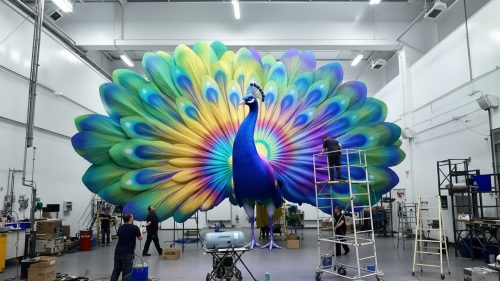
There is something irresistible about standing before a character so large it seems to belong to another world. Whether it’s a towering superhero in a theme park, a mythological guardian at a cultural festival, or a colossal mascot outside a shopping center, giant character models capture our imagination. They are more than just sculptures: they are immersive experiences, storytelling devices, and feats of engineering that merge art and science into breathtaking creations. But how do these monumental figures actually come to life? The journey from a rough sketch on a designer’s notepad to a finished model towering over crowds is a fascinating blend of creativity, technology, craftsmanship, and problem-solving. In this guide, we’ll walk through the entire process, from initial concept to finished installation, revealing the artistry and technical wizardry behind these massive icons.
Why We Build Giants
Giant character models are not built just for fun, though fun is certainly part of it. They exist because size matters when it comes to impact. On a busy convention floor, a colossal robot can stop attendees in their tracks. In a city plaza, a mythic figure can transform into a cultural landmark that residents identify with. For businesses, a giant mascot is a marketing powerhouse, inviting photos, selfies, and free social media exposure. On a deeper level, they fulfill a timeless human desire: to externalize stories and myths in a form we can physically interact with. Just as ancient civilizations carved gods into stone colossi, modern creators build superheroes, dragons, or whimsical mascots to embody ideas larger than life.
The Spark: From Idea to Sketch
Every giant character model begins with an idea. Sometimes it’s a client’s request—“We want a 20-foot version of our brand mascot for an upcoming trade show.” Other times, it’s an artist’s vision—“What if a dragon perched above a city street?”
The first step is sketching. These sketches capture pose, emotion, and scale. A well-drawn sketch doesn’t just show what the character will look like—it suggests how it will feel in space. Will it be playful, intimidating, inspiring? Artists often create multiple sketches, experimenting with gestures and stances until one resonates. At this stage, functionality must also be considered. A dynamic pose with an outstretched arm may look exciting on paper, but will it be stable in real life? Sketches balance aesthetics with practicality, laying the groundwork for the design ahead.
Digital Blueprints: 3D Modeling
Once sketches are approved, the design moves into the digital world. Using software like Blender, Maya, or ZBrush, artists create a full 3D model of the character. This step allows precise control over every detail, from facial expressions to costume textures.
3D modeling also makes scaling possible. A model originally designed at tabletop size can be digitally enlarged to 10, 20, or even 40 feet while retaining correct proportions. Designers can rotate, zoom, and test the model in virtual environments, ensuring it looks good from every angle.
Engineering considerations also come into play. The software helps identify potential structural weak points—like thin ankles or outstretched wings—that might need reinforcement. In some cases, separate digital layers are created for the internal framework and outer shell, aligning artistry with engineering.
Planning for Scale and Environment
Scale is everything. A 12-foot statue designed for an indoor atrium has very different requirements from a 40-foot outdoor model meant to endure wind, rain, and sunlight. Designers must consider where the character will live, who will interact with it, and how long it is expected to last. For temporary displays, lightweight materials may suffice. For permanent outdoor installations, durability becomes a priority, requiring weather-resistant coatings, reinforced frameworks, and UV-stable paints. Accessibility is another factor: can people safely walk up to it, or does it need barriers? These early decisions affect not only how the model looks, but also how it will be built, transported, and maintained.
Choosing the Right Materials
The choice of materials is one of the most critical steps in bringing giant character models to life. Different projects demand different blends of strength, weight, and surface finish.
Foam—especially EPS or XPS—is often used as a base because it’s lightweight and easy to carve. However, foam alone isn’t strong enough to survive long-term use. That’s where fiberglass, resin coatings, or polyurea reinforcement come in, creating a tough outer shell.
Steel or aluminum provides the skeleton that holds everything up, especially for models with extended features like wings, tails, or oversized heads. For fine details, 3D printing is becoming increasingly popular, allowing precision components to be integrated into the larger form.
The materials must work together: foam for volume, metal for strength, coatings for durability, and paint for beauty.
How Giant Character Models Are Fabricated
This is the stage where imagination becomes physical reality, and the process is nothing short of fascinating. Fabrication involves multiple overlapping steps, each demanding specialized skills.
Sectioning and Scaling
The digital model is divided into manageable pieces. A 25-foot dragon, for example, may be broken into dozens of sections that can be carved, coated, and later assembled like a giant puzzle.
Foam Carving and CNC Cutting
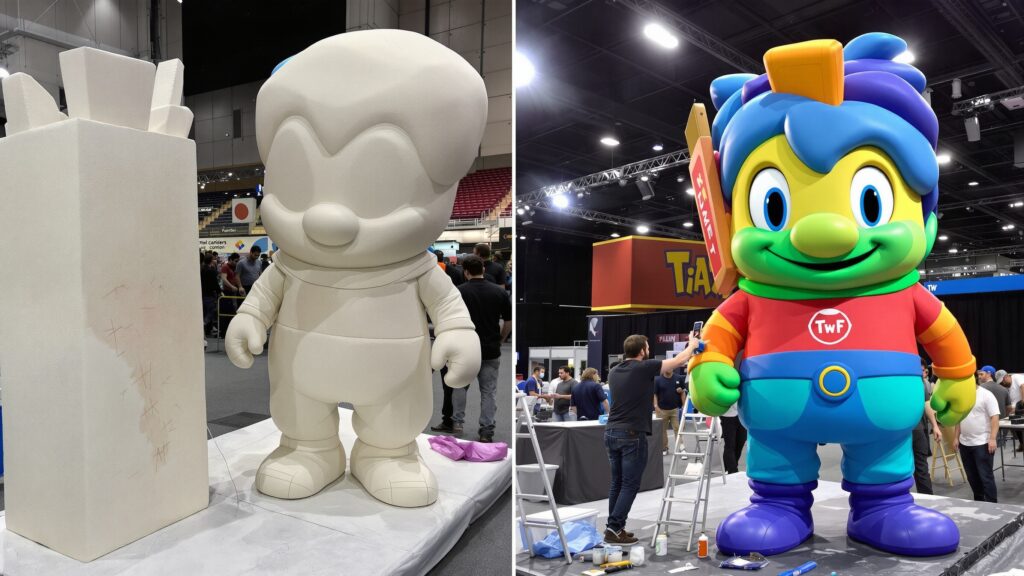
Foam blocks are cut using CNC routers or hot-wire machines to rough out the shapes. Skilled sculptors then refine the details by hand, sanding, carving, and shaping until the foam matches the digital design.
Framework Construction
Inside the model, a steel or aluminum armature is built. This skeleton provides stability, ensuring the figure won’t tip, sag, or collapse. Welders and engineers calculate weight distribution, wind load, and balance to make sure the structure is safe.
Hard Coating and Reinforcement
The foam sections are coated with resin, fiberglass, or polyurea. These layers turn fragile foam into a rock-hard surface capable of withstanding both touch and weather. The coating stage requires precision: too thin, and it’s weak; too thick, and it distorts details.
Assembly and Seaming
The coated sections are joined around the framework. Joints are carefully blended so the model appears seamless. At this point, it begins to resemble a real figure rather than a collection of pieces.
Surface Detailing
Artists add textures: scales on a dragon, fabric folds on a superhero’s cape, or wrinkles on a mascot’s smile. These details transform a blank form into a living character.
Painting and Finishing
Airbrushing, hand-painting, and specialized coatings bring the figure to life. Realistic skin tones, metallic finishes, or vivid cartoon colors are applied, followed by protective layers to preserve the look.
Transport and Installation
Finally, the giant must travel. Because they are too large to transport whole, most figures are disassembled into sections, loaded onto flatbeds, and reassembled on site. Cranes, rigging systems, and skilled installers ensure the figure rises safely into position.
This fabrication process is both art and engineering, requiring collaboration between sculptors, painters, engineers, and installers.
Adding Motion, Light, and Interactivity
Static figures are impressive, but technology can take them further. Animatronics add movement—eyes blink, wings flap, or hands wave. LED lighting can make a superhero glow or a dragon’s eyes burn red at night. Some models integrate sound systems, allowing characters to “speak” or roar. Augmented reality adds another layer: visitors can scan a QR code and watch the figure come alive on their phones. These features transform the model from a sculpture into an experience, encouraging visitors to return again and again.
Where You’ll Find Giant Character Models
These monumental figures are everywhere once you start looking. Theme parks use them to anchor rides and attract visitors. Museums employ them to bring history and science to life, like life-size dinosaurs or cultural icons. Trade shows rely on them to draw attention in crowded halls. Cities commission them as public landmarks, while film sets build them as props for epic scenes. Each context shapes the design. A convention mascot might be bright, playful, and temporary. A city guardian might be solemn, weatherproof, and meant to last decades. The variety is endless.
Challenges in Building Giants
Building on this scale is never simple. Structural safety is paramount, requiring careful engineering and sometimes government permits. Transport logistics can be complex, with oversized loads demanding special vehicles and escorts. Maintenance is ongoing. Sunlight can fade paint, rain can weaken joints, and freezing weather can cause cracks. Owners must invest in inspections and touch-ups to keep the model safe and beautiful. And then there’s cost. Depending on size, materials, and complexity, a giant character model can range from tens of thousands to hundreds of thousands of dollars. Yet many clients see the investment as worthwhile, thanks to the attention and marketing value generated.
The Cultural Role of Giant Figures
Giant character models are not just commercial props. They are cultural artifacts that embody the stories and values of their communities. A massive superhero may symbolize strength and resilience. A colossal dragon may celebrate myth and imagination. A giant mascot may bring humor and joy to everyday life. By occupying public space, these figures invite interaction, photography, and dialogue. They become part of the collective memory of a place, cherished by residents and celebrated by visitors.
The Future of Giant Character Models
As technology evolves, the possibilities grow. Advanced robotics could make figures capable of fluid, lifelike motion. New composite materials may allow models to be lighter yet more durable. Augmented reality could merge digital and physical storytelling, turning a static statue into a hybrid experience. The appetite for spectacle and story is stronger than ever, and giant character models will continue to meet that need—bigger, bolder, and more creative than before.
Conclusion
The journey from sketch to reality in building giant character models is an incredible fusion of art and science. It begins with a spark of imagination, grows into a digital blueprint, and passes through stages of carving, framework building, coating, painting, and installation before finally standing tall in the real world. These towering figures are more than decorative objects. They are landmarks, marketing tools, cultural icons, and works of art. They challenge our sense of scale, invite us to interact, and remind us that some stories can only be told when they are larger than life. So the next time you stand before a colossal mascot, superhero, or mythological figure, you’ll know the secret: behind that towering presence lies a meticulous process of creativity, craftsmanship, and engineering that turns sketches into giants.
Check out WhiteClouds’ 3D Statues for more information.
Contact us today to learn more about our 3D services and how we can help you achieve your goals.