
The Giant Wolf Statue: Power, Mystery, and Monumental Art
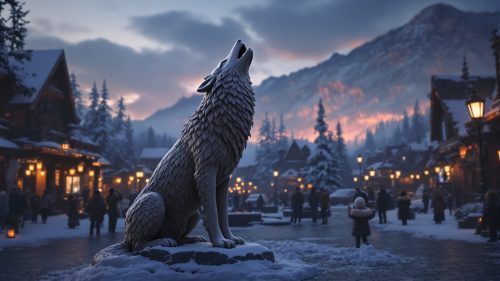
Few animals command as much awe and respect as the wolf. For centuries, it has stood as a symbol of strength, loyalty, cunning, and survival. From ancient myths and indigenous folklore to modern pop culture and environmental conservation, wolves capture the human imagination. When transformed into monumental art, the wolf becomes more than an animal; it becomes a symbolic landmark. The giant wolf statue represents not just the creature itself but also the stories and emotions humans have projected onto it for millennia. These towering sculptures appear in parks, city centers, forests, and roadside attractions, captivating passersby with their scale and artistry. A giant wolf statue is not merely a decoration—it’s a presence. It conveys power, mystery, and connection to nature, while inviting visitors to stop, reflect, and admire.
The Wolf in Mythology and Culture
The wolf has carried deep cultural meaning across civilizations. In Native American traditions, wolves are revered as teachers, pathfinders, and symbols of family loyalty. They are pack animals, devoted to their kin, embodying unity and cooperation. In Norse mythology, wolves like Fenrir loom large as forces of chaos and destiny. In Roman legend, the she-wolf that nursed Romulus and Remus became a foundational image of Rome’s origins. In literature and film, wolves swing between menace and majesty—sometimes cast as villains, other times as noble allies. Their duality—dangerous predators yet symbols of loyalty—makes them endlessly fascinating. This rich symbolic weight makes wolves perfect subjects for monumental art. A giant wolf statue instantly evokes layers of meaning, from mythology and folklore to environmental awareness.
Why Wolves Inspire Monumental Sculptures
Unlike domestic animals, wolves exist on the edge of human imagination, half real and half mythical. Their howls echo through forests, reminding us of the wild that persists beyond civilization. For many, the wolf represents freedom, wilderness, and resilience in a world that often feels increasingly tamed. Scaling a wolf into monumental form emphasizes these qualities. A giant wolf statue doesn’t just depict an animal—it asserts its role as guardian, spirit, and reminder of nature’s power. Visitors feel its presence as if encountering an apex predator in its natural habitat. Communities adopt giant wolf statues because they communicate identity, pride, and respect for the wild.
Artistic Styles of Giant Wolf Statues
No two giant wolf statues look alike. The artistic choices behind them reflect different aspects of how we see wolves.
Some statues are hyper-realistic, capturing every detail of fur, muscle, and gaze. These statues are often placed in natural parks or near wilderness centers, reinforcing conservation themes. Others lean toward stylization, emphasizing the sharp angles of the wolf’s body or exaggerating its howl to the sky. These can be sleek and modern, appealing to urban plazas and contemporary sculpture parks.
There are also abstract wolves, reduced to geometric silhouettes or crafted from recycled materials, emphasizing concept over detail. In fantasy settings, wolves might even be combined with mythical elements—glowing eyes, wings, or armor—transforming them into guardians of imagined realms.
This diversity shows the wolf’s adaptability as a subject. Just as wolves themselves thrive across ecosystems, wolf statues thrive across artistic styles.
The Role of Wolf Statues in Tourism and Community Identity
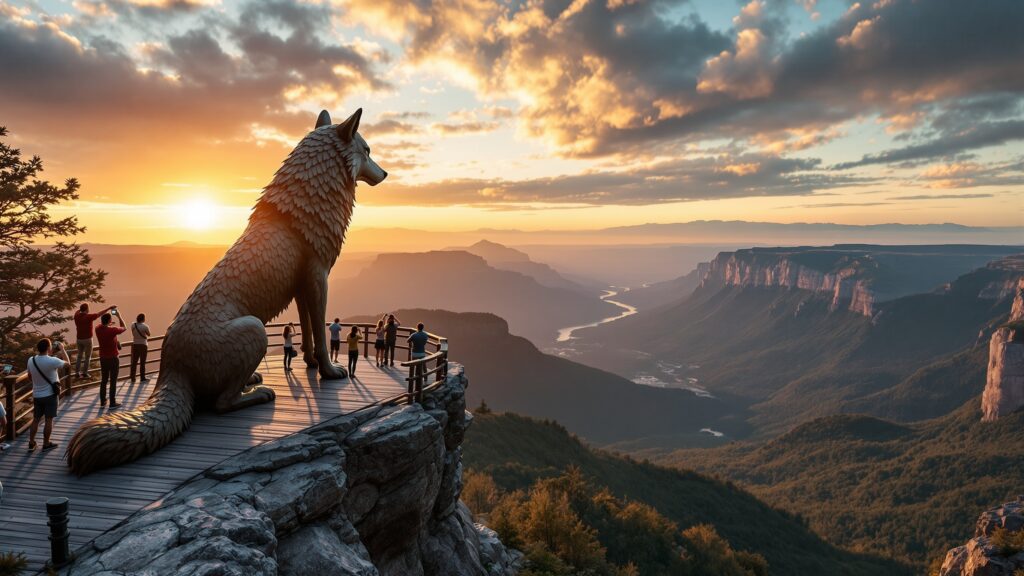
Like giant roosters, bears, or Paul Bunyan figures, giant wolf statues anchor themselves in local tourism. Towns that identify with wolves—whether through local wildlife, folklore, or sports mascots—often adopt statues as community symbols. A wolf statue can stand outside a stadium, welcome travelers into a town, or mark the entrance to a natural reserve. Tourists love them because they’re instantly photogenic. Families pose beneath them, hikers snap photos before hitting the trails, and travelers share them across social media. These statues become unofficial mascots of their regions. For small towns, a giant wolf statue might be their boldest claim to fame, giving them recognition beyond their borders.
How a Giant Wolf Statue Might Be Fabricated
Turning a wolf into a towering sculpture requires both artistry and engineering. Wolves have lithe, muscular bodies and expressive features, which present different challenges from statues of more static animals.
The process often begins with a steel armature, a skeletal framework that defines the wolf’s posture—whether standing tall, crouching to pounce, or howling at the sky. This framework provides structural integrity, ensuring the statue can withstand its own weight and environmental stress like wind and snow.
Over the framework, fabricators apply an outer shell of fiberglass, concrete, resin, or metal panels. Fiberglass is especially popular because it can capture intricate details like fur while remaining lightweight. For more permanent installations, reinforced concrete ensures durability over decades. Some modern statues even use corten steel, which develops a rust-like patina that blends naturally into outdoor environments.
Detailing is crucial in wolf statues. Artists sculpt fur textures, sharpen ears, and capture the intensity of the eyes. For realistic statues, paint is applied in layers to mimic the subtle gradients of a wolf’s coat. For stylized or abstract versions, bold finishes—metallic sheen, painted patterns, or mosaic tiles—can transform the wolf into something more symbolic.
Lighting is often integrated for dramatic effect. Spotlights aimed upward can make a wolf statue look as though it’s illuminated by moonlight. In more elaborate designs, LED lights might be embedded in the eyes, giving the wolf a glowing, almost supernatural presence at night.
Installation requires cranes and heavy equipment, especially for statues exceeding 20 feet tall. Crews secure the wolf’s paws with reinforced foundations, anchoring the sculpture against tipping or erosion. The end result is a statue that not only looks fierce and commanding but also stands resilient against the elements.
Wolves in Contemporary Public Art
Beyond roadside Americana, wolves have become popular subjects in public art projects worldwide. They serve as reminders of endangered species, as emblems of resilience, or as cultural mascots.
In cities, giant wolf statues may take on symbolic roles—representing sports teams, civic pride, or cultural diversity. In wilderness regions, they often highlight conservation efforts, reminding visitors of the ecosystems at stake. For festivals and temporary exhibitions, wolves become canvases for artists to experiment with bold colors, surreal forms, or interactive designs. The wolf’s adaptability as an art subject mirrors its adaptability in nature. It thrives both in folklore and modern symbolism, both in rural landscapes and urban installations.
Imagining Future Giant Wolf Statues
The future of wolf monuments is wide open, as communities and artists push creative boundaries. We might imagine a mirrored stainless steel wolf standing in a city square, reflecting skyscrapers by day and glowing lights by night. Or a pack of giant wolves arranged in a natural setting, allowing visitors to walk among them as though entering a living forest scene.
Some future installations could even incorporate interactivity. Projection mapping might bring a statue to life at night, making it appear as though the wolf is howling under a projected moon. Augmented reality could allow visitors to see the wolf in different poses or colors through their phones. By blending technology and artistry, giant wolf statues of the future will continue to inspire awe while connecting people to the wild spirit these animals embody.
Why the Wolf Works as a Monumental Subject
At the heart of it all, the wolf is a natural fit for monumental sculpture because of its dual identity. It is both real and mythic, both feared and admired. When scaled up into a giant statue, these contradictions only intensify. The wolf becomes a guardian, a warning, a celebration, and a story all at once. Unlike statues of human heroes, wolf statues do not tie themselves to a single narrative. Instead, they represent timeless archetypes—strength, survival, loyalty, freedom. Their universality makes them powerful across cultures and eras.
Conclusion: A Monument to Wilderness and Imagination
The giant wolf statue is more than a work of public art. It is a cultural anchor, a tourist attraction, and a symbolic reminder of humanity’s enduring relationship with the wild. Whether rendered in lifelike detail or abstract geometry, wolves command respect when enlarged into monumental form. For towns, they provide identity and tourism. For artists, they offer expressive possibilities. For visitors, they spark wonder, reminding us that even in our modern world, the spirit of the wilderness is never far away.
In the gaze of a giant wolf statue, we see ourselves reflected: small in scale but vast in imagination, still longing for connection to the primal and the untamed. These statues howl silently across plazas and forests alike, eternal guardians of myth and nature.
Check out WhiteClouds’ 3D Statues for more information.
Contact us today to learn more about our 3D services and how we can help you achieve your goals.