
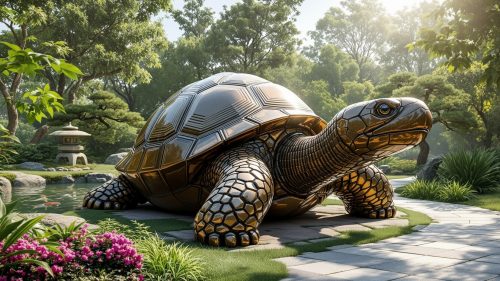
The Giant Tortoise Statue: A Symbol of Patience, Strength, and Timeless Wonder
Statues have long been humanity’s way of capturing stories, myths, and emotions in physical form. From towering monuments of leaders to abstract sculptures that spark thought, each piece serves as a cultural fingerprint left behind for generations. Among these creations, one figure stands apart for its quiet majesty: the giant tortoise statue. Unlike lions, horses, or mythological beasts often immortalized in stone and metal, the tortoise conveys a different kind of power—the power of patience, wisdom, and longevity. The very sight of a massive tortoise statue can stop you in your tracks. Its slow gait frozen in time, its shell an armored dome of intricacy, and its ancient eyes carved with quiet wisdom—all combine to make it not just an artwork but a statement about life itself. In this article, we will explore the cultural resonance of tortoises, why giant tortoise statues are gaining popularity worldwide, the artistry behind them, and even how such a monumental piece might be fabricated.
Why the Tortoise? A Creature Rich in Meaning
The tortoise has been revered in cultures around the world for millennia. In African, Asian, and Native American traditions, tortoises and turtles often symbolize creation, stability, and endurance. Some myths portray the tortoise as carrying the entire world on its back, a living foundation of existence itself. In Chinese mythology, the tortoise is one of the Four Celestial Animals, representing wisdom and longevity. In Hindu cosmology, the tortoise avatar of Vishnu, known as Kurma, plays a central role in supporting the cosmic mountain during the churning of the ocean. Meanwhile, in Native American traditions, the concept of “Turtle Island” describes North America itself resting on the back of a turtle.
By immortalizing such a creature in large-scale sculpture, artists and communities are paying tribute to the timelessness of life and the persistence of nature. A giant tortoise statue is not just an object of visual fascination–it is an embodiment of stories that stretch across cultures and centuries.
The Awe Factor: Why Giant Statues Captivate Us
There is something uniquely compelling about making the small large. A tortoise in reality moves slowly, barely noticed unless one stops to appreciate it. But enlarge that tortoise into a statue two, three, or even four times human height, and it transforms into a creature of mythic proportions. When you stand beside a giant tortoise statue, you feel dwarfed—not just by its physical presence but by the weight of the symbolism it carries. Its size magnifies its significance, allowing people to pause, reflect, and reimagine what they know about this ancient creature. Much like colossal Buddhas, massive lions guarding temples, or enormous dinosaur replicas, the giant tortoise statue reminds us of our own place in the vast timeline of life. We are temporary, fleeting. The tortoise, both in real life and in stone, endures.
Locations Where Giant Tortoise Statues Shine
Though still less common than statues of horses, lions, or religious figures, giant tortoise statues are appearing in gardens, zoos, coastal towns, museums, and even city parks.
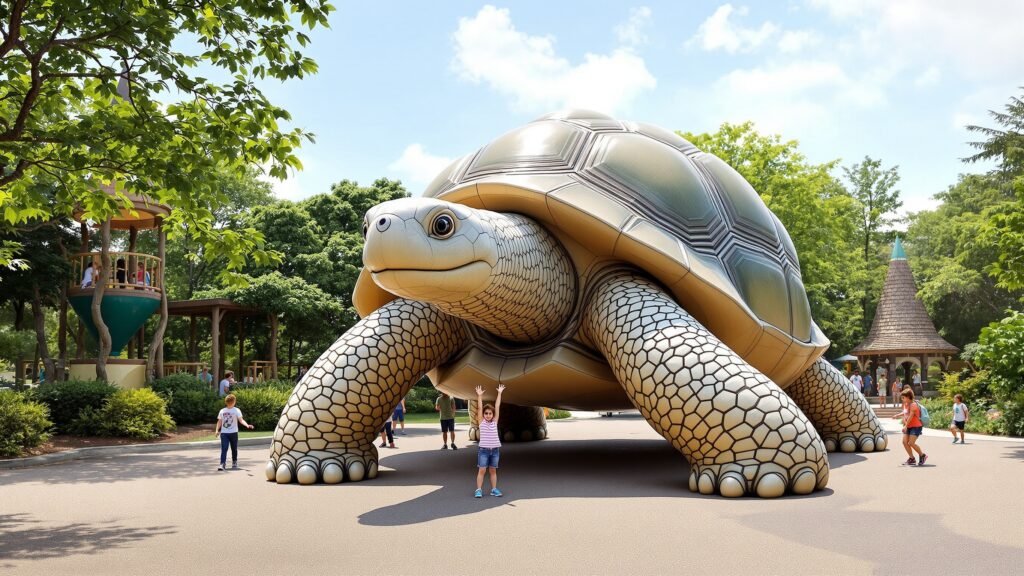
Imagine strolling through a botanical garden and coming across a tortoise sculpture so large you could climb onto its back like a bench. Children laugh and play on its shell, while adults snap photos and admire the craftsmanship. In a zoo, such a statue could serve as an educational centerpiece, drawing attention to the conservation needs of endangered tortoise species like the Galápagos or Aldabra tortoises.
Some seaside towns have embraced marine and reptilian sculptures as part of their waterfront décor. A massive tortoise statue placed by the water’s edge instantly communicates themes of resilience and connection to the ocean. It becomes more than just decoration—it is a landmark.
And in modern art parks, giant tortoise statues are being explored in abstract and imaginative ways. Some are smooth, minimalist interpretations, while others are hyper-detailed, replicating every groove and texture of the shell.
Styles of Giant Tortoise Statues
The beauty of tortoise-inspired art lies in its versatility. Artists and fabricators bring their own interpretations to the subject, resulting in a wide range of statue styles. Some sculptures are realistic, capturing the fine detail of leathery skin, the dome of the shell, and the glint of a wise reptilian eye. These statues feel alive, as if the tortoise has paused mid-step, caught forever in motion. Others are stylized or symbolic. An artist might exaggerate the curves of the shell, transforming it into geometric forms or adding ornate carvings that tell a secondary story. In some cases, the tortoise becomes abstract, reduced to flowing lines that only suggest its form while evoking its spirit. And then there are fantastical interpretations. Imagine a tortoise with a shell resembling a miniature city, symbolizing the world carried on its back. Or a hybrid tortoise-statue that fuses natural and mythological elements—perhaps wings or glowing gemstones embedded in its form. These imaginative pieces push the boundaries of sculpture, turning the tortoise into a canvas for storytelling.
How a Giant Tortoise Statue Might Be Fabricated
Fabricating a giant tortoise statue is a blend of artistic vision, engineering precision, and material science. Unlike small sculptures that can be crafted in a studio, large-scale pieces demand careful planning, structural integrity, and sometimes even collaboration across multiple disciplines.
Concept and Design
It begins with sketches, digital models, or even clay maquettes (small scale models). Artists map out proportions, poses, and surface details. For a realistic tortoise, reference photos and even live tortoises are studied to ensure accuracy. For symbolic or abstract styles, the focus shifts to aesthetic impact and narrative.
Structural Framework
Once the design is finalized, a framework or armature must be built. This internal skeleton ensures the statue can withstand its own weight and environmental factors like wind and rain. Steel rebar or welded frameworks are common choices.
Material Selection
The choice of material depends on location, budget, and purpose.
- Bronze: Classic and durable, often used for museum-quality or outdoor installations.
- Concrete: Affordable, versatile, and weather-resistant, perfect for public parks.
- Fiberglass: Lightweight but strong, excellent for large but transportable sculptures.
- Stone: Granite or marble, though rare for tortoise statues, adds timeless grandeur.
Sculpting and Detailing
For realism, sculptors meticulously carve textures: the scales on the legs, the ridges on the shell, and the creases around the eyes. For stylized versions, smooth surfaces or geometric patterns are emphasized. Techniques vary depending on material—chiseling for stone, clay modeling for bronze casting, or direct carving in foam before fiberglass coating.
Finishing Touches
Surface treatments like patinas, paints, or sealants add character and protection. Bronze may take on a greenish patina over time, enhancing its timeless aura. Painted fiberglass statues might use earthy tones to evoke realism or bold colors for modern flair.
Installation
Finally, the statue is transported and installed at its site. A foundation is laid to secure it, ensuring stability and safety. Depending on the design, plaques or lighting may be added to enhance the viewing experience. In the end, the statue stands as the culmination of weeks—or even months—of labor, waiting to inspire awe.
The Human Connection: Why We Relate to the Tortoise
Unlike fierce lions or galloping horses, tortoises connect to us in subtler, more contemplative ways. They are reminders of endurance, the importance of pacing oneself, and the dignity of age. In a fast-moving world, a giant tortoise statue urges us to slow down. Its presence says: life is not a race. The tortoise’s journey, steady and unwavering, mirrors our own long paths through challenges, growth, and eventual wisdom.
Children are often fascinated by the sheer size and approachable form of tortoise statues. Unlike predatory animals, tortoises inspire curiosity without fear. Adults, meanwhile, may see them as symbols of grounding—a reminder to remain steady in the face of life’s storms.
Giant Tortoise Statues in Modern Culture
Social media has amplified the charm of large statues. Visitors to parks, gardens, or museums rarely leave without snapping photos, and a giant tortoise statue provides an irresistible backdrop. Hashtags like #TortoiseArt, #SculpturePark, and #PublicArt help spread their image worldwide. Some cities have even turned animal statues into cultural trails. Just as cow or bear statues are painted by different artists and displayed across towns, giant tortoise statues could easily be adapted into public art projects. Each tortoise could feature unique shell patterns designed by local artists, turning the town into an open-air gallery.
Environmental and Conservation Messages
The presence of a giant tortoise statue also carries an unspoken message: protect the real tortoises. Many species of tortoises are endangered, threatened by habitat loss, poaching, and climate change. By featuring tortoise statues in public spaces, communities can raise awareness and spark conservation efforts.
Imagine a zoo unveiling a giant tortoise statue alongside educational exhibits about Galápagos tortoise conservation. Visitors would not only admire the statue but also learn about real-world efforts to protect these ancient creatures. In this way, art and activism intertwine seamlessly.
The Timeless Allure of Monumental Art
From the pyramids of Egypt to the Moai statues of Easter Island, humans have always been drawn to building larger-than-life representations of things that matter to us. The tortoise, as an emblem of endurance and wisdom, fits perfectly into this tradition. A giant tortoise statue bridges past and present, myth and reality, nature and culture. It stands as a reminder that even the slowest beings can leave the deepest impressions.
Conclusion: A Monument to Patience and Power
The giant tortoise statue is more than just an oversized reptile in stone, metal, or fiberglass. It is a story carved into form, a lesson frozen in time, and a landmark that transcends generations. Whether realistic or abstract, placed in a garden or museum, each giant tortoise statue captures something essential about life: that strength is not always loud, speed is not always superior, and wisdom is built in slow, steady steps.
As the world rushes ahead, perhaps we need more giant tortoises watching over us, reminding us to pause, breathe, and carry on—at our own pace.
Check out WhiteClouds’ 3D Statues for more information.
Contact us today to learn more about our 3D services and how we can help you achieve your goals.