
Shaping a Giant Spleen Display
A giant spleen display is distinguished by a compact elongated curve, changing thickness, a recessed connection edge, and the choice between a simple exterior and visible interior content. Keeping those decisions specific prevents the page from becoming a generic organ or medical-props article.
Plan a Spleen Display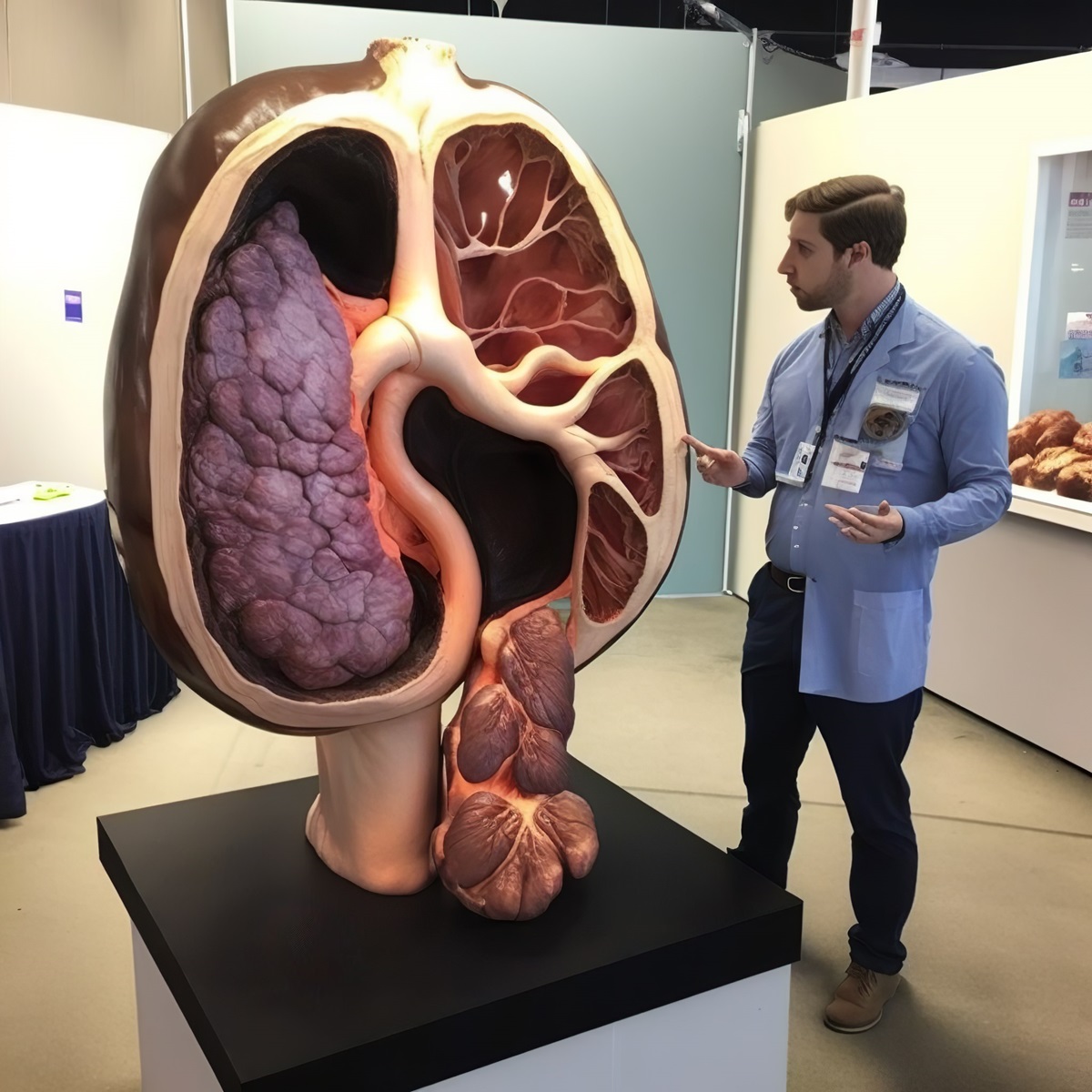
Define the curve before adding interior detail
Start with matching front, side, and three-quarter references. Mark the upper and lower ends, the broad convex edge, the recessed inner edge, maximum thickness, and the way the form tapers along its length. Those proportions should identify the spleen even when labels are absent.
A simplified exterior can use a cleaner outline and larger color areas. A more reference-driven form needs coordinated views so the inner recess and thickness change do not become a generic bean or flattened oval.
See how a cutaway changes the principal face
The pictured display pairs an elongated curved exterior with a large open face, contrasting interior areas, and connection cues along the recessed edge. The cutaway makes one side much more informative than the reverse.
The image does not identify the fabricator or supply construction details. A new request should specify its own contour, interior content, colors, labels, orientation, support, and viewing conditions.
Separate the outer shell from selected visible regions
If the display is open, draw the cut plane and interior depth in section. Identify the number, shape, and color of visible regions and whether a rim, removable panel, labels, or leader lines surround them. Include only the features needed for the intended display.
For a closed exterior, decide whether connection points, surface color changes, or applied callouts provide enough information. A complete walk-around object may need different rear treatment from a wall-mounted display with one primary face.
Place the curved form for recognition
The same spleen can read differently when its long axis changes direction.
Vertical
A vertical pose emphasizes length and can place a cutaway at eye level, but the support must preserve the lower taper.
Diagonal
A diagonal arrangement exposes the curve and creates a wider envelope around labels, connections, or neighboring graphics.
Horizontal
A low display may suit a counter or case while requiring enough elevation to keep the inner recess visible.
Wall or system display
Define how the spleen meets a panel, diagram, or surrounding forms and which connections are physical rather than graphic.
Prepare the exact form and presentation
A useful request connects contour and cutaway content to one physical orientation.
- Approved spleen references from coordinated directions
- Long-axis curve, taper, inner recess, and maximum thickness
- Closed exterior, cutaway, removable section, or labeled arrangement
- Selected connections, interior regions, colors, and callouts
- Vertical, diagonal, horizontal, counter, wall, or integrated position
- Overall dimensions, support, principal view, and finished sides
- Closest audience position and any removable-feature access
- Entry dimensions, final location, and completion deadline
Request pricing for a custom giant spleen display
Send the contour references, exterior or cutaway configuration, connections and labels, dimensions, orientation, support condition, viewing access, destination, and schedule.