
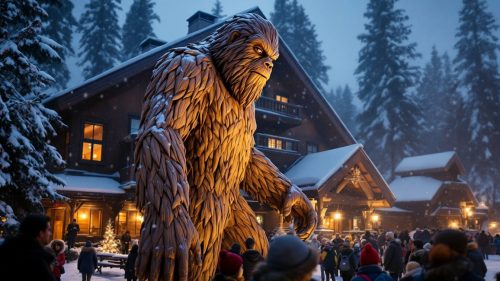
From Folklore to Landmarks: The Rise of Giant Sasquatch Statues
Few creatures capture the imagination quite like Sasquatch. Also known as Bigfoot, this legendary ape-like figure has been spotted—or claimed to be spotted—in forests from the Pacific Northwest to the Appalachian Mountains. Stories of a tall, hairy being wandering the wilderness have fueled folklore for centuries, sparking endless debate: is Sasquatch real, or just an enduring myth? Regardless of belief, one thing is certain: the image of Sasquatch has become a cultural icon. From documentaries and campfire tales to roadside attractions, Sasquatch lives on as a symbol of mystery, adventure, and the wild unknown. And perhaps the most striking way this myth has been immortalized is through giant Sasquatch statues—towering sculptures that bring the creature’s legendary proportions into the real world.

Sasquatch in Folklore and Popular Culture
The origins of Sasquatch run deep. Indigenous cultures across North America have long shared stories of large, hairy beings who lived in the forests and mountains. These beings were often portrayed not as monsters but as guardians of the land, spirits of the wild, or reminders of humanity’s connection to nature.
The modern Bigfoot craze surged in the mid-20th century, fueled by alleged sightings, mysterious footprints, and grainy photographs like the famous 1967 Patterson-Gimlin film. From then on, Sasquatch became a household name, appearing in movies, television shows, advertisements, and local tourism campaigns. Because the creature exists in a space between belief and skepticism, Sasquatch became more than just a cryptid—it became a cultural canvas. Communities embraced it as a playful mascot, businesses used it to draw in curious customers, and sculptors found inspiration in turning legend into monumental form.
Why Sasquatch Inspires Giant Statues
Sasquatch is already envisioned as a giant—often described as eight to ten feet tall—so enlarging him into statue form feels natural. Unlike statues of ordinary animals or people, a Sasquatch statue inherently taps into the thrill of the unknown. Visitors are confronted with the sheer scale of the legend, standing beside a figure that has supposedly roamed forests unseen. Communities use these statues as landmarks, attractions, and sources of identity. A roadside diner might install a towering Sasquatch out front, instantly signaling to travelers that this is a place tied to mystery and fun. Forested towns adopt statues as mascots, reinforcing their connection to wilderness and folklore. For tourists, a giant Sasquatch statue is irresistible—a chance to take a photo with the most famous creature never captured.
Styles of Giant Sasquatch Statues
Not all Sasquatch statues are alike, and the diversity of artistic interpretations makes them endlessly fascinating.
Some are hyper-realistic, with detailed fur, muscular builds, and expressive faces designed to make visitors feel as though they’re truly standing before a living Bigfoot. These statues often lean into the eerie side of the myth, emphasizing the possibility that the creature might really exist.
Others are cartoonish and family-friendly, with oversized smiles or exaggerated features. These versions soften the mystery, turning Sasquatch into a mascot that children and families can enjoy without fear. They work especially well outside ice cream shops, mini-golf courses, or roadside attractions.
Some statues veer toward abstract or symbolic interpretations, using stylized lines, angular shapes, or even modernist materials like polished metal or carved wood. These pieces elevate Sasquatch from cryptid to cultural art icon, suitable for plazas or sculpture gardens.
Each style reflects the tension within Sasquatch mythology itself—between fear and fascination, realism and imagination.
Famous Sasquatch Statues Across the U.S.
The Pacific Northwest, often called Bigfoot’s homeland, is rich with Sasquatch statues. From Oregon’s rustic wooden carvings to Washington’s fiberglass giants, the region has embraced its role as the epicenter of Sasquatch lore. California’s redwood country also boasts massive Bigfoot figures, greeting visitors to themed shops and attractions. Beyond the Northwest, states from Colorado to Ohio have erected statues to celebrate their own alleged sightings. Even areas with no direct Sasquatch folklore have adopted statues as quirky tourist draws. A towering Bigfoot along a highway is enough to make any traveler pull over for a photo. These statues not only bring fun to communities but also create a playful sense of belonging to a larger, nationwide legend.
The Role of Sasquatch Statues in Tourism
For many small towns, tourism is a lifeline—and few attractions are as easy to market as a giant Sasquatch. These statues operate on multiple levels. They are physical billboards, advertising local shops and eateries. They are conversation pieces, encouraging travelers to share stories and photos. And they are cultural anchors, tying communities into the larger mythology of Bigfoot. Families pose beneath the statues, hikers snap selfies before hitting nearby trails, and social media users share their finds with captions like “I found Bigfoot!” In this way, Sasquatch statues don’t just entertain—they fuel economies.
How a Giant Sasquatch Statue Might Be Fabricated
Creating a giant Sasquatch statue is no small task. Unlike geometric figures or abstract shapes, Sasquatch requires lifelike detail and an imposing presence to do the legend justice.
The process begins with design. Artists sketch the statue’s stance—whether mid-stride through the forest, crouching as if stalking, or howling skyward. The pose sets the tone: realistic and intimidating, or friendly and approachable.
Once the design is set, builders construct a steel framework to act as the skeleton. This internal structure must support the heavy torso, broad shoulders, and long arms typical of Sasquatch depictions. Anchored deep into a foundation, the framework ensures stability in outdoor conditions.
Over the framework, the outer body is sculpted. Fiberglass is a popular choice because it can be molded into detailed fur textures while remaining weather-resistant and lightweight. Concrete offers permanence and heft, though it requires more engineering to handle the weight. In some cases, wood is used to tie the statue directly to logging traditions, though wood requires protective treatments to endure the elements.
Surface finishing brings Sasquatch to life. For realistic statues, artisans hand-paint layers of fur in natural shades of brown, black, or auburn, adding depth and variation. For whimsical versions, fur may be exaggerated, and expressions softened with painted eyes or smiles. Some statues integrate artificial hair, attaching synthetic fibers to the surface for added realism.
Advanced builds may incorporate interactive features. Speakers can play recordings of howls or footsteps, while LED lights may make eyes glow at night. Some statues are even hollow, allowing visitors to step inside for photo opportunities or small exhibits.
Finally, installation requires cranes and construction crews. Watching a giant Sasquatch rise into place is often an event in itself, drawing crowds eager to witness the legend made real.
Sasquatch as a Cultural Icon
The giant Sasquatch statue is more than roadside kitsch. It represents the enduring human fascination with the unknown. In a world mapped and cataloged, Sasquatch embodies the possibility that mysteries still lurk beyond the treeline. By building statues, communities keep this spirit alive. They say: even if Bigfoot remains elusive, his presence is part of our story, our identity, and our landscape. In this way, statues serve as monuments not only to a creature but to the human imagination itself.
Imagining Future Sasquatch Installations
The future of Sasquatch statues is as limitless as the legend itself. Artists may create interactive parks where visitors walk among a “family” of Bigfoot statues. Urban designers might build modernist steel silhouettes of Sasquatch towering over plazas. Festivals could feature inflatable Sasquatch figures that roam like parade balloons. With technology, we could even see projection mapping that animates statues at night, making them appear to move, breathe, or walk. Augmented reality apps might allow visitors to point their phones at a statue and watch a digital Bigfoot step out into the world. These possibilities show that Sasquatch’s future in public art is just as mysterious and exciting as the legend itself.
Conclusion: Larger Than Life and Larger Than Legend
The giant Sasquatch statue is a celebration of myth, artistry, and community. It takes a creature of whispers and shadows and plants him firmly in daylight, not to debunk the legend but to honor it. For travelers, these statues are delightful discoveries. For towns, they are proud symbols. For artists, they are chances to bring folklore to life at monumental scale.
Sasquatch may never be proven real, but in these statues, he exists undeniably—towering over plazas, forests, and highways. In their silent stance, giant Sasquatch statues embody not just a myth, but the enduring human desire to believe in something just beyond reach.
Check out WhiteClouds’ 3D Statues for more information.
Contact us today to learn more about our 3D services and how we can help you achieve your goals.