
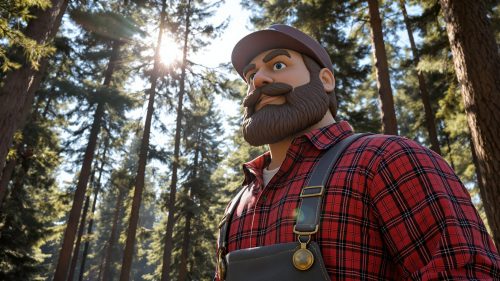
The Giant Paul Bunyan Statue: An American Legend Made Monumental
Few figures in American folklore loom as large—both literally and figuratively—as Paul Bunyan, the mythical lumberjack said to stride across the North American wilderness with his blue ox, Babe, at his side. Tales of Paul Bunyan have entertained generations with stories of colossal trees felled in a single swing and lakes carved from his footsteps. But it is not only in books and campfire tales that Paul Bunyan has endured. Across the United States, communities have immortalized him in giant statues that tower above roadways, parks, and logging towns. These monumental sculptures of Paul Bunyan are more than decorative—they’re icons of Americana, blending folklore, tourism, and artistry into unforgettable landmarks. They remind travelers of the tall tales of the frontier, they celebrate logging heritage, and they embody the larger-than-life spirit of America’s mythic past.

The Origins of Paul Bunyan
Before diving into the statues themselves, it’s worth recalling who Paul Bunyan is and why he inspires such monumental art. The character emerged in American folklore in the late 19th and early 20th centuries, growing out of logging camp stories in the Midwest and Pacific Northwest. Early newspaper stories and promotional tales from lumber companies amplified his legend, painting him as the ultimate lumberjack. Paul Bunyan was said to be so large that his footsteps created the Great Lakes, his campfires scorched whole forests, and his mighty axe cleared swathes of land for settlers. His companion, Babe the Blue Ox, was equally enormous, capable of pulling entire logging camps across snowy terrains. Because Paul Bunyan represents both the rugged labor of the lumberjack and the limitless imagination of American storytelling, it was inevitable that communities would choose to honor him not just in words, but in statues as grand as his legend.
The Rise of Roadside Americana: Why Paul Bunyan Became a Statue
The mid-20th century was the golden age of roadside attractions. As highways expanded and car culture flourished, towns and businesses sought creative ways to lure travelers. Giant statues became one of the most effective marketing tools, and Paul Bunyan—already larger than life in folklore—was a perfect candidate. Communities in Minnesota, Wisconsin, California, and Oregon all laid claim to being “home of Paul Bunyan,” erecting statues that sometimes exceeded 20 or 30 feet tall. These statues not only honored regional logging heritage but also acted as tourism anchors. A family passing through town might stop to take photos, buy souvenirs, or learn about local history—all thanks to a towering lumberjack standing roadside.
Famous Giant Paul Bunyan Statues Across the U.S.
Perhaps the most famous giant Paul Bunyan statue stands in Bemidji, Minnesota, alongside a statue of Babe the Blue Ox. Erected in 1937, this pair has become one of the most photographed roadside attractions in the nation, even landing a spot on the National Register of Historic Places.
Other notable statues include:
Bangor, Maine – This 31-foot Paul Bunyan statue proclaims the city as Bunyan’s birthplace, a claim rooted in regional folklore.
Klamath, California – At Trees of Mystery, a 49-foot Paul Bunyan and a 35-foot Babe greet visitors to a redwood forest attraction. Paul even talks through a hidden speaker system, amusing crowds with interactive greetings.
Akeley, Minnesota – A kneeling statue of Paul Bunyan invites visitors to climb into his outstretched hand for photos.
Each of these statues reflects not just regional pride, but also the playful competition of Americana tourism. By claiming Paul Bunyan, towns tie themselves into a larger-than-life narrative of folklore, industry, and spectacle.
Why People Love Giant Paul Bunyan Statues
The appeal of these colossal lumberjacks goes far beyond novelty. For many, they’re nostalgic reminders of childhood road trips and folklore lessons. For communities, they’re sources of pride, linking local identity to America’s mythic past. Standing before a giant Paul Bunyan statue is also a visceral experience. The scale emphasizes the exaggerated nature of his stories: his massive axe, his oversized boots, his broad shoulders. The statues invite us to imagine what it would be like if this giant truly walked among us, clearing forests and reshaping landscapes.
They’re also irresistibly photogenic. Families pose at his feet, tourists snap selfies with Babe the Blue Ox, and travel bloggers include them in their Americana roundups. In the digital era, these statues have found new life as social media landmarks, continuing their role as magnets for attention.
Artistic Styles and Interpretations
Not all Paul Bunyan statues are alike. Some present him as a realistic lumberjack, clad in plaid shirt, suspenders, and boots, complete with a carefully carved beard and axe. Others exaggerate his features into cartoonish proportions, giving him enormous hands, bulging eyes, or a comically oversized smile. Some communities opt for stoic, heroic Bunyan statues, presenting him like a monument to a founding father. Others lean into whimsy, making him approachable and playful, especially when paired with a smiling Babe. This flexibility in style allows Paul Bunyan statues to embody both reverence and humor, depending on the context.
How a Giant Paul Bunyan Statue Might Be Fabricated
Building a giant Paul Bunyan statue is no small feat. The figure’s scale—often two to five times the height of an average person—requires careful planning to balance artistry with structural integrity.
The process often begins with a steel framework. This acts like the skeleton, supporting the weight of the lumberjack’s broad torso and heavy limbs. Given Paul’s wide stance and thick boots, the base must be reinforced with deep footings, sometimes concrete foundations, to prevent tipping in wind or weather.
The outer shell is typically crafted from fiberglass, concrete, or welded sheet metal. Fiberglass is particularly popular for its lightweight durability and ease of molding into rounded forms like faces and muscles. For permanent, weather-resistant installations, concrete reinforced with rebar provides stability for decades.
Details matter, too. A plaid shirt might be hand-painted with weatherproof coatings, while a fiberglass axe could be constructed separately and attached to his hands. The beard, hair, and boots often receive textural detailing through sculpting or carving before final paint is applied.
Modern fabrication can also incorporate interactive elements. Some statues include hidden speaker systems, allowing Paul to “speak” to visitors. Others may integrate lighting—spotlights highlighting his axe at night or LEDs illuminating Babe’s horns.
Finally, installation requires cranes and skilled crews to hoist the figure into place, ensuring it is safely anchored. Watching a giant Paul Bunyan statue rise over a town is almost as spectacular as seeing the finished monument.
Paul Bunyan as a Symbol of Americana
The giant Paul Bunyan statue is more than just a tourist gimmick. It symbolizes key aspects of American identity: hard work, frontier spirit, humor, and imagination. Like Route 66 signs, giant donuts, or oversized cowboy boots, Bunyan statues embody roadside Americana—a tradition where art meets advertising, folklore meets fun. They also serve as reminders of logging’s role in regional economies. In places like Minnesota and Oregon, the statues celebrate the industry that shaped communities, while also offering a tongue-in-cheek nod to the tall tales that made lumberjacks mythical.
Imagining Future Paul Bunyan Installations
What might the next generation of giant Paul Bunyan statues look like? With modern materials and technology, the possibilities are endless. Communities could design interactive Bunyan experiences, with statues that move their arms or wave at passersby. Virtual projection mapping could transform Paul into a storytelling figure at night, narrating his legendary adventures. We could also see artistic reinterpretations. A minimalist steel-outline Bunyan could stand in a city park, while a mirrored Bunyan might reflect his surroundings like a surreal monument. Some might even experiment with scale by creating Babe statues larger than Paul, flipping the narrative for modern humor. Whatever direction future artists take, the essence will remain the same: Paul Bunyan as a giant, playful, and proud figure of American creativity.
Conclusion: A Lumberjack Larger Than Life
The giant Paul Bunyan statue stands at the intersection of folklore, tourism, and artistry. It transforms a mythic lumberjack into a physical presence, inviting visitors to pause, reflect, and smile. For travelers, it’s a whimsical stop along the road. For communities, it’s a source of pride and identity. And for artists and fabricators, it’s proof that storytelling can be made tangible at monumental scale. As long as Americans love tall tales, road trips, and quirky roadside attractions, Paul Bunyan will continue to rise over plazas, forests, and highways, larger than life and impossible to ignore. In his statues, we see not only a giant lumberjack but also the enduring spirit of imagination that keeps folklore alive.
Check out WhiteClouds’ 3D Statues for more information.
Contact us today to learn more about our 3D services and how we can help you achieve your goals.