
The Giant Mushroom Statue: A Monument to Whimsy, Nature, and Imagination
Mushrooms have always carried a sense of wonder. They sprout overnight, cloak forest floors in mystery, and inspire folklore from fairytales to fantasy realms. But when sculptors and communities enlarge them into monumental public art, mushrooms transform from fragile fungi into towering landmarks. The giant mushroom statue blends nature, whimsy, and imagination, inviting people of all ages to stop, stare, and even step into worlds that feel enchanted. Whether placed in a woodland-themed park, displayed as a roadside attraction, or built as a centerpiece in a public plaza, giant mushroom statues capture something rare: a balance of familiarity and fantasy. They are instantly recognizable, yet larger-than-life versions feel magical, like props from a storybook brought into reality.
Why Mushrooms Make Great Statues
The mushroom is more than just a food source or woodland curiosity. Throughout history, it has represented mystery, growth, transformation, and even magic. Many cultures see mushrooms as bridges between the mundane and the mystical. This makes the mushroom a powerful symbol for monumental art. Enlarging it into statue form amplifies its quirky proportions—the broad cap, slender stem, and organic textures. People are drawn to mushroom statues because they conjure a sense of both play and wonder. Unlike imposing statues of warriors or solemn heroes, mushrooms invite lightheartedness. They remind us of fairy rings, fantasy tales, and childhood adventures.
Famous Examples of Giant Mushroom Statues
While not as widespread as oversized animals or roadside food sculptures, giant mushrooms have appeared in several creative contexts:
Theme Parks: Fantasy parks often feature oversized mushrooms as decorative statues or as interactive play structures. Their bright colors and whimsical shapes make them natural fits for family attractions.
Public Gardens: Botanical gardens and sculpture parks sometimes use giant mushroom statues as focal points, blending art with natural themes.
Roadside Americana: Some roadside attractions, especially in regions with a logging or forest identity, feature oversized mushrooms as quirky photo stops.
Though less common than giant donuts or flamingos, giant mushroom statues are gaining traction as communities look for new, nature-inspired landmarks.
The Mushroom in Culture and Imagination
Mushrooms occupy a fascinating place in culture. They appear in children’s books as stools for gnomes, in video games as magical power-ups, and in traditional folklore as symbols of hidden realms. Giant mushroom statues borrow from this cultural legacy. For children, they spark imagination: a towering mushroom statue could be the home of a fairy or the perch of a forest sprite. For adults, they often carry nostalgic connections to fantasy worlds, from Alice in Wonderland to Super Mario. And for communities, mushrooms symbolize natural abundance and ecological cycles. By enlarging them into monumental forms, artists capture all these associations in one unforgettable sculpture.
Why People Love Giant Mushroom Statues
At first glance, it might seem strange to dedicate resources to a colossal mushroom. But the appeal is obvious when you see how people react to them. Tourists pull over to snap selfies. Families explore them as though they were forest monuments. Artists delight in painting or decorating them.
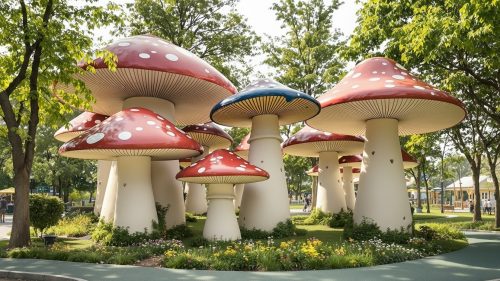
Part of their charm comes from their versatility. A mushroom can be realistic, resembling an oversized version of a forest cap, or it can be stylized, painted in candy-red with white polka dots. This flexibility means a mushroom statue can be whimsical or naturalistic, playful or solemn. And because mushrooms already appear fantastical in nature, scaling them up only emphasizes their surreal character.
Artistic Interpretations: Realism, Whimsy, and Abstraction
Just like other monumental sculptures, giant mushrooms take many artistic forms. Some artists lean toward realism, sculpting mushrooms with earthy browns, textured gills, and lifelike shading. These often appear in natural settings like forest trails or arboretums. Others embrace whimsy, painting their mushroom statues bright red, blue, or yellow with exaggerated polka dots. These versions feel like they’ve stepped out of a fantasy illustration, perfect for parks and playgrounds. Still others explore abstraction, stripping the mushroom down to its silhouette and reimagining it in glossy steel or carved stone. These interpretations focus less on whimsy and more on geometry and design, making them suitable for modern plazas and galleries.
The Role of Giant Mushroom Statues in Tourism
Much like other oversized roadside icons, giant mushroom statues serve as magnets for visitors. They create instant landmarks, the kind that show up on travel blogs and Instagram feeds. For small towns or parks, installing a giant mushroom statue can be a cost-effective way to brand themselves with a memorable identity. Tourists may not remember the name of a café or a playground, but they’ll remember the place with the “big mushroom.” That memory translates into photos, word-of-mouth, and repeat visits. Giant mushrooms also work well as seasonal props. During autumn festivals, they can be lit dramatically to emphasize themes of harvest and woodland magic. In spring and summer, they symbolize growth and vitality.
How a Giant Mushroom Statue Might Be Fabricated
Fabricating a giant mushroom statue combines artistry with engineering. While mushrooms are naturally fragile, their statues must withstand weather, time, and curious visitors.
The process usually begins with a steel skeleton, acting as the stem and cap framework. This internal structure ensures that the tall stem won’t buckle under the weight of the broad cap. Over this skeleton, artists add an outer shell of fiberglass, metal, or concrete. Fiberglass is especially popular because it can be molded into smooth curves and textured surfaces while remaining lightweight and durable.
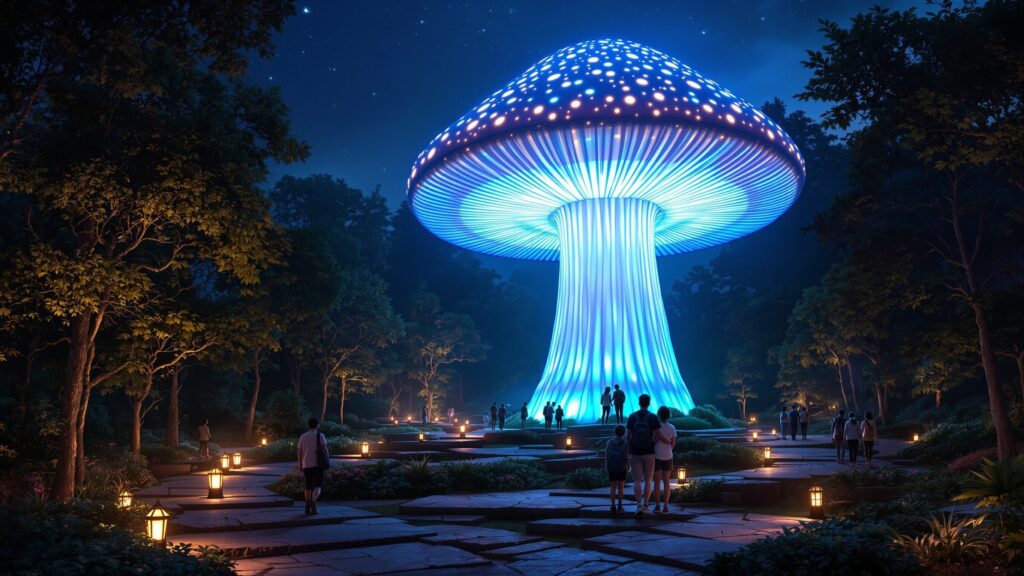
Surface treatment depends on artistic vision. For realistic mushrooms, airbrushing can create speckled caps, gill textures, and natural shading. For whimsical versions, bold paint in bright hues or even mosaic tiles can make the mushroom pop. Some artists embed LED strips or spotlights, allowing the mushroom to glow at night, creating an otherworldly beacon.
Placement is equally important. A giant mushroom statue can stand alone as a singular landmark, or it can be grouped with others to form a whimsical “mushroom grove.” Landscaped with benches and pathways, these installations become destinations in themselves.
The Mushroom as Public Art and Play Structure
One of the advantages of mushroom statues is their shape. Their wide caps naturally lend themselves to shading or even covering small spaces beneath. Some designers have leaned into this by creating hollow mushroom statues that serve as playhouses, gazebos, or small pavilions. Imagine a children’s park where a giant mushroom doubles as a climbing structure, or a garden where the mushroom cap provides shade for a bench beneath it. These dual-purpose sculptures blur the line between art and architecture, offering both beauty and function.
Cultural Resonance: Why the Mushroom Works Across Contexts
Unlike statues tied to specific figures or myths, the mushroom is endlessly adaptable. It can be natural or fantastical, serious or silly, modern or nostalgic. This versatility explains why giant mushroom statues thrive across such different contexts. In parks, they create fairytale landscapes. In towns, they become quirky roadside claims to fame. In art installations, they transform into sleek abstract forms. The mushroom is approachable, recognizable, and universal, making it an ideal subject for monumental interpretation.
Imagining Future Mushroom Installations
The possibilities for future mushroom statues are as rich as the imaginations of artists and communities. One could picture an illuminated glass mushroom glowing like a lantern in a city square, or a mirrored stainless steel mushroom reflecting the trees of a forest. Festivals might introduce giant inflatable mushroom groves, creating interactive environments that appear and disappear overnight.
Even more ambitious would be an entire “mushroom village,” with multiple giant sculptures of different species, each designed for interaction. Some could house seating areas, others could contain projection shows, and still others might feature climbing elements for children. Together, they would form immersive environments where nature and imagination meet.
Conclusion: A Symbol of Wonder Enlarged
The giant mushroom statue demonstrates the magic of turning small, familiar forms into monumental art. Mushrooms already carry connotations of mystery and fantasy; when enlarged, they become portals into dreamlike worlds.
For communities, they are effective branding tools. For artists, they are flexible canvases. For families and tourists, they are whimsical destinations worth detouring for. And for everyone, they are reminders that nature—when viewed through the lens of imagination—can feel both magical and monumental. By enlarging a mushroom into a statue, we don’t just recreate a fungus at scale. We create a beacon of wonder, a landmark of whimsy, and an invitation to play.
Check out WhiteClouds’ 3D Statues for more information.
Contact us today to learn more about our 3D services and how we can help you achieve your goals.