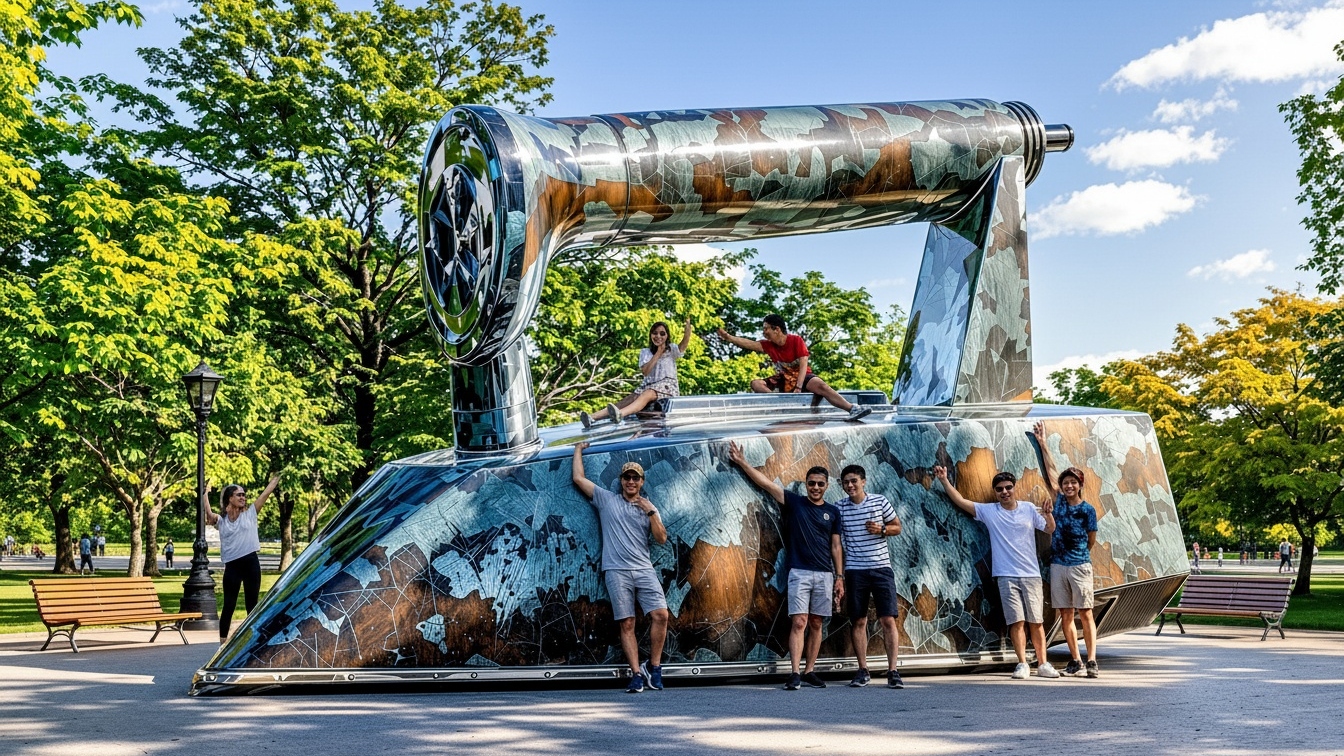
Giant Iron Statue
Giant Iron Statue
We Build Custom Giant Iron Statues
The Giant Iron: When Everyday Tools Become Monuments
The iron is one of the most familiar tools in human history, quietly woven into the daily fabric of life. For centuries, it has represented discipline, neatness, and transformation—the act of smoothing out wrinkles from clothes has always been both practical and symbolic. But when this simple household tool is recreated at a massive scale, it becomes something else entirely. A giant iron is not just an oversized replica; it is a celebration of industrial design, a quirky work of public art, and in some cases, a bold cultural landmark. These monumental irons can be found outside textile museums, in city squares, or as roadside attractions, each one capturing attention by turning the mundane into the magnificent. They remind us that even the simplest tools can hold deeper meanings when magnified and appreciated as art.

A Brief History of the Iron
Long before the invention of electricity, irons were literal hunks of metal heated on stoves or filled with hot coals. In the 17th and 18th centuries, smoothing irons were symbols of diligence and often passed down as household essentials. Cast iron models, heavy and cumbersome, demanded both strength and patience. The 19th century saw innovations in design, while the 20th century introduced electric irons, making the task quicker and more manageable. Over time, irons became an unquestioned staple of domestic life, found in nearly every household around the globe. Their history is deeply tied to textiles, industry, and domestic labor—making the iron a surprisingly powerful object to honor in giant form.
Why a Giant Iron?
So why build a giant version of such a common tool? The answer lies in both whimsy and heritage. A giant iron is whimsical because it playfully distorts scale. An object meant to fit in the hand is suddenly taller than a person, absurd yet fascinating. It makes passersby smile, stop, and take photos. But it is also serious. For communities shaped by the textile industry, a giant iron is a tribute to labor, craftsmanship, and economic heritage. It honors workers whose efforts often went unseen, smoothing out the garments of entire nations. For artists, the giant iron is a statement about design. Its shape—sleek, triangular, and ergonomic—is functional but also inherently sculptural. Enlarged, it reveals the elegance of utility.
Famous Giant Irons Around the World
The Flatiron Building in New York
Although not an iron itself, the famous Flatiron Building in Manhattan is one of the most iconic examples of how the iron’s shape has inspired monumental design. Completed in 1902, its triangular wedge form resembled a cast-iron flat iron so distinctly that the name stuck. Today, it is one of the most photographed buildings in the world.
Textile Museum Monuments
Several textile museums around the world feature large-scale iron sculptures at their entrances. These giant replicas serve as fitting tributes to the tools that defined entire industries and economies. They help contextualize the enormous role ironing once played in daily life.
Quirky Roadside Attractions
In places where creativity and humor define public art, giant irons appear as roadside oddities. Some are painted in bright colors, others sculpted in gleaming metal. They catch the eye, spark curiosity, and create memorable landmarks that visitors talk about long after their travels.
Symbolism of the Giant Iron
A giant iron carries multiple layers of symbolism.
First, it embodies transformation. The iron turns wrinkled fabric into something smooth and presentable, symbolizing the human desire to create order from chaos.
Second, it represents labor and discipline. For generations, ironing was a symbol of care, diligence, and responsibility—qualities communities may choose to highlight when erecting such monuments.
Third, it serves as a commentary on design. In oversized form, the iron’s sleek curves and sharp angles take on a sculptural presence, elevating function into artistry.
Finally, there is humor and whimsy. Seeing a massive iron in the middle of a public square makes us laugh. It is playful, unexpected, and oddly charming.
How a Giant Iron is Fabricated
Constructing a giant iron requires more than scaling up a model. It is an intricate process blending engineering, artistry, and practical considerations.
Concept and Planning
Artists and engineers begin with detailed drawings or digital models of the iron. They must decide whether to replicate a vintage cast-iron model, a modern electric iron, or a stylized artistic version. Each choice tells a different story and appeals to different audiences.
Structural Skeleton
The internal skeleton is crucial. Made from steel beams or rods, this framework supports the outer shell and ensures the iron can withstand outdoor elements like wind, rain, and snow. Engineers carefully calculate weight distribution, particularly if the iron is tilted or stylized in its presentation.
Exterior Construction
The body of the iron is usually fabricated from fiberglass, aluminum, or stainless steel. Fiberglass is lightweight and moldable, making it ideal for smooth curves. Stainless steel offers durability and a polished, modern finish. In some cases, concrete may be used for permanence and heft.
Surface Detailing
Details such as grooves, buttons, handles, and vents are added to ensure realism. For vintage irons, sculptors may replicate cast-iron textures. For electric irons, plastic-like finishes and sleek lines are emphasized.
Painting and Coating
The statue is painted or polished to match the design. Protective coatings are applied to resist fading, corrosion, and weathering. Bright, bold colors are often chosen for roadside versions, while industrial tributes may favor muted, realistic tones.
Installation
The iron is transported in sections and assembled on-site. A reinforced concrete base anchors it securely to the ground. The unveiling often becomes a community celebration, transforming the iron into a shared landmark.
The Giant Iron as Public Art
Public art often thrives on the unexpected, and the giant iron is a perfect example. By enlarging a household tool to monumental proportions, it forces viewers to reconsider its role in daily life. What once seemed mundane becomes worthy of admiration. For some artists, the iron becomes a commentary on domestic labor—drawing attention to the often-invisible work of women in history. For others, it is about industrial design, celebrating the elegance of simple, functional forms.
Placed in a public setting, a giant iron becomes interactive. People gather around it, pose for photographs, and engage in conversations about its meaning. It is both sculpture and social catalyst.
Tourism and Community Impact
Communities with giant iron statues often see direct benefits. These unusual landmarks attract tourists, encourage photography, and put towns “on the map.” Restaurants, shops, and local attractions benefit from the foot traffic, turning whimsy into economic opportunity. For textile-rich communities, a giant iron also strengthens identity. It acknowledges the role of textiles and domestic labor in shaping the community’s past, while also projecting pride in craftsmanship and history.
The Future of Giant Irons
As technology advances, giant irons may evolve in exciting ways. Interactive elements could include digital screens projecting textile history or augmented reality features that “animate” the iron for visitors. Sustainable materials—such as recycled metals and eco-friendly paints—may ensure longevity while aligning with modern values of sustainability. We may also see more artistic interpretations. Abstract versions might stretch or warp the iron’s form, turning it into avant-garde sculpture. Others may combine light, sound, or water features to enhance their presence.
Whatever the approach, the iron’s iconic shape will continue to inspire. Whether playful roadside oddities or serious cultural monuments, giant irons remind us that the beauty of design often lies in simplicity.
Conclusion: Smoothing Out the Wrinkles of the Ordinary
The giant iron is proof that even the most ordinary tools can become extraordinary when magnified. More than just a whimsical roadside attraction, it is a monument to transformation, labor, and design. Standing before one, you cannot help but reflect on its dual nature. On the one hand, it is playful—an absurdly oversized household object. On the other, it is profound—an emblem of human ingenuity, history, and the dignity of everyday work. As communities continue to celebrate their heritage and embrace public art, the giant iron will remain a fascinating example of how we can smooth out the wrinkles of the ordinary, elevating it into something memorable, meaningful, and monumental.