
Giant Egyptian Statue: Monument, Myth, and Modern Mastery
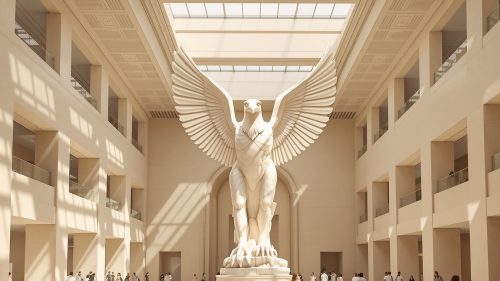
Some monuments don’t merely occupy space; they rewire it. A giant Egyptian statue has that effect. The moment a serene, stone-faced colossus or a crouched sphinx enters a skyline, streets take on a ceremonial axis, sunlight becomes theater lighting, and passersby instinctively lower their voices. Egypt’s monumental tradition is an instruction manual for awe: clarity of form, disciplined proportion, symbolic precision, and a choreography of approach that turns the ordinary act of walking into pilgrimage. Translate those principles into a contemporary public artwork and you’ll gain more than a photogenic landmark—you’ll earn a place that teaches, gathers, and endures.
Why Egyptian Monumentality Still Captivates
Egyptian statues are engineered for legibility. The planes are calm and deliberate: a forehead framed by the nemes headdress, eyes that look past the near horizon, shoulders that read as architecture as much as anatomy. Even from hundreds of feet away, a viewer recognizes the silhouette and understands the mood: timeless composure. That composure is the secret to their modern magnetism. In a world of visual noise, a giant Egyptian statue offers a singular, comprehensible form. It doesn’t require a caption to communicate dignity, continuity, and gravity. It provides a counterweight to chaos and does so with a visual grammar that photographs beautifully at every hour of the day. Egypt’s art also carries a storytelling density that rewards repeat visits. The cobra of the uraeus, the striped rhythm of the nemes, the crook and flail, the ankhs etched into a seat—all of these elements function like hyperlinks to history, language, and ritual. For families, it’s a ready-made lesson plan. For travelers, it’s an anchor point for memory. For locals, it becomes a locus of pride and a stage for festivals, markets, and seasonal ceremonies.
Choosing the Subject: Pharaoh, Deity, or Sphinx
Selecting the figure determines the tone of the destination. A standing pharaoh in the classic pose, one foot forward and arms to the sides, communicates order and forward motion. A seated figure, hands on knees, speaks of judgment and watchfulness—a perfect guardian for a museum plaza or civic square. A sphinx shifts the mood toward guardianship and riddled mystery, its leonine body and human head embodying strength guided by intellect. Deific figures open additional narrative doors. Anubis brings the motif of protection and passage; Horus suggests sky, kingship, and the wide sweep of a falcon’s sight; Hathor evokes hospitality, music, and joy. The decision is less about favoritism than fit: what story should this place tell, and how will the statue’s role support that story every day, in every season?
Once the subject is settled, pose and expression shape the experience. Egyptian portraiture privileges serenity over theatrics. The magic is in restraint: a mouth barely curved toward benevolence, eyes slightly lifted as if they register more than they reveal. The hands—fists around regalia, palms on knees, or forearms crossed—should read with clarity at long distance and echo in shadow at night. Ornamentation must be exacting. The uraeus is not a generic snake; its form, scale, and placement carry meaning. The nemes has a countable rhythm of stripes. Cartouches are not decorative widgets; they frame names and titles, which should be either historically respectful or allegorical and clearly interpreted on-site.
Proportion, Canon, and Iconography
Egyptian sculptors worked within canons—grids and ratios—that stable societies adopt to keep their symbols stable. Recreating that discipline is not about slavish imitation; it’s about understanding the logic. A grid-based proportioning system ensures that features align to a calm geometry, even when the figure is towering. Shoulders remain broad and planar; the torso reads as stacked, deliberate masses; the head is slightly oversized relative to the body so the face holds its authority when viewed from below. Surfaces are not over-modeled; micro-anatomy yields to idealized planes that catch sunlight predictably.
Iconography should be curated with care. If hieroglyphic panels are integrated into a seat, base, or back pillar, their content should be vetted by Egyptologists or qualified scholars, and their intent made legible to the public with tastefully placed translations. Use this opportunity to teach without turning the statue into a billboard. Better to concentrate inscriptions in areas where visitors can approach slowly and appreciate them at hand scale: the rear of a throne, a belt, a plinth face designed for touch.
Site Selection and the Power of Axis
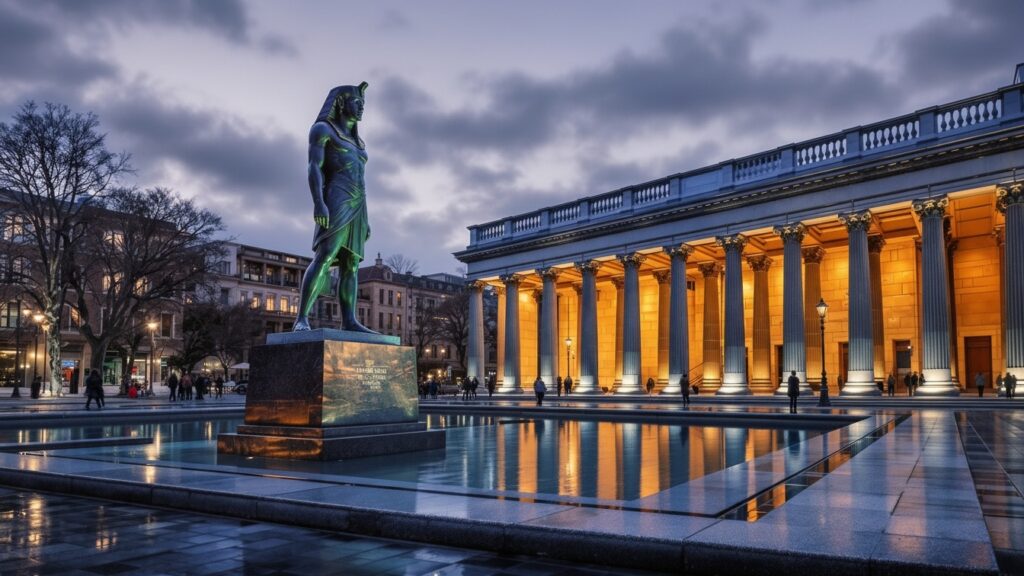
Great Egyptian architecture organizes attention with axes. A giant statue should do the same. Imagine a straight approach path that compresses your view between low plantings and then releases it into a forecourt where the figure waits, centered on an axis aligned to sunrise or to a local landmark. The statue should not be an island; it should be the terminus of a sequence. Begin with a threshold—perhaps a pair of tall, minimal pylons or a subtle narrowing of the path—so visitors feel the transition from everyday to ceremonial space. Expand into a plaza that allows orbiting and lingering. The backdrop matters. Align the figure so morning sun gilds the face and shoulders, then let late afternoon rake light pull relief from the headdress and carved bands. Context completes the composition. In an arid climate, plantings that nod to papyrus forms and reeds frame the piece with spare elegance. In a temperate city, architectural grasses and stone mulch keep the foreground quiet, letting the statue’s geometry dominate. Avoid clutter. Benches and low walls can be treated as an extension of the base, sharing stone textures or shadow reveals so furniture feels like part of the ritual rather than an afterthought.
Visitor Choreography and Photo Moments
Approach is a narrative. The best routes stage incremental revelations: the first glimpse of the headdress above plantings, the widening of shoulders as you clear the threshold, the arrival at a point where the eyes meet yours even though the face looks slightly above you, as Egyptian portraits often do. Build in vantage points that encourage respectful engagement. A raised overlook lets photographers capture the head and shoulders with sky beyond; a ground-level pad set at a generous distance frames the full figure without crowding. Consider the scale of the base not only for structural reasons but for human habit. A base tall enough to deter climbing can still welcome touch with a lower band of carved stone or bronze panels designed for hands. Provide seating within earshot but just outside the sacred “breathing zone” of the statue, so conversations don’t feel like they intrude on a guardian’s presence.
Materials and Finish: Stone, Metal, and Modern Composites
Material choices determine how the statue will age and what kind of care it will demand. Carved stone is the most archetypal path: limestone or sandstone for warm, quiet surfaces; granite or basalt for dark gravitas and crisp edges. Stone’s strengths are authenticity, mass, and the way it handles light. Its trade-offs are weight, quarry logistics, and the craft time required for detailing at monumental scale. Bronze offers a different voice. It allows panelized fabrication with exquisite surface control and accepts patinas that range from honey browns to black-greens. A bronze statue can incorporate discreet gilding on uraeus or collar elements to echo ancient luxury without tipping into kitsch. Weathering steel reads as contemporary, earthy, and powerful, but it must be used thoughtfully—it’s best in dry climates with detailing that ensures water drains cleanly.
Modern composites expand possibilities. Glass fiber–reinforced concrete (GFRC) yields thin, strong shells with stone-like presence at a fraction of the weight; ultra-high-performance concrete (UHPC) can achieve knife-edge reveals and tight joint tolerances; glass fiber–reinforced polymer (GFRP) excels for interiors or sheltered sites where lightness and transport logistics drive decisions. Hybrid constructions are compelling: a stainless steel armature with GFRC or UHPC panels for body masses, bronze for head and hands where detail matters most, and gilded accents reserved for symbols whose glow carries narrative weight. Finish decisions should be tested on large samples in site light, because a surface that looks powerful indoors may wash out in summer sun or lose legibility at night.
Color, Gilding, and the Question of Polychromy
Many people picture Egyptian sculpture as bare stone, but ancient statues often carried color. A contemporary giant statue can nod to that truth with restraint. Slightly warmed stone, muted pigments in recessed bands, or selective gilding can evoke polychromy without turning the figure into a cartoon. Gold leaf, used sparingly on a crown element or collar, creates a ceremonial pulse at sunrise and dusk. If color is applied, choose mineral-based coatings with matte finishes and exceptional UV stability, and recess them where weather and touch won’t quickly degrade the effect.
Lighting: Day, Dusk, and Night
Night lighting should read like reverent moonlight rather than stage glare. Grazing uplights pull quiet drama from the headdress and shoulders. A narrow, soft accent can define the uraeus without turning it into a spotlighted logo. Keep fixtures low-glare, full-cutoff, and carefully aimed, preserving dark skies and the contemplative mood. Controls that shift color temperature subtly for solstice ceremonies or cultural events—warmer ambers in winter, neutral whites in summer—allow seasonal nuance without spectacle. Daytime strategy matters too. The best sites position the face for morning light and the flanks for late-day relief so the statue photographs well in casual phone shots and professional images alike.
Interpretation, Ethics, and Collaboration
A giant Egyptian statue amplifies a heritage that still belongs to people, places, and languages. Collaboration is non-negotiable. Engage Egyptologists, museum professionals, and cultural advisors from the first sketch. If the statue references named historical figures, be transparent about what is historically accurate and what is allegorical. Provide context about the original functions of such statues—as guardians, as embodiments of roles rather than individual personalities, as pieces in an architectural and ritual ensemble. Offer bilingual or multilingual interpretation where appropriate. QR codes can open longer-form content, from the canon grid to quarrying methods, from myths to modern conservation of monuments on the Nile. This isn’t about gatekeeping; it’s about making sure admiration translates into understanding rather than appropriation.
Programming and Place-Making
Landmarks gain lives when they host rituals. A forecourt can become a venue for solstice gatherings, school field trips that discuss ancient measurement systems, storytelling evenings about river civilizations, or artisan markets featuring stone carving and gold leaf demonstrations. Seasonal moments—soft percussion concerts at dusk, poetry readings that explore time and empire, astronomy nights that connect ancient sky lore to modern stargazing—help the statue serve as more than backdrops for selfies. The measure of success is not just foot traffic but the diversity of quiet experiences the place allows.
How a Giant Egyptian Statue Might Be Fabricated
Monumental sculpture blends scholarship, digital craft, heavy industry, and hand skill. The process begins with research and a maquette. Designers study canons of proportion, garments, regalia, and the structural logic behind ancient portraits. A sculptor blocks out a small clay or digital model, focusing on silhouette and serenity. Photogrammetry or laser scanning converts the maquette into a high-resolution mesh, which is retopologized for clean edges and smart panelization. At this stage, engineers join the conversation. They analyze wind loads, seismic demands, and visitor interactions to size the internal frame and base connection.
For carved stone, the digital model is sliced into quarry-manageable blocks, each labeled for grain orientation and lift strategy. A five-axis CNC mill roughs forms from limestone, sandstone, or granite, leaving a margin for hand tooling. Carvers return the soul to the stone: refining planes, cut-backing to crisp shadow lines, and unifying textures so sunlight reads the surface as one voice. Pins and stainless dowels tie blocks to each other and to an internal spine; joints are micro-chamfered to accept expansion and to catch shadow subtly rather than telegraph as cracks. The base or back pillar can carry structural duty, ferrying loads to a reinforced concrete mat or piers below.
For bronze, the team builds a full-scale positive from foam and clay or prints it in segments that are chased to the final surface. Silicon rubber molds capture detail; lost-wax casting converts wax panels into bronze shells through ceramic investment and pour. Panels are welded on a stainless armature that handles wind and visitors. Welds are chased until invisible. Patina artists use heat and chemical solutions to establish layered color, then burnish and wax to a durable sheen. Selective gilding of uraeus or collar is applied last with sheltering tape lines and soft squirrel hair tips, sealed with clear coats formulated for UV stability.
For GFRC or UHPC, a master mold is produced from the full-scale positive. Technicians spray a face coat, then back it with a fiber-rich structural matrix, integrating ribs, edge returns, and embedded stainless anchors that hang panels on a steel subframe. Joints align with carved bands or architectural seams so panelization disappears into the language of the sculpture. Sealants are selected for color stability and dirt shedding, and weep paths are built into horizontal elements to keep water moving. GFRP follows a similar mold path with marine-grade resins and UV-resistant gelcoats, supported by a welded stainless skeleton. Hybrid builds often put bronze where fingers will go—the head, hands, and symbols—and GFRC on large, unreachable masses, balancing craft and cost.
Hieroglyphics demand a specific approach. In stone, artisans incise sunken relief with V-chiseled edges that hold shadow and resist weather. In bronze, shallow relief is sculpted into the wax and chased after casting. In GFRC, inscriptions are formed in the mold with a slight undercut so they read crisply once released. Where color is appropriate, mineral pigments and lime-based washes seat in pores rather than sit as films. All text used on the statue is echoed nearby in translations that give visitors a foothold without crowding surfaces with plaques.
Foundations anchor the myth to physics. A geotechnical study establishes soil bearing, groundwater, and frost depth. Engineers design a reinforced mat or drilled piers tied by grade beams, accounting for overturning and uplift in extreme winds. Base plates are leveled with non-shrink grout; anchor rods are protected in sleeves to avoid galvanic couples. Where seismic demands apply, a moment frame or base isolation strategy keeps the statue upright and repairable after shocks. Lightning protection may be appropriate for exposed sites: a concealed air terminal and down conductor tied to a ground ring protect both artwork and visitors.
Transport and installation are their own theater. Segments travel on lowboys with oversize permits and escorts. Rigging plans are rehearsed in the shop; lift points are engineered and labeled for balance. On site, cranes choreograph a sequence: set the subframe, align the back pillar or throne, place the major body masses, then the head, then regalia. Welders close seams behind removable plates. Conservators touch up patina and gilding at dawn and dusk to color-match shop work in real light. A final wash verifies drainage and highlights any seam lines that need finessing before opening day.
Maintenance and Longevity
Endurance is part of the promise. Stone prefers gentle care: periodic rinsing to remove dust and pollutants, occasional poultice treatments for stains, and repointing of joints as needed. Bronze thrives on a rhythm of cleaning and rewaxing; a spring wash and a fresh wax coat often suffice in mild climates, with more frequent attention where de-icing salts or heavy smog intrude. GFRC and UHPC want breathable, water-shedding sealers and inspections of joints and weeps. GFRP appreciates UV-stable topcoats and vigilant attention to fasteners. Anti-graffiti coatings—sacrificial or permanent—turn a potential headache into a routine call. Bird-deterrent strategies should be humane and subtle: perching spikes concealed on horizontal ledges or micro-slope adjustments that make resting spots less attractive.
Build maintenance access into the design. Concealed hatches allow interior inspections. Lifting eyes hidden in the head or shoulders enable safe future picks if a major repair is ever needed. Drainage pathways must remain clear, with screens that stop debris but let water pass. The best monuments read as serene on the outside because they were engineered to be serviceable on the inside.
Accessibility, Safety, and Comfort
A welcoming site anticipates many bodies and many kinds of attention. Approaches are smooth and gently sloped; handrails, if used, are placed to avoid cutting key sightlines. Seating has backs and arms for ease of use and faces both the statue and the horizon so visitors can alternate between contemplation and conversation. Tactile models of the headdress or uraeus mounted at hand height invite touch for those who can’t navigate steps or prefer not to get close. Climb deterrence is achieved with form, not fences: subtle overhangs and smooth transitions above a certain height discourage risky behavior while keeping the base generous and friendly.
Education, Commerce, and Community
Interpretation deepens attachment. A kiosk or small pavilion nearby can host rotating exhibits about the canon of proportion, ancient quarrying, and the chemistry of patina and gilding. School partnerships transform the forecourt into an outdoor classroom, where math lessons on ratios use the statue itself as a chalkboard and art classes study how shadow defines shape. Markets and festivals tied to equinoxes or cultural exchange weekends generate foot traffic that supports local vendors and gives return visitors new reasons to come. The statue becomes both centerpiece and compass for community life.
Digital Wayfinding and SEO Essentials
In the attention economy, clarity wins. Give the statue a consistent name—“Giant Egyptian Statue at [Place]”—and use it across your site, maps, and social channels. A clean landing page with high-resolution photos, hours, accessibility notes, and an accurate map pin reduces friction. Include structured data so search engines understand it as a tourist attraction and event venue. Offer a simple photography guide: sunrise paints the face; late afternoon pulls relief from the nemes; night lighting grazes the uraeus. Invite visitors to share images with a short, memorable hashtag, and refresh a gallery seasonally so the page feels alive.
Measuring Success Without Losing Soul
Track the basics—visitors, dwell time, event attendance—then listen for the subtler signals. Are school buses returning? Are nearby cafes citing weekend surges? Do guestbook comments reference learning something specific rather than just “cool statue”? If the forecourt shows wear at a bottleneck, adjust circulation with plantings and a new seating cluster, not ropes. If selfies always converge at one corner, create a second designed moment across the axis. Let data guide stewardship in service of wonder, not the other way around.
Conclusion: Build for Calm, Build for Centuries
A giant Egyptian statue is more than spectacular stone or metal. It is a contract between place and time, a promise that calm is possible and that dignity can be designed. Choose a subject that fits your story. Honor proportion and iconography. Align approach paths to the sun and to the way people already move through your city. Fabricate with craft, combining ancient discipline with modern engineering. Light it like moonlight. Maintain it like a treasured tool. Invite scholarship, music, schoolchildren, and quiet. Do these things, and the statue will repay you for generations—standing still while everything else, including the river of daily life, flows around it.
Check out WhiteClouds’ 3D Statues for more information.
Contact us today to learn more about our 3D services and how we can help you achieve your goals.