
The Allure of the Giant Egg Statue: Symbolism, Spectacle, and Storytelling
There’s something undeniably enchanting about taking an ordinary object and scaling it up until it becomes extraordinary. Among the many roadside attractions and sculptural oddities that capture attention across the world, the giant egg statue occupies a curious, almost whimsical niche. It’s familiar yet surreal, mundane yet magical. Eggs already symbolize life, renewal, nourishment, and mystery, so when they’re transformed into towering sculptures, they gain new cultural weight and spark fresh waves of imagination. This article explores the fascination with giant egg statues—from their symbolism and real-world examples to their place in art, tourism, and fabrication. Whether perched in a park, showcased in a plaza, or acting as a local landmark, these oversized ovals invite us to see the world differently.
The Egg as a Symbol
Before diving into statues themselves, it helps to consider why the egg is such a powerful motif. Across civilizations, eggs have represented fertility, creation, and potential. In ancient mythology, the “cosmic egg” is said to contain the universe. In Christianity, the egg has long been tied to resurrection and Easter traditions. In modern culture, eggs carry connotations of nourishment, comfort food, and even humor (who hasn’t chuckled at a cartoon egg with a personality?). When rendered as sculpture, the egg becomes a blank canvas—smooth, simple, and universal—yet loaded with symbolic layers. Enlarging it into a monumental form amplifies these meanings, creating not just an object to look at but an experience to enter, photograph, and remember.
Famous Examples of Giant Egg Statues
Though less common than statues of animals or people, giant egg sculptures can be found scattered across the globe, often as quirky landmarks.
Vegreville Pysanka (Canada): Perhaps the most famous, this Ukrainian-style painted Easter egg in Alberta stands over 30 feet tall. Built in 1975 to honor Ukrainian settlers, it is both a cultural monument and an engineering marvel, composed of thousands of aluminum pieces.
Egg-shaped art installations in Europe: Cities like Vienna and Prague occasionally feature oversized egg sculptures during Easter festivals. These temporary works are often elaborately decorated and function as seasonal public art.
Whimsical tourist props in the U.S.: Roadside diners, breakfast-themed cafés, and farm attractions sometimes feature giant egg statues as playful marketing tools. Whether perched outside a pancake house or at the entrance of a poultry farm, these statues act as oversized invitations.
Each example demonstrates how an egg—seemingly plain—can be elevated into something iconic when magnified.
Why People Love Giant Egg Statues
The charm of giant egg statues lies in their blend of simplicity and strangeness. Unlike a giant dinosaur or superhero, a giant egg doesn’t rely on narrative drama or fierce detail. Instead, it captivates through scale and suggestion.
- Photogenic appeal: The smooth, curved form contrasts beautifully with both natural and urban backdrops. Tourists instinctively pose beside or in front of giant eggs.
- Universal recognition: Everyone knows what an egg is. It transcends language and culture, so the sculpture resonates globally.
- Duality of meaning: The egg is both fragile and strong, both ordinary and profound. Enlarging it magnifies this duality, turning it into a philosophical object as much as a roadside gimmick.
A giant egg statue also lends itself well to seasonal traditions, from Easter hunts to spring festivals, making it a flexible icon for event planners and communities alike.
Artistic Interpretations: From Realistic to Abstract
Not all giant egg statues look alike. Some strive for realism, mimicking the exact textures and colors of a hen’s egg. Others embrace abstraction, turning the egg into a glossy metallic form or an elaborately painted canvas.
Realistic eggs often appear in agricultural or rural contexts, where the egg is tied to poultry farms or food heritage. Painted eggs borrow from cultural traditions such as Ukrainian pysanka, making the egg not just large but ornate. Modernist interpretations strip away detail to present the egg as a sleek, polished form in marble, steel, or resin. These are more at home in plazas, galleries, or high-design urban spaces. The egg’s simplicity makes it endlessly adaptable—whether playful, solemn, or futuristic.
The Giant Egg in Tourism and Americana
Roadside attractions are the lifeblood of Americana travel culture, and a giant egg statue fits perfectly into this tradition. Imagine a traveler cruising along a highway when suddenly, out of nowhere, a gleaming egg looms by the roadside. Instantly, curiosity demands a stop. In small towns, such landmarks serve as identity anchors. A community that installs a giant egg instantly acquires a quirky claim to fame, drawing road-trippers, bloggers, and Instagrammers. Businesses, too, benefit—restaurants, gift shops, and local farms can market themselves as “home of the big egg.” In this way, the giant egg statue isn’t just sculpture—it’s economic development disguised as whimsy.
How a Giant Egg Statue Might Be Fabricated
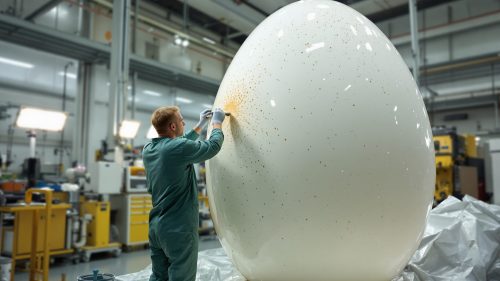
Turning an egg into a monument requires careful consideration of both design and engineering. Unlike statues with flat planes or angular surfaces, an egg’s continuous curves present unique fabrication challenges.
Choosing Materials
- Fiberglass: Lightweight yet durable, fiberglass is one of the most popular materials for roadside sculptures. It can be molded into smooth, seamless curves.
- Metal (steel or aluminum): Strong and weather-resistant, metals allow for striking finishes (polished, matte, or painted). The Vegreville Pysanka demonstrates how metal plates can create stunning mosaic-like patterns.
- Concrete: For permanent, heavy installations, reinforced concrete provides stability. Concrete eggs can be painted or left raw for a natural stone look.
Constructing the Framework
A giant egg typically requires a steel armature or skeleton to hold its shape. This framework might resemble a cage of ribs and rings, following the contours of the egg. The outer shell (fiberglass, panels, or concrete) is then attached to this framework.
Surface Treatment
- Painted realism: Layers of primer, base color, and speckles can replicate the look of a real egg.
- Decorative finishes: Cultural patterns, murals, or festival themes can be painted or vinyl-wrapped.
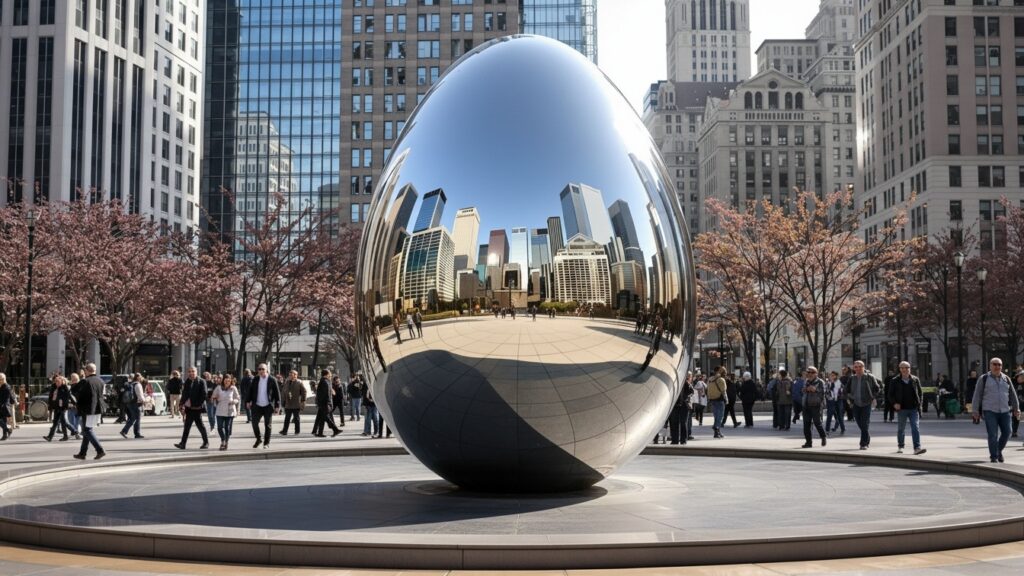
- Modern polish: Resin coatings or metallic plating give the egg a sleek, futuristic vibe.
Site Integration
Placement matters. A giant egg can sit directly on the ground, perch on a pedestal, or even be tilted at an angle for visual drama. Some designers add landscaping around the egg—benches, flowers, or pathways—transforming it into a mini plaza. In advanced projects, lighting may be integrated so the egg glows at night, enhancing its landmark appeal.
The Egg as a Stage for Events
One intriguing use of giant egg statues is as seasonal centerpieces. Imagine a plaza where a massive egg is painted anew each year for Easter, spring festivals, or art competitions. Artists could be invited to decorate the egg with fresh designs, making it a living tradition. In tourism-heavy regions, a hollow egg large enough to walk inside could even double as an event space, housing exhibitions or interactive displays. The egg becomes more than sculpture—it becomes an immersive environment.
Cultural Resonance: Why the Egg Works Across Contexts
Unlike statues that are tied to specific heroes, animals, or myths, the egg is almost infinitely versatile. It can be serious or silly, religious or secular, modern or traditional. This adaptability explains why giant egg statues thrive across such diverse contexts. In religious celebrations, they take on the role of a symbol of rebirth and resurrection. In agricultural towns, they highlight poultry and farming heritage, serving as tributes to rural life. In urban spaces, they are often reimagined as sleek, abstract art installations, polished and modern in design. And in tourist destinations, they transform into iconic “photo stops,” attracting travelers with their quirky scale and universal familiarity. The egg is universal, timeless, and approachable, making it the perfect subject for monumental interpretation.
Imagining Future Giant Egg Projects
The next wave of giant egg statues could be even more inventive, with artists and communities exploring a wide spectrum of creative directions. One could imagine a mirrored egg in a city park that reflects the surrounding skyline, turning the landscape itself into part of the sculpture. Another possibility is a glowing LED egg that changes colors at night, pulsing like a heartbeat and becoming a beacon of light in public spaces. Cities might create entire themed egg series scattered across neighborhoods, each painted by a different artist, forming an “egg trail” for tourists to follow. Even more ambitious would be a hollow egg pavilion, large enough to serve as a small event venue complete with interactive lighting and sound. Each of these concepts would amplify the egg’s symbolic core while pushing design boundaries, demonstrating just how versatile and imaginative this simple shape can become.
Conclusion: A Simple Shape with Endless Possibilities
The giant egg statue reminds us that even the simplest shapes can hold profound meaning and joy when scaled up. Whether it’s a cultural monument, a roadside attraction, or a modernist art piece, the egg never fails to intrigue. It speaks of beginnings, of nourishment, of potential waiting to hatch. For travelers, it’s a photo-op and a curiosity. For artists, it’s a blank canvas. For communities, it’s an anchor of identity and pride. And for everyone, it’s a reminder that wonder often hides in the most ordinary things—until we choose to make them monumental.
Check out WhiteClouds’ 3D Statues for more information.
Contact us today to learn more about our 3D services and how we can help you achieve your goals.