
Giant Crab Statue: From Tidepool Myth to Coastal Icon
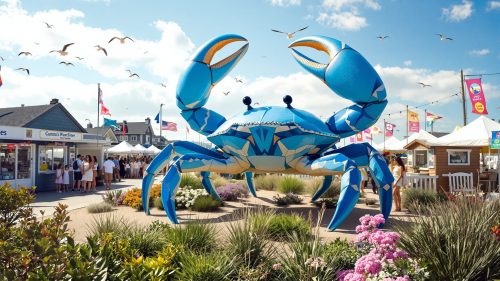
Coastlines make storytellers of all of us. The horizon is a moving line, the air tastes like salt and metal, and the tide writes and rewrites the same sentence twice a day. Set a giant crab statue against that living backdrop and you get a landmark that feels unshakably local yet instantly universal. Crabs are industrious, adaptable, a little theatrical, and—thanks to their armor, claws, and sideways swagger—immediately recognizable from afar. A well-designed giant crab statue doesn’t just decorate a boardwalk; it anchors an identity, frames photos, and turns a stretch of waterfront into a destination people remember and recommend.
Why a Giant Crab Statue Captivates
Crabs carry a bundle of meanings that fit coastal towns like a glove. They suggest fisheries and working harbors, beachcombing and tidepool science, maritime folklore and festival food. Unlike many animal subjects, a crab’s silhouette reads powerfully at long distance: broad carapace, outstretched chelae, spiky legs. The geometry is dramatic but legible, which helps photographers and visitors compose shots quickly. At human scale—say, a statue two or three times the size of a real Dungeness or blue crab—the form becomes playful and approachable. At larger-than-life scale—perhaps 18 to 30 feet across—those same forms turn monumental, a visual signal that says: “Here begins the waterfront.”
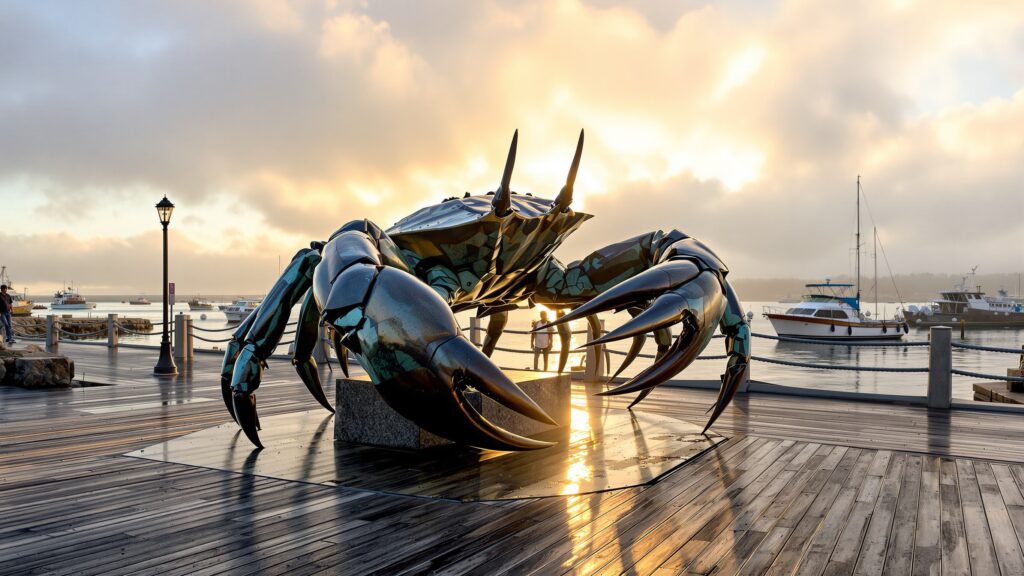
Crabs also lend themselves to a range of moods. A low, defensive pose with raised claws feels vigilant and strong; a sideways stance with one claw lowered and one lifted feels almost conversational, as if greeting visitors. The sheen of shell materials—bronze, stainless steel, enameled panels, glass mosaic—catches changing light the way wet rock does at low tide. This pairing of clear silhouette and shifting surface makes a giant crab a time-of-day machine: different at dawn than at noon than at night.
Species, Pose, and Character
Choosing a species is more than a biological detail; it’s a narrative choice. A Dungeness crab connects to Pacific fisheries and cold-water kelp forests. A blue crab signals Atlantic and Gulf estuaries, brackish marshes, and summer feasts. A horseshoe crab—ancient and otherworldly—points to evolutionary time and spring spawning events that feed migrating shorebirds. Each species has a unique carapace outline, spine count, and claw proportion that will shape the statue’s silhouette and thus its personality.
Pose is the statue’s thesis. A forward-canted carapace and outward-curving claws feel welcoming, perfect for a harbor entry. A high, more vertical posture on a gentle plinth turns the crab into a beacon for a roundabout, traffic island, or ferry terminal. Slight asymmetries—one claw partially open, a leg lifted as if mid-step—give life without slipping into cartoon. Surface texture can swing from stylized shell plates to micro-realism that shows growth lines, barnacle scars, and the matte-to-gloss transitions that real carapaces display. The eyes, set on short stalks, can be handled in subtle ways: a dark, light-catching inset rather than a glossy “googly” look keeps the piece from feeling toy-like.
Scale should harmonize with the site. On a wide boardwalk, a 14- to 20-foot span reads confidently without blocking views; on an elevated overlook or pier terminus, 24 to 30 feet can claim the horizon without overwhelming pedestrians. The trick is to make the crab big enough to be seen from a distance and intimate enough that visitors can stand under a claw, along the carapace edge, or by a leg for perspective shots.
Place-Making on the Coast
A giant crab statue belongs where water, sky, and human activity intersect. Ideal locations include harbor entries, pier heads, ferry plazas, dune overlooks, and the centerpoints of long boardwalks. The backdrop should be chosen with care: tidal flats, working boats, harbor cranes, and rocky promontories each lend a different mood. If the site sits near wave action or storm surge, set the piece on an elevated plinth or terrace with a seawall lip, both for protection and for drama when seas build.
Sun path matters. Morning light from the water side will silhouette the form for commuters and early walkers; late afternoon light will warm bronze and glaze glass with highlights for golden-hour photos. Wind exposure is both a structural and experiential factor. Position seating nooks downwind of the statue’s “lee,” using the crab itself as a windbreak. ADA-compliant paths with gentle slopes and firm, slip-resistant surfaces invite everyone to approach, circle, and linger. Night access benefits from low-glare, fully shielded lights that graze the shell and outline the claws without bleaching the scene or washing out the stars.
Storytelling With Respect
A waterfront icon is never neutral. It’s an amplifier for the history, ecology, and labor of a place. Build the narrative with the people who live and work on that water: fishers, Tribal Nations, marine biologists, dockworkers, educators, and youth. On-site interpretation can be elegant and minimal, with QR codes leading to oral histories, local recipes, migration maps, and tidepool etiquette. Prioritize Indigenous languages and perspectives and credit knowledge holders directly. If the crab evokes a local fishery, explain seasons, gear types, and sustainability practices; if it sits near sensitive habitat, articulate the basics of protection—no collecting, observe from distance, pack out trash. Done well, the statue becomes a portal into the living system, not a billboard for consumption.
Material Choices for Salt, Sun, and Time
Coastal air is unforgiving. Materials must be chosen for corrosion resistance, maintainability, and visual character under salt spray, UV, sand abrasion, and temperature swings. Bronze (silicon bronze alloys) delivers a classic patina and excellent durability when properly waxed and maintained; it darkens and greens gracefully and can tolerate occasional dousing by waves with the right coatings. 316L stainless steel resists pitting corrosion from chlorides better than 304 and can be bead-blasted or brushed to a satin that keeps glare down. Duplex stainless grades offer higher strength and crack resistance for thin, wide spans like claws. Powder-coated aluminum is light and corrosion-resistant, but coatings must be marine-grade with robust UV packages. Weathering steel (corten) is generally poor in marine environments unless placed well inland and kept dry; salt interrupts the protective patina cycle. Fiberglass-reinforced polymer (FRP) can achieve crisp detail with modest weight, but the gelcoat must be formulated for UV and salt, and the structure must include integrated frames to handle wind loads.
Mixed-media shells shine for crabs. Imagine a duplex stainless skeleton with panelized bronze plates over the carapace and claws, joint lines aligning with real sutures. Alternatively, a stainless or FRP base clad with vitreous enamel steel panels or hand-cut glass mosaics can capture the shimmer of the intertidal zone. Mosaic brings colorfastness and micro-sparkle, especially at sunrise and sunset, and allows community tile-making workshops that literally embed local handwork into the statue.
Coatings and finish systems should be layered: zinc-rich primers on steel, epoxy intermediates, and polysiloxane topcoats for color and gloss retention; microcrystalline wax on bronze with periodic re-application; anti-graffiti barriers that are sacrifical and re-coatable. Where metal meets salt, details like drip edges, weep holes, and hidden gutters are not luxuries but necessities.
Visitor Choreography and Photo Moments
Approach should feel like discovery: a slight rise in the boardwalk, a framed view down a pier, a turn in the path that reveals the crab’s full span. The plinth can double as seating with a warm, non-glare surface—dense hardwoods like ipe or thermally modified ash, or concrete with a subtle sandblast for slip resistance. Carve “micro-stages” into the landscape at leg and claw level so families can pose without standing in circulation paths. If the site allows, a low overlook directly above the carapace lets photographers capture the whole form with the harbor as a backdrop, while a ground-level pad under a claw creates the iconic “tiny human, giant crab” shot. Small interpretive “touch points”—a cast bronze carapace fragment at hand height, a tactile model of a claw—invite hands while protecting the main surface from wear.
Lighting the Tidal Theater
Night lighting should read like moonlight enhanced, not stadium glare. Grazing uplights along the carapace ribs exaggerate relief; narrow accents on claw edges draw the eye without overpowering the scene. Shielding, tight beam control, and warm color temperatures protect dark skies and migrating birds. Lighting controls can shift gently for seasonal events—soft amber during a seafood festival, cooler whites for winter maritime nights—without turning the statue into a billboard. Where power access is limited, integrate solar bollards for paths and use low-wattage, high-efficiency fixtures anchored to the plinth with concealed conduits. Corrosion-resistant housings and gasketing are mandatory in salt air.
Community, Commerce, and Ritual
Landmarks become economic engines when they host rituals. A giant crab statue can anchor a seasonal crab festival, cooking demonstrations with sustainable recipes, kids’ science days with touch tanks and microscope stations, beach cleanup meetups, plein air painting mornings, and “harbor nights” with acoustic music. A small kiosk nearby can sell field guides, local art, and memberships to conservation groups, channeling visitor enthusiasm into action. Partnerships with schools produce field trips that pair a statue visit with tidepool walks led by educators. Over time, the crab stops being “that statue” and becomes “our crab,” a shared friend that surfaces in calendars, yearbooks, and family stories.
How a Giant Crab Statue Might Be Fabricated
The making of a monumental crab is a choreography of digital modeling, material science, craftsmanship, and marine-savvy engineering. It starts with research: biological references for species-specific anatomy, measurements of carapace proportions and claw geometry, and high-resolution photos to capture shell textures, spine placements, and growth lines. A sculptor creates a maquette in clay or digitally in ZBrush or Blender, focusing first on gesture and silhouette. Photogrammetry or laser scanning converts the maquette into a precise mesh, which is retopologized into clean geometry for fabrication. At this stage, the team decides on segmentation—where the carapace plates, claws, and legs will break for transport, assembly, and structural logic.
For a bronze build, a full-scale positive can be CNC-milled in foam from the digital model and then clay-refined by hand to chase textures—minute pits, ridges, and the matte areas where barnacles may have once adhered. Flexible silicone molds capture these details, backed by rigid mother molds. Lost-wax casting proceeds in panelized sections sized for foundry capacity: multiple carapace plates, inner and outer claw halves, and leg segments. Wax sections are gated, invested in ceramic shells, burned out, and poured. After de-vesting, bronze panels are welded together over a stainless or bronze armature designed to distribute loads to the plinth. Welds are chased to disappear, and any slight warps are corrected by heat and persuasion. Patina artists use chemicals and flame to develop layered color: deep umbers, seaspray greens, tidepool reds. A microcrystalline wax seals the surface and is buffed to a soft sheen.
For a stainless steel shell, fabricators begin with a skeletal frame—laser-cut ribs at regular stations, water-jet webs at leg joints, and longitudinal stringers. Finite element analysis guides plate gauge, rib spacing, and joint reinforcement, especially at the cantilevered claws where wind loads and curious kids’ lean forces combine. Skin plates are brake-pressed and roll-formed to approximate compound curves, then TIG-welded and planished to a continuous surface. To keep glare down and fingerprints controlled, a bead-blasted or brushed finish is common; hidden cavities are sealed from salt intrusion but vented to avoid pressure build-up. Where the aesthetic calls for mixed media, bronze or enamelized plates are mechanically fastened to stainless sub-frames with isolating washers and sealants to prevent galvanic corrosion.
FRP approaches take advantage of lightness. A full-scale plug is milled or sculpted; tool molds are made in high-temperature resins; technicians lay up fabrics with vinyl ester resin for superior chemical resistance. Gelcoats are marine-grade with UV absorbers. Internal frames in aluminum or stainless provide lifting points and distribute loads to the plinth. If mosaic is desired, artisans adhere glass or porcelain tile to the FRP or metal substrate with marine mortars, followed by high-performance grout formulated for freeze-thaw and salt. Edge detailing is critical so wave splash and runoff don’t undermine the bond over time.
Anchoring and foundations are adapted to site. On a boardwalk deck, the statue may sit on a reinforced concrete plinth integrated with the pier structure, tied through with 316L threaded rods and epoxy-grouted sleeves. In a dune or coastal park, helical piles or drilled shafts below frost line connect to a grade beam that resists uplift and overturning. Base plates are leveled with non-shrink grout and detailed with capillary breaks. All embedded metals are isolated from dissimilar materials to prevent galvanic couples. If the site is within a storm surge zone, the plinth steps up above the design storm elevation to protect the artwork and lighting gear.
Transport and installation are staged. Components ship on lowboy trailers with padding and shrink wrap, permits secured for oversize widths and heights. Rigging plans are rehearsed in the shop with test picks. On site, cranes lift segments in sequence—legs and plinth frames first, then carapace halves, then claws—using soft slings and spreader bars at marked balance points. Field welding or bolting occurs behind removable plates that are later sealed and finished. Patina touch-ups and final waxing happen early in the morning or late in the afternoon to match shop lighting conditions. The last act is a water test: hose down the sculpture to check drainage, weeps, and seal integrity.
Engineering for Wind, Waves, and Salt
Marine sites demand an aggressive engineering posture. Wind loads are calculated for code-required gusts; claw surfaces are modeled to reduce sail effect without compromising silhouette, sometimes with subtle perforations or reverse curves. If waves or boat wakes can reach the plinth, impact loads are accounted for in base design, and splash zones are detailed with materials that tolerate constant wetting and drying cycles. Lightning protection may be prudent for exposed promontories: a concealed air terminal and down conductor to a ground ring preserves aesthetics while safeguarding the piece and nearby visitors. All fasteners, hinges (if any kinetic elements are used), and access panels are specified in 316 or duplex stainless with anti-seize compounds compatible with marine environments.
Accessibility, Safety, and Stewardship
A welcoming landmark anticipates all kinds of bodies and abilities. Approaches are wide and smooth, slopes gentle, and transitions flush. Tactile wayfinding at path edges helps low-vision visitors track the approach, while quiet seating locations are sited out of gusty wind. The statue should be enticing but not climbable in dangerous ways. Subtle design moves—slight inward overhangs on the carapace, transitions from rough grip to smooth low-friction surfaces above a certain height—discourage risky scrambling while allowing safe, joyful engagement at leg and claw bases. Railings, if required near water, are set to preserve prime sightlines. Signage focuses on invitation and etiquette rather than prohibition. Stewardship includes the nonhuman world. Plantings near the statue should be native, salt-tolerant species that stabilize soils and welcome pollinators without inviting nesting in the artwork. Lighting is bird-safe, low-blue, and timed to reduce all-night illumination. Stormwater from the plinth drains into planted swales, not directly into the harbor, filtering pollutants picked up from foot traffic.
Maintenance and Longevity in a Marine Setting
Salt is relentless but beatable with a rhythm of care. A maintenance plan includes regular fresh-water rinses to remove salt deposits, especially after storms; seasonal inspections for coating wear, sealant integrity, and fastener corrosion; and scheduled re-waxing for bronze surfaces. Stainless finishes benefit from occasional passivation treatments that restore chromium oxide layers. Mosaic surfaces get grout sealing and checks for debonded tiles. Anti-graffiti measures are in place to make cleanup quick and non-destructive. Access hatches, lift points, and interior cavities are designed for inspection without invasive disassembly. The best plan reads like a tide chart: predictable, calm, and tuned to local seasons.
Education and Programming
A giant crab statue can be a classroom in plain sight. Partner with local aquariums, marine labs, and schools to host tide charts, crab molting displays, and citizen-science projects tracking water quality or eelgrass. QR codes can lead to short videos on how crabs move (the biomechanics of sideways gait), how fisheries manage sustainable harvests, and how to explore tidepools without harm. During festival days, the plinth can become a stage for storytelling, sea shanties, and cooking lessons focused on ethical sourcing and zero-waste practices. Winter months can feature night sky programs that mix maritime navigation history with stargazing.
Digital Wayfinding and SEO
Discovery starts online. A dedicated landing page with high-resolution images, a pin-accurate map, parking guidance, accessibility notes, tide information, and hours helps visitors plan. Structured data (schema for tourist attractions, events, and images) gives search engines context. Consistent naming across platforms avoids confusion: “Giant Crab Statue at [Harbor/Boardwalk Name]” should be your north star. Publish a simple photography guide—a few sentences on best light (sunrise over the channel, golden hour on the shell), vantage points, and respectful behavior. Invite user-generated content with a short, memorable hashtag, and rotate community photos seasonally to keep the page fresh. A two-minute behind-the-scenes video on fabrication and installation converts casual interest into deeper engagement.
Measuring Success Without Flattening Wonder
Quantitative metrics—visitor counts, dwell time, event attendance, local business feedback—pair with qualitative indicators like guestbook comments and social media sentiment. If paths show wear, adjust circulation subtly with plantings and benches. If crowds bottleneck in one photo spot, create a second designed moment under another claw with better lighting. Survey teachers, fishers, and neighbors annually to learn how the statue is serving them and where it could do more. Let the data guide care, not spectacle.
Funding, Partnerships, and Ownership
Enduring landmarks belong to many hands. Seed funding might come from a public art program or tourism board, but long-term stewardship thrives on a circle of partners: Tribal governments, fishing co-ops, environmental NGOs, schools, and small businesses. A donor ribbon integrated into the plinth—stainless nameplates with room to grow—acknowledges support without shouting. Membership tiers tied to benefits like early access to events, behind-the-scenes maintenance tours, or a yearly “wash the crab” volunteer day make giving feel like participation. When ownership is shared, the statue gains guardians who notice problems early and celebrate successes loudly.
Conclusion: Let the Crab Hold the Shoreline
A giant crab statue is both spectacle and shelter, a piece of theater framed by sky and tide and a piece of furniture that invites rest, conversation, and memory. Choose a species whose story belongs to your coast. Pose it with confidence. Build it from materials that laugh at salt and wind. Tell your place’s true history, honor the people who know the water best, and offer visitors a choreography of approaches, textures, and views. Light the carapace like moon on wet rock. Maintain it with the unhurried regularity of a tide schedule. Then watch what happens: families gather, school buses arrive, fishers nod passing by, and the harbor’s soundtrack gains a new, steady note. The crab doesn’t move, but somehow the whole waterfront does—toward pride, care, and the kind of shared story that turns a point on a map into a place on the mind.
Check out WhiteClouds’ 3D Statues for more information.
Contact us today to learn more about our 3D services and how we can help you achieve your goals.