
Rethinking the Retail Experience
In today’s retail world, every square foot of space has to do more than hold products. Stores are no longer simply transactional environments; they are storytelling arenas where brand identity comes alive and customers are immersed in a curated experience. From flagship showrooms to boutique outlets, retailers are pushing design boundaries to stand out in a crowded market. One of the most striking innovations in this space is the use of topographic maps integrated into store design. Whether showcased at checkout counters or built into in-store displays, these maps bring depth, texture, and a sense of place that resonates with customers. They are part art installation, part brand narrative, and part interactive feature. By turning geography into design, retailers are creating high-impact touchpoints that connect shoppers not only to products but to the landscapes and stories behind them.

Why Topography Works in Retail
The appeal of topography lies in its ability to connect people to land and memory. Maps, in any form, invite curiosity. They orient, inspire, and remind us of places we’ve been or hope to explore. When those maps are sculpted into three-dimensional forms, they become even more powerful. Placed in a retail environment, topographic maps serve multiple purposes. They act as visual anchors, drawing attention and sparking conversations. They create emotional resonance by representing landscapes that carry meaning for customers—mountains climbed, valleys hiked, rivers paddled. And they subtly reinforce brand positioning, especially for companies rooted in outdoor culture, exploration, or sustainability.
When used at checkout counters, topo maps transform a transactional zone into a storytelling hub. Instead of being a place people passively wait to complete a purchase, the counter becomes a destination. Customers linger, run their hands across the contours, and engage with the story. In other parts of the store, wall-mounted or freestanding topo displays provide moments of discovery that enrich the entire shopping journey.
Design Approaches That Leave an Impression
There is no single way to integrate topographic maps into store design. Creativity and context guide the approach, and the most successful installations are those that reflect both the brand’s identity and the specific environment they occupy.
At checkout counters, topo maps can be inset into the surface itself, transforming the countertop into a sculptural landscape. Using materials like powder-coated aluminum, wood laminates, or acrylic layers, designers can create durable and eye-catching installations that stand up to high-touch environments. Illuminated contours or embedded LED points can highlight key features, from trailheads to brand-relevant landmarks, sparking both curiosity and interaction.
For in-store displays, the possibilities expand. Large wall-mounted maps can serve as statement pieces, while smaller freestanding displays can be positioned near featured products. Retailers might choose to represent the local geography of their community to foster connection with regional customers or depict iconic landscapes that align with their brand narrative.
One compelling design idea is the integration of interactive features. Control panels can allow customers to highlight trails, rivers, or mountain ranges, while augmented reality overlays can expand the physical model with digital content. These features not only add technological flair but also ensure that customers become active participants in the experience.
Inspiration from Real-World Installations
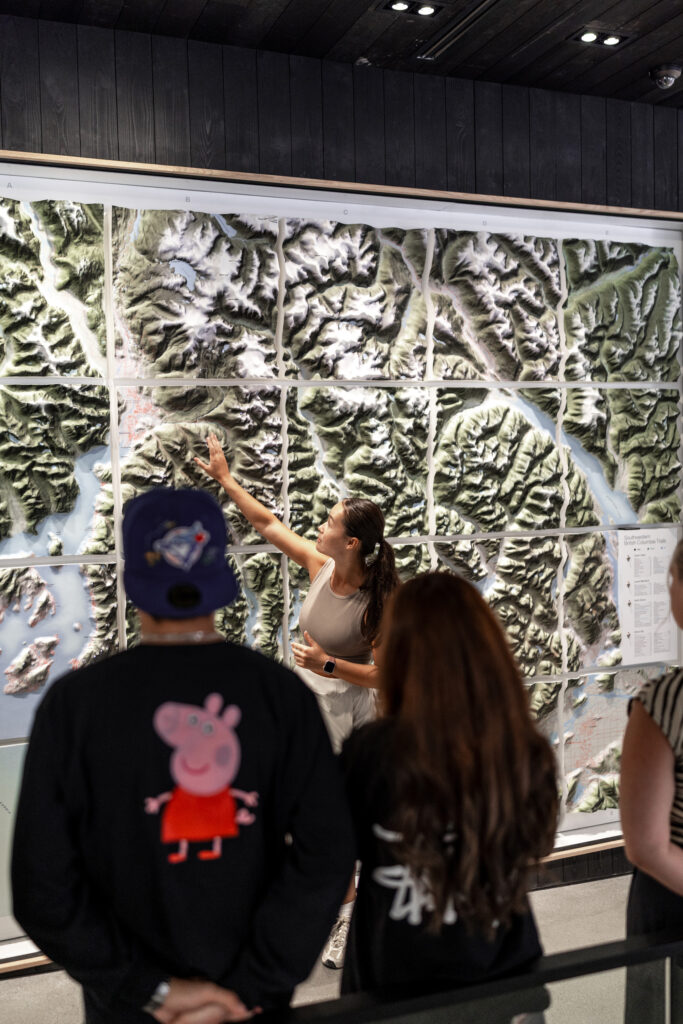
The integration of topographic maps into retail is not theoretical—it is already happening in stores around the world, often to dramatic effect. Arc’teryx, known for its commitment to high-performance outdoor gear, embraced this concept in its Vancouver flagship store. A massive 11×9 foot illuminated topo wall map of Southwestern British Columbia became the centerpiece of the space. Integrated LEDs allow visitors to activate trailheads, turning the installation into both an art piece and an interactive guide to the region. While this piece dominates a wall, the principles behind it can easily translate to checkout counters and smaller in-store displays: precision, interactivity, and connection to place.
Smaller retailers have adopted topo-inspired counters to highlight local identity. A boutique ski shop in the Alps integrated a topographic map of surrounding slopes into its checkout desk, with glowing inlays showing lift routes. Customers not only admired the craftsmanship but also discussed favorite runs with staff while completing purchases, turning checkout into a conversation starter. Visitor centers and cultural spaces have also embraced topo displays as interactive educational tools. These examples demonstrate that the design concept is flexible, scalable, and effective across a wide range of environments.
Engineering Meets Aesthetics
Designing topographic maps for checkout counters and in-store displays is as much an engineering challenge as it is a creative endeavor. These installations must be durable, safe, and maintainable, especially in high-traffic zones. Materials need to withstand constant use, from hands brushing over contours to items being placed on countertops.
Powder-coated aluminum offers strength and a sleek finish, while layered wood or acrylic creates warmth and texture. White sidewalls emphasize contours while aligning with modern minimalist aesthetics, though natural finishes can evoke rustic charm. Lighting systems, whether LEDs marking trailheads or edge-lit contours, must be designed for longevity and ease of repair.
Accessibility is another important factor. Interactive features like switches or control panels should be intuitive and positioned for easy reach. Clear legends and labels ensure that the storytelling remains accessible to all customers, not just those familiar with maps. The engineering effort extends beyond construction to the integration of wiring, anchoring systems, and modular designs that allow for updates or repairs without dismantling the entire installation. When executed well, these practical considerations disappear into the background, leaving only the artistry and impact of the piece.
The Business Case for Topographic Design
For retailers, the decision to invest in topographic maps at checkout counters and in-store displays is not just about aesthetics—it is about impact. These installations elevate the brand experience in ways that traditional signage or décor cannot.
First, they increase dwell time. Customers linger at checkout counters with topo features, exploring the contours while waiting for a transaction. They pause longer at in-store displays, drawn in by the uniqueness of the design. This extended engagement deepens brand connection and often translates into greater sales.
Second, they foster emotional resonance. A customer who sees their favorite local trail etched into a counter or illuminated on a wall feels a sense of belonging. This connection transforms a store visit into a memorable moment, strengthening loyalty.
Third, they create organic marketing opportunities. Striking topo installations are highly photogenic, often becoming the most shared elements of a store on social media. Customers post photos, tag locations, and in effect amplify brand visibility far beyond the physical space.
Finally, they future-proof the retail experience. As online shopping continues to expand, physical stores must lean into experiences that cannot be replicated digitally. Topographic displays embody this principle perfectly—immersive, tactile, and rooted in real-world engagement.
Designing the Future of Retail Storytelling
Looking ahead, the role of topographic maps in retail design is poised to grow. Advances in fabrication technology, from CNC routing to 3D printing, are making precision topography more accessible. Integration with digital overlays, augmented reality, and even projection mapping could expand storytelling possibilities even further. Retailers may soon use topo counters that respond dynamically, with touch-sensitive lighting systems that highlight features under a customer’s hand. In-store displays might integrate live data, showing trail conditions or weather updates projected onto physical maps. The fusion of physical and digital will only deepen the immersive quality of these installations.
At the same time, the timeless appeal of topography ensures that even simple, non-digital designs will remain effective. A beautifully crafted wooden topo countertop can be just as impactful as a high-tech illuminated wall, provided it aligns with the brand’s narrative and values. The real key lies in authenticity. Customers can sense when design is gimmicky. Topographic maps succeed because they are authentic to the spirit of exploration, geography, and connection to place. For brands that embody those values, topo displays are not a design trend—they are a natural evolution.
Carving Stories into Counters and Walls
Topographic maps for checkout counters and in-store displays are redefining how retailers think about design. They turn transactional spaces into storytelling hubs and transform walls into landscapes of memory and aspiration. They fuse art with engineering, brand identity with geography, and retail strategy with emotional resonance.
From Arc’teryx’s illuminated flagship installation to smaller local retailers highlighting their home terrain, the examples are multiplying. Each one demonstrates the ability of topographic design to create high-impact moments that customers remember long after leaving the store. In an era where retail must be more than commerce, these maps carve stories into counters and walls, ensuring that every visit is not just a transaction but an experience. They remind customers that the landscapes that inspire adventure can be celebrated indoors, etched into the very spaces where brands and people connect.
Contact us today to learn more about our 3D services and how we can help you achieve your goals.