
When Flat Worlds Come to Life
Once confined to inked pages and glowing screens, anime and manga characters are now stepping out of two-dimensional space and into the real world. Their hair catches light, their clothes ripple, and their eyes shimmer with depth. What was once sketch and color now breathes with volume, texture, and emotion. The leap from 2D to 3D isn’t just a visual upgrade—it’s a cultural evolution. Fans, artists, game developers, and filmmakers are re-imagining what it means to see their favorite characters. From fan-made statues to cinematic blockbusters and immersive VR worlds, 3D anime modeling has become a global art form. This isn’t about replacing hand-drawn charm. It’s about expanding it—bringing stylized imagination into the realm of physical form and photorealistic space. Let’s dive into how 3D anime worlds are made, why they captivate millions, and how digital fabrication is giving fans something to literally hold onto.
From Page to Polygon: The Birth of 3D Anime
Anime began as an illusion of motion built on thousands of hand-drawn frames. Every wink, spin, and tear was crafted by artists who understood rhythm and expression. Manga, on the other hand, was static yet cinematic—a storyboard for emotions on paper.
The transition to 3D modeling started quietly in the 1990s. Early experiments appeared in openings of shows like Ghost in the Shell and Macross Plus. But it wasn’t until the 2010s that technology matured enough to blend anime’s iconic look with real-time 3D rendering.
Software like Blender, Maya, and ZBrush allowed artists to sculpt characters with anime proportions—exaggerated eyes, gravity-defying hair, slender silhouettes—while maintaining the crisp linework and shading of 2D illustration. The result was something uncanny yet mesmerizing: living, breathing characters that still looked hand-drawn.
The Style Challenge: Preserving the Anime Aesthetic
Translating 2D anime into 3D is a paradox. The charm of anime lies in its simplicity—flat shadows, minimal lines, and emotion expressed through exaggeration. But 3D is all about light, depth, and realism. How do you combine the two without losing magic on either side? Artists developed an approach known as “non-photorealistic rendering” (NPR) or “toon shading.” Instead of aiming for realism, this style mimics how traditional anime looks under studio lighting. Surfaces are smooth, shadows are hard-edged, and eyes gleam like illustrated glass. Modern engines like Unreal and Unity now have anime-specific shader packs designed to reproduce manga linework, halftone textures, and even stylized motion blur. When done well, these models feel like 2D drawings that somehow exist in three-dimensional space—a visual sweet spot between technology and art.
Breathing Life into 3D Characters
Creating an anime character in 3D begins with a concept sketch, often drawn by the same artists who design the 2D versions. From there, 3D modelers sculpt the character’s base mesh—a digital clay figure that defines proportions and anatomy.
Then comes the fun part: texturing and shading. The artist paints the model’s skin tones, costume fabrics, and facial details while applying anime-style shaders that flatten depth where needed and accentuate lines where expression matters.
Rigging is where the character gains bones and muscles. Every joint, strand of hair, and fluttering skirt is controlled by a digital skeleton. Once animated, the model can walk, fight, cry, or dance exactly like their 2D counterpart—but with spatial realism that allows for cinematic angles never possible in traditional animation.
The Emotional Science of Depth
Why do fans respond so strongly to 3D anime characters? Because depth adds intimacy. Seeing a beloved hero rendered in 3D feels like stepping closer to a dream world you’ve always loved but could never touch. A 3D version allows the viewer to experience presence. The camera can orbit around a character, revealing details—belt textures, armor scratches, faint blushes—that bring humanity to fantasy. In VR, it’s almost surreal; standing face-to-face with your favorite character feels like meeting an old friend from another universe. For creators, 3D modeling is also emotional engineering. The subtle curvature of a smile or the glint of light on an iris can transform digital art into soul-stirring performance. It’s not about realism—it’s about resonance.
From Games to Cinema: Where 3D Anime Shines
The gaming world was the first to fully embrace anime in 3D. Franchises like Final Fantasy, Persona, Genshin Impact, and Xenoblade Chronicles pushed stylistic modeling to stunning heights. Characters feel both painterly and physical, their every gesture captured with motion-capture precision.
Then came cinema. Films like Stand By Me Doraemon and Dragon Ball Super: Super Hero experimented with hybrid aesthetics, merging hand-drawn design with 3D animation pipelines. Even the critically acclaimed Spider-Man: Across the Spider-Verse drew heavily from anime’s visual grammar—cel-shaded characters with comic-panel energy brought to life in full 3D.
And now, with streaming giants investing in high-budget anime adaptations, studios are re-creating entire worlds—Tokyo streets, mecha battlefields, fantasy kingdoms—in detailed three-dimensional glory. The line between game, movie, and manga has never been thinner.
The Collector’s Dream: Anime in Physical 3D
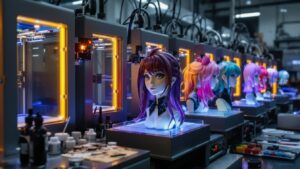
3D anime isn’t limited to pixels—it’s also tangible. Statue and figure fabrication has exploded, with companies and fans producing intricately sculpted versions of beloved characters. These figures start as digital 3D models, often built by the same artists who create game assets. The files are then refined for 3D printing—scaled, supported, and detailed for resin or polymer output. Once printed, they’re sanded, painted, and assembled into breathtaking collectibles that capture every fold of clothing and every strand of hair.
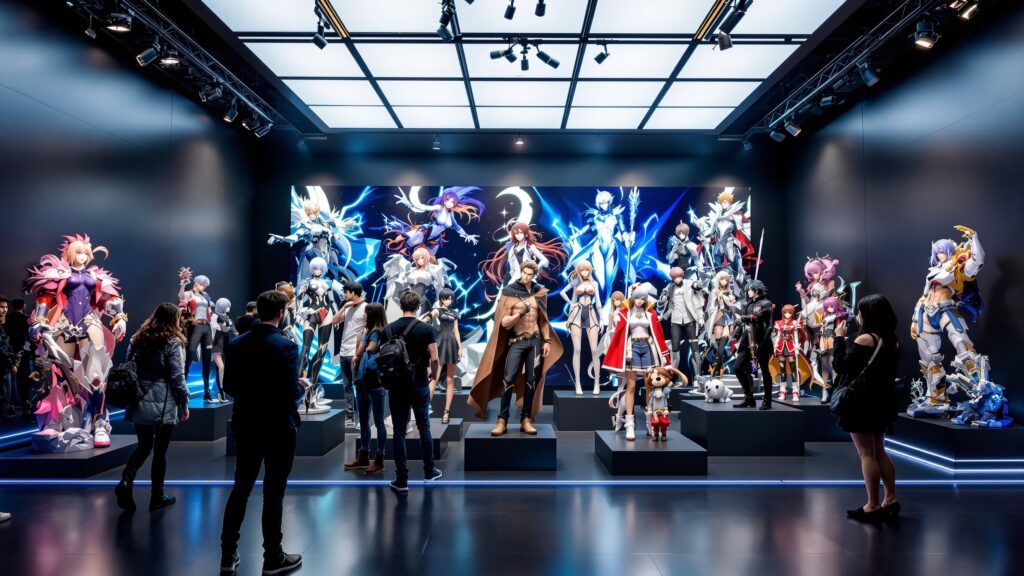
Some artists take it further, adding mechanical articulation—movable joints, magnetic accessories, even LED eyes. It’s engineering meets obsession. In exhibitions and conventions, full-scale 3D anime statues now tower over fans, bridging the gap between fantasy and reality. Standing next to a life-sized 3D render of your favorite hero isn’t just exciting—it’s uncanny, almost like meeting fiction made flesh.
The Rise of Virtual Idols and AI Avatars
3D anime models aren’t just used for entertainment—they’re becoming digital personas. Virtual YouTubers (VTubers) like Kizuna AI, Gawr Gura, and Ironmouse rely on anime-style 3D avatars animated in real time. These characters smile, sing, and interact with audiences using motion-capture technology and AI-driven facial tracking. Fans don’t just watch them—they talk to them, share jokes, and form communities around them. It’s a fusion of performance art, software engineering, and character storytelling that redefines fandom. In a sense, these 3D anime personalities are the first generation of digital beings with sustained emotional relationships to audiences—half mascot, half mirror of human creativity.
The Global Workshop: Fans as 3D Creators
What was once the domain of big studios is now a playground for fans. Open-source tools like Blender and 3D printing platforms have democratized anime modeling.
Online communities on Sketchfab, ArtStation, and Reddit share thousands of fan-made 3D versions of classic manga and anime characters—some faithful recreations, others bold reinterpretations. A high school student in São Paulo can model a One Piece ship while a designer in Seoul creates their own Naruto-inspired ninja world, all shared instantly online.
Fan 3D modeling contests, cosplay prop fabrication, and VRChat avatar creation have turned anime modeling into a living, collaborative ecosystem. The spirit of doujin (fan-made art) has evolved from print to polygon.
How Anime and Manga Characters Are Fabricated in 3D
The fabrication process of anime models bridges digital design and physical craftsmanship. It’s both science and storytelling.
Step 1: Digital Sculpting
Artists sculpt the character using 3D modeling software. They build anatomy, hair, clothing folds, and props. Every detail—from eyelash length to sword hilt design—is precisely measured.
Step 2: Texturing and Color Mapping
Using digital painting tools, artists apply textures that mimic anime shading—flat base colors with soft gradients and hard shadows. They often hand-paint cel-style edges to maintain a 2D feel.
Step 3: Preparing for Print or Render
For physical models, meshes are optimized for 3D printing—support structures are added, fragile areas reinforced, and scale determined. For virtual models, rigs and shaders are added for animation.
Step 4: Printing and Assembly
3D printers bring the design to life layer by layer. Resin printing captures microscopic details, from facial expressions to armor etching. Once printed, the pieces are cleaned, sanded, and assembled like a puzzle.
Step 5: Painting and Finishing
Airbrushing and hand painting add final touches—blush tones, glossed eyes, metallic armor finishes. Some collectors even add LED lights or mechanical features.
In short, the fabrication of anime characters in 3D is where digital dreams become tangible art.
The Art of Stylized Realism
Anime characters defy anatomy, yet in 3D they must still obey physics—hair needs volume, fabric needs gravity, and eyes need depth. The artistry lies in stylized realism, the perfect balance between believability and exaggeration. Too realistic, and the charm disappears. Too cartoony, and the model feels flat. Artists use subtle optical tricks—slightly enlarged irises, softened shadows, and exaggerated proportions—to preserve expressiveness while adding realism. This balance is what makes modern 3D anime models breathtaking: they look alive, but never lose that painterly essence of manga panels and animation cels.
The Ethical and Legal Dimension
As 3D modeling grows, so do questions of ownership and authenticity. Who owns a fan-made 3D model of a famous character? Is it tribute or infringement?
Some studios encourage fan creations as free promotion, while others guard their intellectual property fiercely. The gray area is complex, especially when 3D prints or digital avatars can be monetized.
Meanwhile, AI tools capable of auto-generating anime models raise new ethical questions—about authorship, artistry, and consent. As fabrication becomes faster and easier, the line between inspiration and imitation will need constant negotiation.
3D Anime in the Age of the Metaverse
The concept of the metaverse—a persistent, shared virtual space—is tailor-made for anime aesthetics. Imagine exploring a city straight out of Attack on Titan or attending a concert performed by Hatsune Miku in fully immersive 3D. As VR and AR technologies mature, anime characters are poised to become the ambassadors of digital identity. Their expressive design and universal appeal make them perfect companions for virtual worlds.
3D anime avatars already populate social platforms like VRChat and Horizon Worlds, embodying everything from heroic adventurers to everyday citizens of imagined universes. It’s not science fiction anymore—it’s social reality, designed in cel-shaded color.
When 3D Meets Emotion
The greatest achievement of anime in 3D isn’t technical—it’s emotional. Seeing your favorite character rendered with depth and motion evokes nostalgia, wonder, and awe all at once. For artists, it’s a way of touching the stories that shaped them. For fans, it’s a bridge between imagination and reality. For the industry, it’s a new language—visual, interactive, and endlessly expressive. Anime has always thrived on feeling, not just form. The move to 3D hasn’t dulled that passion—it’s magnified it.
The Future: AI Artists, Real-Time Rendering, and Holograms
The next chapter of 3D anime will push creativity into realms once unthinkable. AI now assists in generating base meshes, predicting facial expressions, and even animating gestures in real time.
Advances in real-time ray tracing will allow anime scenes to glow with dynamic light while maintaining hand-drawn style. Holographic displays will let fans project full-size characters into their living rooms.
In ten years, you might walk through a One Piece ship deck via AR glasses or chat with a fully interactive digital companion rendered from manga art. The boundary between character and viewer will blur completely.
Why 3D Matters to Anime’s Soul
Anime isn’t just about style—it’s about heart. And 3D modeling, at its best, doesn’t erase that—it amplifies it. It gives physicality to imagination and turns storytelling into shared space.
A 3D anime figure is a love letter to its 2D roots, built polygon by polygon instead of brushstroke by brushstroke. Each one captures the same spark that first drew fans to the medium: emotion distilled into design.
When you watch a 3D anime character smile, you’re not seeing pixels—you’re seeing possibility. The future of anime isn’t flat. It’s dimensional, dynamic, and dazzlingly alive.
A New Dimension of Dreaming
Anime and manga characters have always existed between worlds—half fantasy, half reflection of our deepest emotions. 3D technology hasn’t taken them away from us; it’s brought them closer than ever. From sculpted collectibles to immersive metaverse adventures, these re-imagined characters embody the perfect blend of nostalgia and innovation. They remind us that art evolves not to replace the past, but to expand its reach. The future of anime is unfolding in three dimensions—and it’s more breathtaking, more expressive, and more human than anyone could have imagined.
Check out WhiteClouds’ 3D Props for more information.
Contact us today to learn more about our 3D services and how we can help you achieve your goals.