
Mapping the Sky: From Ancient Legends to Modern Astronomy
Look up at the night sky on a clear evening, and you’ll see more than just scattered stars. You’ll notice patterns—some obvious, some subtle—that have guided explorers, inspired myths, and shaped human curiosity for thousands of years. A constellation map is the tool that brings those patterns into focus. It transforms the seemingly random into something structured, readable, and meaningful. At its core, a constellation map is a visual representation of the night sky that connects stars into recognizable shapes and organizes them into constellations. But that simple definition barely scratches the surface. A constellation map is also a bridge between science and storytelling, between navigation and imagination, between ancient traditions and modern astronomy. It helps us understand where we are in the universe, even as it reminds us how long humanity has been looking upward for answers.
The Basics: What a Constellation Map Shows
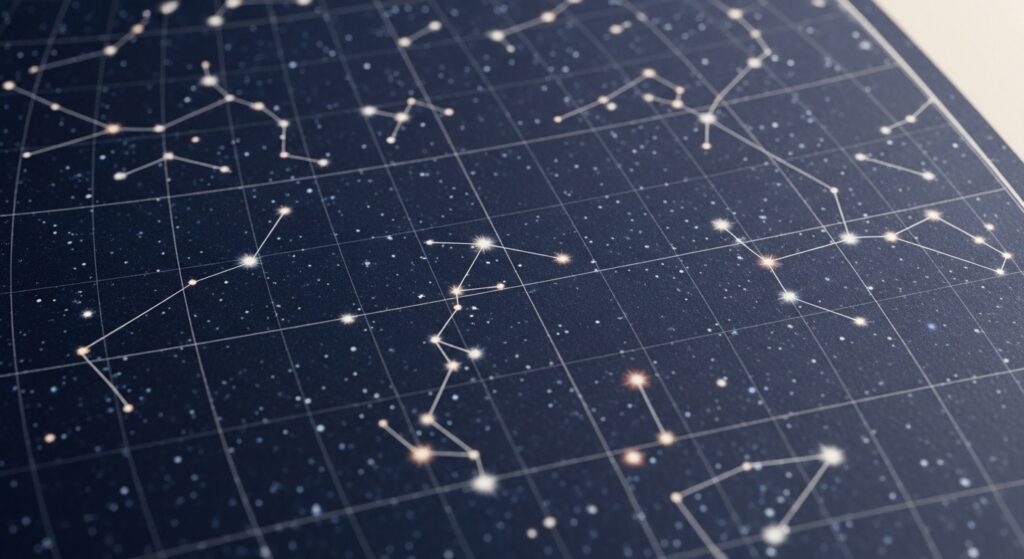
A constellation map charts the positions of stars as seen from Earth and groups them into named constellations. These groupings are not random; they follow patterns that have been recognized and refined over centuries. Each constellation is like a piece of a larger puzzle, helping observers navigate the sky.
The map typically includes the brightest stars, drawn in relation to one another, with lines connecting them to form recognizable shapes. Some resemble animals, others mythological figures, and some are more abstract. The purpose is not to reflect physical connections between stars—many are separated by vast distances—but to create a framework that makes the sky easier to interpret.
Modern constellation maps also include boundaries. These boundaries divide the sky into officially recognized regions, ensuring that every point in the sky belongs to a specific constellation. This system helps astronomers communicate precisely about celestial objects, whether they are discussing a distant galaxy or a newly observed comet.
A Map of the Sky, Not the Ground
Unlike a traditional map that represents geography on Earth, a constellation map represents a dome of stars surrounding the observer. This makes it fundamentally different from maps we use every day. Instead of roads and borders, it shows points of light projected onto an imaginary sphere.
This concept is known as the celestial sphere. Imagine standing at the center of a vast globe, with stars fixed on its inner surface. A constellation map flattens part of that sphere so it can be printed, displayed, or viewed digitally. This flattening introduces some distortion, just as a world map does, but it allows us to visualize the sky in a practical way.
Because the Earth rotates, the sky appears to move. A constellation map often accounts for this by being specific to a time and location. The constellations visible in the winter sky are different from those seen in summer. Likewise, what you see in the Northern Hemisphere differs from what is visible in the Southern Hemisphere. A good constellation map helps you understand not just where stars are, but when and where to look for them.
The Origins of Constellation Maps
Constellation maps have ancient roots. Long before telescopes, people looked to the stars for guidance, storytelling, and meaning. Early civilizations in Mesopotamia, Egypt, China, and Greece all identified patterns in the sky and assigned them significance.
These early maps were not always drawn on paper. They existed in oral traditions, carvings, and early manuscripts. The Greeks, in particular, played a major role in shaping the constellations we recognize today. Figures like Orion, Cassiopeia, and Andromeda come directly from Greek mythology, and their stories are still reflected in modern star charts.
Over time, astronomers began to record these patterns more systematically. Star catalogs were created, mapping the positions of stars with increasing accuracy. During the Renaissance, printed star maps became more detailed and widely available, combining scientific observation with artistic representation. These maps often featured elaborate illustrations, blending astronomy with art in a way that made them both functional and visually captivating.
Modern Constellation Maps and Scientific Precision
Today’s constellation maps are far more precise than their ancient counterparts. Advances in astronomy, optics, and digital technology have allowed us to chart the sky with incredible accuracy. Modern maps are based on detailed measurements of star positions, brightness, and motion.
The International Astronomical Union has officially recognized 88 constellations, each with defined boundaries. These boundaries ensure consistency in astronomical research and communication. When scientists refer to a specific region of the sky, they can do so with clarity and precision.
Digital constellation maps have taken things even further. Apps and interactive tools allow users to point their devices at the sky and see constellations overlaid in real time. These tools adjust for location, time, and even atmospheric conditions, making stargazing more accessible than ever before.
Despite these technological advancements, the essence of a constellation map remains the same. It is still about connecting stars into meaningful patterns and using those patterns to navigate and understand the sky.
How Constellation Maps Are Used
Constellation maps serve many purposes, from practical navigation to educational exploration. Historically, they were essential tools for sailors and travelers, helping them determine direction and position when landmarks were not visible. The stars provided a reliable guide, and constellation maps made that guide easier to interpret.
Today, constellation maps are widely used in education. They help students learn about astronomy, understand the structure of the sky, and develop an appreciation for the universe. By identifying constellations, learners can begin to recognize patterns and understand how the sky changes over time.
Amateur astronomers rely on constellation maps to locate stars, planets, and deep-sky objects. A well-designed map can guide the observer from a bright, easily recognizable constellation to a faint galaxy or nebula. This process, known as star hopping, is a fundamental skill in observational astronomy.
Constellation maps are also used in art and design. Their aesthetic appeal makes them popular in prints, home décor, tattoos, and custom gifts. A personalized constellation map, showing the night sky on a specific date and location, can be a meaningful way to commemorate special moments such as birthdays, anniversaries, or significant life events.
Different Types of Constellation Maps
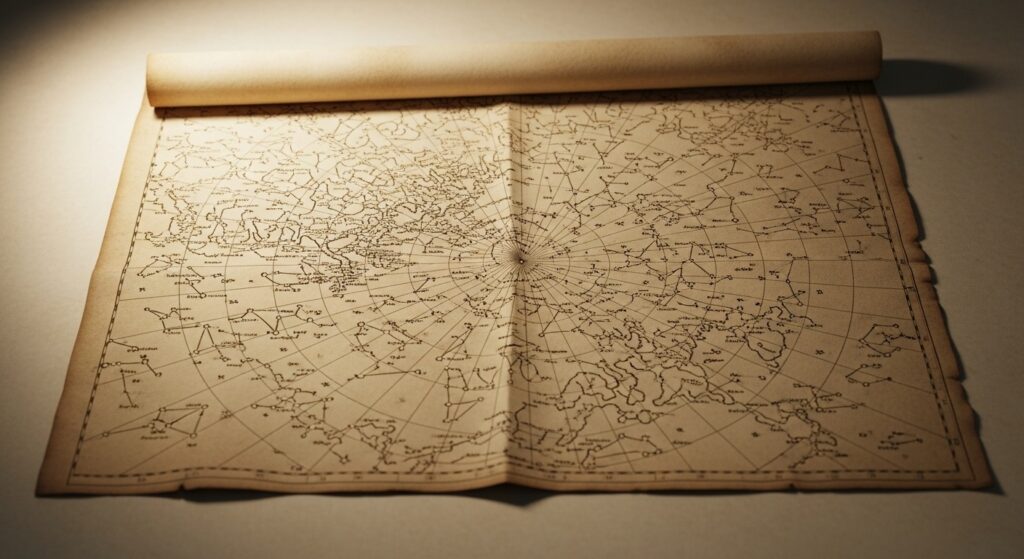
Not all constellation maps are the same. They come in various formats, each suited to different purposes and preferences. Some are simple and easy to read, designed for beginners who are just starting to explore the night sky. Others are highly detailed, including thousands of stars and additional astronomical information.
Planispheres are one of the most practical types of constellation maps. These are rotating star charts that allow users to adjust the view based on the date and time. By aligning the chart correctly, you can see which constellations are visible at any given moment.
Star atlases are more comprehensive. They are often used by serious amateur astronomers and professionals, providing detailed charts that cover the entire sky. These atlases may include information about star magnitudes, coordinates, and deep-sky objects, making them valuable tools for observation and research.
Digital maps and apps offer convenience and interactivity. They can display real-time sky views, provide detailed information about celestial objects, and even guide users to specific targets. These tools have made constellation maps more accessible, especially for those who may not have experience with traditional charts.
The Role of Constellations in Storytelling
One of the most fascinating aspects of constellation maps is their connection to storytelling. Each constellation carries a history, often rooted in mythology or cultural tradition. These stories give meaning to the patterns in the sky, turning them into narratives that have been passed down through generations.
For example, the constellation Orion is often depicted as a hunter, complete with a belt and sword. Cassiopeia is represented as a queen seated on a throne. These figures are not just artistic interpretations; they are part of a larger tradition that links the sky to human experience.
Different cultures have their own constellations and stories. While many modern maps are based on Greco-Roman traditions, other systems exist, reflecting the diverse ways people have interpreted the night sky. This cultural richness adds depth to constellation maps, making them more than just scientific tools.
Why Constellation Maps Still Matter
In an age of advanced technology and space exploration, it might seem like constellation maps are relics of the past. But they remain incredibly relevant. They provide a way to connect with the night sky that is both intuitive and meaningful.
Constellation maps encourage observation. They invite you to step outside, look up, and engage with the universe directly. In a world filled with screens and distractions, this simple act can be surprisingly powerful. It fosters curiosity, wonder, and a sense of perspective.
They also serve as a gateway to deeper exploration. By learning to recognize constellations, you build a foundation for understanding more complex astronomical concepts. You begin to see the sky not as a random collection of stars, but as a structured and dynamic system.
The Experience of Using a Constellation Map
Using a constellation map is an experience that blends learning with discovery. At first, it may seem challenging. The sky is vast, and the patterns are not always obvious. But with practice, the shapes begin to emerge. A few bright stars become a recognizable figure. That figure leads to another, and soon the sky starts to feel familiar.
There is a sense of accomplishment in identifying constellations on your own. It transforms stargazing from passive observation into active exploration. Each night offers something new, whether it is a different arrangement of stars, a passing planet, or a deeper understanding of the patterns above.
Constellation maps also create a sense of continuity. The same stars that guided ancient travelers are still visible today. The patterns we see are part of a shared human experience that spans cultures and centuries. In that sense, a constellation map is not just a tool. It is a connection to the past and a guide to the future.
A Map That Goes Beyond the Stars
Ultimately, a constellation map is more than a chart of the night sky. It is a way of seeing. It helps us organize the vastness of space into something we can understand and appreciate. It bridges the gap between science and imagination, between observation and meaning. Whether you are a beginner looking to identify your first constellation or an experienced observer exploring the depths of the cosmos, a constellation map remains an essential companion. It reminds us that even in a universe of unimaginable scale, we can find patterns, stories, and connections. And perhaps that is the most remarkable thing of all. A constellation map does not just show us where the stars are. It shows us how to see them.