
Why Donuts Work So Well on Screen
A donut reads instantly, even in silhouette. That ring shape means the prop solves two problems for filmmakers at once: it’s instantly legible, and it frames the action. A character peeking through the hole creates a built-in vignette; a camera gliding past the curvature suggests motion and reveals texture. Donuts also carry cultural associations that directors can steer like a spotlight. Put a pastry in a quiet office and you’ve got a morale boost. Place a box of donuts in a cop show and you’re either honoring or subverting a trope. Scale the donut to billboard size and you’ve created Americana—nostalgic, playful, and lightly ironic. The donut’s color palette helps too. Cinematographers love the contrast between creamy neutrals, glossy glazing, and saturated sprinkles. Those elements catch highlights beautifully and make even a quick establishing shot feel luscious. Meanwhile, production designers appreciate how a donut can soften dense urban scenes, punctuate sterile sci-fi interiors, or give texture to the mundane. In short, donuts come with mood included.
The Donut as Character Development
Props are storytelling engines. A donut is rarely “just” a donut: it’s a character’s craving, a stress valve, a broken promise to a diet, a morning ritual that says more than dialogue could. When a protagonist shares a donut, we read generosity and intimacy. When a villain absently eats one, it projects unnerving calm. When the hero goes for the donut against orders—during a stakeout, before a spacewalk—it’s comic relief and humanizing at once. The donut becomes a personality test that plays in seconds. Some of cinema’s best donut beats are all about timing. A laugh lands when a donut is bitten right after a devastating reveal. A slow push-in on an untouched donut box can suggest loneliness more eloquently than a speech. And in action movies, the absurdity of a giant pastry in a high-stakes scene becomes a permission slip for the audience to exhale and enjoy the spectacle.
From Desktop to Set Piece: Scaling the Pastry
Once a donut leaves a bakery box and enters the world of production design, scale becomes the superpower. There are three broad categories you’ll see on screens big and small:
Handheld hero props are the close-up donuts that actors eat or gesture with. They must look edible at macro distances under hot lights and repeat takes. Food stylists often prepare multiple batches with consistent color and texture, swapping in fresh pieces between setups.
Set dressing donuts include racks, boxes, and display cases that communicate place—think diner counters, break rooms, or corner shops. They don’t need to be edible, but they must read as mouthwatering from six to ten feet away. Painted foam or sculpted resin stands in for pastry when continuity is a beast.
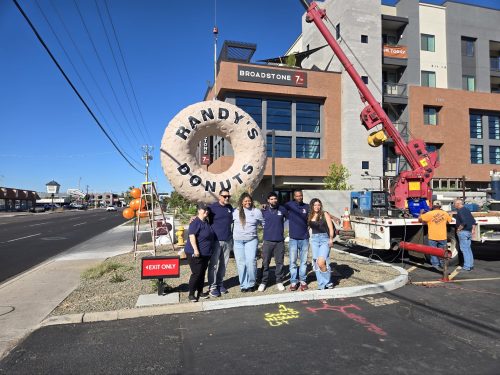
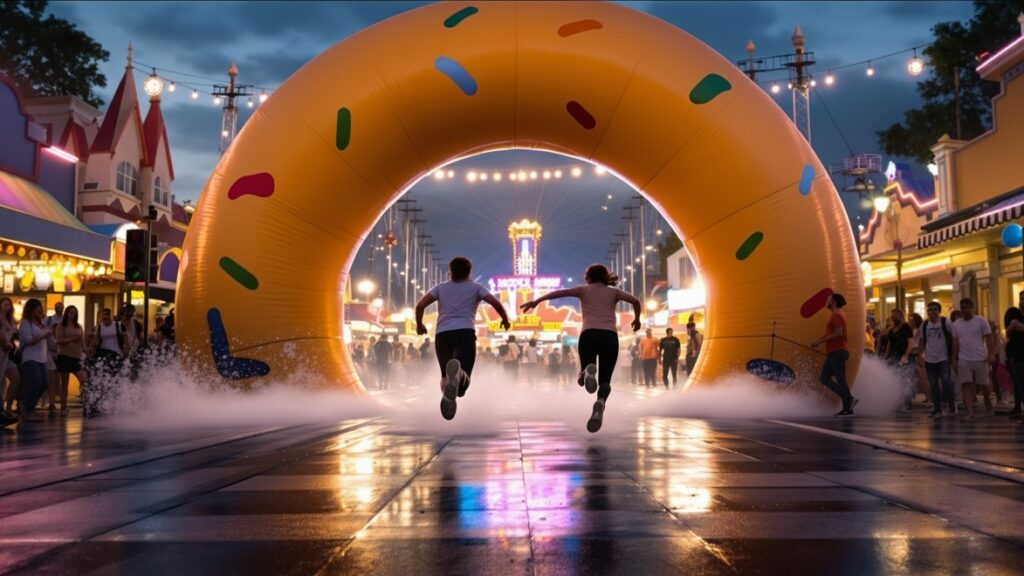
Oversized donut props are the showstoppers. These can be freestanding sculptures, inflatable rings, or architectural elements used as backdrops and gags. The bigger the donut, the closer it gets to monument or signage—and the more it blurs into roadside heritage and public art.
If you want to track down real-world landmarks that often become backdrops for commercials, music videos, and films, plan a photo safari using Famous Giant Donut Shops and Signs. That guide highlights places where the pastry silhouette has shaped the streetscape—and countless establishing shots.
Anatomy of a Hero Donut (That the Camera Loves)
The camera demands consistency. A “hero” donut for a close-up needs crisp glazing, believable crumb, and a symmetrical profile. Food stylists will often apply a thin layer of edible glycerin to keep the donut shiny under lights without weeping. Sprinkles are curated like gemstones: too matte and they vanish; too glossy and they strobe. Powdered sugar props can be a nightmare because airflow from lights or AC moves it between takes; stylists fix it with a mist of alcohol so it clings without clumping. For jelly or custard fills, the team rigs inserts so every cut reveals a generous, repeatable cross-section.
Continuity is the eternal hurdle. If a character takes a bite on camera, the department tracks bite marks, broken glaze, and crumb fallout with still photos. A dozen matching donuts sit on deck, each labeled for take and angle. The goal is that the editor never has to choose between a great performance and a broken donut.
Big Donut Gags and Practical Effects
Oversized donut props unlock practical gags that VFX artists love to augment. A giant ring can crash through a storefront in slow motion, shedding “sprinkles” that are actually painted foam beads. A comedic chase might use a rolling donut like a benign boulder, evoking silent-film slapstick with a sugary twist. Inflatable donuts collapse perfectly on cue and reset fast, but when the gag demands realistic weight, fabricators build hard shells around aluminum or steel frames. For flying donuts, rigging teams hide anchor points and run lines up and out, then art departments paint out hardware or leave that task to post. Edible chaos is carefully controlled. Glaze lines are disguised tubing that can pump syrup on cue; the viscosity is engineered to catch the light and read as delicious at normal speed and in slow-mo. If the prop must break, fabricators pre-score seams or produce modular segments with magnets so a “shatter” looks violent but resets in minutes. The artistry lies in keeping the gag readable in a single, wide shot—so viewers register donut first, then debris and laughter.
Building the Big Ones: Fabrication for Film
Large donut props usually start in foam or clay maquettes, then move to CNC-carved foam forms or 3D-printed segments. The skin might be fiberglass, urethane, or epoxy-coated foam, reinforced with internal ribs. Texture sells the gag; teams sculpt pores, bubbles, and pocked edges that mimic fried dough. For “frosting,” artists glaze the surface with high-build coatings, then scumble acrylics to create depth. Finally, transparent topcoats add subtle sheen without turning the donut into a mirror.
When the prop interacts with talent, safety rules everything. Non-toxic finishes, rounded edges, and hidden grab points protect performers. If the donut is climbable or serves as an arch, engineers spec the load path and sign off on the anchoring and footings. The prop department then builds a twin—or at least a swap-out surface—for stunt work, replacing fiberglass with soft foam where impacts occur. In wide shots, the hard-shell hero sells the realism; in close-quarters, the stunt version protects bodies (and budgets).
If this kind of spectacle is your endgame for a brand launch, festival activation, or red-carpet entrance, you’ll pick up practical ideas in Big Donut Props for Events and Advertising. Many of the same materials and safety practices carry from film sets to live environments, with extra attention paid to crowd flow and durability.
Cinematic Language: How Directors Shoot Donuts
Directors deploy donuts as visual punctuation. A classic approach is the “reveal”: begin with an abstract curve or a spray of sprinkles in extreme close-up, then rack focus to show the full ring as a character enters frame. Another favorite is the “portal shot,” placing the lens so actors are framed by the donut hole, creating layered depth for comedy or romance. Car-mounted rigs love donuts because the round shape plays beautifully with motion blur; even a simple pass-by reads as kinetic and cheerful. Light matters more than you’d think. Glaze looks best in cross-light where micro-textures sparkle; powdered donuts prefer soft, low-contrast illumination. Cinematographers use polarizers to tame specular highlights and protect the donut’s color. If an oversized prop is part of a skyline, blue hour is magic: LED accents glow, and the donut silhouette reads crisp against the cobalt sky. For daytime exteriors, a low, wide lens exaggerates scale, while a 50mm compresses background and can make a modest ring feel monumental.
The Donut’s Roadside DNA
Even the most cinematic donut owes something to roadside architecture—the mid-century impulse to sculpt a building into the thing it sells. That heritage is why movie donuts feel so “American”: they echo a country where signage became sculpture and convenience became theater. When productions shoot in cities with famous pastry landmarks, they’re borrowing a pre-built myth. Viewers might not know the address, but they intuit the vibe: bright sun, palm crowns, busy boulevards, and a dash of kitsch.
If the history and travel side of this world hooks you, take a deeper look at Famous Giant Donut Shops and Signs, which maps the physical places that still hoist enormous rings. It’s not just architecture—it’s a living backlot for commercials, music videos, and travelogs.
From Prop to Sculpture: When Movies Inspire Monuments
Film doesn’t only borrow from the street; sometimes it gives back. A memorable donut gag can prompt a city to commission a permanent piece, or a studio to install a long-term display in a plaza. When screen props go viral, fans want a selfie with the “real” thing, and pop-up exhibits morph into semi-permanent landmarks. Materials shift to weather-resistant composites, foundations get engineered for wind, and the donut steps into the realm of public art.
For a gallery of pastry-shaped artworks beyond the set, see Giant Donut Statues and Sculptures. You’ll spot museum pieces, plaza installations, and traveling exhibitions that prove the donut isn’t just a prop—it’s a sculptural muse.
Nostalgia, Irony, and the Joke That Always Lands
A donut can straddle multiple tones at once. In a satire, it’s a jab at consumer culture. In a thriller, it’s dissonance that heightens the creep factor. In a rom-com, it’s endearing shorthand for comfort and compromise. The same ring that sells innocence can also hint at obsession; a wall of donuts might look like heaven or like temptation stacked to the ceiling. That versatility keeps writers and directors coming back. As memes multiply across platforms, donut imagery remains evergreen—shareable, visually bright, and surprisingly eloquent for a circular pastry with a hole.
Marketing Synergy: Why Brands Love Donut Props
On-screen donuts don’t just serve film plots—they serve campaigns. A brand cameo with a pastry aesthetic brings warmth even when the product is unrelated to food. Music videos use giant donuts as backdrops for choreography because the shape reads cleanly in wide and medium shots. Comedy shows lean into giant pastry gags for instant crowd-pleasers. The through-line is that donuts are “sticky” for the camera, and even stickier for audiences. They photograph beautifully, shrink well into thumbnails, and look good on a billboard, a bus wrap, or a phone screen.
This synergy explains why event teams keep commissioning donut arches for premieres and pop-ups. It’s the same logic that built roadside rings decades ago: big shape, quick read, maximal smiles. For practical how-to on choosing materials, lighting, and safe rigging in public spaces, circle back to Big Donut Props for Events and Advertising—the production toolkit overlaps heavily with screen-used builds.
Safety, Cleanliness, and Edible Ethics
When productions use edible items, they still follow guidelines for hygiene and waste. Donuts that will be eaten on camera are handled by gloved stylists and replaced frequently as takes pile up. Sets coordinate donations when possible, but health codes dictate what can leave a controlled environment. With oversized props, non-toxic paints and coatings protect performers and crew. If the donut incorporates motion—rotating displays, rolling gags—lockouts and redundant anchors are part of the plan. None of this is glamorous, but it’s what lets a crew stage delicious chaos without injury.
A Craft Hidden in Plain Sight
The best donut props vanish into the story. That’s the paradox: when the craft is impeccable, viewers don’t notice the engineering; they just feel the delight. Think of the meticulous color work that keeps a glazed donut luminous under harsh fluorescents, or the hand-cut foam textures that sell a giant prop as “fried.” Consider the quiet genius of a continuity binder that tracks bite marks across a six-minute scene. Or the production assistant with a tray of fresh duplicates who sprints in during resets like a pastry ninja. Thousands of tiny decisions culminate in a prop that elicits a grin before a line is spoken.
Trivia You Can Taste (With a Side of Research)
Film sets gather the quirkiest donut trivia. How many sprinkles does it take to fill a hero bowl for a slow-motion toss? Which glaze formulation holds up under 4K macro without melting under key lights? How many matching donuts fit in a continuity cooler? Prop departments keep notes on what works, and the answers aren’t always what you’d expect. If you’re hungry for more curious tidbits—some cinematic, some historical—pour yourself a coffee and nibble through Fun Facts and Donut Trivia. It’s the perfect palate cleanser between location scouting and storyboard meetings.
Planning Your Own Donut Moment
If you’re a filmmaker or brand creative planning a donut-driven scene, start by clarifying the role your pastry plays. Is it a comfort object, a punchline, or a skyline dominator? From there, choose scale. Handheld donuts require hero-level styling and abundant duplicates. Set-dressing donuts need consistent palette control so they don’t moiré on camera. Oversized props demand engineering, permits, and clear choreography so they feel central without eclipsing your cast.
Scout locations with strong sight lines and complementary geometry. Alleys and narrow streets add drama to a large freestanding donut, but big boulevards let you stack palm crowns and streetlights around the ring for a textbook Americana frame. If you’re indoors, monitor color temperature and swap harsh overheads for bounced light to keep glazes appetizing. And when in doubt, let the donut frame your story: a push through the hole into a character’s reaction is a cut any editor will thank you for later.
The Donut Endures
Trends rotate like pastry in a display case, but donuts never fall out of fashion. They’re generous shapes; they invite participation. Audiences can practically taste them through the screen, which makes them perfect props for building empathy or dialing up absurdity. At blockbuster scale, they transform into urban icons. At handheld scale, they turn a moment human. This duality—monument and morsel—keeps the donut at the center of film language and pop culture. Whether perched in a sitcom break room or anchoring a cinematic skyline, the donut is both a punchline and a love letter to the everyday. And that may be the donut’s greatest special effect. It reminds us that humor and warmth can live inside any story, even one that features car chases or existential dread. It’s a circle that completes itself, inviting the camera—and the audience—to come back for another bite.
Keep Exploring the Donutverse
If this tour of donut props has you plotting a location scout or dreaming up your own oversized gag, these related deep-dives will help you expand the world:
Travel and photography tips for visiting real landmarks: Famous Giant Donut Shops and Signs
Production and brand tactics for wow-factor activations: Big Donut Props for Events and Advertising
The donut as public art, from plazas to museums: Giant Donut Statues and Sculptures
Bite-sized curiosities and stats: Fun Facts and Donut Trivia
For the master overview—and a launchpad to everything pastry-colossal—head back to World’s Largest Donut