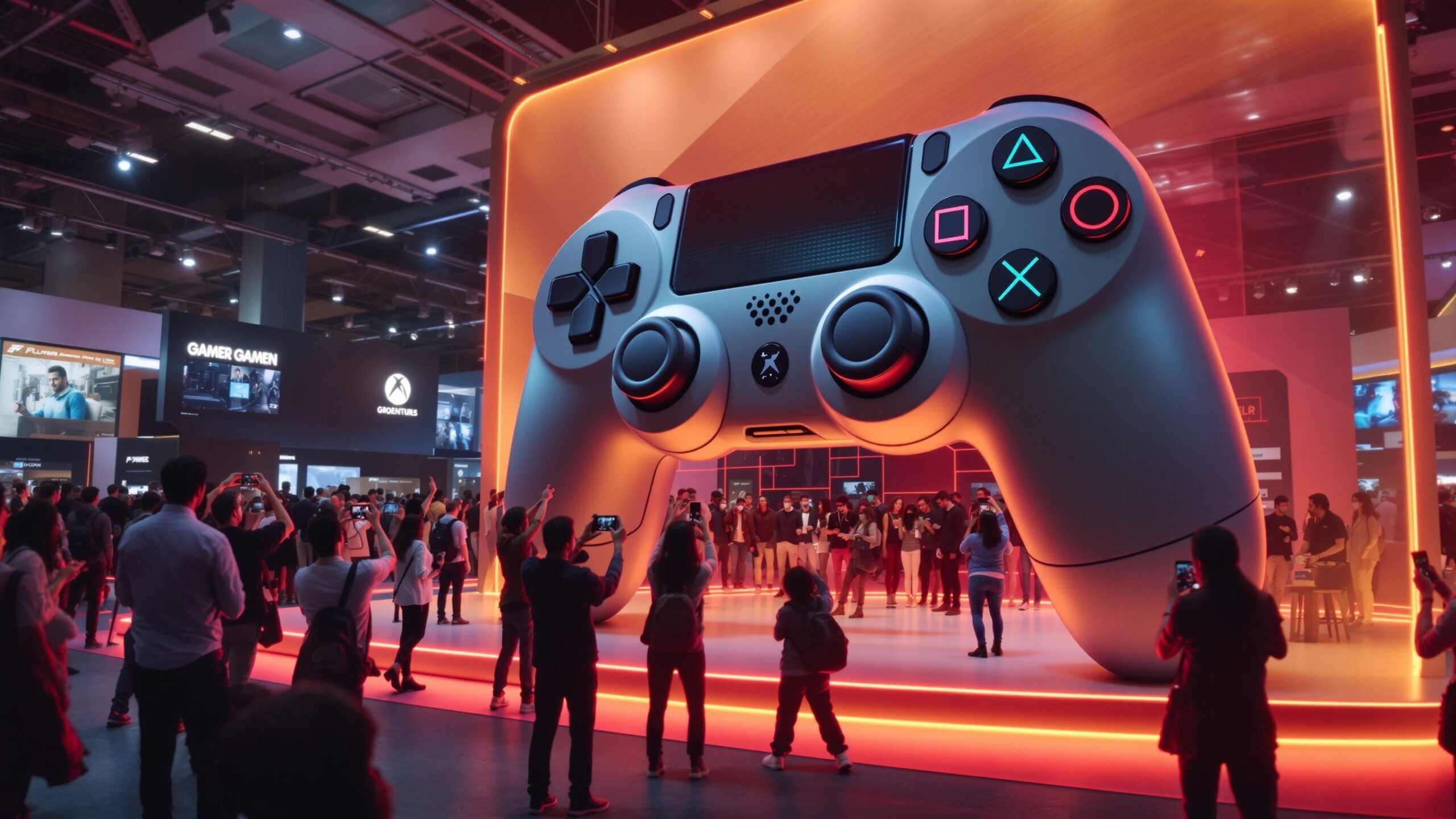
Giant Game Console Controller Prop
We Build Custom 3D Props
When Play Becomes Life-Size Fun
What happens when something that normally fits in your hands suddenly demands your whole body to operate? A giant game console controller prop is more than a novelty—it’s a celebration of play itself. Whether displayed at a gaming convention, used in a retail promotion, or installed as an interactive art piece, this oversized version of a beloved device instantly captures attention. It invites people to step into a world where imagination and engineering collide, where nostalgia is blown up to epic proportions, and where adults and children alike become part of the game. There’s a magic in seeing the familiar enlarged beyond expectation. The tactile forms we know—the smooth analog sticks, the iconic button layouts, the distinctive branding contours—all take on new meaning when you can lean against them, press a button with your palm, or walk across a directional pad. It’s playful surrealism brought to life.

Why Giant Controllers Captivate Us
Humans are drawn to scale shifts. When an object breaks its expected size, it triggers both curiosity and joy. Giant props—whether a colossal coffee mug or a massive donut—transform ordinary experiences into memorable spectacles. But when the object is a game controller, the emotional connection deepens. Gaming is personal, nostalgic, and social all at once. A huge controller evokes entire eras of shared play, from the first pixelated adventures to today’s cinematic gaming worlds.
For gamers, it’s like stepping into their own childhood daydream: “What if I could be inside the game?” For event planners, it’s a magnet for cameras and social media buzz. And for fabricators, it’s an irresistible design challenge—how do you scale up sleek ergonomics without losing authenticity? The result is always an object that feels alive with personality. It becomes a bridge between pop culture, sculpture, and interactivity—a monument to fun.
The Many Faces of Giant Game Controllers
There’s no single way to interpret a life-size or larger controller prop. Each iteration tells a slightly different story depending on design goals, audience, and context.
- The Classic Console Tribute A larger-than-life NES, SNES, or Sega controller taps into the golden age of gaming nostalgia. These props often appear at retro game expos or themed restaurants, celebrating the birth of home gaming culture. Their charm lies in simplicity: clean lines, pastel buttons, and iconic logos scaled up to museum-quality detail.
- The Modern Gaming Statement Piece Today’s controllers are ergonomic marvels filled with technology—triggers, haptic feedback, touchpads, wireless sensors. Scaling one of these into a six-foot sculpture feels futuristic, emphasizing design innovation. These often appear in trade show booths or technology exhibits, where they double as symbols of innovation.
- The Interactive Installation Some props go beyond static display. Imagine a ten-foot-wide controller connected to a working console where multiple people must coordinate to play. One player jumps to hit “A,” another slides across the joystick, a third stomps “B.” It’s cooperative chaos—a metaphor for teamwork and laughter.
- The Artistic Interpretation Sculptors and designers sometimes abstract the idea entirely—melting controllers, transparent acrylic shells, or controller-shaped furniture. These artistic renditions blur the boundary between gaming and contemporary art.
From Pop Culture to Public Spectacle
Giant controllers are the physical embodiment of gaming culture’s rise from bedroom pastime to mainstream entertainment. They appear on red carpets, in tech museums, and even in parks as public art installations. Each one communicates that gaming is no longer a subculture—it’s part of modern heritage. Imagine a downtown plaza featuring a ten-foot Xbox controller as a community art piece. Tourists stop to take photos, gamers recognize the symbolism, and kids climb the thumbsticks like playground mounts. It’s whimsical, yes—but it’s also deeply cultural. Gaming shaped a generation’s creativity, storytelling, and technology literacy. By monumentalizing the controller, we’re celebrating that influence. Even streaming and esports events use these props as immersive backdrops. When a brand’s booth is anchored by a massive controller, it signals scale, energy, and modern relevance. It says, “We take play seriously.”
The Science of Scaling Fun
Scaling any object requires more than just enlarging its dimensions. A controller’s appeal lies in its ergonomics—the subtle curvature that fits the human hand, the tactile spacing of its buttons. Enlarging it means rethinking every proportion for visual harmony and structural integrity.
The main challenge is preserving recognizability. A button that’s slightly off-angle at small scale becomes glaringly distorted when five feet wide. Likewise, paint finishes that look sleek on plastic must be adapted to industrial materials while maintaining that same glossy, gamer-tech aesthetic. Precision in design and craftsmanship becomes paramount.
To make these props believable, fabricators often rely on detailed digital modeling. CAD software or 3D scanning captures the exact curves of an original controller, which can then be scaled proportionally. The enlarged design is sliced into manufacturable segments—foam cores, fiberglass shells, or lightweight composites. It’s an engineering puzzle disguised as a toy.
Fabrication: From Foam to Finish
Building a giant game console controller prop is an art of both creativity and technical expertise. The fabrication process typically unfolds in several stages:
Concept and Digital Modeling
Everything begins with an accurate 3D model of the chosen controller. Designers may use laser scanning or digital modeling based on manufacturer specifications. The scaled model ensures all proportions remain faithful even at massive sizes.
Core Construction: Foam or Frame
Expanded polystyrene (EPS) or extruded polystyrene (XPS) foam is the go-to material for sculpting large forms. Lightweight yet shapeable, foam allows artisans to carve precise button recesses, joystick contours, and surface transitions. For extra durability, an internal armature—typically PVC, aluminum, or wood—is added to reinforce the shape. In some builds, fabricators use CNC routers or hot-wire machines to cut precise foam slices from digital templates. These are then stacked and bonded to create the main structure. For outdoor or long-term use, a steel subframe may anchor the base, especially if the prop must resist wind or physical interaction.
Surface Coating and Detailing
Once shaped, the foam surface is coated with a hard-shell material. Polyurea spray coatings are common for strength, weatherproofing, and impact resistance. In museum or indoor settings, a lightweight epoxy or fiberglass layer may suffice. After curing, artisans sand and smooth the surface to mirror the seamless plastic texture of a real controller. High-build primers fill any gaps, followed by automotive-grade paints and gloss clear coats to mimic factory finishes. Metallic paints and airbrushed gradients replicate button sheen and subtle highlights.
Button and Joystick Assembly
Each button becomes a sculpture of its own. Depending on scale, they might be crafted from high-density urethane foam, acrylic domes, or even translucent resin with LED lighting for dramatic illumination. Joysticks can be made of PVC piping wrapped in sculpted foam and painted to replicate soft-touch materials. If interactivity is desired, large pneumatic or electrical switches can be installed behind the buttons to trigger lights or sounds. Some props even integrate pressure sensors to simulate gameplay cues—pure spectacle for event environments.
Branding and Finishing Touches
The magic is in the details: embossed logos, printed button labels, and textured grip zones. Decals are custom-printed on vinyl and applied under a protective clear coat. Some fabricators use 3D printing to reproduce emblematic details—think PlayStation’s circle-square-triangle-X icons—so they appear crisp even at monumental scale.
Finally, the prop is mounted on a sturdy base or pedestal. This might be a painted platform, a stylized plinth with lighting, or an integrated part of a themed environment like a gaming zone or photo stage.
Where Giant Controllers Come to Life
Trade Shows and Conventions
Gaming expos like E3 or PAX thrive on spectacle. A towering controller instantly becomes the booth’s centerpiece, drawing lines of visitors eager to pose for photos. It’s both a marketing anchor and a conversation starter, symbolizing the company’s brand identity through playfulness.
- Retail Displays and Launch Events When a new console debuts, retailers often commission large controller props for storefronts or promotional pop-ups. The visual impact sells excitement—the bigger the controller, the bigger the buzz.
- Museums and Exhibitions Technology and pop culture museums increasingly include interactive gaming exhibits. A giant controller acts as both artifact and interpretive tool, illustrating the evolution of design. Visitors can physically explore what “ergonomic innovation” means when it’s magnified.
- Corporate Lobbies and Offices Gaming studios and tech firms use these props as interior sculptures that double as brand statements. A six-foot PlayStation DualSense in a lobby says: “We create joy at scale.”
- Themed Entertainment and Film Sets Theme parks, escape rooms, and movie productions often commission hyper-realistic props for immersive storytelling. A colossal controller might appear in a futuristic set or a dream sequence where the player becomes part of the machine.
The Psychology of Play at Human Scale
Standing next to a giant controller taps into more than nostalgia—it reawakens our innate sense of play. Humans are hardwired to find joy in oversized, approachable objects. They make us feel small in the best way, re-positioning us inside a world of imagination. There’s also a social aspect. These props encourage interaction—posing, touching, exploring—which transforms spectators into participants. The laughter, the selfies, the tactile engagement all amplify emotional connection. That’s why event designers love them: they convert passive traffic into active enthusiasm. On a symbolic level, the controller represents agency and creativity—the power to influence a virtual world. Enlarging it magnifies that symbolism. The player’s tool becomes an icon of possibility, craftsmanship, and cultural significance.
Design Challenges and Creative Solutions
Every project brings its own set of puzzles. Maintaining proportion accuracy at large scale can be tricky, especially with complex curves. Fabricators often build maquettes (miniature models) to test how light and shadow behave before committing to the full-scale version. Because controllers are symmetrical, even a millimeter of distortion in one side can ruin the illusion.
Color matching is another challenge. Manufacturers guard their proprietary hues tightly, so artists must recreate them through meticulous mixing and digital color calibration. High-gloss finishes demand dust-free environments and multi-stage polishing to achieve that factory-fresh sheen.
Transport logistics also shape the design. A twelve-foot controller can’t travel as a single piece, so it’s engineered in modular sections—each labeled, reinforced, and designed to reassemble seamlessly on-site.
Sustainability and Innovation in Prop Fabrication
The new era of large-scale props embraces sustainability. Many studios now use biodegradable or recyclable foam alternatives, water-based coatings, and digital workflows to minimize waste. CNC cutting reduces material offcuts, while reusable molds enable efficient replication.
3D printing has also entered the arena. For smaller giant props—say, one-to-two-foot miniatures—3D printing can produce high-detail components like button icons or trigger mechanisms with perfect precision. Combining printed elements with traditional sculpting creates hybrid craftsmanship that’s both efficient and beautiful. Some innovators go further, embedding electronics for interactivity or projection mapping for dynamic visual effects. A controller that lights up, vibrates, or displays animations adds an extra layer of engagement—turning static sculpture into living experience.
The Perfect Photo Moment
Every giant prop thrives on the “wow” factor—and nothing fuels that more than shareable visuals. These controllers become instant photo zones. People love pretending to “play” them, leaning into buttons, or sitting cross-legged atop a giant D-pad. The result? Viral content. For brands, that’s invaluable. Each snapshot shared online multiplies reach organically. The combination of nostalgia, humor, and artistry ensures these props never fade into the background—they are the experience.
How a Giant Controller Reflects Modern Culture
The evolution from home consoles to immersive digital worlds mirrors our collective embrace of technology as an extension of creativity. A giant controller celebrates that journey—it’s a tangible metaphor for how games shape identity, imagination, and innovation. It also embodies inclusivity. In a crowd, everyone recognizes it regardless of age or background. It’s a universal language of fun. The shape alone—a D-pad, buttons, sticks—speaks of play, cooperation, and endless possibility. It’s both retro artifact and futuristic sculpture, a perfect blend of design and emotion. In art theory terms, it transforms a utilitarian object into a cultural relic. The ordinary becomes monumental, and the ephemeral becomes permanent. Like pop art before it, the giant controller bridges consumer culture and creative commentary.
Behind the Scenes: The Team That Makes It Real
No single artisan builds something this complex alone. These props require multidisciplinary collaboration. Designers handle CAD and scaling, sculptors perfect form, painters handle finishing, and engineers ensure stability. Electricians wire lighting, project managers coordinate logistics, and installers bring it to life on site.
In some projects, the same team that fabricates movie props handles giant controllers, because the craftsmanship overlaps—both must blend realism, durability, and spectacle. The teamwork behind the scenes is as impressive as the final reveal. Each completed prop carries signatures of multiple trades—foam sculptors’ precision cuts, painters’ steady hands, and engineers’ hidden reinforcements. It’s art and engineering in perfect sync.
The Future: Interactivity and Augmented Reality
As technology evolves, the next generation of giant controllers may merge physical sculpture with digital experiences. Imagine pointing your phone at a massive controller to trigger AR overlays that explain its history, or tapping a sensor to play a short clip about its console. Visitors could compete in mini-games projected onto the surface, turning a static sculpture into a hybrid playground. Augmented props like these redefine how audiences interact with design. They extend storytelling beyond the material form, inviting both gamers and non-gamers into an experiential space that’s both nostalgic and futuristic.
The Power of Play at Monumental Scale
A giant game console controller prop is more than a spectacle—it’s a symbol of how creativity magnifies joy. It honors decades of design evolution, from the simple rectangle of early systems to today’s sculpted masterpieces of ergonomics and technology. It’s also proof that art doesn’t need to whisper; sometimes it shouts playfully across a convention hall, reminding everyone that imagination still rules. In a world often obsessed with speed and screens, a massive, tangible controller brings us back to something human: the tactile thrill of pressing “Start.” It’s nostalgia we can touch, culture we can stand beside, and inspiration that sparks the next wave of dreamers and makers. So next time you see a controller too big to hold, step closer—because in that moment, you’re not just looking at a prop. You’re standing inside the game.
Check out WhiteClouds’ 3D Props for more information.
Contact us today to learn more about our 3D services and how we can help you achieve your goals.